



Never trust anybody who tries to tell you that anime is “all the same.” (And definitely never listen to anyone who insists it’s all just super-saiyan level action … not that there’s anything wrong with that.) In 2025 alone, the medium gave us an eclectic mix of small screen titles ranging from slice-of-life comedies to stories about superheroes, courtly political intrigue, and even humanity’s historic pursuit of knowledge about the greater universe. Elsewhere, anime features ruled theaters last year, with the likes of “Demon Slayer: Kimetsu no Yaiba — Infinity Castle” and “Chainsaw Man — The Movie: Reze Arc” ruling the global box office.
Now that 2026 is underway, though, it’s time to ask the question: What were the best anime titles released in 2025? Our experts in this area put their heads together and came up with the following top 10 list, which is indeed in the order that they settled on. Read on and see what you make of their picks.
10. Lazarus
Shinichirō Watanabe is an anime auteur, most famous as the director of “Cowboy Bebop.” Adult Swim turned “Bebop” into a whole generation of Americans’ gateway anime, and for Watanabe’s latest project, he partnered with Adult Swim. The result? The 13-episode spy thriller “Lazarus.”
In 2052, brilliant scientist Dr. Skinner reveals his miracle drug, Hopna, is secretly poisonous. In 30 days, people who’ve ingested it — practically everyone alive — will start to die. So, government agency Lazarus assembles five highly-skilled criminals into an espionage team to track down Skinner before time runs out; they’re like the Suicide Squad without the super-villain costumes.
Watanabe is known for his episodic storytelling and eclectic mixing of different genres; music is also a key motif in his filmmaking, and sure enough, he samples then remixes like a musician. Different episodes of “Cowboy Bebop” often explored unique genres. “Lazarus” is the same, as the team tracks different leads across the globe. It only has half the episodes of “Bebop,” though, and greater urgency, since here there’s a set deadline and goal. Yet, the music of “Lazarus” is rather soft and lo-fi; the ending credits even use the song “Lazarus” by the Boo Radleys, a British shoegaze band.
Both “Cowboy Bebop” and “Lazarus” suggest you can’t escape your past, so perhaps it’s fitting that the nostalgia cycle has finally come for Watanabe. If “Lazarus” falls short of the depth of “Cowboy Bebop” and “Samurai Champloo,” its style at least shows Watanabe is still the king of adult-oriented action anime. (Devin Meenan)
9. To Be Hero X
Japanese pop media may not embrace the phrase “superhero” quite like the U.S. does. However, between Super Sentai (the basis for “Power Rangers”) and shonen about people with extraordinary abilities, Japan has the same fondness for superheroes as folks do stateside.
One of the country’s reigning superhero franchises is the Chinese-Japanese co-production “Be The Hero,” which released its third and latest iteration, “Be The Hero X,” this past year. In this world, people’s love for superheroes is the very thing that makes them exist; superpowers are derived from people’s belief that a specific hero has those superpowers. (Compare that to Grant Morrison and Frank Quitely’s comic “All-Star Superman,” which argued that if Superman didn’t exist, we’d create him.)
“Be The Hero X” uses a tournament arc where the world’s most popular superheroes gather to compete against each other and be ranked as “Hero X,” the most popular one. While its narrative hits some familiar beats, “Be The Hero X” makes an impression by frequently swapping its animation style. It goes from a hyperactive 2D anime aesthetic resembling the works of Studio Trigger (“Cyberpunk: Edgerunners”) to a 3D approach evoking the Netflix series “Arcane.” The main hero, Hero X, can even swap the animation styles with a snap of his finger. (Devin Meenan)
8. Gachiakuta
Studio Bones is a master of shonen anime, with titles like both “Fullmetal Alchemist” anime and “My Hero Academia” to its name. As of 2025, its latest hit is “Gachiakuta” (pronounced Gah-Chi-Ahchk-Ta). That’s a Japanese word that translates to “legit trash,” but the anime is anything but.
Adapted from Kei Urana’s original manga, “Gachiakuta” is set in a future where the world has been overtaken by, well, trash. The richest live on a floating city, the Sphere; our hero, young Rudo Surebrec, is framed for murder, so he’s cast out of the Sphere and into the Abyss below. On the ground, Rudo learns the secrets of Anima, or humans’ life-force, and how people can infuse their own Anima into objects. That creates powerful “Vital Instruments,” because any possession can be a treasure if treated with care.
In keeping with its grimy and polluted setting, Urana uses a graffiti-inspired art and lettering style for “Gachiakuta.” Bones’ animators bring that style, and her intense action scenes, to life with brutal beauty. The opening title sequence, scored to the head-banging track “HUGs” by Paledusk, sets the “Gachiakuta” mood just right. An opening shot of hands reaching up to grab refuse falling from the Sphere leads to a pile of trash shaped like a single, glowing red eye. Rudo, a short-fused boy who swore he’d one day return to the Sphere to send it crashing into the Abyss, is literally always seeing red. (Devin Meenan)
7. The Apothecary Diaries season 2
Hyūganatsu’s beloved light novel series, “The Apothecary Diaries,” got a stunning anime adaptation treatment in 2023. Its second season only continues to detail the compelling adventures of Maomao, who is now working closely with Jinshi after proving herself to be an asset to the Imperial Palace. Season 1 established Maomao as a refreshing female lead, and her no-nonsense nature (coupled with her unique eccentricities) are carried over into the second season, which greatly benefits from having such a strong personality as its lead. The appeal of “The Apothecary Diaries” lies in its slow-burn genre-blend; the anime series takes a meandering approach to its romantic threads and mystery-of-the-week cases, which are spaced out in between the show’s characters dealing with all manner of moral turmoil.
Season 2 foregoes the predominantly lighthearted nature of its predecessor and isn’t afraid to plunge into darker subject matter, including the sinister political entanglements within the Palace. This helps position Maomao’s agency front and center, as she must tackle these unsavory aspects head-on in order to get to the bottom of things. The second season is also more intentional in its use of environmental storytelling; light and shadow are cleverly employed to convey suspense or up the ante, even as the show builds a sense of dread. With significantly higher stakes, “The Apothecary Diaries” season 2 plays like a natural extension of the world introduced in season 1, replete with gorgeous visuals that make every setting seem incredibly lived-in. (Debopriyaa Dutta)
6. City the Animation
Anime isn’t all super-saiyan level action; slice-of-life comedy is another backbone of the medium. And the best that 2025 had to offer for that genre was the madcap “City the Animation,” adapted from the original “City” manga by Keiichi Arawi.
“City” follows three university student roommates: the money-hungry slacker Midori Nagumo, short-fused Ayumu Niikura, and airhead Wako Izumi. They live in an apartment building owned by the also-eccentric Makabe family, located in a city called … City, and the series follows their escapades across that metropolis. They do reside in a city after all, a huge place that’s filled with people and intersecting stories beyond our lead trio.
The anime uses a simple, chibi-ish art style that allows for hyper-expressiveness and exaggerated movement. The color palette is bright and high-contrast in the way an illustrated storybook is. Due to that art style, “City” sometimes looks more like a manga in motion than a traditional anime, especially when it uses split screen effects (drawn with thick comic-like panelling) to divide its characters. While the humor is loud and comic pacing relentless, the simplicity of “City” makes it an easy, blissful watch, perfect to unwind to as you get lost in this City. (Devin Meenan)
5. Dan Da Dan season 2
“Dan Da Dan” is a show that defies description. Adapted from Yukinobu Tatsu’s manga of the same name, it mixes virtually every genre in anime (including sci-fi, horror, comedy, and romance) while also being a shonen, a musical, and much more. Then there’s the plot: The series centers on a teen girl and boy who become friends after experiencing a supernatural incident together. Also, they set out on a journey to recover the boy’s testicles from the vengeful spirit who stole them. Yes, really.
Science Saru does some all-time great work with this show, between the fluid, kinetic animation, striking camera angles, and the character movements that captures the energy of the original manga. But while there is plenty of silliness in “Dan Da Dan,” it’s far from unserious. Quite the opposite. It’s a series that excels at building a genuine friendship between its two leads, themselves an odd couple (with hints of a future romance) who are endearing, compelling, and fun to watch. Also, the show extends immense empathy toward its “evil” spirits, who are given nuanced backstories full of tragedy. Loneliness, bullying, abandonment — these are all themes at the center of each new story arc, and it’s this balancing act of ridiculous humor with raw emotion that makes the series so special. “Dan Da Dan” only continues to expand in season 2, incorporating more characters and bigger fights while deepening its central relationship. It’s balls-to-the-wall fun. (Rafael Motamayor)
4. Chainsaw Man – The Movie: Reze Arc
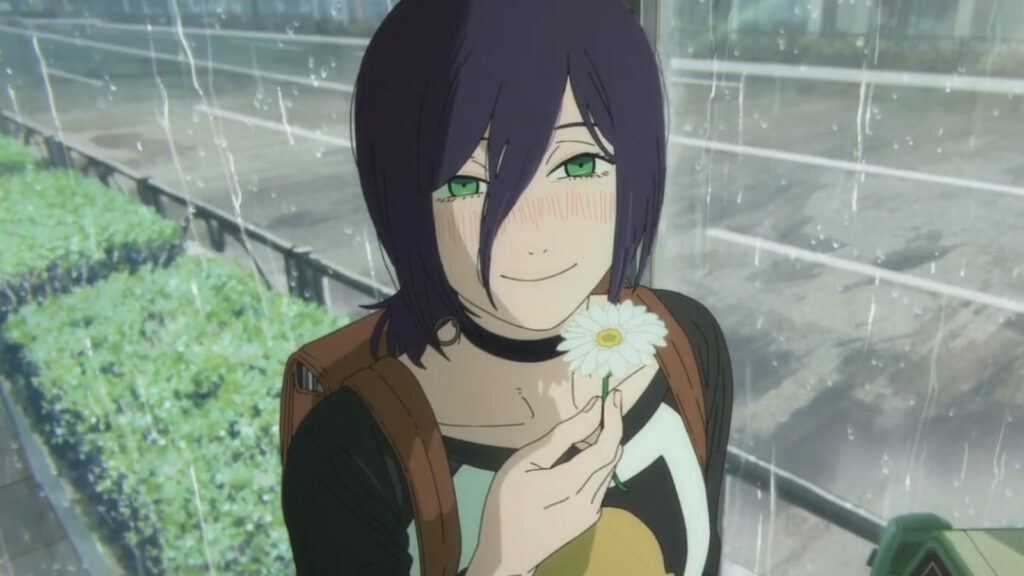
A rainy day meet-cute kicks off “Chainsaw Man — The Movie: Reze Arc,” where our titular devil hunter, Denji, falls head over heels for Reze. Still grappling with the traumatic events that have shaped his existence, Denji initially doubts his ability to feel, but these anxieties are put to rest when fledgling love blossoms soon after. Alas, the animated film’s rom-com elements quickly swerve into horror territory, as Denji realizes that his Chainsaw Man heart has become a prime target due to his unique powers. As the mood shifts to darker vignettes, the animation also morphs into a stunning spectacle in which bullets are exchanged, and limbs are viciously torn apart.
Tatsuki Fujimoto’s ongoing “Chainsaw Man” manga series grapples with complex topics, and the “Reze Arc” touches upon some of the issues that plague kids like Denji, who are used as pawns and coerced into missions. Reze also emerges as an intricately layered addition, and her dynamic with Denji brings fascinating character motivations to the surface. What does a traumatized teen yearn for when they’re not being thrown into outlandish fights with their lives constantly on the line? “Chainsaw Man — The Movie: Reze Arc” does a commendable job of exploring these narrative threads while also offering an intimate overview of the antagonistic forces lurking in the shadows. Even those unfamiliar with the franchise can immerse themselves in this volatile world, as the film finds a way to tug at our heartstrings. (Debopriyaa Dutta)
3. My Hero Academia season 8
“My Hero Academia” ended its run with a phenomenal eighth season that pays off several character arcs, along with the show’s themes, in a satisfying manner. Adapting Kohei Horikoshi’s manga series of the same name, the final season of “My Hero Academia” focuses on the last stage of the all-out war against All For One. Beginning with the epic final battle between the supervillain and his archenemy, the aged superhero All Might, season 8 is full of massive set pieces and thrilling and dynamic action scenes. Studio Bones spared no expense or time in bringing to life some of the greatest moments in the entire series’ run. Bakugo’s big fight scene, in particular, isn’t just an exhilarating and visually stunning sequence, it’s also a cathartic climax to his story.
Under all the flashiness of the action, however, lies an emotionally charged and thematically rich final season. “My Hero Academia” has always been about the power of empathy and heroism, and these final episodes hammer that home in a powerful way. It doesn’t excuse the villains’ actions, but it nevertheless shows that evil can come from anywhere, warping anyone that feels betrayed by the world around them. At its best, this series explores the ramifications of a world where heroism is a profession and an institution, and season 8 reckons with the cracks in that institution in poignant ways. (Rafael Motamayor)
2. The Summer Hikaru Died
Horror anime often runs the risk of leaning into genre clichés or resorting to vapid shock value to make a mark. “The Summer Hikaru Died” — based on Mokumokuren’s eponymous manga series — stands apart as a genre marvel, even as it builds upon core tenets of Japanese horror. “The Summer Hikaru Died” opens with Yoshiki almost losing his dear friend, Hikaru, who goes missing in the mountains. A while later, “Hikaru” inexplicably returns, but Yoshiki is unable to reconcile this person with the Hikaru he knew so well. Six months later, the realization dawns: the Hikaru of the past is no more, but something inhabiting his body is more than happy to be close to Yoshiki and even share its darkest secrets with him.
The anime drops this bombshell reveal within its first five minutes, choosing to linger on the nitty-gritty details of this dramatically-altered relationship. Coming-of-age tales are inherently bittersweet, as they embody the discomfort of adolescence and the intense societal pressures teenagers have to contend with. Yoshiki’s anxieties as a queer kid growing up in a small town are unraveled with great depth here, especially when it involves “Hikaru,” who eagerly reciprocates his feelings. Grief takes on a strange new meaning, as Yoshiki is torn between mourning his human friend and connecting with the inhuman “Hikaru” (who struggles with its innate monstrosity). The implications are both tender and uneasy, often escalating into moments of full-blown gore when things get expectedly messy. (Debopriyaa Dutta)
1. Orb: On the Movements of the Earth
“Orb: On the Movements of the Earth” is a stone-cold masterpiece and one of the best new anime of the decade. Set in a medieval European country modeled after Poland, this anime follows several protagonists over time as they come to a simple realization that ends up changing their lives forever: What if the Earth isn’t the center of our universe? What follows is a gripping, thrilling, poignant drama that challenges what anime can be. It’s a story about the price of knowledge, as well as the many, many nameless people history forgets who helped move the needle in the pursuit of progress. In a way, this is the anime equivalent of “Andor,” at least in terms of how it portrays a movement fighting impossible odds and the sacrifices it’s willing to make.
In a sense, “Orb” is just as reminiscent of the work of “Pluto” creator Naoki Urasawa as it is a Mike Flanagan joint. The animation pays as much attention to and gives just as much detail to the subtle character acting as it does to the action scenes and the majesty of the cosmos (a beautiful background that’s ever-present). Best of all, there’s no singular lead character; instead, “Orb” focuses on the very idea of heliocentrism and how it impacts everyone that encounters it. The result is a love letter to humanity’s curiosity and capacity for wonder, a beautifully animated show, and a gripping period drama. (Rafael Motamayor)