
The automobile is seen by some as a symbol of America and our inherent freedoms. We’re free to choose from a varied selection of cars, we’re free to roam this vast country of ours in them, and we ride that freedom all the way to over 40,000 deaths per year from motor vehicle crashes. The cars themselves have it even worse, as even when people survive an accident, the cars typically aren’t as lucky. So, yeah, it makes sense that they might want some revenge.
Genre cinema is filled with horror movies about inanimate objects killing people, and sometimes those objects are vehicles. Below you’ll find a list of the best killer car movies. It should be noted that we’re being specific about cars here, meaning no killer semitrucks (“Duel,” “Maximum Overdrive”), no killer construction equipment (“Killdozer”), no killer car parts (“Rubber”), etc. We’re only looking at killer cars. Our second rule is that, whether they’re sentient or driven by a human, the killer car has to be a major player and a focus of the film/plot, so no “Mad Max” movies, despite their collections of both cars and death.
Now keep reading for a look at the 10 best killer car movies, ranked.
Crash!
It’s a tale as old as time. Marc Denne (Jose Ferrer) is a wealthy man who blames his hot trophy wife, Kim (Sue Lyon), for a car accident that left him unable to play tennis. He understandably decides to kill her by instructing his loyal Doberman to attack Kim while she’s driving in her convertible, which results in a crash that leaves her a banged-up amnesiac. She might not remember, but her ancient Hittite keychain does, and soon her black convertible is roaming the roads, killing anyone in its way, as it heads home for revenge.
Charles Band’s directorial efforts have long since descended into forgettable gibberish like “Gingerdead Man vs Evil Bong” — he’s even planning an actual Barbenheimer movie — but early efforts like “Trancers” and “Head of the Family” still deliver the goods. 1976’s “Crash!” belongs in that latter group as its blend of marital strife, hocus pocus, and legitimately thrilling car crash sequences makes for a wildly entertaining time. Nonsensical, to be sure, but entertaining all the same.
Kim’s keychain takes control of a couple wheelchairs at times, too, but it’s the vehicular action that steals the show. The convertible is cruising around without a visible driver — it appears to be a remote-control rig, and it’s very effective, trading paint with regular folks and cops alike. Police cars are its most frequent target with several flying off the road and/or exploding on the asphalt. Its end face-off with the old man earns a smile with a very definitive final move that seals this as one weird but fun ride.
Phantom Racer
Two friends are among the competitors in a car race, but when they crash, it’s only JJ (Greg Evigan) who walks away unscathed. Years later, JJ returns to town just as his dead friend’s car begins claiming lives of its own. Authorities are quick to blame JJ, but the truth involves a supernatural thirst for revenge.
It’s not often that you see Syfy original movies on “best of” lists, but “Phantom Racer” earns a spot here for a couple reasons. First, there are far fewer killer car movies than you think. Second? It’s a good, goofy time that offers up a simple premise backed up with some solid stunts and gory practical effects. You do have to swallow some pretty terrible computer generated effects at the start and end of the film, but the bulk of it entertains as its haunted Chevrolet Monte Carlo claims one victim after another.
Rough CGI bookends aside, the car action here features a real car causing practical mayhem from chases and crashes to acts more specific in their carnage. One punk has the life squeezed out of him by an ever-tightening seatbelt, while another is dismembered by something in the trunk. Later, an unfortunate police officer ends up on the car’s hood only to see his face sliced off by the windshield wipers. People are run over, heads are smooshed, teens are imperiled, and an angry ghost sees both his vengeance and his ride crushed. It won’t win any awards, but this one absolutely deserves a spot on this “best of” list.
The Wraith
A small Arizona town is home to both the unsolved murder of a young man and a violent gang of car thieves who take pink slips after illegal car races, and the two just might be connected. Packard (Nick Cassavetes) is the gang’s leader and the coolest guy in town, but that changes when a newcomer named Jake (Charlie Sheen) rides into town on his motorcycle. Also new to town? A helmeted stranger dressed head to toe in black, driving a sleek, souped up, and equally black sports car — and it’s prone to blowing up cars and gang members alike.
“The Wraith” isn’t exactly beloved, but it remains a cult classic for a reason. Well, reasons, as one of them is most definitely its arrival in the mid-1980s when so many future movie-lovers were coming of age and seeking out cool, lesser-known pieces of genre cinema. There’s also a memorable cast seemingly tailor-made for nepotism accusations: a young, pre-tiger blood Sheen, future filmmaker Cassavetes, a sedate Randy Quaid, and an enormously coiffed Clint Howard. Plus, there’s Sherilyn Fenn!
Writer/director Mike Marvin pairs his sci-fi revenge plot with some 1950s sensibilities like drag racing for pink slips and the gang hanging out at the carhop diner, but his more direct inspirations run the gamut from “High Plains Drifter” to “The Road Warrior.” It’s alternately cheesy and engaging with a soundtrack that pops with recognizable 1980s tunes, but it’s at its best with the car action. Races thrill even before they end in explosive, fiery deaths for the gang, and the Dodge Turbo Interceptor at the heart of it all is a slick-looking ride throughout.
Super Hybrid
Two punks steal a car hoping for a joy ride, but the car has other plans. It speeds off, killing the thieves in darkness, and it’s then T-boned by another car at an intersection. The wreck is towed to an understaffed police department parking garage where it quickly fixes itself and begins to terrorize and kill the mechanics on duty. A homicidal car is bad enough news, but this vehicle holds two surprises: It can shape-shift, and there’s a hungry, sentient octopus in the engine.
Admit it. You were wholly on board with the description above until those last few words. It’s a fair reaction, but a big swing like this earns a certain degree of respect, and “Super Hybrid” backs it up by fully committing to the concept. The car and being within are compared to a crab in a shell with the crab, in this case, being the alien octopus feeding on people while blending into its surroundings with a shell that morphs to fit the environment. It’s a bonkers setup with some dodgy CGI, but it’s just audacious enough to work.
Viewers who can accept the killer octopus premise will be rewarded by some entertaining vehicular action. There’s real impact to the crashes and some variety to the kills as folks are offed by both the car and its tentacled occupant. The multi-level underground garage is also a terrific location used to its fullest to craft set pieces and chase sequences. The cast is a mixed bag, but Shannon Beckner delivers a worthy final girl leading up to a fun ending.
Highwaymen
James Cray (Jim Caviezel) is out of prison and on the hunt. He watched years earlier as a man named Fargo intentionally ran over James’ wife, killing her instantly. He chased the murderer down, leaving Fargo blind and limbless on one side, and he was convicted for his actions, while Fargo limped free. Both men roam the roads now, Fargo killing women with his souped-up Cadillac Eldorado and James in desperate pursuit.
Director Robert Harmon’s best known for another road thriller, 1986’s “The Hitcher,” about a maniacal hitchhiker who terrorizes a young man across the southwest. “Highwaymen” arrived nearly two decades later — around the same time as a direct-to-video sequel to Harmon’s classic called “The Hitcher II: I’ve Been Waiting” — and while it can’t touch that earlier film (and was reportedly trimmed by the studio prior to release), it’s still a tight, entertaining tale of suspense and carnage.
There are various elements at play here that make the film work despite its barebones screenplay, from the cast (also including Rhona Mitra) to the Cadillac’s production design, but key to it all is Harmon’s approach to vehicular action. It’s all practical, and it is fantastic. Crashes, stunts, chases — it’s easy to forget these days how effective and thrilling automobile action can be when captured with an eye and an ear for the tangible and real. You can feel the metal crunching to the tune of screams and squealing tires as the chase races towards its inevitable conclusion.
The Car
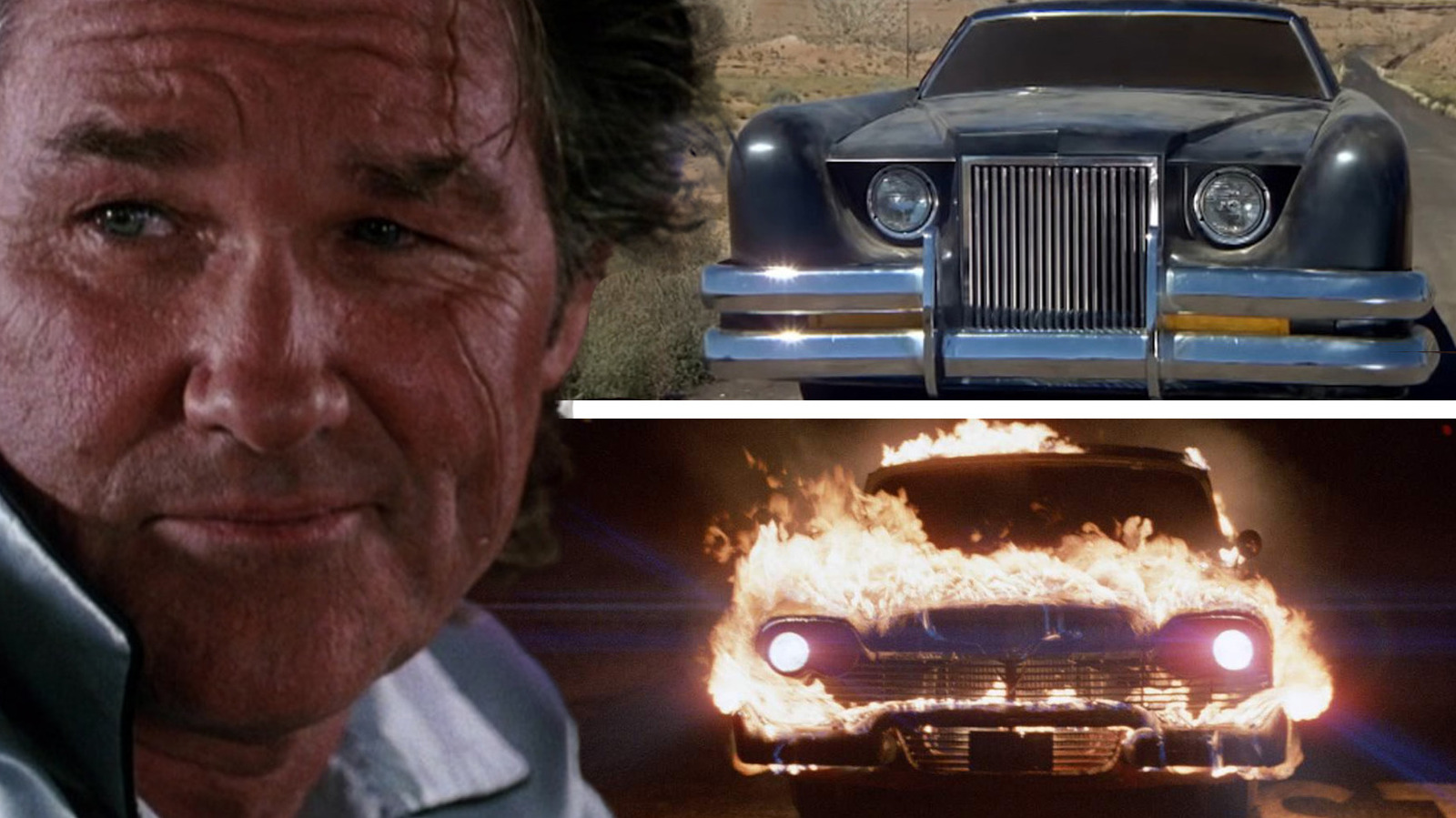
A small town in Utah sees its population take a hit when a black Lincoln Continental begins mowing down pedestrians. When the local sheriff is killed by the car, the task of figuring out what the hell is happening falls to Deputy Parent (James Brolin), who soon discovers that the car is seemingly operating without a driver. The attacks amplify, the body count rises, and the beleaguered deputy begins to suspect that something evil is afoot — or maybe awheel?
1977’s “The Car” isn’t the wildest riff on “Jaws” (and doesn’t even land a spot on our list of the best “Jaws” knockoffs) — that honor probably belongs to 1989’s “Blades” about a killer lawnmower terrorizing a golf course — but it still has a good time with the concept as the sleek black car moves through town like a shark fin cutting through the water. Only the deputy seems to be taking it extremely seriously, the town refuses to cancel a public event that the car is destined to ruin, and the four-wheeled monster can ultimately only be defeated via a big explosion.
Smaller explosions pepper the film as the car wreaks havoc, sending others to their fiery dooms, and the weighty, evil-looking Lincoln dominates the frame. One major set piece sees the car drive straight through a house — unexpectedly killing a major character — and it remains a terrifically effective and frightening sequence (that undoubtedly inspired a similar beat in 1984’s “Razorback”). The film wisely doesn’t explain in any real detail what’s behind the car’s intentions, but its supernatural nod in the finale earns a smile.
Death Car on the Freeway
Female drivers on the Los Angeles freeways are being terrorized by a Dodge van with tinted windows driven by a man known only as the Fiddler. See, he plays fiddle music really loud on his tape deck while running them off the road. Janette (Shelley Hack) is a news anchor who deals with misogynist men at her job, on the streets, and with the police, and soon she finds herself targeted by the Fiddler.
“Death Car on the Freeway” is a TV movie from 1979 – and yes, before you ask, a van is a car, and it says so right there in the film’s title – and it has all the expected trappings of just such an endeavor, from its low budget to a bevy of familiar faces of the time including Abe Vigoda, George Hamilton, Peter Graves, and more. On the atypical side of things, the film is very cognizant and confrontational when it comes to misogyny in the workplace and the unchecked responsibilities of television advertisers.
You’re here for the killer car, though, and the film succeeds well on that count, thanks to director Hal Needham. The filmmaker behind theatrical hits like “Smokey and the Bandit,” “Hooper,” and “Cannonball Run” knows more than a few things about cinematic car action, and he delivers thrilling chase scenes on busy freeways, high speed car stunts, and some epic explosions. He even cameos as a stunt driving instructor who teaches Janette some life-saving tricks. Come for the killer car action, stay for the realization that the film’s premise involving a woman-hating, leather glove-wearing killer who’s ultimately beaten by a woman who out-maneuvers him behind the wheel is an obvious inspiration for Quentin Tarantino’s “Death Proof.”
Death Race 2000
It’s the future, the year 2000, and the United States is a totalitarian regime. Don’t worry, though, because it’s also a fun one that knows how to keep its populace entertained. The government puts on an annual, cross-country race that’s televised to the masses, and while the goal is to cross the finish line, the real focus is on the vehicular murders. Drivers get points for mowing down pedestrians with kids and the elderly earning big bonuses. Let the game commence!
If you’ve only seen the 2008 remake, put that out of your mind immediately as 1975’s “Death Race 2000” is where it’s at. The Roger Corman production was inspired by 1975’s “Rollerball,” but Corman and director Paul Bartel leave that film in its dust thanks to a potently entertaining mix of vehicular action, social commentary, and utter absurdity. The race, complete with over-the-top broadcast announcers, is a reality TV spectacle that sees five cartoonishly charismatic racers vying for the top spot.
David Carradine plays the antihero Frankenstein, Sylvester Stallone is Machine Gun Joe, and both bring big, campy performances that crank up the fun. Each car is uniquely styled with Frankenstein driving an alligator-themed, VW/Corvette mashup and Joe behind the wheel of a convertible with weaponized mounts on the hood. Contestants and pedestrians are knocked out with violently goofy abandon with one all-timer sequence seeing a retirement home line up their residents alongside the road to watch the race — only to have them run over for buku bonus points.
Death Proof
Stuntman Mike (Kurt Russell) has an eye for the ladies. He watches them in bars, watches them talk and laugh together, and then likes to watch them die. His weapon of choice? A 1970 Chevy Nova, modified both inside and out to make it a death-proof vehicle… for the driver. He tears his way through one group of friends with ease, but he makes a fatal mistake when he targets a stunt performer named Zoe and her revenge-happy besties.
Both films in the “Grindhouse” double feature are entertaining, but while Robert Rodriguez’s “Planet Terror” goes the gooey horror route, Quentin Tarantino’s “Death Proof” takes a different path all together. It’s essentially a slasher, of sorts, as Mike stalks and kills women, but the car element allows Tarantino to turn it into an electrifying action picture too. Sure, there’s the expected down time filled with characters talking — and talking — but both energy and thrills rev all the way up once Mike is on the prowl.
Tarantino, acting as his own feature cinematographer for the first (and only) time, cuts loose with adrenalized creativity and captures the fast, muscular cars with a fine attention to both the visuals and the sounds. He lets Bell do the same with some genuinely risky stunts, which makes sense seeing as she’s basically playing herself. Watching her on the hood of a fast-moving car is already exciting, but add in a second car causing chaos, and the thrills go all the way to eleven. Tarantino has talked about Russell being the perfect choice for Mike, and he’s not wrong. Mike and his car claim plenty of lives, but this batch of final girls are ready to put a violently cathartic end to his evil ways.
Christine
Arnie Cunningham (Keith Gordon) is as nerdy as they come in the late 1970s, but he’s hoping to up his cool factor with the purchase of a 20-year-old Plymouth Fury in rough condition. He showers it with love, restores it to its former glory, and soon both man and machine are the coolest duo in town. Arnie’s personality takes a dark turn, though, and as his relationships hit hard times, the car — nicknamed Christine — begins targeting anyone who hurts either one of them.
“Christine” is as synonymous with spooky cars as Cujo is to aggressive dogs, and it’s arguably due as much to John Carpenter’s movie (one of his best) as it is to Stephen King’s novel. It’s the story of a head-on collision between obsession and possession, and Carpenter gives it glorious, gorgeous life. He and cinematographer Donald Morgan film the car with one eye on its chrome and cherry red beauty and the other on its unrelenting evil, and it makes scenes with Christine pop with an uncomfortable energy.
The sequence where it restores itself in front of Arnie, metal and glass reforming and popping back into place before his eyes, is unforgettable. The electrifying nighttime shot of Christine, ablaze and racing down the street after its next victim, is iconic. Carpenter’s score shares ear space with rock and roll, and together they highlight the highs and horrors of our teenage years. More than four decades later, the Carpenter/King collaboration remains the benchmark for killer car movies as it pairs a compelling story with a title character whose name will never be forgotten.


Leave a Reply