



With the rise of social media and Letterboxd, online film discussion among general-audience movie fans and dedicated cinephiles has become more democratized than ever. But before celebrities and fans were sharing their Top Four films in viral social media clips, the go-to resource for discerning the greatest films of all time, as decided by the public, was the IMDb Top 250.
The Top 250 list is pretty much what it sounds like: the 250 films on IMDb with the highest ratings from “regular voters” on the website (the criteria for who is considered a regular voter haa been kept secret). Those ratings are then collated using a weighted averaging formula that helps to balance films with high scores versus films with high amounts of ratings, and bam, you’ve got 250 films that are ostensibly considered the “best” by IMDb users.
The Top 250 encompasses all genres, but in this instance, we’re interested in sci-fi. What are the greatest films involving those varying elements of space adventure, cyborg action, dystopian futures, and beyond, as deemed by IMDb users? They’re, of course, films that are widely considered by popular opinion to be some of the greatest sci-fi films ever made from filmmaking heavyweights — the sci-fi entries in particular offer a considerable hint as to the director with the most entries on the Top 250. You can rest assured that the best sci-fi movies according to IMDb is full of definitive sci-fi classics.
10. Alien
Given that “Alien” holds a legacy as one of the most important box office hits in history, on top of its status as a quintessential piece of sci-fi horror, it’s no surprise that Ridley Scott’s 1979 masterpiece makes this list. This franchise-spawning outer-space descent into abject terror is a marvel to behold, as thoroughly designed as it is generationally frightening.
“Alien” also features a genre-defining lead performance by Sigourney Weaver. She plays Ripley, an officer aboard the doomed interplanetary vessel the Nostromo, which is about to board a new, much more dangerous, voracious, and slimy passenger. After a company-compliance-satisfying pitstop that earns the crew an encounter with a mysterious lifeform, a new organism grows within the Nostromo’s airshafts and bunkers, ruthless in its ability to kill.
The classic boasts some of the greatest practical creature design ever put to film, with the unnatural, black-hole-unknowability of the iconic Xenomorph alien contrasting perfectly against the sweaty, intrepid attempts of Ripley and the rest of the crew to stay alive. With a supporting cast that includes Tom Skerritt, Veronica Cartwright, Harry Dean Stanton, John Hurt, and Ian Holm, it is incomparable in its performances and Scott’s dread-inducing direction. James Cameron’s 1986 follow-up “Aliens” would become beloved in its own fashion, but maybe there’s a good reason it’s “Alien” on this list instead.
9. Spider-Man: Across The Spider-Verse
The most recent film on IMDb’s Top 250, some will doubtlessly take umbrage with the high placement of “Spider-Man: Across the Spider-Verse.” Whether or not it’s the ninth-best sci-fi movie of all time may be a fair question, but don’t let that fool you into believing that the film is not worthy of its many accolades. That’s because this is a great comic-book movie that carves its own distinct path forward within the crowded field of superhero fare.
Indeed, the “Spider-Verse” movies are so far ahead of other superhero movies that it’s become a bit embarrassing, especially if you take a look at the endlessly trivial wheel-spinning the Marvel Cinematic Universe has been up to after “Avengers: Endgame.” But “Across the Spider-Verse” pays no mind to the interconnected necessities of brand franchising, and it’s concerned merely with the possibilities of its endlessly expansive world.
And that’s just what this sequel does: expand. “Across the Spider-Verse” takes the distinct multiversal conceit of the first film and springs into a wide-ranging, alternate-world-spanning quest for understanding one’s identity. And of course, no mention of the “Spider-Verse” films is complete without touching the ludicrously beautiful visual style, which blends 3D and 2D animation into the closest thing ever rendered to a living, breathing comic book. “Spider-Man: Across the Spider-Verse” is in an exclusive echelon of films that actually translate the thrill of comics to the big screen.
8. The Prestige
The first of a few Christopher Nolan films on this list, “The Prestige” sometimes gets swept aside amidst the grandeur of “The Dark Knight” and “Oppenheimer.” But Nolan’s immediate follow-up to his franchise-inventing “Batman Begins” is sneakily one of his finest works, using his familiar style of propulsive, undulating story events that collectively wash over you to tell a story of magic and masculine obsession.
It’s an almost chintzy type of movie for Nolan to make. If it were in someone else’s hands, you could imagine this movie, in which Christian Bale and Hugh Jackman are trying to outdo each other’s magic tricks and dressing up in silly disguises to spy on one another, as approached with a broader tack. But under the command of Nolan, it’s something altogether more striking that he makes stick to your ribs in an uneasy fashion, as the escalation of what two men are willing to sacrifice to satisfy their cravings of ego and conquest is played with a dark melancholy.
“The Prestige” is one of Nolan’s most acclaimed movies, despite being only a modest box office hit. No matter its contemporary general reception, time has been kind to this tale of obsession and vanity, which perfectly molds its dueling magicians’ conceit into a story that incorporates both heady sci-fi and tragic character detail, culminating in a drama that sits distinct both within Nolan’s catalogue and among other films of its ilk.
7. Back to the Future
It’s hard to top one of the most beloved and influential sci-fi movies ever made. The DNA of “Back to the Future” can be felt in the decades of blockbuster moviemaking that followed this landmark crowd-pleaser. Hell, even one of 2026’s best comedies is a not-so-subtle guerrilla remake of this cinematic milestone.
“Back to the Future” is the film that single-handedly transformed director Robert Zemeckis’ career, allowing him to evolve from a B-list handyman into a box-office titan. He was aided by Bob Gale, who co-wrote what is often considered the most structurally perfect screenplay ever written, omitting any sense of lag to tell a propulsive and endearing tale of time-travel adventure.
Of course, it also properly launched the career of Michael J. Fox as a reliable leading man and gave Christopher Lloyd what will undoubtedly go down as his defining performance. Fox is slacker high-schooler Marty McFly, a boy inexplicably friends with the generations-older Lloyd as the eccentric inventor Dr Emmett Brown (or Doc, if you’re Marty). When Doc builds a functioning time machine out of a DeLorean sports car, the two find themselves in the 1950s, where Marty runs into his parents as teenagers and risks preventing his own birth. The personal and existential stakes make “Back to the Future” one of the most gratifying start-to-end movies ever made, and its lighthearted humor mixed with inventive spectacle ensures it holds up as one of the most re-watchable.
6. Star Wars: Episode IV – A New Hope
Ah, yes, one of the more controversial picks on this list. That’s, of course, a joke, unless you think that “Star Wars: A New Hope: is better than “Star Wars: The Empire Strikes Back.” In which case, you’ll want to stop right here on this list and not go down several spots further.
In any case, it’s true that “A New Hope” typically plays second fiddle to its sequel, but most “Star Wars” fans could probably throw one ahead of the other interchangeably on any given day. As the origins of what is now an inescapable cultural touchstone that transcends any generation or insulated fandom, “A New Hope” is superbly ambitious but also remarkably scrappy, forged by sheer willpower in a way remedied by later films that were made with more confident studio backing.
But there’s such a wonderful, endearing charm in the ways “A New Hope” is desperately stitched together. Out of all the films in the franchise, it’s the one that most closely captures the spirit of the ’50s sci-fi serials that inspired George Lucas so heavily, and accentuated by the film’s occasionally shambly special effects. They look remarkable nonetheless and serve as further illustrative details, propelling Lucas’s vision of the pulpy B-movies that defined his childhood. Lucas has, of course, made numerous modernizing updates to the film since its release. However, you can still feel that plucky initiative coursing through its DNA, kickstarting a legacy of archetypal reference by telling a story that should have been outdated on release. “A New Hope” remains a preeminent sci-fi adventure.
5. Terminator 2: Judgment Day
Writer-director James Cameron, never shy about blatant efforts to one-up not only himself but the accepted standards of moviemaking itself, returned to the franchise that solidified his status as one of Hollywood’s premier blockbuster directors and changed the industry forever. “Terminator 2: Judgment Day” forgoes the relative techno-slasher simplicity of its predecessor to reorient its vision of an AI post-apocalypse into a time-traversing action phenomenon.
Indeed, you may be aware that “T2” is widely considered superior to the relatively modest ambitions of “The Terminator.” Cameron remolds the image of Arnold Schwarzenegger’s killer T-800 cyborg into a robo-protagonist, reprogrammed and sent back in time to protect young John Connor (Edward Furlong), future leader of the human resistance against the domineering Skynet, from the T-1000 (Robert Patrick), an advanced liquid-metal shape shifter. Along the way, we also catch back up with John’s mother, Sarah Connor, portrayed by Linda Hamilton in what is considered one of the most iconic action heroine performances ever put to screen.
“T2” is one of the greatest examples of a filmmaker refusing to compromise his vision for the sake of pure franchising. Every aspect of the film feels directly pulled from that specific intersection of Cameron’s brain that obsesses over genre filmmaking and tech fetishism — that’s why “T2” succeeds so greatly as a sequel and as a leap forward for technological innovations in filmmaking. At the end of the day, it’s the clever and faithful script from Cameron and Gale Anne Hurd that has allowed “T2” to stand the test of time. Arnold Schwarzenegger didn’t break his own sequel rule to star in the film for nothing, after all.
4. Interstellar
Since its release in 2014, “Interstellar” has significantly grown in estimation among general audiences and critics. Plenty of ink was spilled about the enrapturing visual experience that Christopher Nolan constructed, with some of the greatest cinematic renderings of outer space that we’ve seen this side of “2001: A Space Odyssey.” But its script proved divisive, with thematic ideas that were often critiqued as landing right at the problematic intersection of too obtuse and technical, and too sappy and sentimental.
It’s true, Nolan took a giant swing with his approach to “Interstellar.” But its newfound appreciation has proven Nolan to be savvy and ahead of audiences in his approach to injecting heady science fiction with a large dose of sentiment. It’s proven by box-office receipts: “Interstellar” earned an impressive worldwide gross of $24.5 million during its 10th-anniversary IMAX re-release in 2024.
It makes one wonder how recently “Interstellar” may have shot up to this high a position on the IMDb Top 250 list, but its status is plenty earned. “Interstellar” is perhaps Nolan’s most visually impressive and emotionally impactful movie. For a man who, contrary to “Interstellar” criticisms, can be pegged as a mechanical and stoic screenwriter, his instinct to contrast the remote coldness amid the vastness of space with the idea that love is an element intrinsic to the universe capable of saving the world is marvelously poignant.
3. The Matrix
Perhaps it’s not all that surprising for this list to be made up of movies so iconic, so intimately tied to the fabric of worldwide popular culture, that it’s hard to imagine a world in which they didn’t exist. As far as “The Matrix,” think about how many parodies of the film’s innovative “bullet-time” solo-mo action sequence style you’ve ever seen; think about the instantly recognizable costuming of Neo (Keanu Reeves) in his black coat and micro sunglasses; hell, think of how fringe right-wing political groups have tried to misappropriate the meaning of “taking the red pill.” To this day, everybody wants a piece of “The Matrix.”
“The Matrix” is in exclusive company with a couple of other films on this list — it broke the box office, and cinema was never the same once the world got hold of it. Warner Bros. took a significant chance on the still-emerging directors Lana and Lily Wachowski, who had yet to take on a project at such a staggering scale. Their tale of a man who learns his life is a lie and that he’s been living in a simulation manufactured by a sinister, conquering artificial intelligence was conceived from a grab bag of influences far from the American mainstream, from Japanese anime to Hong Kong action movies. To this day, it feels like a miracle that “The Matrix” feels so effortlessly assembled.
2. Star Wars: Episode V – The Empire Strikes Back
Look, there’s a reason “Star Wars: Episode V – The Empire Strikes Back” tops our ranked list of every “Star Wars” film. This is one of the most lauded blockbusters of all time, highly esteemed for broadening the possibilities of the world established in the first film and for setting a darker tone, introducing more intense obstacles for our heroes to overcome.
“The Empire Strikes Back” teaches Luke (Mark Hamill), Leia (Carrie Fisher), and Han (Harrison Ford) that battling the Empire’s malicious forces will remain a task more arduous than they could have ever anticipated. It sets more distressing personal stakes, as seen in one of cinema’s most famous scenes when Darth Vader (David Prowse; voiced by James Earl Jones) reveals his true nature to Luke. Where the Rebel Alliance saw such optimistic successes in “Star Wars,” “The Empire Strikes Back” finds them scrambling to make headway.
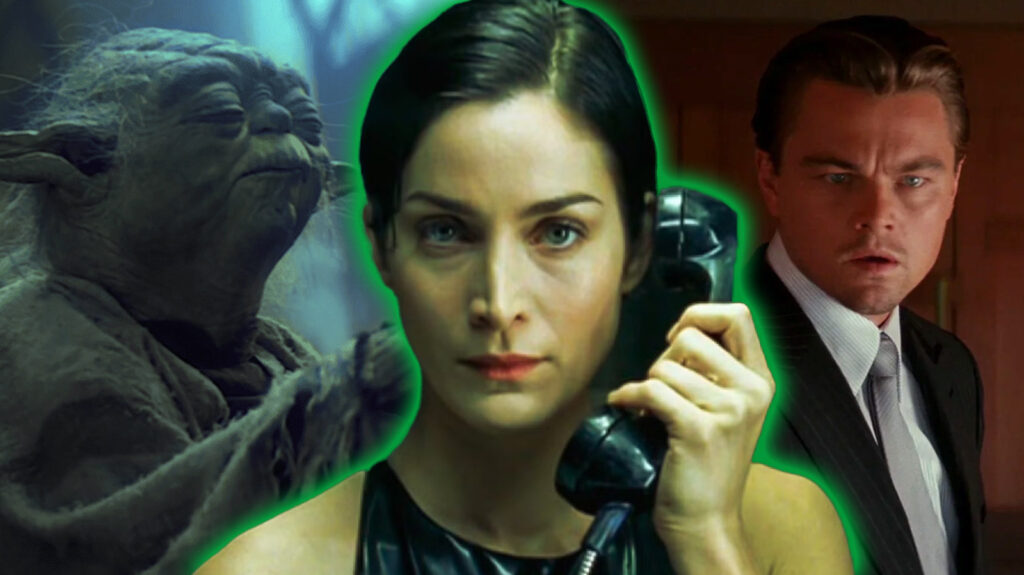
It’s the wildly economic script by Lawrence Kasdan and Leigh Brackett that really allows this movie to sing. It fits all the grand theatricality of a drawn-out space opera into just two hours, cleverly leveraging the story’s central character archetypes to streamline the emotional and action elements. That’s not to mention the beautiful analog special effects and sets that populate every inch of the film, introducing viewers to corners of this world that changed people’s imaginations forever — try to think about going to the movie theater and seeing the weird, irritable elderly alien puppet that is Yoda for the first time. There’s simply nothing like “The Empire Strikes Back.”
1. Inception
If you’re like me, you may be slightly surprised to see Christopher Nolan’s 2010 mind-bending dream-heist thriller sitting at the top of the IMDb Top 250 for sci-fi. But then again, maybe it shouldn’t be such a shock. After all, we shouldn’t forget how big a sensation “Inception” was as a novel, original blockbuster. Indeed, it’s gone down as one of the biggest original box office hits ever.
“Inception” was basically Nolan’s blank check film, following the massive financial and cultural sensation that was “The Dark Knight.” With Warner Bros. allowing him to get away with whatever he wanted, he, of course, went heady, cerebral, and tactical with this intellectual action movie-meets-thought experiment following Nolan’s fascination with dreams. It’s as much “Paprika” as it is “Heat,” as the layered dream sequences are staged with the realism of authentic, booming shoot-outs, mixed with the surreal possibilities of the inner workings of a mind.
Frankly, it still works like gangbusters today, immensely satisfying as a pop studio film and a brainy indulgence for its creator. With a stellar ensemble led by the likes of Leonardo DiCaprio, Joseph Gordon-Levitt, Ken Watanabe, Tom Hardy, Elliott Page, Cillian Murphy, and Marion Cotillard, “Inception” is a perfect, distilled showcase of Nolan’s specific appeal as a filmmaker, and it remains an enduringly influential piece of speculative sci-fi.