


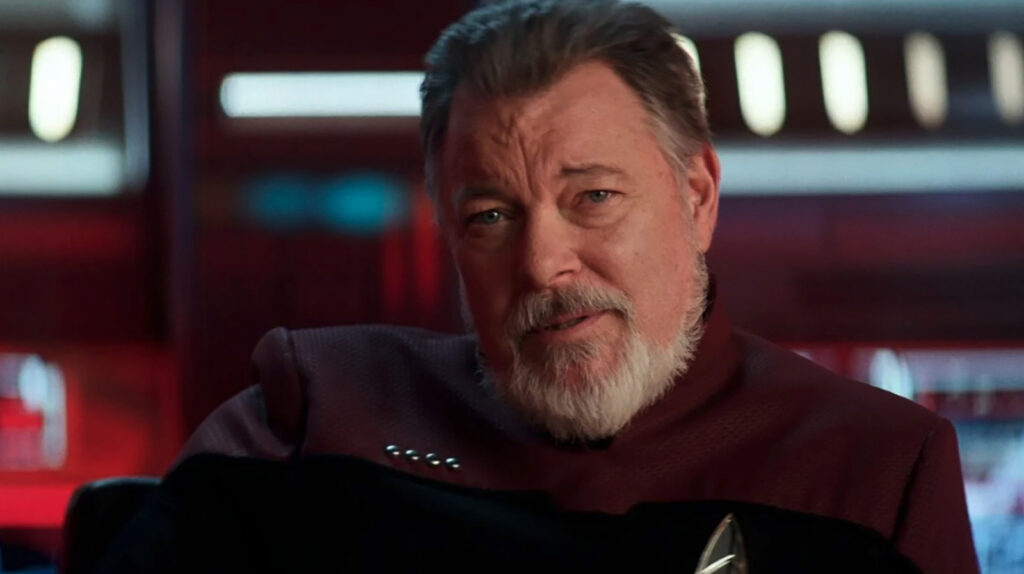

More than just starring as William Riker in “Star Trek: The Next Generation” and other “Star Trek” shows and movies, Jonathan Frakes has been a prolific director for the franchise. This additional showcase for Frakes’ creative talents has spread to numerous projects, even beyond “TNG” era. Frakes has helmed some of the best stories throughout the franchise, including the 1996 film “Star Trek: First Contact.” But there is something particularly special when Frakes takes the director’s chair for a “Star Trek” episode, intuitively capturing the appeal of the franchise.
From “TNG” to the recent streaming shows on Paramount+, Frakes has an impressive track record as a “Star Trek” director. We’re highlighting his best work behind the camera this time, standing among the greatest episodes in their respective series. Frakes has been a crucial part of the franchise’s legacy, and a show just doesn’t feel the same if it doesn’t have him direct at least one of its episodes.
These are the 10 best “Star Trek” episodes directed by Jonathan Frakes ranked across his extensive history with the franchise.
10. Projections (Voyager)
Given its primary location in the Delta Quadrant, much of “Star Trek: Voyager” is separated from the previously established franchise tropes, at least initially. The second season episode “Projections” offers a familiar face with a twist through the return of “TNG” supporting character Reginald Barclay (Dwight Schultz). While going about his business on the Voyager, the Doctor (Robert Picardo) encounters Barclay, who informs him that he’s trapped in an elaborate holodeck simulation. To escape, Barclay directs the Doctor to destroy the starship, with the virtual physician debating if the Starfleet officer is telling him the truth.
So much of “Projections” revolves around the conversations between the Doctor and Barclay, and Frakes works well with the actors in keeping this debate interesting. This working relationship proved fruitful and provided Robert Picardo with a clever way to get a role in “First Contact.” But beyond the networking opportunity, Frakes works well with the “Voyager” cast in creating a mystery that keeps the viewer guessing alongside the Doctor. “Projections” is a highlight in the show’s second season, subverting expectations by ostensibly bringing back a “TNG” character, with Frakes instilling the intrigue well.
9. The Quality of Life (The Next Generation)
The second season episode “The Measure of a Man” had Data (Brent Spiner) defend his right to be recognized as an autonomous individual, with all due respect and courtesy. In the sixth season episode “The Quality of Life,” Data gets to pay it forward by extending those protections to a new artificial intelligence. Encountering a line of repair robots known as Exocomps, Data discovers they have an observable sense of self-preservation and sentience. Data moves to ensure the Exocomps are protected accordingly but is faced with a crisis that requires their sacrifice to rescue Picard (Patrick Stewart) and La Forge (LeVar Burton).
“The Quality of Life” is a spiritual sequel to “The Measure of a Man” from season 2, though it’s more of a mystery, whereas its predecessor played like a courtroom drama. This installment serves as a great showcase for Spiner’s acting talents, as he faces his own moral conundrum involving how to approach new machine-based life. The story also contains a healthy amount of urgency and action-packed stakes, something that “The Measure of a Man” lacked. An underrated sixth season episode and important chapter in Data’s development, “The Quality of Life” is a fantastic existentially themed story.
8. Seventeen Seconds (Picard)
When Riker resurfaced in “Star Trek: Picard,” he was a family man, having married Deanna Troi (Marina Sirtis) and had children with her, one of whom died of an illness. These personal pressures come to a head in the third season episode “Seventeen Seconds,” as Riker assumes command of the USS Titan. This comes as the Titan is locked in combat with a mysterious enemy ship, before it’s discovered that the Changelings are behind the attack. Meanwhile, Worf (Michael Dorn) and Raffi Musiker (Michelle Hurd) track down another hostile Changeling as the conspiracy against Starfleet expands.
In directing “Seventeen Seconds,” Frakes brings a markedly cinematic flair to “Star Trek” again, certainly with regard to ship-to-ship combat intensity. Paranoia and tension are high across the Titan, including the most acrimonious conversation between Riker and Picard in the franchise’s history. The big Changeling reveal is what much of the season’s overarching narrative hinges on, resurrecting a long-settled “Star Trek” storyline to appropriately shocking effect. A huge twist and one of the most gripping episodes in all of “Star Trek: Picard,” “Seventeen Seconds” kicks the show’s final season into high gear.
7. Those Old Scientists (Strange New Worlds)
More than just helming action-oriented episodes, Frakes is also a strong comedic director as well, most visibly showcased with his work in “Star Trek: Strange New Worlds.” Frakes’ best directorial effort in the series to date is in the second season episode “Those Old Scientists,” which features a crossover with “Star Trek: Lower Decks.” Brad Boimler (Jack Quaid) and Beckett Mariner (Tawny Newsome) are accidentally transported a century into the past where they are picked up by Christopher Pike (Anson Mount) and the Enterprise. The duo try to avoid spoiling the future for the celebrated crew while trying to find a way back to their own time period.
“Those Old Scientists” is a beautiful and hilarious tribute to “Star Trek” fandom, with Boimler and Mariner getting to channel their inner fans around their idols on the Enterprise. Quaid and Newsome clearly are having a lot of fun with that premise, and that joy is infectious to the audience. There is a self-aware quality to the humor throughout the episode, something that both “Strange New Worlds” and “Lower Decks” have excelled at. Frakes understands those strengths intuitively and leans into them with the episode’s cast, making “Those Old Scientists” an all-around highlight.
6. The Offspring (The Next Generation)
Frakes’ directorial debut for the franchise was with the third season episode “The Offspring,” another exploration of Data taking a protective role with new machine-based life. Data creates an android child whom he names Lal (Hallie Todd) and takes on the identity of his daughter. Learning about human behavior through her observations and interactions with the crew, Lal develops her own humanity quickly, including the visible expression of emotions. However, Starfleet Command believes that Lal should be remanded to a science facility for further study, essentially asking Data to surrender his daughter.
Frakes knew his first “Star Trek” directing gig was going to be special and he took care to make “The Offspring” stand out. The story continues Data’s exploration of humanity, this time vicariously through the creation of a child, with Todd given considerable range to play with as Lal adapts rapidly. In lesser hands, these developments could’ve come off as cloying and awkward, but Frakes and his team handle them well, especially with the episode’s heartbreaking conclusion. Another exploration of identity and belonging, “The Offspring” highlights Frakes working well directing his regular cast mates in particularly emotional areas.
5. Past Tense, Part II (Deep Space Nine)
Across the entire seven-season run of “Star Trek: Deep Space Nine,” Frakes only directed three episodes, with his last directorial contribution being his best. The episode was the concluding installment in the third season two-parter “Past Tense,” a dark storyline set in 2024. Benjamin Sisko (Avery Brooks) and his landing party accidentally travel to a turbulent moment in Earth’s past, amid widespread social inequality and strife. Sisko is forced to pose as fallen activist Gabriel Bell (John Lendale Bennett) to ensure that this pivotal historical moment comes to pass.
While Reza Badiyi directed the first half of the two-parter, Frakes helms the tense conclusion, with Sisko leading a standoff to maintain Bell’s role in history. The episode is a stark contrast from the futuristic idealism that the franchise is known for and the most grounded “Star Trek” episode Frakes has directed. These elements all work and feel like a precursor to the more morally complex stories that “DS9” told in its subsequent seasons. A sobering political commentary “Past Tense” is a pointed reminder of how far humanity needs to go to live up to its harmonic potential.
4. The Chase (The Next Generation)
The “Star Trek” is rich in diverse humanoid life, including the Romulans, the Klingons, the Cardassians, and, of course, humanity. The “Next Generation” season 6 episode “The Chase” reveals that this is not by accident, unveiling an ancient shared origin for these species. Driven by a discovery from his late mentor Richard Galen (Norman Lloyd), Picard finds evidence that the numerous humanoid species in the galaxy were seeded by an ancient race. As the Enterprise follows clues towards confirmation of this theory, their search is joined by representatives from other species, who believe the revelation will uncover a powerful weapon.
“The Chase” is presented like a spacefaring mystery with archaeological flourishes, with the participation of other hostile races fueling the stakes and urgency to great effect. The storyline then heavily informed the fifth and final season of “Star Trek: Discovery,” though Jonathan Frakes has refused to take credit for it. One of the things that makes his achievement with the episode all the more impressive is that its budget was stolen by “DS9,” given the sister series’ expensive costs. “The Chase” manages to hide these shortcomings in delivering a propulsively fun episode in the show’s penultimate season.
3. No Win Scenario (Picard)
The best “Star Trek” episode Frakes has directed outside of “TNG” so far is the “Picard” third season episode “No Win Scenario.” Picking up from the cliffhanger ending of “Seventeen Seconds,” the Titan is heavily damaged and appears on the verge of certain destruction by the Changelings. Picard has a heart-to-heart with his newfound son Jack Crusher (Ed Speleers) and a far less sentimental one with the Titan’s captain Liam Shaw (Todd Stashwick). Not ready to admit defeat yet, the crew devises a last-ditch effort to fight back against the Changelings and escape to safety.
There’s a lot that’s going on in “No Win Scenario,” maintaining the tension from its preceding episode while providing a calm before the storm. While the sci-fi action is present in full, the real highlight is the very different conversations that Picard has with three different characters on board. This reinforces the season’s emotional core and stakes while showcasing the type of tonal balances and pacing that Frakes has long mastered. Offering a few moments of quiet before pivoting to a triumphant reversal of fortunes, “No Win Scenario” stands as “Picard” at its best.
2. The Drumhead (The Next Generation)
For the fourth season episode “The Drumhead,” “TNG” shifted into courtroom drama mode, with institutional paranoia sweeping the Enterprise. After the starship endures an internal explosion, Starfleet sends retired Admiral Norah Satie (Jean Simmons) to lead the investigation of the cause. The discovery of an unrelated collaborator with the Romulans prompts Satie to launch a full witch hunt of the ship’s crew. This culminates in Satie subjecting Picard himself to a prolonged trial questioning his loyalties to Starfleet in an effort at a kangaroo court.
Frakes decided to break a “Star Trek” big rule when directing “The Drumhead,” giving it a more pronounced visual flair than more conventionally shot episodes. This helps the episode stand out considerably from the rest of the series, beyond the content of the story itself. The story is penned by the late legendary screenwriter Jeri Taylor, with its themes highlighting how easily people can be subjected to hysteria and the fragile nature of justice. A beautiful realization of Taylor’s script anchored by a memorably guest-starring appearance from Simmons, “The Drumhead” is “TNG” at its best.
1. Cause and Effect (The Next Generation)
Several of “Star Trek: The Next Generation’s” best episodes are directed by Frakes and few top the fifth season episode “Cause and Effect.” The episode has the Enterprise caught in a temporal loop, repeatedly colliding with a time-displaced starship, resulting in both vessels’ explosive destruction. With the loop restarting with each destruction, the crew get an underlying sense of deja vu as they relive the events leading up to the collision. Through his unique programming, Data begins to leave himself clues to eventually break the harrowing cycle for good.
“Cause and Effect” is one of the most rewatchable “Star Trek: The Next Generation” episodes ever, something that’s inherently baked into its time loop premise. After starting off with a literal bang, the story plays out like a repetitive mystery, intentionally as disorienting to the audience as the crew. There are a lot of moving parts to get this tricky feat to work well, but Frakes and the rest of the team understand the assignment and proceed accordingly. A puzzle box keeping viewers riveted with each loop, knowing what’s coming and looking for a release, “Cause and Effect” ranks among Frakes’ best directorial work overall.