


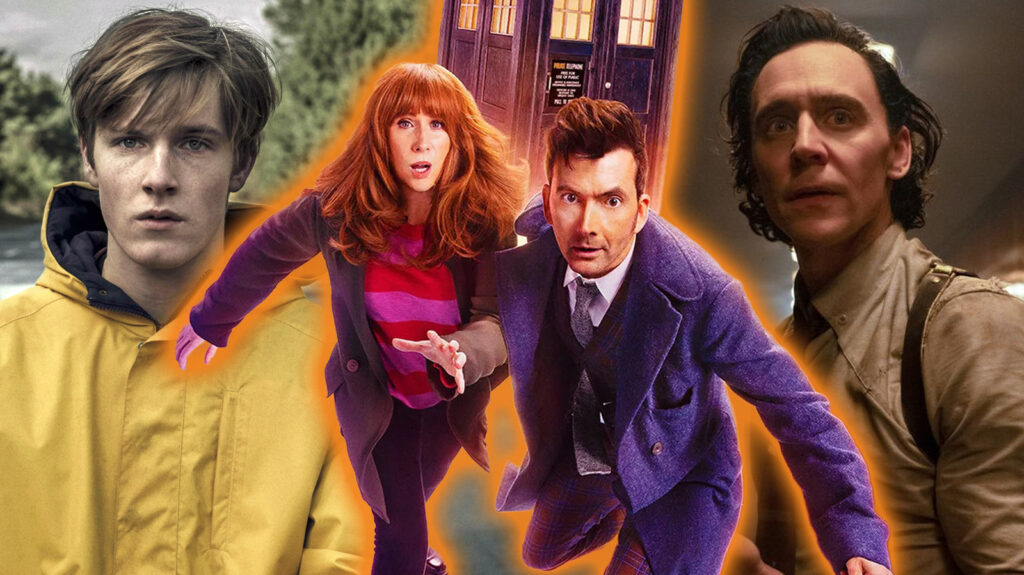

We may receive a commission on purchases made from links.
At least since Charles Dickens first sent those three ghosts to visit old Ebenezer Scrooge on Christmas Eve, audiences around the world have been captivated by the idea of time travel. It’s easy to imagine how the narrative device became so infectious — after all, humans have likely used their minds as private time machines since the dawn of consciousness. Who wouldn’t want to go back and experience a past they’ve long forgotten? Who hasn’t thought of one choice they’d change, big or small, to amend a present that just feels… off? Who doesn’t imagine the future so vividly that they would give anything to meet a specter or scientist with the ability to take them there now?
These stories speak to a wide range of complicated emotions and anxieties all at once, in some cases allowing audiences to escape to a world free of them — in others, they ask us to confront the disquieting, unknowable force of time and the fears that confrontation stirs within our minds. While cinematic contributions to the subgenre are regularly lauded — from the sci-fi thrillers of “Terminator” and “Tenet” to the time-loop comedies of “Groundhog Day” and “Palm Springs” — those coming from the small screen rarely get their time to shine.
We’ve traveled through our own television timeline to highlight our 10 favorite time travel TV shows of all time, ranking them based on overall quality and their impact on the subgenre.
10. DC’s Legends of Tomorrow
If you checked out of the Arrowverse during the early years of its flagship series, you would certainly be bewildered by what it became by the time it ended. The franchise catalyzed by an intensely grounded, crime procedural spin on the “Green Arrow” comic books exploded into an ever-expanding television multiverse with time travel as a consistent core plot device. Suffice it to say this led to somewhat mixed results, storytelling-wise. It did, however, at the very least grant us “Legends of Tomorrow,” a unique mash-up of superhero and time travel tropes that proved the two subgenres were a dynamic duo just waiting to leap into action.
The 1st season primarily succeeded in taking advantage of the franchise’s second-string heroes, a supporting ensemble that continued to grow beyond their usefulness to their original series. From “Arrow” came the revived Sara Lance (now a vigilante known as the White Canary, played by Caity Lotz) and billionaire superhero Ray Palmer / The Atom (Brandon Routh); from “The Flash,” Captain Cold (Wentworth Miller), Heat Wave (Dominic Purcell), and the new Firestorm (Franz Drameh). Overtly attempting to evoke the same sci-fi-swashbuckling fun of the 2010s’ preeminent time travel series, the series brought in beloved “Doctor Who” companion Arthur Darvill to lead them on a time-hopping quest to thwart the immortal supervillain Vandal Savage.
“Legends,” unlike most Arrowverse shows, starts out solid enough and gets better with every season. Even when things got a little goofy (who among us could forget the time Gorilla Grodd tried to kill Barack Obama?), a bend toward the absurd was exactly what the series needed to make the most of its time travel premise.
9. Timeless
As the science fiction genre at large further leans on a hypothetically more “realistic” understanding of time travel that imagines it as a mode of exploration related to interdimensional travel, we have to admit that something feels lost from the time travel subgenre. The fantasy that keeps us coming back to this narrative device is not its potential practicality, after all, but the idea of getting to experience history as it actually was with the knowledge we have now — knowledge that presents as much power as it does danger when alterations threaten the timeline as we know it.
This waning story engine is what drives the criminally underrated “Timeless,” which aired on NBC for just two brief seasons in the mid-2010s. Created by prolific TV producers Eric Kripke (“Supernatural,” “The Boys”) and Shawn Ryan (“The Shield,” “The Night Agent”), this classic time travel adventure series follows a trio of inexperienced heroes who are tasked with using their diverse skill sets to prevent a rogue, time-traveling U.S. intelligence asset (“ER” actor Goran Višnjić) from altering the course of history. It stars “Suits” and “Grey’s Anatomy” alum Abigail Spencer as an expert historian capable of navigating the past without destroying it, Malcolm Barrett (“The Boys”) as the technical specialist, as well as the pilot of their spaceship-like time machine, and Matt Lanter (Anakin Skywalker on “Star Wars: The Clone Wars”) as a U.S. soldier who tries to keep them from getting killed.
Even the most casual American history buffs will be amused by how “Timeless” revisits events like the Lincoln assassination, the capture of Al Capone, and the Hindenburg disaster. At the same time it indulges in such escapism, it consciously engages with the complexities of confronting American history with the foreknowledge to understand its horrors.
8. Future Man
Straddling the line between genre love letter and irreverent send-up, “Future Man” is a stupidly fun watch. The Hulu comedy adventure series won’t satisfy everyone reading this list. Its time travel rules are deliberately vague and chaotically employed, usually in the service of the kind of indulgently crude humor you’d expect from Seth Rogen and Evan Goldberg (the “Superbad” and “Sausage Party” writers serve as the series’ executive producers). That said, if you can get on its wavelength, “Future Man” feels like it was made specifically for diehard fans of the time travel subgenre.
Josh Hutcherson stars as Josh Futterman, an aimless, unsatisfied janitor who essentially lives his life like a teenage boy. What little purpose he does have comes from the video game “Biotic Wars,” which, unbeknownst to him, is a recruiting device designed to help rebel soldiers from the 22nd century find humanity’s savior. (It’s a whole “The Last Starfighter” thing, as Josh points out.) Teaming up with grizzled insurgents Tiger (Eliza Coupe) and Wolf (Derek Wilson), Josh must travel back in time to prevent the Miles Dyson-esque scientist Dr. Kronish (Keith David) from inadvertently spawning the beings responsible for humanity’s destruction. And to do that, of course, they have to first prevent the scientist from getting herpes at a house party.
Ridiculous as it sounds, that initial premise paves the way for an outrageously meta riff on time travel adventures that (in addition to skewering everything from “Terminator” to “Back to the Future”) boldly and hilariously deconstructs the subgenre by challenging the hyper-moral self-seriousness of shows like “Timeless.” It’s one of the best series Hulu has ever made, so naturally, they’ve scrubbed it from the platform entirely. Thankfully, it’s available on physical media, which is worth paying for, because “Future Man” is unhinged, delightfully dumb, and consistently entertaining TV.
7. Life on Mars
Some readers might have an issue with us listing “Life on Mars” as a time travel series, though those same readers are also most likely to appreciate why we have to at least acknowledge how inventively it uses time travel as a story device.
The first and least-spoilerly issue is the fact that there’s really only one moment of time travel in the series. Sam Tyler — a dogged police inspector from 2006 (played by John Simm, unsurprisingly the second notable “Doctor Who” alum on our list so far) — is somehow sent back to the year 1973 after being struck by a car. To make matters even more confusing, Sam is not a misfit in this timeline, but an inspector with a documented history who is expected to join a new police department. Thus, around a throwback procedural format that sees him partner with Philip Glenister’s Gene Hunt to solve the case of the week, Sam is forced to reckon with the nature of his reality in an ambiguous and philosophical way that admittedly stretches the boundaries of the time travel subgenre.
Those looking for historical revisionism will have to look elsewhere. Instead, “Life on Mars” uses Sam’s displacement in time to intimately explore the experiences of isolation, searching for purpose, and the strange escapist compulsion that inspires time travel stories in the first place. Psychologically, this is a more imaginative take on time travel than most series on this list — narratively, it is so necessarily restrained that we have to rank it lower than its overall quality otherwise warrants.
6. Outlander
Armed with a surprising mix of genres and the dynamic emotional depth needed to do them all justice, “Outlander” is a true television epic that combines the sweeping beauty of a historical romantic drama with the tension of a brutal adventure tale. The series follows former World War II nurse Claire Randall (Caitríona Balfe), who is sent back in time while honeymooning in Scotland in 1945. Finding herself stranded in the mid-18th century, she is taken in by James Fraser (Sam Heughan), a ferocious yet noble Scottish warrior fighting in a rebellion against the British Army. What begins as a partnership of survival develops into a complicated and compelling romance that forces Claire to reckon with the conflicting desires of returning to her time and embracing a dangerous yet more fulfilling life she’s found in the past.
Like “Life on Mars,” “Outlander” uses time travel in a more psychological way. The drama it creates is in Claire’s efforts to survive a time she’s only beginning to understand, one which draws her in spite of the safe, comfortable life waiting for her back in the 20th century. It also doesn’t turn the past into a total romantic fantasy — on the contrary, its setting is often upsettingly horrific and vivid in its depiction of the era’s violence, and potential new viewers should investigate available content warnings to determine if the show is right for them.
Ultimately, the horror and brutality exists with an earned beauty that pervades the series visually and thematically. Against the backdrop of the historic highlands, “Outlander” paints a grand, time-bending romantic saga that spares neither passion nor complexity.
5. Loki
There was an appropriate amount of skepticism leading up to the release of “Loki.” Though the Marvel Cinematic Universe wasn’t in quite the creative rut it entered in the years afterward, it seemed a bit odd that one of the franchise’s inaugural Disney+ series would be dedicated to a character that already had a complete and seemingly exhaustive character arc over the course of the Infinity Saga, and definitively died. When it became clear the series would star a narratively-reset variant of Tom Hiddleston’s character (plucked from the end of “The Avengers”), it was even more unclear what the point of this exercise could possibly be.
What “Loki” ultimately does so brilliantly is give its character new, unlikely purpose by getting to the heart of what time travel stories actually are: battles for authorship and autonomy in a world that normally forces us to march blindly forward, with our own free will uncertain in the face of external forces beyond our knowing or influence. The series picks up right after Loki’s time-aberrant escape from the Avengers, where he is quickly captured by the Time Variance Authority (TVA), a paradoxical, metaphysical bureaucracy that is responsible for protecting a single, sacred timeline.
Though they explain themselves as impartial custodians preventing multiversal chaos, the emotional stakes for Loki are clear from the first episode: His whole life, filled with tragedy and corruption, has been of someone else’s making. Thus, as he reluctantly collaborates with the TVA, the new Loki uses his journey through time to explore his deceptively harmonious needs for control and purpose, becoming the truest representation of the character along the way.
4. 11.22.63
Despite an understandable aversion to the enduring conspiracy theories surrounding the Kennedys, “11.22.63” is a thrillingly paranoid neo-noir mystery miniseries that interrogates the psychological toll of attempting to change the past. James Franco stars in this adaptation of Stephen King’s 2011 novel, which was released in 2016 (the series has since found a second audience on Netflix, alongside the streamer’s impressive library of King adaptations). It was something of a passion project for the actor, who wrote about his own connection to the novel in a feature for Vice that was published prior to the series’ casting (as a not-so-subtle attempt to publicly insist on his involvement in the adaptation). In the article, Franco argues that King’s use of time travel allows the reader/audience to marvel at the past through the author’s uniquely vivid rendering of it.
The idea of getting trapped in bygone beauty carries over into the miniseries, with Franco playing a lost schoolteacher who is charged with traveling to the past to prevent the assassination of John F. Kennedy. Believing that Kennedy’s survival would have ensured a more moral contemporary world but constrained by the unassuming time portal’s ability to send him back to the year 1960, Franco’s character must fully live in the ’60s for three years. As he tracks the movements of Lee Harvey Oswald (Daniel Webber) and investigates the possibility of other shooters, he finds himself falling in love with a past that actively tries to extinguish him. Even more than the immersive reverie Franco apparently found captivating, this creates a tension that invites the viewer to be skeptical of such idealism, much less sacrificing one’s future in an attempt to preserve it against nature.
3. Dark
If you were left disappointed by the “Stranger Things” finale or loved the series so much that you’ve been heartbroken over its end, “Dark” needs to be your next Netflix binge. There are few science fiction stories on TV that are this intricate, strange, and daring, and its time travel mechanics and small-town setting evoke the mystery of Hawkins all over again.
Instead of Hawkins, though, “Dark” takes viewers all the way to Winden, a seemingly perpetually sullen town in Germany, where a series of bizarre tragedies are secretly linked to a cave system that sends those who enter decades in either direction from their present time in 2019. The catalyst for the series’ plot is the disappearance of a young boy, the search for whom starts to reveal secrets hidden in the past and future.
Without spoiling anything, the series naturally builds upon its understanding of time travel as the characters themselves change, impressively maintaining it as both a narrative device and a method for exploring themes of trauma, fatalism, morality, and sacrifice. By the time the series ends, the mechanics have taken such a satisfying turn that you’ll want to immediately rewatch the entire thing to enjoy every clue cleverly hidden in plain sight. For first-time viewers, “Dark” is a gripping sci-fi mystery that offers unsettling and novel answers to the subgenre’s central question of free will.
2. 12 Monkeys
“12 Monkeys” is quietly the most ambitious time travel TV show created in the 21st century, especially considering it combines complex, elastic time travel mechanics with an action sci-fi story intended for a broad mainstream audience. Loosely based on the 1995 Terry Gilliam sci-fi thriller of the same name (which starred Bruce Willis and Brad Pitt), it initially presents itself as a straightforward, “Terminator”-esque time travel mission: go back in time, change whatever’s necessary to avert the apocalypse. In this case, that apocalypse is a virus that poses an existential threat to humanity, and the “hero” is a decidedly unheroic, tortured survivor named James Cole (“X-Men” actor Aaron Stanford). He executes missions at the behest of the calculating 2040s scientist Katrina Jones (Barbara Sukowa) and with the help of 2010s CDC virologist Cassandra Railly (Amanda Schull).
The series is immediately inventive with how it uses its own rules of chronological causality to progress the story and create mystery, but that’s only the beginning. With each new season, the characters and the audience have their understanding of time travel — and even the nature of time itself — challenged, while at the same time coming to terms with the unpredictability of the people they thought they could trust. “12 Monkeys” is as surprising as it is fearless, taking full command of almost every time travel trope imaginable and employing them in a story that feels like it’s aiming to be the subgenre’s definitive masterwork. Whether or not it succeeds is very much up for debate, but the sheer excitement of experiencing it for the first time is not.
1. Doctor Who
For as many great time travel series as we’ve gotten in the past 50 years or so, there’s no rewriting history. “Doctor Who” is, has been, and likely always will be the time travel TV show. Whether you’re considering the entirety of its 800+ episode run, stretching all the way back to 1963 or merely the contemporary era that began in 2005, no other series in the subgenre can claim to be even half as enduring, culturally ubiquitous, or influential.
If you’re somehow reading this list and have yet to give it a chance, here’s the gist: A time-traveling humanoid alien referred to as “The Doctor” (played by 14 different actors as of writing, each of whom bring a unique characterization to the role) who journeys across time and space in a flying police call box, almost always with a human companion or two. It’s a wonderfully broad and open-ended premise that’s amenable to elements of fantasy and hard science fiction depending on the story. It also allows the series to keep surprising longtime fans while creating fresh points of entry for new ones to find their own way into its wibbly-wobbly, timey-wimey narrative.
If you can think of a time travel trope, “Doctor Who” has perfected it, deconstructed it, and absorbed it into its sprawling lore. From simple time loops and historical revisions to time wars and using forced time travel itself as a chillingly cruel method of murder, the best episodes of the series are some of the greatest time travel stories ever told on television.