


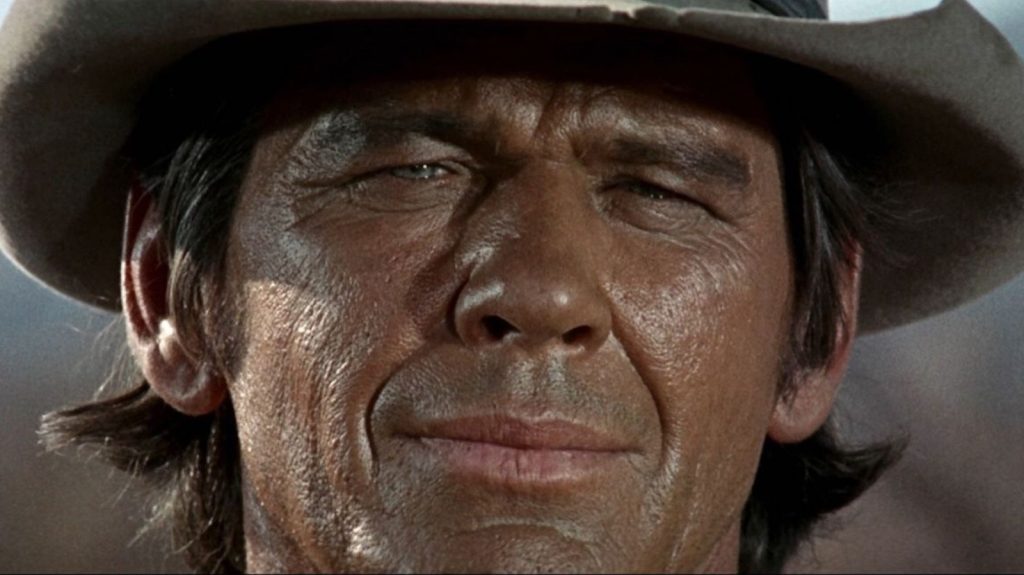

While Westerns boast breathtakingly rustic vistas and memorably rugged main characters, chances are, we’re there to see some sharpshooting gunplay. Many Western movies that everyone should watch at least once are anchored by a riveting action set piece between frontier gunfighters. These sequences range from drawn-out battles throughout harsh landscapes and dusty towns to quick-draw showdowns over in a single burst of gunfire. We’re looking back at personal favorite gunfights in the history of Western movies, each earning a spot in cinematic history.
Silver screen legends like John Wayne and Clint Eastwood immortalized themselves through the gunfight scenes in Westerns they starred in. In many cases, the single most iconic scene in a given Western is its gunslinging action sequence. After all, the Wild West archetype is one revolving around its laconic gunfighters, not its bucolic communities on the fringes of civilization.
With those qualities in mind, these are the best Western movie gunfights of all time ranked, epitomizing the genre’s gunslinging appeal.
10. Shane
So much of the classic 1953 Western “Shane” is the build-up to its titular protagonist finally showing everyone what he’s got. Played by Alan Ladd, the character is a drifter with a mysterious past who comes to work on a farm on the frontier. When these homesteads are targeted by an unscrupulous land baron, Shane’s lethal skills quickly come in handy. This comes to a quick-draw climax as Shane kills the murderous crook along with his sadistic hired gun Jack Wilson (Jack Palance), though Shane himself is wounded.
Ladd’s Shane is the ultimate gunslinger archetype, though he really only gets one gunfight in the entire movie. Fortunately, “Shane” makes this sequence count, with this violent inevitability expertly staged and crafted. To heighten the mood, much of this climax is filmed in a shadowy saloon as Shane overcomes the obvious trap that he knowingly walks into. Fans still debate over 70 years later if Shane survived this gunfight, which is a testament to how memorable the sequence and its ambiguous aftermath are.
9. 3:10 to Yuma
Even though it became a Western that flopped at the box office, the 2007 remake of “3:10 to Yuma” does its 1957 predecessor proud. That said, the difference between the two movies are most acutely felt in how they each end. The 2007 remake features farmer Dan Evans (Christian Bale) escorting outlaw Ben Wade (Russell Crowe) to a train station, with Ben begrudgingly going along for the last run. What follows is a running gunfight against those trying to stop Dan, who still finds the time to convince Ben to cooperate.
The last few minutes of the “3:10 to Yuma” remake are its most exciting, while filmmaker James Mangold still delivers on its main character arcs. Any sense of triumph is quickly undercut by the movie’s tragic conclusion, differentiating it from both its short story source material and the 1957 film. The movie handles that fake-out marvelously while not mitigating the excitement that came before during this desperate run. Easily one of the greatest Western movies of the 2000s, “3:10 to Yuma” saves its best for last.
8. Butch Cassidy and the Sundance Kid
For as breezy as the overall movie is, the most well-known scenes in “Butch Cassidy and the Sundance Kid” are its most relentlessly intense. Though the duo being pursued by a posse across the Wild West for their train robberies stands out, the movie’s ending is arguably its most famous sequence. Having relocated to Bolivia to resume their criminal activities, Butch (Paul Newman) and the Sundance Kid (Robert Redford) are ambushed by the authorities and take shelter in a nearby building. Charging outside, Butch Cassidy and the Sundance Kid go out in a blaze of glory, with the movie ending on a freeze-frame as the pair are gunned down.
The alternate ending of “Butch Cassidy and the Sundance Kid” thankfully wasn’t used, which would’ve actually shown its likable duo gruesomely killed. Instead, the scene leaves the carnage to the audience’s imagination, rather than treading the same territory as the ending of “Bonnie & Clyde.” That freeze-frame approach works well for the overall movie, giving the story its inevitable ending but without dwelling on the violence, staying in line with its general tone. The only gunfight on this list which doesn’t show its decisive salvo on-screen, “Butch Cassidy and the Sundance Kid” focuses on its title characters’ legend rather than its tragedy.
7. True Grit (1969)
John Wayne led a lot of different Western movie gunfights, from classic quick-draws in “The War Wagon” to shadowy shootings in “The Man Who Shot Liberty Valance.” But the Wayne-starring gunfight that stands out from the rest of his work is his climactic confrontation in “True Grit.” Wayne plays U.S. Marshal Rooster Cogburn in the 1969 movie, finally catching up with a crew of outlaws he had been pursuing for the entire film. After being insulted by the gang’s leader Ned Pepper (Robert Duvall), an incensed Cogburn charges them alone with a gun in each hand and his horse’s reins in his teeth.
John Wayne considered “True Grit” to be his first decent role in 20 years, and his one-man charge cements his character’s place in his legacy. The action sequence isn’t just the movie at its most rousing, and it shows a more ornery side to Wayne’s usual frontier archetype. Expertly twirling his rifle in one hand to chamber a new round, just as he did in “Stagecoach” three decades prior, Wayne hasn’t lost a step. Putting a furiously gun-toting Wayne back in the saddle, “True Grit” proved this old dog still had some new tricks.
6. Django Unchained
Over a decade later, “Django Unchained” is still Quentin Tarantino’s biggest movie, at least from a commercial standpoint. The final act of the 2012 movie takes place in Candyland, a notoriously brutal plantation run by the cruel slave owner Calvin Candie (Leonardo DiCaprio). Subjected by Calvin’s nightmarish hospitality in an effort to rescue Brunhilda (Kerry Washington), the enslaved wife of Django (Jamie Foxx), King Schultz (Christoph Waltz) kills Calvin. This kickstarts a particularly blood-soaked gunfight, as Schultz is killed and Django battles gunmen around the plantation, until he is eventually forced to surrender.
The sanguine shootout may not be the final showdown in “Django Unchained,” but it’s a scene that we wish would never end. After the smug cruelty that Django and Schultz endure in Candyland, the action sequence feels like a cathartic release as Django exacts comeuppance on his hosts. To heighten the effusive enjoyment of the scene, Tarantino uses “Unchained (The Payback/Untouchable)” by James Brown and Tupac, while making every bullet hit like an artillery shell. The best gunfight that Tarantino has filmed to date, “Django Unchained” has its titular hero bring bloody retribution to its main villain’s antebellum lair.
5. Unforgiven
For much of “Unforgiven,” the violent backstory of outlaw Will Munny (Clint Eastwood) was only hinted at, with Munny himself focused on being a farmer and single father. After learning that his old friend Ned Logan (Morgan Freeman) was murdered by the sadistic sheriff Little Bill Daggett (Gene Hackman), with his body mockingly displayed, Munny’s lethal demeanor resurfaces. Storming into Little Bill’s saloon, Munny shoots him and several of his associates, maintaining a clear-eyed, if furious, focus. After finishing off Little Bill, Munny threatens everyone to properly bury Logan or experience his wrath again before departing from the rainy frontier town for good.
The “Unforgiven” ending reveals that some legends are better left to fade away, and Munny is every inch the killer that he was reputed to be. Moreover, Munny inadvertently demonstrates Little Bill’s own insight against him, staying calm and collected during the chaos of the gunfight, allowing him to take down all his enemies. Keeping in tone with the rest of the revisionist Western nature of the movie, this burst of violence isn’t particularly flashy or stylized. But that makes the carnage all the more grounded and with understated menace as Eastwood delivers his definitive word on the genre that made him a star.
4. Tombstone
The most famous shootout in real Wild West history was the gunfight at the O.K. Corral in 1881 between the Cowboy outlaw gang and lawmen led by Wyatt Earp. Though this fateful showdown has been dramatized plenty of times in Western movies, the most entertaining depiction is in “Tombstone.” Roughly serving as the centerpiece of the movie, the scene only lasts less than a minute, like the historical event. Several of the outlaws are killed in the exchange, while both of Wyatt’s brothers are wounded before inciting the wrath of the other gang members.
“Tombstone” presents its historical figures in a stylized and colorful light, helping make it one of the best Western movies of the 1990s. Comparatively, the gunfight at the O.K. Corral is played relatively straight, which helps it stand out from the rest of the movie. The action is quick, brutal, and consequential, setting in motion the back half of the movie’s stakes. Certainly one of the best gunfights in a relatively modern Western movie, “Tombstone” knows a lot is riding on its marquee confrontation and delivers accordingly.
3. Once Upon a Time in the West
The single most recognizable shot in Sergio Leone’s “Once Upon a Time in the West” is the sight of three gunmen confronting Harmonica (Charles Bronson) at a train station. The scene opens the film, playing out largely with diegetic noise as the three gunfighters await the incoming train with their target. This sets the stage for Harmonica’s arrival, earning his nickname from his first appearance with a screeching melody played from his mouth organ. Unfazed that he’s outnumbered three-to-one, Harmonica takes his position against his three enemies and guns them all down singlehandedly though wounded in the skirmish.
“Once Upon a Time in the West” is bookended with genre-defining gunfights, but the opening sequence is the superior of the two. Leone’s masterful positioning his actors in frame and suspense building until the inevitable draw finally punctuates that crescendo with a single exchange of gunfire. With Leone, it was all about finding ways to fuel that tension before letting it finally go off like a pressure cooker, a lesson that has visibly influenced Quentin Tarantino. “Once Upon a Time in the West” is among Charles Bronson’s best movies and seeing him anchor the movie’s opening gunfight sets the mood for Leone’s requiem to the genre.
2. The Wild Bunch
If “Once Upon a Time in the West” is best known for its opening, the following year’s “The Wild Bunch” is best known for its ending. The movie follows a group of aging American outlaws in the early 20th century, led by Pike Bishop (William Holden), who flee to Mexico after a botched bank heist. The ensemble get caught up in the revolution south of the border, culminating in the quartet making their last stand against the full might of the Mexican army. Gathering around a machine gun emplacement, the group are eventually overwhelmed and killed but not before massacring scores of soldiers.
The gruesome to “The Wild Bunch” was reportedly as brutal to film as it was to watch, heightening the verisimilitude of the sequence. In a matter of seconds, this situation escalates out of control, full of fire and fury as Pike and his associates stand in the face of oblivion. There’s no mistaking that these four men are marching quietly to their deaths, but as the scene reveals, they’re going out on their own terms and they’re not going alone. More than just the tale of four old outlaws, “The Wild Bunch” signals that the Wild West era didn’t die out peacefully but with a violent fire in its guts.
1. The Good, the Bad and the Ugly
Of course a Clint Eastwood Western was going to top this list, and of course it was going to be “The Good, the Bad and the Ugly.” Virtually every Sergio Leone Western, like “Once Upon a Time in the West,” has a standout shootout sequence, but the greatest is in his 1966 epic. The movie reaches its crescendo when it brings its titular trio together in a sprawling cemetery as they search for a hidden stash of loot. With the three gunslingers at odds, the characters have a tense staredown before Blondie (Eastwood) guns down Angel Eyes (Lee Van Cleef).
Powered by a stirring score by Ennio Morricone, the climax is one of the most effectively staged sequences Leone has ever directed. The intercutting of close-ups between the three main characters before being punctuated by a single burst of gunfire with mounting suspense all the while is masterfully done. The moment also provides Blondie with another opportunity to pull a fast one on Tuco (Eli Wallach), secretly unloading his pistol for the duel. The quick-draw gunfight that epitomizes Leone’s meticulous style, “The Good, the Bad and the Ugly” ends on a truly iconic note.