
We love westerns around these parts. Our collective love for the genre has seen us explore the best westerns of all time, the best spaghetti westerns, and even the best westerns of the 21st century so far. Westerns have been around since the dawn of filmmaking, and while the genre has seen its share of highs and lows over the years, its lowest point in time is fairly inarguable.
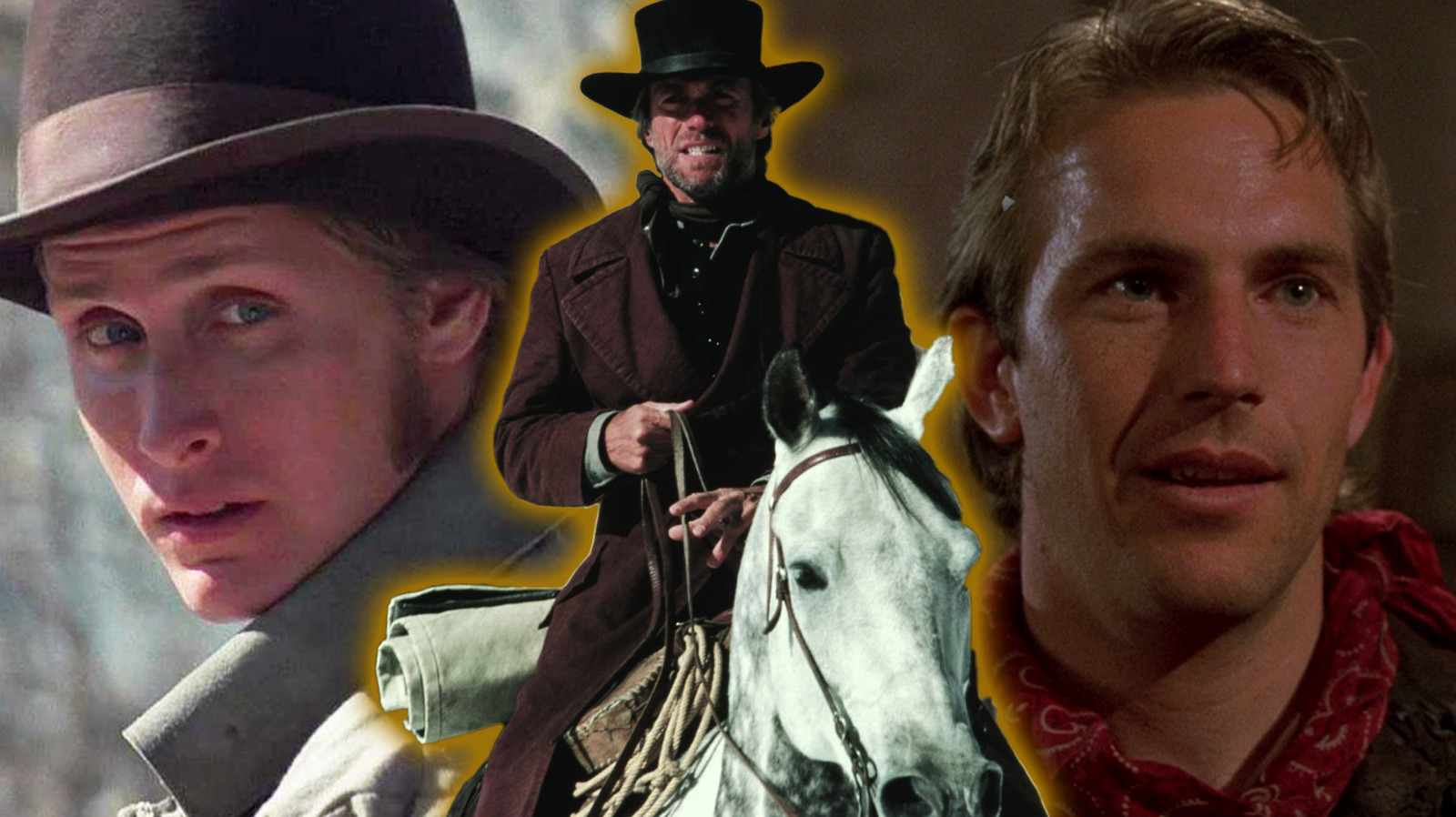
We’re talking, of course, about the 1980s. Filmmakers still wanted to play in the western sandbox, but studios and financiers wanted nothing to do with the genre, which had been declared dead at the box-office by audiences seemingly more interested in contemporary action pictures. Happily, some filmmakers refused to listen. Clint Eastwood, a genre legend, managed to make a single western. Kevin Costner, who would go on to become a driving force in the genre, got his first taste with a starring role in a big studio western. Steve McQueen, whose life ended prematurely in the early 1980s, still managed to make his penultimate film a worthwhile western.
But even though the 1980s were the lowest point for the western genre, we’ve rounded up the best westerns of that cursed decade.
10. Three Amigos!
The Three Amigos — Lucky Day (Steve Martin), Dusty Bottoms (Chevy Chase), and Ned Nederlander (Martin Short) — are a popular silent film trio making westerns that showcase their singing, dancing, and cowboy talents in the early 20th century. They’re fired by the studio for daring to ask for a raise, but they find solace in a letter requesting their services in Mexico. They think it’s for a show, but the people who sent it think they’re actually gunfighters and heroes.
Look, at the risk of repeating ourselves, the 1980s were not a great time for westerns. The decade saw some great ones, namely the first five below, but that leaves some scattershot titles to fill in the remainder of our top ten list. So, is “Three Amigos!” a great western? Maybe not, but it is a good one. More than that, it’s also a very funny comedy. The film is written by Martin, Lorne Michaels, and Randy Newman, and it plays into the western genre’s tropes about townspeople cowering before outlaws, strangers riding in to fight back villainy, and the kinds of stories that are passed down as legends.
Yes, there’s a singing bush here. Sure, there’s an invisible swordsman. But the core of the film is three men who know how to handle horses and handguns who rescue people from violent oppression. It’s a plethora of endlessly silly as gags both verbal and visual fill the screen, but it still respects the genre it’s poking fun at. Director John Landis handles the lunacy well, though one wonders how Steven Spielberg’s version would have looked had it come to fruition.
9. Outland
William O’Niel (Sean Connery) is marshal of outpost Con-Am 27, a remote location home to hard-working miners struggling to procure titanium ore from deep underground. He takes notice when miners start dying in odd, violent ways, and he soon discovers a conspiracy that threatens anyone in the know. With assassins en route and no one willing to stand with him, O’Niel prepares for the fight of his life.
Director Peter Hyams was one of the more reliable journeyman genre filmmakers throughout the 1970s, 1980s, and 1990s with titles like “Capricorn One,” “Running Scared,” and “Timecop” to his name. He had wanted to make a western but was told the genre was dead, so he recalibrated his sights, wrote “High Noon” in space — ie “Outland” — and quickly found both a star and a studio to help get it made. Hyams isn’t shy about the obvious influences, but even with the narrative similarities, the film finds its own voice and delivers its own entertainment. Connery excels in the lead role as the tough marshal ensuring this as one of his many great films. (But is it great enough to make our list of Connery’s best films?)
It’s easy to imagine this film unfolding in the same universe as Ridley Scott’s “Alien” as the sci-fi dressing works as set dressing for a tale of blue-collar workers unfairly treated as expendable and the price of doing business. This is the more grounded of the two, of course, and Hyams keeps his western motifs evident throughout, from the standoffs and small town feel to one particular shot showing O’Niel coming through saloon-like doors into the outpost’s equivalent of a bar.
8. The Man from Snowy River
Jim Craig (Tom Burlinson) is just a teenager when his father dies in an accident in the rugged and remote wild of Australia. Unable to take over the land, he heads down the mountain to work a ranch and gain experience, but he lands face first into a power struggle between estranged brothers (Kirk Douglas in both roles) while also falling love.
Most westerns have some sort of visceral, immediate conflict at their core that requires a finale fueled by lead, but “The Man from Snowy River” takes a wholly different tact. There’s violence here, to be sure, but this isn’t a western destined to be settled by a standoff in front of the local saloon. Instead, it’s a coming-of-age tale set against Australia’s equivalent of the American West circa the late 1800s. Still, while the dramatic conflict at its heart isn’t quite on the level of life and death, it finds its weight in relationships, revelations, and the rugged reality of everyday life.
Director George T. Miller — no, not Australian “Mad Max” franchise director George Miller — found his biggest success here with a film that offers a visual feast for fans of Australia’s epic landscape. The horse action is thrilling, the romance is compelling, and Douglas’ twin characters explore both sides of the coin when it comes to the people who worked to make inhabitable places home with one a wealthy landowner and rancher and the other a simple prospector. Warmth, humor, beauty, and adventure are the goals here, and the film manages all four.
7. Young Guns
A cattleman named Tunstall (Terence Stamp) hires a group of rowdy young men he nicknames the Regulators to work his ranch and get educated along the way. On ongoing feud with another rancher leaves Tunstall dead, and the Regulators are tasked with securing justice. The group’s de facto leader, Billy the Kid (Emilio Estevez), soon takes things in a more dangerous direction.
Few people would include “Young Guns” on a list of the best American westerns overall, but the benefit of focusing on the 1980s means some simply good films still earn a spot here. That’s not to say the film isn’t worthy, though, as it pairs a focus on entertainment with its standout cast of young talents. It’s often grouped in with more traditional Brat Pack movies like “The Breakfast Club” and “St. Elmo’s Fire,” and it’s easy to see why. Estevez is joined by Kiefer Sutherland, Lou Diamond Phillips, Charlie Sheen, Dermot Mulroney, Casey Siemaszko, and even, if you don’t blink, a very brief cameo by Tom Cruise.
The cast, which also includes older talents like Stamp, Jack Palance, Brian Keith, and Terry O’Quinn, is arguably the big draw here, but Christopher Cain’s film delivers an entertaining ride complete with some fairly thrilling shootouts. Historical accuracy may not be its primary focus, but western buffs will still appreciate the insight into the real-life Regulators, which carried on for a sequel a few years later. Is there enough story there for “Young Guns 3” to happen? Estevez still thinks so.
6. The Grey Fox
Bill Miner (Richard Farnsworth) spent much of his life robbing people and stagecoaches before spending three decades behind bars for those choices. He’s released at the turn of the 20th century, ill-equipped for a world that’s moved on without him, so he returns to what he knows and loves best — with a slight twist — and decides to become a train robber.
While the 1980s were light on westerns in general, the ones that were made often leaned towards being eulogies of sorts for the Old West. “The Grey Fox” is a Canadian production, but those same themes and ideas come into play with a man who’s almost out of time, both metaphorically and literally. He doesn’t fit in anymore, try as he might, so his only recourse is to settle back into the life he knows best. The film is based on the real-life Bill Miner, a legendary stagecoach thief known for being kind during robberies and even originating the cautionary phrase “hands up!” instead of merely shooting everyone in sight.
Director Philip Borsos, perhaps best known stateside for the 1985 Kurt Russell thriller “The Mean Season,” crafts a sweet but (mostly) honest ode to the so-called Gentleman Bandit, and Farnsworth is perfect in the role. The younger than he looks actor — he was only 62 when he made this film — creates a crafty, wise, and kindly criminal who quickly becomes an antihero. That’s fitting as the real Miner accomplished the same, and it serves to make the film’s ending more palatable than the man’s real fate.
5. Tom Horn
The 20th century has dawned, and the American West is becoming more populated and more civilized. The landscape still remains, and cattle rustlers hide among the hills, so an organization of ranchers hire Tom Horn (Steve McQueen) to help put an end to the thievery. He’s a legendary tracker and a crack shot, but he’s also a man clinging to a West that is no more.
“Tom Horn” is a western pitting tradition and the individual freedoms of the open West against the increasing power of the wealthy. Where older films would simply end with the hero shooting the rich villain, revisionist westerns take on the onus of being far more honest in their outcomes. That can make for a bleak ride, but McQueen — an actor in his own twilight years unaware that he was just a few months away from death — finds the simple heart and integrity of a character equally unaware of what’s to come.
The only feature film from busy television director William Wiard — a gig he landed after McQueen apparently helped hasten the departure of three previous filmmakers — it’s a beautifully shot western exploring the last gasp of both a man and an ideal. It’s the open range being battened down with laws, regulations, and no trespassing signs. It’s the crushing end of naivete and the realization that the American Dream isn’t for just anyone. It might not have made the cut on our list of McQueen’s best films, but it’s the perfect lead-in for the film below.
4. Heaven’s Gate
James Averill (Kris Kristofferson) is a marshal in Wyoming’s Jackson County in the late 19th century. Conflict is the norm, but a bigger one is brewing between wealthy barons controlling the land and immigrants arriving from Europe in search of better lives. A bloody fuse gives way to an explosion of violence as greed and determination paint the land red.
Few films can take credit for killing a genre and changing the trajectory of an entire studio, but Michael Cimino’s “Heaven’s Gate” certainly took its toll on United Artists. They lost so much money on the film that MGM picked up UA for a song just a year after this film’s release. Contemporary reviews called it one of the worst movies ever made, but time and the eventual release of Cimino’s preferred cut — clocking in at three hours and 37 minutes — have afforded it a new lease on life. As beautiful as it is brutal, the film nods both to the flurry of the American Dream and the extinguishing of it by the ultimate nightmare of capitalism.
It starts with such palpable hope and optimism, but reality is a harsh mistress fueled by money, power, and the eternal conflation of both. Cimino’s grounded, cynical thesis unfolds with both fluid grace and fractured energy while burgeoning talents like Christopher Walken, Jeff Bridges, John Hurt, Isabelle Huppert, Sam Waterston, Brad Dourif, and Tom Noonan bring character and humanity to the forefront. It’s flawed and a real time investment, but it’s also an American epic far, far better than its reputation suggests.
3. The Long Riders
Post-Civil War America, particularly in the vast Midwest, is a land where calm and civility are always at risk of interruption by chaos and gun smoke. Jesse James (James Keach) and his brother Frank (Stacy Keach) headline a roving band of highly successful and deadly thieves, but greed, poor choices, and an ever-changing landscape mean their ride may be coming to an end.
The main talking point when it comes to “The Long Riders” typically falls upon the film’s casting of multiple sets of real-life brothers. The outlaws consisted of brothers, and here they’re played by the two Keach brothers plus David Carradine, Keith Carradine, Robert Carradine, Dennis Quaid, Randy Quaid, Christopher Guest, and Nicholas Guest. A gimmick on its face, perhaps, but it works beautifully to embolden the illusion as the individual brotherly bonds are evident throughout.
Director Walter Hill is a longtime fan of the western genre as evident by a filmography that includes both traditional (“Wild Bill,” “Geronimo”) and neo-flavored westerns (“Extreme Prejudice,” “Streets of Fire”). This one leans towards the former with a familiar tale told well and without excess. It’s arguably too slim — fans wanting something longer and denser should seek out the more drawn out “The Assassination of Jesse James by the Coward Robert Ford,” one of the best movies of the 2000s — but it still works to deliver character and action sequences that remind of a what a good western can be.
2. Pale Rider
A ragtag community of prospectors and their families, all focused on mining gold and establishing a home, are under siege in a California canyon. A full-fledged mining outfit run by a greedy, heartless man named Coy (Richard Dysart) and his son Josh (Christopher Penn) is using violence to push them out. A stranger (Clint Eastwood) rides in on a pale horse, and justice will be served.
Eastwood was a driving force for the western genre throughout the 1960s and 1970s, but like most others, he chose to step back from it during the 1980s — with just this one exception. “Pale Rider” is a classic western in its themes and presentation, and Eastwood directs it with a formal eye and genuine grace, even if it’s not his absolute best western. Its two most apparent inspirations, 1953’s “Shane” and Eastwood’s own “High Plains Drifter” from 1973, seem wholly at odds on their surface, but he makes the pairing work beautifully.
The stranger is called Preacher, since he’s wearing a clerical collar, and he arrives just in time to help the strugglers prospectors against a bigger, tougher, better-armed bully. A teen named Megan (Sydney Penny) prayed for help and sees Preacher as a hero sent by God, and the film isn’t shy about teasing the possibility that he’s an avenging angel and/or the ghost of a wronged man. While Eastwood’s earlier endeavor used a similar detail to unleash a grimly cynical brutality, here it remains far more wholesome and every bit as satisfying.
1. Silverado
Four men in the American West of the 19th century come together with a common goal — to reach the town of Silverado. Emmett (Scott Glenn) and Jake (Kevin Costner) are brothers looking to reunite with their sister, Mal (Danny Glover) is looking for justice, and Paden (Kevin Kline) is simply looking for a purpose.
While the #2 film above is just as deserving of this top spot, the deciding factor came down to ambition. “Pale Rider” is a masterclass in the familiar, a top-notch riff on the “Shane” formula, but Lawrence Kasdan’s “Silverado” is an equally masterful western that takes a bigger swing along the way. Its individual elements may be western tropes, but bringing them all together into an epic ensemble of cast and character is somewhat anathema to the feature film format these days. (At least until Kevin Costner kicked off his ill-fated “Horizon: An American Saga” epic.)
Each of our four leads are given beats and sequences where they shine, and they’re joined by a tremendously talented roster of supporting players including Linda Hunt, Brian Dennehy, Rosanna Arquette, John Cleese, Jeff Goldblum, Jeff Fahey, and more. It’s a big, rousing adventure with gun fights, saloon brawls, land battles, and gorgeous cinematography capturing the natural landscapes. Rather than lean into revisionism like many of its peers, the film feels like a sincere nod to westerns of old — but bigger — and it’s a welcome sight for fans.





Leave a Reply