
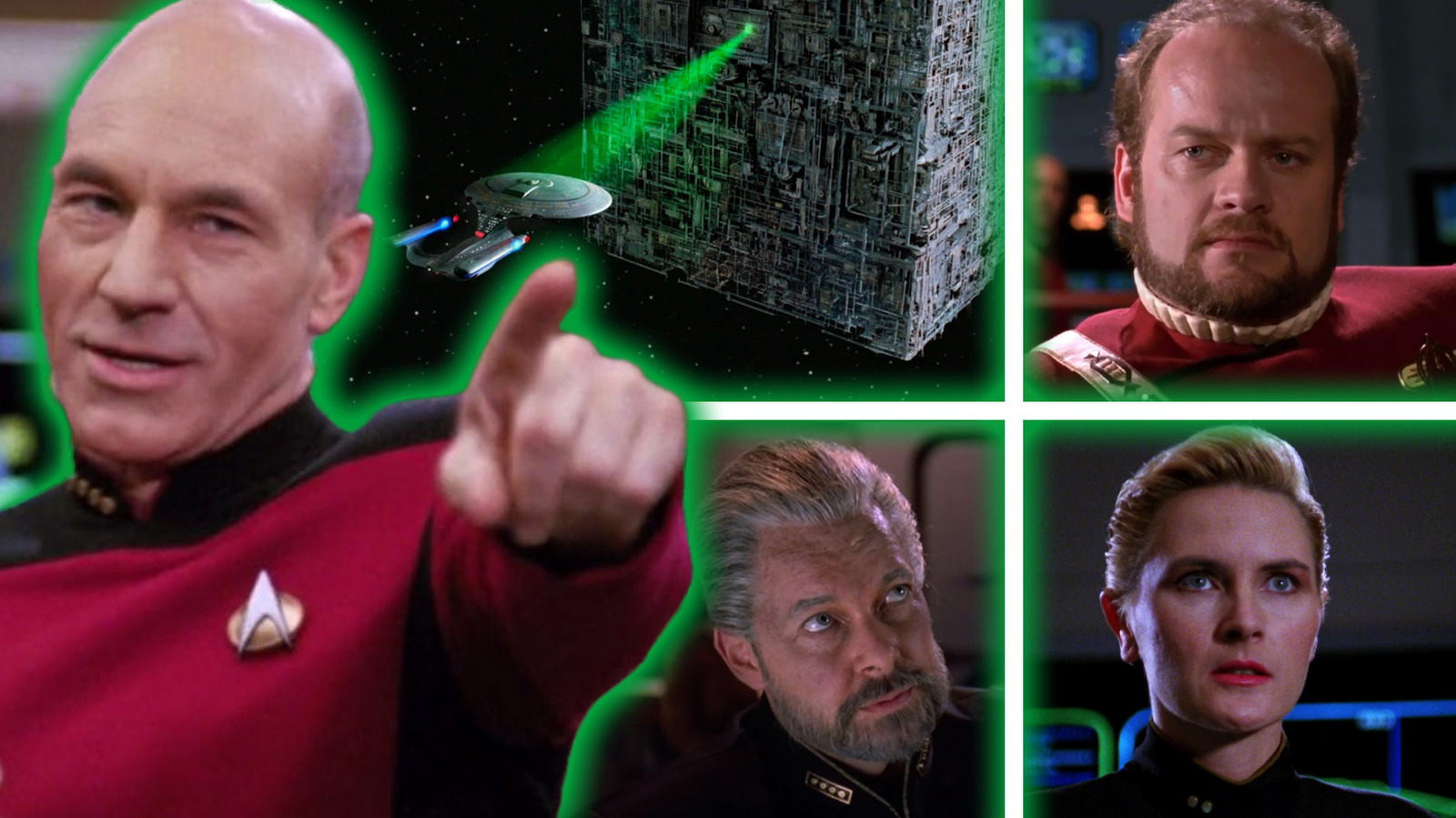
The “Star Trek” franchise got its first television revival with 1987’s “Star Trek: The Next Generation,” which ran for seven seasons until 1994. More than just modernizing the science fiction property for contemporary audiences, the series redefined what “Star Trek” could be while telling both familiar and daring stories within the fan-favorite world. The series centers on Captain Jean-Luc Picard (Patrick Stewart) who commands the USS Enterprise-D approximately a century after “Star Trek: The Original Series.” The show spawned several spin-off series and its own set of continuation movies in the overall franchise.
With over 170 episodes, there are just some stories across the series’ history that stand out especially well for fans to revisit. To be clear, we’re not talking about the best “Star Trek: The Next Generation” episodes this time around. Overall quality isn’t always a guarantee for rewatchability, with some excellent episodes so searing that they’re best kept to limited repeat viewings.
With all that in mind, here are the 10 most rewatchable episodes of “Star Trek: The Next Generation.”
Q Who
The omnipotent Q (John de Lancie) is one of the most powerful “Star Trek” characters, often bending the rules of reality to bring mischief to the Enterprise. One Q story that’s deadly serious is the second season episode “Q Who,” with the cosmic demigod whisking the starship to a distant corner of the galaxy. Leaving the Enterprise to their own devices, the ship is shocked to encounter the Borg Collective, a cybernetic race who assimilate organic life into their ranks. Technologically outmatched, the Enterprise tries to retreat to safety but not before the Borg inflict heavy damage to the intrepid starship.
The first full appearance by the Borg does not disappoint, giving us the first “TNG” antagonist that cannot be outwitted, overpowered, or negotiated with. There is a growing sense of menace in introducing the Borg, culminating in the episode’s climactic chase that remains an exciting watch. “Q Who” also features several memorable conversation-driven scenes, from Picard’s interactions with Q to a warning from the ship’s bartender Guinan (Whoopi Goldberg). One of Q’s best moments from across the franchise, “Q Who” highlights the character’s complicated relationship with Picard while bringing in one of the greatest “Star Trek” villains.
Yesterday’s Enterprise
Another story with a pivotal appearance by Guinan, the third season episode “Yesterday’s Enterprise” is a time-bending tale and a highlight of the series. The Enterprise finds a temporal rift from which the long-missing Enterprise-C emerges, significantly altering history and creating a divergent timeline. Only Guinan is aware of the changes to reality around her and looks for a way to restore the timeline. However, with the Klingon Empire being enemies of the Federation in this reality, the two Enterprises will have to act fast before this timeline becomes permanent.
“Yesterday’s Enterprise” is one of the best “Star Trek” time travel episodes, regardless of series, and holds up with repeating viewings. Seeing the late Tasha Yar (Denise Crosby) back in action on the Enterprise is always a treat, particularly when the character realizes her true tragic fate. The episode also provides an intriguing alternate reality compared to the familiar timeline and a subtly fresh perspective on ship and its crew. An action-packed time travel story that sees two Enterprises team up to save history, “Yesterday’s Enterprise” showcases “TNG” firing on all cylinders.
The Best of Both Worlds
The threat of the Borg comes back in a big way for the third season finale “The Best of Both Worlds,” ending on a memorable cliffhanger. As the Borg invade Federation space, assimilating anyone in their way, the Enterprise moves to intercept them and stop their rampage. Meanwhile, Commander Will Riker (Jonathan Frakes) contemplates his place in Starfleet, turning down the opportunity to captain a smaller starship in favor of staying on the Enterprise. Riker is thrust into a command position when Picard is captured and assimilated as the Borg obliterate any opposition on their way to Earth.
Really, both installments of “The Best of Both Worlds” belong in tandem on this list, though the first half of this two-parter is the better episode of the two. The episode brings the most cinematic-level of action that “TNG” ever saw while offering a personal story for Riker. Even in repeat viewings, the sight of Picard as the Borg drone Locutus is a chilling sight and one of the most iconic images in the series. The best “Star Trek” Borg story, “The Best of Both Worlds” still packs a punch, from the clinical ferocity of the Borg to the unforgettable ending to its first half.
Family
Sort of an epilogue to “The Best of Both Worlds,” the fourth season episode “Family” focuses on Picard recuperating from his Borg assimilation back at his family vineyard in France. This involves him reconnecting with his estranged older brother Robert (Jeremy Kemp), who runs the vineyard with his family. The siblings’ heated interaction forces Picard to come to terms with his trauma as the brothers finally reconcile and Picard decides to resume his command. In the meantime, Wesley Crusher (Wil Wheaton) discovers a message recorded by his late father Jack (Doug Wert) when Wesley was just an infant.
Reportedly, Gene Roddenberry hated the episode “Family” and its prominent depiction of familial strife between Jean-Luc and Robert Picard. All due respect to the “Star Trek” creator, but the episode is one of the finest character-centric stories in the series and finally offers a glimpse behind Picard’s stoic facade. Wesley’s subplot is also a highlight for the character and provides Wheaton with one of his best performances in the role. A well-earned and executed dramatic piece after the bombastic spectacle of “The Best of Both Worlds,” “Family” is perfect for fans of more dramatically oriented “Star Trek.”
The Wounded
The fourth season of “TNG” introduced a new major antagonistic presence in the Cardassian Union, who fought an unseen war against the Federation years before the series. The Cardassians debut in “The Wounded,” which sees respected Starfleet officer Benjamin Maxwell (Bob Gunton) go rogue and start attacking Cardassians ships. When Maxwell refuses to surrender to the Enterprise, Picard implores that his crewmate Miles O’Brien (Colm Meaney) try to convince his former commander to stand down peacefully. Adding intrigue and tension to the incident is that Maxwell’s suspicions about the Cardassians’ military build-up around Federation territory have strong supporting evidence.
More than just providing the Cardassians with their memorable introduction, “The Wounded” is a fantastic thriller fueled by paranoia and political intrigue. Picard is doing his best to maintain a fragile peace, but there is a bigger, more complicated game at play that’s fascinating to see unfold. The story is written by the late legendary “Star Trek” writer Jeri Taylor and is an essential episode from her prolific work with the franchise. A lot of the moral ambiguity that would be built up in “Star Trek: Deep Space Nine” took root in “The Wounded” and the episode is a tautly delivered tale.
Darmok
Largely thanks to Patrick Stewart’s appropriately commanding performance, Jean-Luc Picard anchors a lot of the best episodes in “The Next Generation.” A prime example is the fifth season episode “Darmok,” which opens with Picard trapped on a planet with a Tamarian individual named Dathon (Paul Winfield). As Tamarians speak in allegorical phrases, the universal translator proves largely worthless in communicating with Dathon as the two are forced to work together against a ravenous predator. Along the way, Picard learns how to communicate with Dathon as the two bond against a common threat.
“Darmok” features one of the most inventive concepts for the series with the unique structure of the Tamarian language. Seeing Picard realize how to use this linguistic model to work with Dathon is as much a joy to the audience as it is to him. A lot of that comes down to the survivalist rapport between the two characters, even as their shared trial takes a lethal turn. Another character-focused story with more personal stakes, “Darmok” demonstrates “The Next Generation” really thinking outside of the narrative box.
Cause and Effect
“The Next Generation” was particularly adept at employing time travel elements into its various stories, notably including the fifth season episode “Cause and Effect.” The Enterprise finds itself caught in a temporal loop with the time-displaced starship, the USS Bozeman, with both ships perpetually colliding and exploding. Each destruction results in the loop being reset, though the characters begin to develop a mounting sense of deja vu as they notice events repeating themselves. The crew must find a way to warn themselves of their impending annihilation to break the cycle and free themselves from the loop.
In addition to featuring Kelsey Grammer’s “Star Trek” cameo, “Cause and Effect” offers a sort of puzzle box for the characters to solve. The episode has an intentionally disorienting quality to it, with viewers continually experiencing the same broad beats as the crew building to an explosive climax. Repeat viewing is the entire crux of the episode’s premise and one that’s carefully staged as the characters relive the story’s events. One of the best “Star Trek” time travel episodes, “Cause and Effect” presents a temporal trap that’s a delight to watch over and over again.
The Inner Light
Another more intimately scaled story is the fifth season tale “The Inner Light,” Patrick Stewart’s favorite episode and a “TNG” classic. The ship encounters an ancient probe which beams a signal into Picard’s mind, leaving him completely incapacitated for several minutes. Within that time, Picard lives the life of a man named Kamin from a star system that’s long since been consumed by a nova. Across this timespan, Picard has and raises a family with Kamin’s wife Eline (Margot Rose) and enters his twilight years before realizing the purpose of the probe.
“The Inner Light” is sweet and sentimental, with Picard getting to experience a lifetime over the span of the episode. With that premise in mind, “Star Trek” doesn’t get much more slice-of-life than that, albeit it just happens to be somebody else’s life that Picard inhabits. Despite the relatively low stakes, the story has a profound quality and one that only seems to appreciate with each viewing. A philosophical “Star Trek” episode that leaves viewers thinking, “The Inner Light” is an enduring showcase of the franchise’s sci-fi potential.
Chain of Command
The Cardassian plot thread established in “The Wounded” gets revisited in a big way in the sixth season two-parter “Chain of Command.” While Picard leads a small covert mission to destroy a Cardassian weapons installation, Captain Edward Jellico (Ronny Cox) takes interim command of the Enterprise. Riker bristles against Jellico’s vastly different command style while Picard is captured by a Cardassian ambush and tortured by the cruel Gul Madred (David Warner). Learning about Picard’s fate, Jellico and Riker are forced to work together to defuse the situation and secure the release of the imprisoned captain.
Like “The Best of Both Worlds,” we’re going to lump both installments of “Chain of Command” together, though, in this case, the second episode is the better of the two. While Cox’s performance as Jellico is a welcome change of pace, the real highlight is Stewart and Warner’s opposing dynamic. Testing his true mettle with diminishing hope of escape, “Chain of Command” stands as one of the best Jean-Luc Picard episodes. As far as rewatchability, we could watch Picard shout “there are four lights” on repeat for hours.
All Good Things…
Just as “The Next Generation” began with a challenge from Q for Picard to prove humanity’s worth, so too does it end with the same challenge. The finale “All Good Things…” has Q plunging Picard into different eras of his life – the present, when he took command of the Enterprise, and after he settles into retirement. In all three time periods, Picard is faced with a spatial anomaly which has the destructive potential to wipe out humanity. Picard must think simultaneously between these contrasting eras to figure out how to stop the anomaly from growing dangerously unstable.
The perfect closing bookend to the series, “All Good Things…” is the best “Star Trek” series finale to date. The episode revisits the show’s earliest days while offering audiences a glimpse into its possible future, including how the passage of time may impact the character dynamics. The story also provides a satisfying time-bending challenge for Picard and capitalizes on his complex rapport with Q. The most rewatchable series finale in the franchise, “All Good Things…” is a beautiful coda and one that can be viewed regularly on its own merits.






Leave a Reply