


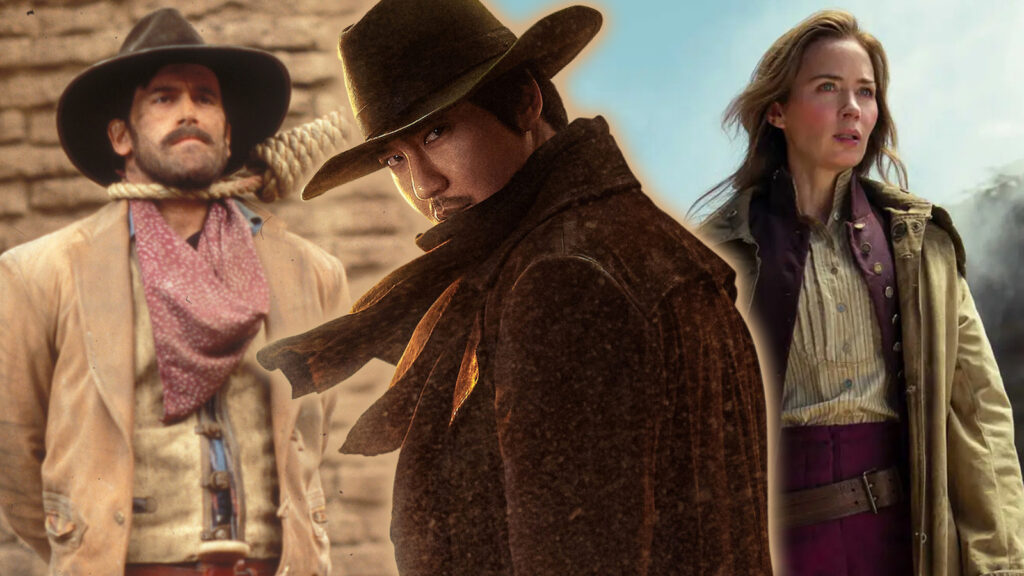

Westerns used to be the staple genre on American television for decades with long-running series like “Gunsmoke” and “Bonanza.” Though the genre doesn’t have the widespread ubiquity it once enjoyed, prolific television creator Taylor Sheridan has spurred a resurgence with his line of shows. With so many great Western shows around, it’s only inevitable that some series are going to fall through the cracks. There are countless overlooked Western television series that are overshadowed by their more popular and enduring counterparts still are still generally recognized.
After taking a look at the best Western TV shows ever, we’re going to focus on shows that need wider appreciation. These are series that may have been successful during their original run but didn’t have the cultural staying power as some of their contemporaries. In other cases, we’re including shows that didn’t get much recognition at all, either only receiving a brief run or international productions overlooked in North America.
Here are 10 underrated Western TV shows everyone needs to watch at least once, especially if they’re fans of the genre.
Have Gun – Will Travel
One pivotal ’50s Western that hasn’t gotten the appreciative reevaluation it deserves by modern audiences is “Have Gun – Will Travel.” Starting in 1957, the show follows a gentleman gunslinger, known simply as Paladin (Richard Boone), who takes on jobs along the frontier. More than just being a quick-draw gunfighter, Paladin can speak several languages, is knowledgeable in martial arts, and is an expert card player. Usually dressed in all black, Paladin puts his myriad of skills to good use, saving the day with a more sophisticated air than his bucolic contemporaries.
“Have Gun – Will Travel” brought a level of class to the Western genre on television unseen elsewhere, aided by robust writing. The show was slickly filmed and boasted one of the most stylish opening credit sequences of its time, regardless of genre. Looking back, the series didn’t have the longevity of “Gunsmoke” and “Bonanza” or the breakout talent of “Wanted: Dead or Alive,” “Maverick,” and “Rawhide” to stand out. But for a consistently stellar Western show that largely maintained its quality across six seasons with a fresh angle on familiar tropes, “Have Gun – Will Travel” delivered.
The Westerner
Before directing some of the best Westerns of the 1970s, filmmaker Sam Peckinpah created the 1960 television series “The Westerner.” The show follows Dave Blassingame (Brian Keith), a drifter wandering the frontier trying to gather up enough money to purchase his own ranch. Blassingame finds that his skills as a gunfighter and brawler are the talents that frequently come in the most handy in the unpredictable westward expanse. Blassingame often finds himself at the center of violent misunderstandings, trying to avoid violence and come about his payments honestly, despite his brutal skillset.
Only running for 13 episodes before its cancellation, much of Peckinpah’s creative sensibilities can be seen throughout “The Westerner.” Rather than featuring dashing heroes and clearly established moral lines, the show’s stories were often darker and more cynical than its contemporaries. Peckinpah would direct six of the series’ episodes and write or co-write four of them, highlighting his preference to tell more grounded and gritty Western stories. An overlooked early work from the firebrand filmmaker, “The Westerner” stands out considerably from other shows of its era.
The High Chaparral
David Dortort, who previously created the long-running Western “Bonanza” in 1959, offered a very different kind of Wild West family story with “The High Chaparral.” Premiering in 1967 on NBC, the series is named after a family ranch in the Arizona Territory in the 1870s. Middle-aged widower John Cannon (Leif Erickson) runs the ranch with his brother and son, marrying a neighboring rancher’s daughter, Victoria (Linda Cristal) in a marriage of convenience. Despite the couple’s age difference, they come to truly love each other as they defend the ranch from hostile indigenous tribes and other threats to their home.
Running for four seasons, “The High Chaparral” wasn’t unsuccessful but certainly didn’t boast the longevity of Dortort’s “Bonanza.” The show deserves more attention from modern audiences, with surprisingly sophisticated writing highlighting the blended family premise. But more than just the period piece drama, the series did feature a steady dose of action, often handled by Cannon’s fiery younger brother Buck (Cameron Mitchell). Overlooked by many genre fans today, “The High Chaparral” marks the medium growing more narratively rich within the familiar confines of a Western.
Nichols
James Garner’s acting career had taken off thanks to his starring role in the ’50s Western television series “Maverick.” As the genre’s popularity began to wane in the ’70s, he returned to television for the similarly mononymously titled 1971 show “Nichols.” Garner starred as Frank Nichols, an army veteran who returns to his frontier hometown in 1914 only to find his family’s fortunes squandered, reluctantly becoming the town’s sheriff. Given the rapidly changing times, Nichols prefers riding motorcycles and cars to horseback and detests resorting to violence to get his job done.
“Nichols” wisely capitalizes heavily on Garner’s wry charm, but unfortunately, this didn’t help the show connect with contemporary audiences. The offbeat Western series was cancelled after a single season, inadvertently paving the way for Garner to find greater success starring in “The Rockford Files” two years later. But “Nichols” lays a lot of the foundation for Garner’s modern detective, subverting genre expectations including an abhorrence of gunplay. A showcase of Garner’s talents and a welcome return for him to the realm of television Westerns, “Nichols” definitely deserved better than its brief run.
The Adventures of Brisco County, Jr.
After starring in the original “Evil Dead” trilogy, fan-favorite actor Bruce Campbell starred in the sci-fi Western “The Adventures of Brisco County, Jr.” Set in the 1890s, Brisco County, Jr. (Campbell) is the Harvard-educated protagonist who decided to shift his career towards bounty hunting. After his father (R. Lee Emery) is murdered, Brisco sets out to find the outlaw gang responsible while investigating phenomena surrounding a mysterious artifact known as the Orb. Apart from paranormal activity fueled by the Orb, Brisco deals with other weird science and technological advancements as the new century and widespread industrialization approaches.
With everything from steampunk technology to the overtly supernatural elements, “The Adventures of Brisco County, Jr.” uses its Wild West canvas to blend disparate genres together. At the same time, the series incorporates plenty of classic Western tropes into its stories, from bar brawls and shootouts to train robberies and marauding outlaws. This is all anchored by Campbell’s considerable charm, with the show wisely leaning into his naturally charismatic persona. Though it only ran for a single season, “The Adventures of Brisco County, Jr.” is a fun-filled genre blend.
The Magnificent Seven
The 1960 film “The Magnificent Seven” proved that anything could be a Western by masterfully reimagining Akira Kurosawa’s 1954 classic “Seven Samurai.” The Western’s broad premise was expanded into a 1998 television series “The Magnificent Seven,” running for two seasons on CBS. The show has gunfighter Chris Larabee (Michael Biehn) recruit six other men to join him in defending vulnerable communities across the lawless Wild West. Each of the group have their own backstories and motives driving them to take up arms for justice explored throughout the series.
Led by Biehn, “The Magnificent Seven” has a solidly assembled main cast, including fan-favorite actor Ron Perlman as a guilt-ridden preacher in the gunslinger group. With its two-season scope, the show draws its inspiration not only from the 1960 movie but its underrated line of sequels while putting its own twist on the archetypes. The genre action is well-executed and its attention to detail in bringing its period piece setting to life is meticulously done. Another short-lived and overlooked ’90s Western series, “The Magnificent Seven” is an inspired retelling of the classic story.
Godless
Filmmaker Scott Frank crafted the epic Netflix Western “Godless,” serving as the writer, director, and executive producer for the 2017 limited series. The story follows fugitive outlaw Roy Goode (Jack O’Connell), who flees from his merciless gang leader Frank Griffin (Jeff Daniels) with a stash of stolen loot. Roy seeks refuge in the New Mexico town of La Belle, which saw most of its male population killed in a horrific mining accident. With Griffin and his bloodthirsty gang in hot pursuit, this sets up the community for a fierce showdown to survive the notorious outlaw’s wrath.
“Godless” provides an overdue predominantly female perspective on the Wild West, led by a magnetic performance from Michelle Dockery. Daniels also offers a strong performance playing against type as a hardened killer, conveying a more subdued menace until violence inevitably erupts. In filming the show, Frank provides his series with a beautifully sweeping backdrop, capturing the scenic landscapes in between the gunslinging mayhem. A solid Western tale that hasn’t gotten much appreciation beyond its initial release, “Godless” ranks among the best Netflix limited series.
That Dirty Black Bag
Ever since the 1960s, spaghetti Westerns have been an important sub-genre, with European filmmakers offering their own vision of the Wild West. The spirit of the spaghetti Western is alive and well in the 2022 AMC+ series “That Dirty Black Bag.” The show gets its title from bounty hunter Red Hill (Douglas Booth), who beheads his targets, transporting their heads in a black bag to collect upon delivery. Arriving in the violent frontier town of Greenvale, Hill becomes targeted by its corrupt sheriff Arthur McCoy (Dominic Cooper).
With plenty of gratuitous violence and sex, “That Dirty Black Bag” leans into the more salacious and brutal sides of the genre. The series revolves around the complicated dynamic between Hill and McCoy but also expands its scope on the community in and around Greenvale at large. In keeping with the spaghetti Western tradition, there is a stylish flair to the series that helps set it apart. Seamlessly bringing the sub-genre’s sensibilities to modern television, “That Dirty Black Bag” is a lot of sanguine fun.
The English
The Wild West gets a British perspective with the Prime Video original series “The English,” which premiered in 2022. The show stars Emily Blunt as Lady Cornelia Locke, who arrives at the 1890 American frontier from her native England to search for those responsible for killing her son. Locke convinces a Pawnee scout named Eli Whipp (Chaske Spencer) to accompany her to Wyoming as part of her hunt for vengeance. As they two travel together to carry out the vendetta, they discover that they have a shared history as truth behind their respectively painful backstories are revealed.
“The English” didn’t get a lot of buzz when it debuted, though it did receive widespread critical acclaim. Blunt gives a career-defining performance in the underrated Western, capturing all the complicated nuance and intimate secrets to Locke under the surface. She’s matched by Spencer playing a character who’s been wronged all of his life, but endures and fights for his own measure of justice. A revenge tale that proves to be much more complex than it appears on the surface, “The English” is a solid one-and-done Western story.
Song of the Bandits
While South Korea may not seem like the first setting for a Western that comes to mind, the 2023 Netflix series “Song of the Bandits” makes that juxtaposition work beautifully. The show is set during the brutal Japanese occupation of Korea in the 1920s, with Korean refugees fleeing to the Gando region of China. Korean-born former Japanese soldier Lee Yoon (Kim Nam-gil) moves to defend the refugees from both the Japanese military and other bandits exploiting them. Lee leads his band of resistance fighters against enemies throughout the Gando region, putting his gunslinging and close-combat skills to lethal use.
Despite its East Asian setting, “Song of the Bandits” still provides all the usual genre thrills, including train heists and plenty of dusty gunplay. This is escalated by the added stakes on the story’s main characters being freedom fighters, taking on an entire army and giving the narrative a defiant underdog quality. In between the bloody action, the show is a redemption tale, with Lee Yoon looking to atone for the sins he committed while taking up arms against his own country. An overlooked K-drama is one of Netflix’s best Westerns, with “Song of the Bandits” expanding what the genre can be.