
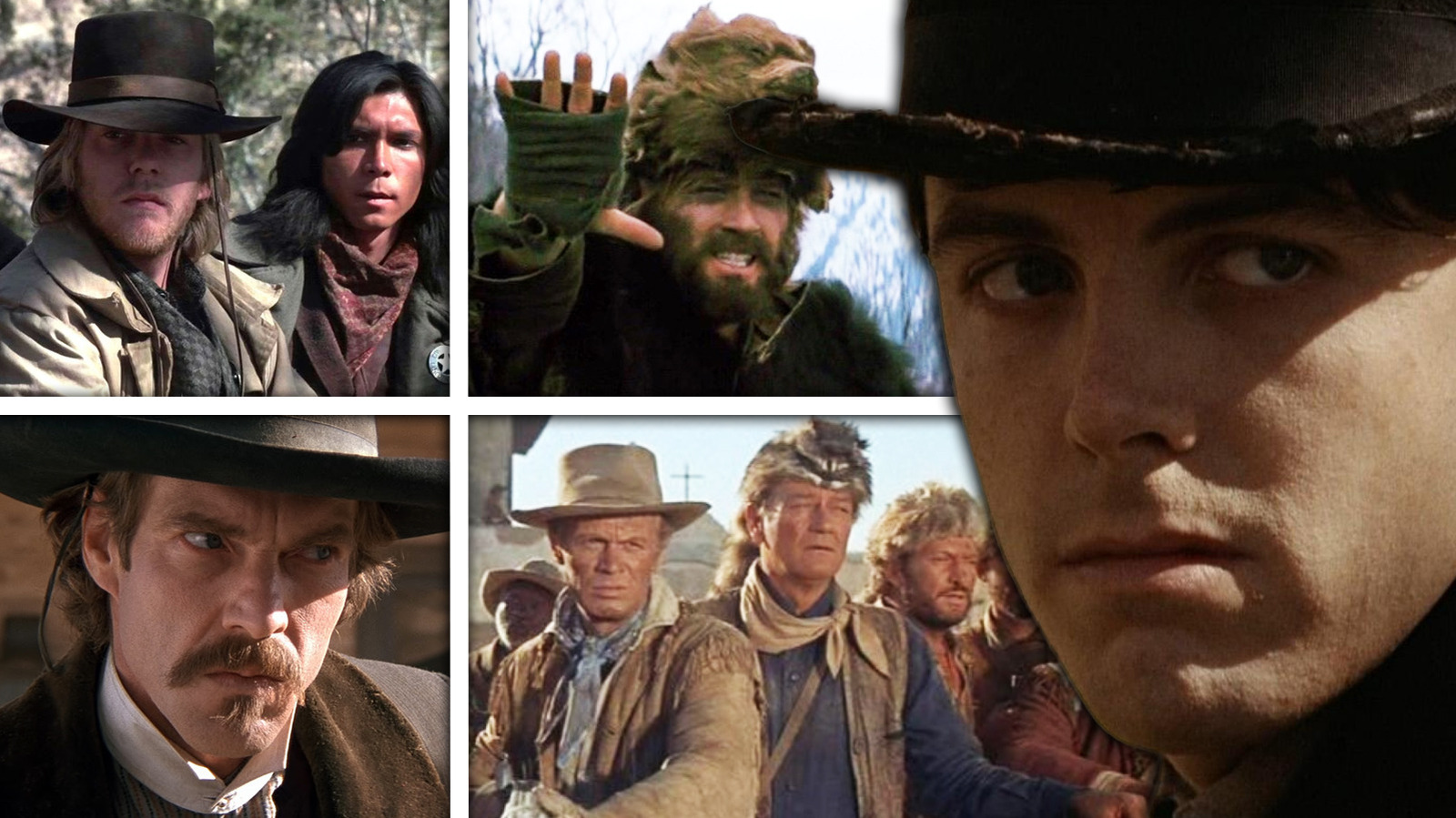
While the Western genre and its archetypes generally evoke an iconic era in American history, many movies produced for it are works of pure fiction. The Wild West setting provides a richly atmospheric backdrop that films have been taking full advantage of since the earliest days of the medium. That said, there are also a number of memorable Westerns that are, at least partially, based on true stories. Recounting the exploits of actual historical figures and events, these movies are often heavily fictionalized compared to the factual accounts, but they’re still thoroughly entertaining.
Some of the best Western movies of all time are at least nominal depictions of true stories, always with a degree of creative license taken in the execution. These can range from more heroic depictions of the historical figures featured in a given movie or subversion of genre tropes to benefit contemporary audiences. Either way, the movies included here are each entertaining in their own right, no matter how many creative liberties they each take with the historical material.
Here are 12 Westerns that are based on true stories, adding an intriguing wrinkle to the narrative.
They Died with Their Boots On
One of the last major on-screen collaborations between Errol Flynn and Olivia de Havilland was the 1941 biopic “They Died with Their Boots On.” The movie chronicles the life of George Armstrong Custer (Flynn), starting with his arrival at West Point military academy. Custer’s school commitments and subsequent military service during the American Civil War fighting for the Union disrupts his courtship and marriage to Libbie Bacon (de Havilland), but their love perseveres. This is all upended when Custer is assigned to the Dakota Territory, where he finds the cavalry in disarray and the indigenous population growing increasingly hostile after constant exploitation.
To be sure, “They Died with Their Boots On” is a heavily fictionalized depiction of Custer’s life and times. As per the era and genre, Custer is portrayed in an exceedingly positive light, overlooking many of his flaws and questionable acts. But the audience forgives these clear shortcomings in historical accuracy because of Flynn’s considerable charisma and enduring chemistry with de Havilland. One of the best American Civil War movies, “They Died with Their Boots On” explores one of history’s more divisive generals.
The Alamo (1960)
The 1836 Battle of the Alamo is a historical event that has long since passed into Texan legend as inspired movie depictions since, at least, 1911’s “The Immortal Alamo.” The most lavish Hollywood production of the pivotal battle is 1960’s “The Alamo,” a longtime passion project of John Wayne. In addition to starring as frontiersman Davy Crockett, Wayne directed and produced the movie, chronicling the siege of the San Antonio mission by the Mexican army. This culminates in a grueling battle where the defenders are shown no quarter as they buy time for the larger Texan independence army to regroup.
More inspired by John Wayne’s lingering guilt in not serving in World War II than historical accuracy, “The Alamo” is a sweeping epic that heavily romanticizes the siege and battle. The movie is also surprisingly graphic for its time, as its defenders are gruesomely skewered as they’re overwhelmed, likely catching contemporary audiences off-guard. There would be subsequent movie depictions of the Battle of the Alamo, including a 2004 film also simply titled “The Alamo.” But Wayne’s bloated blockbuster remains the most well-known Hollywood take on the event over 65 years later even if it gets its facts wrong.
Butch Cassidy and the Sundance Kid
1969’s “Butch Cassidy and the Sundance Kid” follows the final days of the titular Wild West outlaws as a cozy revisionist take on the genre. As Butch (Paul Newman) and Sundance (Robert Redford) carry out lucrative heists, they both become wanted men as their notoriety spreads. Pursued relentlessly by a posse hired by a railroad company to bring them in dead or alive, the duo relocate to Bolivia. Resuming their criminal activities in South America, the two robbers discover new challenges in staying one step ahead of law.
There were challenges in convincing studios to produce “Butch Cassidy and the Sundance Kid,” precisely because of the historical story. On the surface, it is a story about outlaws constantly fleeing for their lives, rarely taking a stand for a blazing gunfight. But the movie doesn’t depict its eponymous characters as cowards but rebellious counter-culture figures defying faceless and overbearing authority. A charming collaboration between Newman, Redford, and director George Roy Hill, “Butch Cassidy and the Sundance Kid” a pleasantly gentle subversion of the genre.
Chisum
The Lincoln County War of 1878 saw several rival businessmen and their hired gunmen fight for commercial control of the New Mexico Territory. This incident serves as the basis for the 1970 movie “Chisum,” named for prominent participant John Chisum, a cattle rancher who became involved. John Wayne stars as Chisum, whose livelihood is threatened when land baron Lawrence Murphy (Forrest Tucker) begins forcibly buying up land, intimidating and killing those in his way. With local law enforcement secretly backing Murphy, Chisum is joined by Pat Garrett (Glenn Corbett) and Billy the Kid (Geoffrey Deuel) to stop the power grab and restore order.
“Chisum” features plenty of historical figures from throughout the Lincoln County War, though it reimagines many of their respective roles in the conflict. The movie’s younger cast shines particularly well, especially in its efforts to humanize Billy the Kid and illustrate his friendship with Pat Garrett. Contrasting this is Wayne’s Chisum, a more paternal and gentler figure than other gunfighters he’s played, while still bringing the action. An underrated John Wayne movie worth watching, “Chisum” fits right within the actor’s usual comfort zone.
Jeremiah Johnson
Another classic Western with Robert Redford, 1972’s “Jeremiah Johnson” loosely covers the legend of its titular real-life 19th century mountain man. With Redford playing the title role, Johnson settles in the Rocky Mountains to become a trapper in the wilderness. As other settlers move westward ignoring local customs, they incur the wrath of the indigenous populations, with Johnson caught in the middle. After losing his found family, Jeremiah launches a bloody vendetta against those responsible, cementing his legend as a solitary figure not to be trifled with.
“Jeremiah Johnson” is one of James Gunn’s favorite Robert Redford movies, and the prolific superhero filmmaker certainly has good taste. Given the premise, Redford has to do much of the movie’s heavy lifting by himself on-screen, often without saying a single word. This underscores the inherent tragedy of Johnson’s ordeal and lonely life, essentially severing his connection with humanity to maintain his existence in the wilderness. A revenge Western with a magnetic lead performance, “Jeremiah Johnson” ranks among Robert Redford’s best movies.
Heaven’s Gate
The Johnson County War in Wyoming during the late 19th century serves as the loose basis for 1980’s “Heaven’s Gate.” The movie follows Harvard graduate James Averill (Kris Kristofferson) as he arrives in Wyoming while tensions erupt between impoverished European settlers and the local cattle barons. As the businessmen employ increasingly vicious methods to intimidate and kill the settlers and those assisting them, Averill and his friend Nate Champion (Christopher Walken) take a stand. This escalates into a full-blown turf war, with no one escaping from the bitter conflict unscathed.
“Heaven’s Gate” became an infamous box office bomb that nearly killed the Western genre, at least as far as major studio productions were concerned. In weaving his Western epic, filmmaker Michael Cimino drew broadly from the Johnson County War, including naming his story’s main characters after historical figures in the conflict. However, the characters’ roles in the incident deviated significantly from actual historical accounts to suit Cimino’s vision. Though it killed one of Hollywood’s most iconic studios, “Heaven’s Gate” has seen its reputation improve gradually over time as an under-appreciated, if historically flawed, masterpiece.
Death Hunt
Notorious trapper Albert Johnson is the subject of a fictionalized take on the figure in 1981’s “Death Hunt.” Charles Bronson stars as Johnson who, after defending himself from rival trappers in the Yukon in the 1930s, becomes a wanted man. Authorities suspect Johnson of being the Mad Trapper, a serial killer in the area murdering other trappers for their gold teeth. As Johnson stays one step ahead of his pursuers, the true Mad Trapper reveals himself during the exhaustive manhunt.
There’s something innately appealing about the on-screen pairing of Bronson and co-star Lee Marvin, dating back to their work together in 1967’s “The Dirty Dozen.” Their mutually gruff demeanors complement each other well in “Death Hunt,” with their respective characters two sides of the same coin. The movie makes Johnson to be more sympathetic than his historical counterpart, attributing his murderous reputation to a different character in the film. Regardless of its historical accuracy, “Death Hunt” stands as one of the best Charles Bronson movies, leaning into his no-nonsense tough guy image.
Young Guns
A more modern and stylized take on the Lincoln County War is 1988’s “Young Guns,” starring Emilio Estevez as Billy the Kid. The movie opens with Billy being recruited by rancher John Tunstall (Terence Stamp), joining his group of wayward young men known as the Regulators. After Tunstall is killed under orders from rival businessman Lawrence Murphy (Jack Palance), Billy and the Regulators go on a reckless vendetta to avenge their mentor. This leads large bounties to be placed on their heads as Billy grows obsessed with exposing Murphy’s corruption and villainy.
Like “Chisum” before it, “Young Guns” takes a lot of creative liberties with its depiction of the Lincoln County War. These changes include significantly aging Tunstall to be a middle-aged man, added love interests, and a heightened portrayal of the violence, including a different fate for Murphy. Audiences didn’t mind these deviations, with the movie getting a sequel in 1990 and a third “Young Guns” movie apparently in the works. More of a showcase for its young cast than delivering a history lesson, “Young Guns” is a must-watch for big Brat Pack fans.
Tombstone
Another Wild West historical event that’s been thoroughly mythologized is the 1881 gunfight at the O.K. Corral in Tombstone, Arizona. The fateful duel between the Earp brothers and Doc Holliday against the Cowboy gang has been depicted in television and film for decades. This includes 1993’s “Tombstone,” which details the marauding gang’s villainy as Wyatt Earp (Kurt Russell) and his brothers move to Arizona. The feud between the two groups only escalates after the gunfight, with Wyatt launching a revenge-fueled ride when his brothers are ambushed by the outlaws.
“Tombstone” marks legend passing into cinema in an enduring way that no other depiction of the gunfight has before or since. Like many other adaptations of the event, the movie plays fast and loose with the facts, but keeps things entertaining. More than shaping cultural perception of the event, Kurt Russell claims “Tombstone” is one of the most quotable Westerns ever, which is hard to deny. One of the most memorable Westerns of all time, “Tombstone” remains a fun ride through history being turned to myth.
Wyatt Earp
It’s hard to talk about “Tombstone” without also mentioning the 1994 biopic “Wyatt Earp,” directed, produced, and starring Kevin Costner as the titular lawman. This version of the story takes a much more focused look on Wyatt, starting with his teenage years and the circumstances that ultimately drive him to Arizona. The Earps’ feud with the Cowboys, of course, is retained, with Wyatt joined by his longtime friend and fellow gunfighter Doc Holliday (Dennis Quaid). The movie also delves more deeply into Wyatt’s personal life, including the tumultuous romances that he formed leading up to his bloody feud.
Kevin Costner almost killed “Tombstone” before production could even begin to make way for his own Wyatt Earp story. Comparatively, “Wyatt Earp” is a much more grounded take on the story and presented across a considerably more grandiose runtime. Dennis Quaid attributed the latter point in causing “Wyatt Earp” to flop, but the entire film is a generally more pretentious affair overall. A full portrait of its eponymous subject’s life, “Wyatt Earp” is self-indulgent but definitely doesn’t leave any stones unturned.
The Assassination of Jesse James by the Coward Robert Ford
Another real-life outlaw that’s gotten pop culture attention is Jesse James, including in the 1983 novel “The Assassination of Jesse James by the Coward Robert Ford” by Ron Hansen. The book was adapted into a movie of the same name in 2007, with Brad Pitt playing James and Casey Affleck playing Ford. In the beginning of the movie, Ford idolizes James and hopes to join his gang, becoming involved in their criminal activities. However, the more time that Ford spends with his outlaw hero, the more disillusioned and resentful he becomes of him, eventually agreeing to help bring him in dead or alive.
Warner Bros. thought “The Assassination of Jesse James by the Coward Robert Ford” was going to be a shoot’em-up, led by Pitt and Affleck at the top of their game. What it is, instead, is a contemplative deconstruction of the genre and the myth-making around Jesse James and his outlaw reputation. The movie’s soft focus cinematography and sprawling landscapes create a more distant and desolate take on Westerns, highlighting its themes. The broad strokes of the history around James’ death are accurate and faithful to Hansen’s novel, albeit more contemplatively executed for this meditative film.
The Revenant (2015)
Michael Punke’s 2002 historical novel “The Revenant,” depicting the exploits of real-life 19th century frontiersman Hugh Glass, was adapted into a movie in 2015. Leonardo DiCaprio plays Glass, with the movie showing him leading a hunting and trapping expedition into the Dakotas in 1823 with his son Hawk (Forrest Goodluck). After the expedition is ambushed by indigenous warriors and Glass is mauled by a bear and left for dead, greedy trapper John Fitzgerald (Tom Hardy) murders Hawk. Clawing himself back from the brink of death, Glass not only moves to escape hostile territory but avenge his son by hunting Fitzgerald.
With “The Revenant” filmed in the snowy wilderness of Canada and Montana, the movie really captures the spirit of the untamed frontier. This is matched by an absolutely grueling performance from DiCaprio, who endures a whole gauntlet in his depiction of Glass. While the broader elements of Glass’ ordeal are inspired from historical accounts, including the addition of a son and revenge element are not. These creative embellishments give the story more of a fiery motivation for Glass to move forward and keep audiences riveted with a clear antagonist to root against.






Leave a Reply