
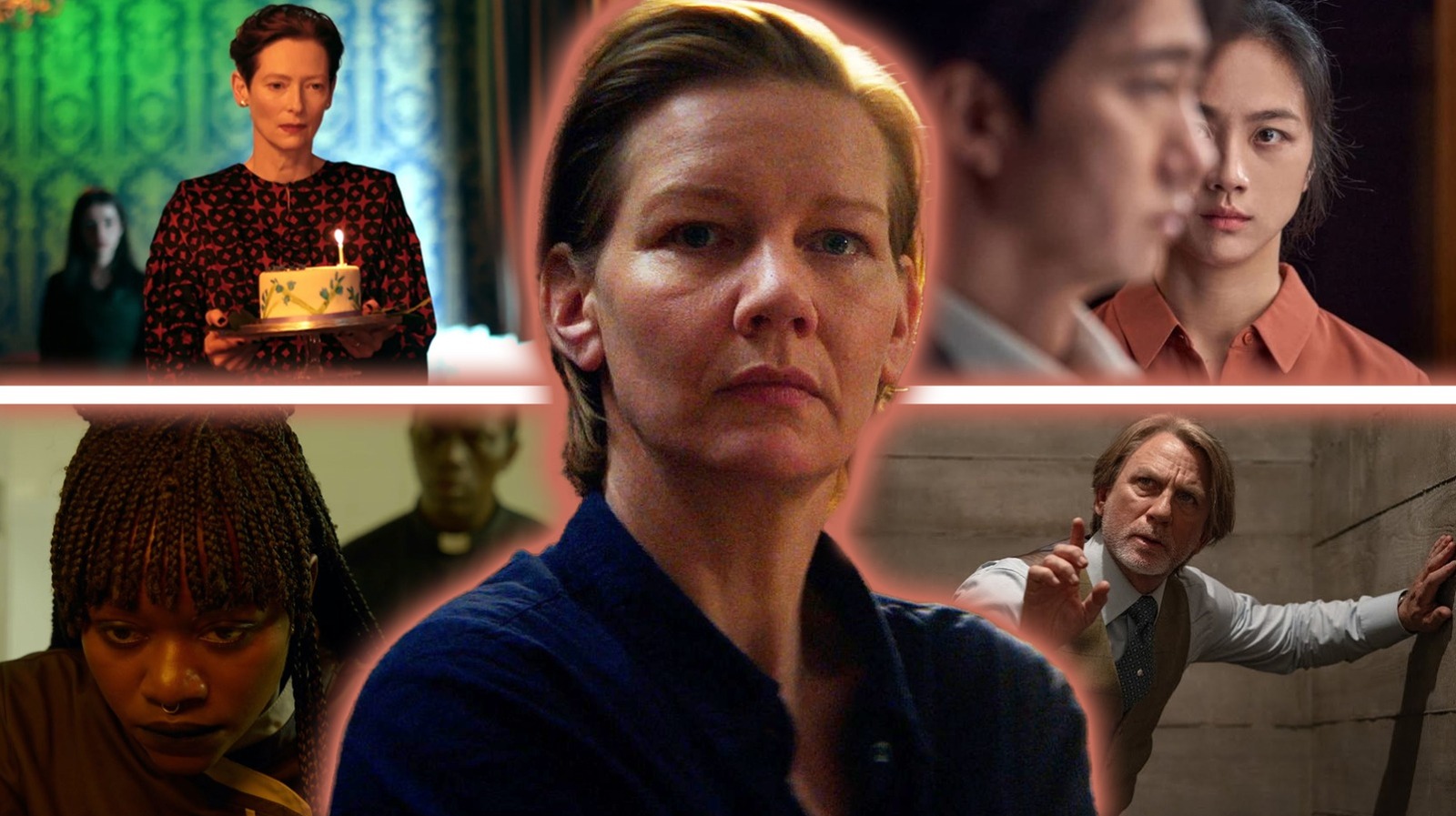
Every movie is a mystery movie, insofar as our enjoyment of movies derives largely from our anticipation of what will happen and what we will be shown next. But there’s something special about the movies that make that tension literal by exploring literal mysteries, incorporating the allure of open questions into the very pull of their storytelling.
The 2020s have been a particularly great decade for mystery cinema; writers and directors of everything from arthouse character pieces to “Sherlock Holmes”-esque whodunits to Disney-produced franchise comedies have been relying greatly on the hypnotic power of engaging the audience’s curiosity and eagerness to know more. This list compiles 15 particularly wonderful mystery movies released in the 2020s so far, with “mystery movie” covering anything where an enigma is presented early on and the expectation of its potential resolution becomes a central pillar of the film’s architecture. In many, if not all cases, we recommend going in with as little foreknowledge as possible.
Anatomy of a Fall
Sandra Voyter (Sandra Hüller) and Samuel Maleski (Samuel Theis) live with their blind 11-year-old son Daniel (Milo Machado-Graner) in a mountain cottage near Grenoble, France. One day, Daniel goes out for a walk with his guide dog, Snoop (played by Oscar standout Messi), and returns to find his father dead on the ground outside the house. Investigations conclude that he fell to his death, but uncertainty remains as to what caused the fall: Was it an accident? Did Samuel die by suicide? Or do the odd forensics of Samuel’s death indicate that Sandra killed him?
Premise-wise, Justine Triet’s “Anatomy of a Fall” doesn’t get more complicated than that: We follow Sandra’s trial and upended family life, and watch as her past, her personality, and even her literary work get dissected before a French jury. But there’s a reason this deceptively simple courtroom drama snagged the Palme d’Or at Cannes and made a killing at the Oscars: Triet superbly uses the gripping rhetorical structure of a murder trial to deconstruct the very nature of truth, communication, and storytelling, roping us right into the morbid fascination and the persistent tragedy of it all. And Hüller is nothing short of spectacular.
Rotting in the Sun
Sebastián Silva (Sebastián Silva) is a depressed filmmaker living in Mexico City, going through a massive existential crisis. During a trip to the gay nudist beach of Zicatela, he meets American actor and social media influencer Jordan Firstman (Jordan Firstman). Unlike Sebastián, Jordan is lively and motivated, and takes their chance encounter as a sign that they should work together. He pitches Sebastián a TV project, and they schedule a meeting in Mexico City. By the time Jordan arrives, however, Sebastián has gone missing.
The details of what unfolds are best kept under wraps; suffice to say that “Rotting in the Sun” is the best kind of deranged — a heaving, lurid, sun-drenched gay take on an Agatha Christie mystery that manages to stay consistently two steps ahead of the viewer. The fact that Silva and Firstman are both playing abrasively outsized versions of themselves gives the movie an additional layer of cheeky misbehavior, allowing Silva (also the film’s director and co-writer) to modulate smartly and unpredictably between engrossing thriller and scathing industry satire without breaking a sweat — offscreen, anyway.
Yana-Wara
In a small Aymara village in the Peruvian Andes, the elderly Don Evaristo (Cecilio Quispe) is being tried by a council of community leaders for the murder of his own teenage daughter, Yana-Wara (Luz Diana Mamani). There’s no mystery, however, as to whether Don Evaristo has committed the act. The real question is about his intentions: Clearly distraught over his actions, Don Evaristo insists that he did it out of mercy. He recounts Yana-Wara’s life story in an effort to persuade the council that she was haunted from birth by the demon Anchanchu, and that death was her only possible escape.
What emerges is a two-pronged story: Both a hair-raising, horror-skirting tale of a life besieged by possibly supernatural tragedy and the depressingly universal story of one girl’s abuse at the hands of an overwhelming patriarchal system. Written and initially directed by up-and-coming Aymara filmmaker Óscar Catacora before his untimely death mid-production, “Yana-Wara” was finished by Óscar’s uncle Tito Catacora. It’s a rich, expansive, ambitious film, in which the whisper of dreadful uncertainty hanging over the plot draws you into even greater and more harrowing questions.
Weapons
One night, in the small suburban town of Maybrook, Pennsylvania, all but one of the eighteen children in the class of third-grade teacher Justine Gandy (Julia Garner) wake up at exactly 2:17 a.m., walk out of their homes, run off into the dark, and seemingly vanish from the face of the Earth. Stricken by confusion, despair, and suspended grief, the town’s parents lash out at Justine, who has no idea what happened. Alex Lilly (Cary Christopher), the only kid who didn’t disappear, refuses to talk to Justine. The police are at a loss for clues.
What the heck is happening? Such is the question that Zach Cregger’s puzzle-box horror flick “Weapons” explores via a brilliantly skewed POV structure, doling out just a little bit of information at a time by switching into the perspectives of several different characters. The resulting film is by turns gripping, hilarious, unbearably suspenseful, outright horrifying, and surprisingly intense, with a mastery of crowd work that made it a massive box office hit for very good reason.
Decision to Leave
Jang Hae-jun (Park Hae-il) is a South Korean police detective who divides his time between his work jurisdiction in Busan and his home in the fictional seaside town of Ipo, where he spends weekends with his wife Jung-an (Lee Jung-hyun). While investigating the death of a retired immigration officer (Yoo Seung-mok) who fell from the top of a mountain during one of his habitual climbs, Hae-jun and his partner Soo-wan (Go Kyung-pyo) zero in on his younger wife Song Seo-rae (Tang Wei), a Chinese immigrant whose grief seems strangely muted.
During his stakeouts outside of Seo-rae’s home and work as an elderly caregiver, Hae-jun becomes fascinated by her — and the two embark on a relationship that threatens to unravel not just the investigation but their entire lives. As tight, tense, and twist-filled as you’d expect from Park Chan-wook, this Korean crime thriller masterpiece features some of Park’s most handsome and exacting direction ever, all in service of a story that flits excitingly and unpredictably — with help from a truly astonishing Tang Wei — between procedural mystery and Earth-scorching romance.
The Secret Agent
In 1977, donning the alias of Marcelo Alves, former college professor Armando (Wagner Moura) drives his yellow Volkswagen Beetle to the bustling Northeastern Brazilian metropolis of Recife, where he takes refuge in the home of Dona Sebastiana (Tânia Maria). It’s the height of the Brazilian military dictatorship, and Armando has gotten on the bad side of someone powerful. Slowly, we come to understand what he’s running from, and what he’s planning on: An elaborate escape from Brazil to Europe alongside his young son Fernando (Enzo Nunes), with help from an underground resistance network.
Interspersed with the gritty street-level action of Kleber Mendonça Filho’s “The Secret Agent” is a framing device at once distancing and entrancing: Two history students (Laura Lufési and Isadora Ruppert) analyze, in the present day, several tapes and other historical records left behind by the (fictional) story’s main players, attempting to piece together the truth of what happened to Armando. It’s the perfect foundation for Mendonça Filho to weld his fascination with history and memory to his love of crowd-pleasing genre fare, crafting a thriller where dutiful academic investigation fuels concrete, material, Hitchcockian suspense. It just might be the best movie of 2025.
Trenque Lauquen
Botanist and historian Laura (Laura Paredes) has disappeared from the Argentinian city of Trenque Lauquen, leaving her boyfriend, Rafael (Rafael Spregelburd), and her infatuated coworker Ezequiel (Ezequiel Pierri) to hit the road in search of her. While they negotiate their different understandings of Laura and their mutual fixation on getting to the heart of who she really was, we get glimpses into Laura’s past through several nonlinear flashbacks, and discover her own obsession with the mystery of a series of clandestine love letters hidden in the books of a library. And then things get much, much weirder from there.
At 260 minutes split into two parts, “Trenque Lauquen” has plenty of time to chase its own idiosyncratic curiosities down several crisscrossing rabbit holes. Like other films from El Pampero Cine, an indie production outfit at the vanguard of New Argentine Cinema, this is a movie that keeps pulling tricks on the viewer while offering up untold levels of narrative and formal fascination; even as it becomes harder and harder to get a grip on what you’re watching, Laura Citarella’s brilliant directorial hand keeps every scene and every moment riveting.
Mars Express
In the year 2200, humans have established a fully functional colony on Mars. Aline Ruby (Léa Drucker) is a Mars-based private detective who works with an android replica of her late partner Carlos Rivera (Daniel Njo Lobé). After capturing and then releasing hacker Roberta Williams (Marie Bouvet) when her arrest warrant mysteriously disappears, Aline and Carlos are hired to track down college student Jun Chow (Geneviève Doang), who has gone missing and is being accused of illegally jailbreaking an android from her university.
As Léa and Carlos search frantically and doggedly for Jun around the urban sprawl of Mars, diving into the city’s darkest and seediest corners in the process, Jérémie Périn’s “Mars Express” reveals itself as a thrilling sci-fi noir. Although the philosophical contemplation of android sentience is subtler and less preponderant than in genre forebears like “Ghost in the Shell” and “Blade Runner,” expressed primarily through the intriguingly gauche stops of a breakneck action procedural, the movie still offers plenty enough to chew on — and to marvel at, thanks to its eye-popping cyberpunk animation.
The Eternal Daughter
English film director Julie Hart (Tilda Swinton) and her mother Rosalind (Tilda Swinton) hitch a taxi to a large, Gothic-looking hotel that used to be Rosalind’s family home; Julie wants to spend some long-overdue quality time with her mother in order to get inspiration for a film. As soon as they reach the hotel, however, trouble starts: The receptionist (Carly-Sophia Davies) is oddly hostile, there are no other guests in sight, and bizarre noises in the night suggest that there may be more to the building than meets the eye.
To say more about what happens in “The Eternal Daughter” would spoil the fun, so just know that the mystery of what exactly is up with the haunted hotel gets addressed in haunting, twisty, and deeply affecting ways. A spiritual sequel of sorts to Joanna Hogg’s autobiographical investigation in “The Souvenir” and “The Souvenir Part II” (also starring a directorial self-insert named Julie), the movie shrewdly uses its enigmatic charge as a gateway into deeply personal questions about familial history, storytelling, and mother-daughter bonds, inviting the audience to probe alongside Julie. And Swinton’s dual performance is just as much of a mesmerizing special effect as you’d imagine.
Our Father, the Devil
Marie Cissé (Babetida Sadjo) is a Guinean immigrant living in a small town in southern France, and working as the head chef at a nursing home for seniors. Give or take struggles with the nursing home’s understaffing problem, she seems to be living a relatively content and stable life — until the town parish welcomes Father Patrick (Souléymane Sy Savané), a man Marie recognizes as a possible figure from her repressed past as a child soldier. But what exactly happened to Marie? What did the priest do? And how will this history of trauma explode into the present?
The feature film debut of Cameroonian filmmaker Ellie Foumbi, “Our Father, the Devil” hovers menacingly between genres and directorial modes, unspooling Marie’s life both past and present with enthralling patience and intelligence, and ultimately arriving in utterly unexpected places. Foumbi’s lurking camera echoes the subliminally unnerving thrillers of Michael Haneke and Kiyoshi Kurosawa, yet gets a bolt of electricity from Sadjo’s phenomenal performance, which translates the theme of revenge as a dubious tonic into Marie’s every gaze and movement.
Memoria
Flower saleswoman Jessica Holland (Tilda Swinton) is a Scottish immigrant living in Medellín, Colombia, and visiting her ill sister Karen (Agnes Brekke) in Bogotá. Jessica is awakened from her slumber one night by a loud, deep thumping sound — a contemplative sonic boom that nobody else seems to have heard. She endeavors to understand more about the sound and why she keeps hearing it at seemingly random moments, even going so far as to meet with a sound engineer (Juan Pablo Urrego) to attempt to recreate it digitally. But each avenue pursued by Jessica only leads to more mystery.
This is the sensorially-charged setup that Apichatpong Weerasethakul, arguably the greatest filmmaker of the 21st century, utilizes to cook up his most expansive and ambitious reflection yet on the nature of memory, cinema, and being. Weerasethakul’s command of the visual and aural fundamentals of filmmaking is so profound, so full of curiosity and intention, that it becomes incantatory; there’s very little to “understand” or “interpret” in Jessica’s journey in a traditional sense, yet taking that journey through her feels like a nonstop onslaught of mind-rewiring, spiritually jolting revelation.
Monster
Minato Mugino (Sōya Kurokawa) is a fifth-grade student in Japan who has begun to exhibit strange, erratic behaviors that alarm his single mother, Saori (Sakura Andō). Saori begins to suspect that Minato’s teacher, Michitoshi Hori (Eita Nagayama), is abusing her son, and initiates a righteous quest for justice. But her perspective on Hori doesn’t quite correspond to the facts, and, unbeknownst to her, there’s another player in the story: Yori Hoshikawa (Hinata Hiiragi), a classmate whom Minato may be either bullying or getting bullied by.
With a triptych structure showcasing the facts from Saori’s, Hori’s, and then Minato’s perspective, “Monster” applies the emotionally searing poetic realism of Hirokazu Kore-eda to a story in which the truth couldn’t be further from what we initially assume. The movie gains in richness and narrative complexity with each new chapter, bowling the viewer over with the futility of their own snap judgments as Kore-eda unveils the reality of what’s going on with Minato — all the way to a finale that’s nearly overpowering in its sheer poignancy.
Chip ‘n Dale: Rescue Rangers
In a “Roger Rabbit”-esque world shared by humans and animated characters, former ’90s TV stars and best friends Chip (John Mulaney) and Dale (Andy Samberg) have been estranged since their show’s cancellation. 30 years on from their dramatic falling-out, the two chipmunks are brought together by a plea for help from their old co-star, Australian mouse Monterey Jack (Eric Bana), who warns them of a dangerous cartoon trafficking ring before suddenly disappearing. Chip and Dale call a truce, join forces with LAPD officer Ellie Steckler (KiKi Layne), and begin to investigate.
Written by Dan Gregor and Doug Mand and directed by Samberg’s The Lonely Island partner Akiva Schaffer (with Jorma Taccone providing several additional voices), “Chip ‘n Dale: Rescue Rangers” is essentially a send-up of Hollywood’s contemporary nostalgia frenzy that manages to have its cake and eat it, featuring enough meta-referential cartoon cameos to fill a convention center. The gags are both affectionate and surprisingly sharp, the voice performances are delightfully committed, and, best of all, the mystery is more compelling than it has any right to be.
Wake Up Dead Man
Young Catholic priest Jud Duplenticy (Josh O’Connor) has just been relocated to a small town parish in upstate New York. He immediately comes into conflict with the parish’s monsignor, Jefferson Wicks (Josh Brolin), a domineering, reactionary preacher whose approach to doctrine is founded on anger and gruff macho posturing. Just as the animosity between the two is becoming evident to the congregation, Wicks is murdered in a storage closet midway through a Good Friday mass — and suspicion inevitably falls on Jud. Because the murder’s circumstances seem almost impossible, detective Benoit Blanc (Daniel Craig) is brought into the case.
Befitting its ecclesiastical setting, “Wake Up Dead Man” is the darkest movie in the “Knives Out” trilogy. With a cast of fantastic performances led by a stirring Josh O’Connor, the movie doubles down on the franchise’s political slant, stopping to consider the true toll of a murder mystery in the Year of Our Lord 2025 — which never subtracts one bit from the requisite fun and goofiness of Rian Johnson’s subversive whodunit scaffolding.
Close Your Eyes
In the 1990s, production on the (fictional) Spanish film “The Farewell Gaze” was halted when star Julio Arenas (José Coronado) disappeared mid-shoot. Decades have passed without Julio ever being found; eventually, the case is revived by the crew of the sensationalist Spanish docuseries “Unresolved Cases,” who approach since-retired “The Farewell Gaze” director Miguel Garay (Manolo Solo) and ask him to take part in the investigation.
Just as Miguel and the other characters grapple with the legacy of the unfinished movie-within-a-movie, “Close Your Eyes” sends the viewer’s mind zooming back through the 65-year career of director Victor Erice — who only made four feature films (counting this one) in that time — and hadn’t released a new one since 1992. Erice’s penchant for slow, observant, quietly transcendental filmmaking gets an atypically plot-heavy workout in this long-awaited comeback, but, as usual for the Spanish master, the narrative intrigue per se is only the first layer. In perusing the dangling threads of Julio’s disappearance (and metatextually evoking his own 31-year hiatus), Erice asks you to consider decades of transformations and dilapidations undergone by cinema itself — and asks himself what it is, all these years later, that still compels him to pick up a camera and scour the world’s hidden corners in search of beauty and truth.





Leave a Reply