
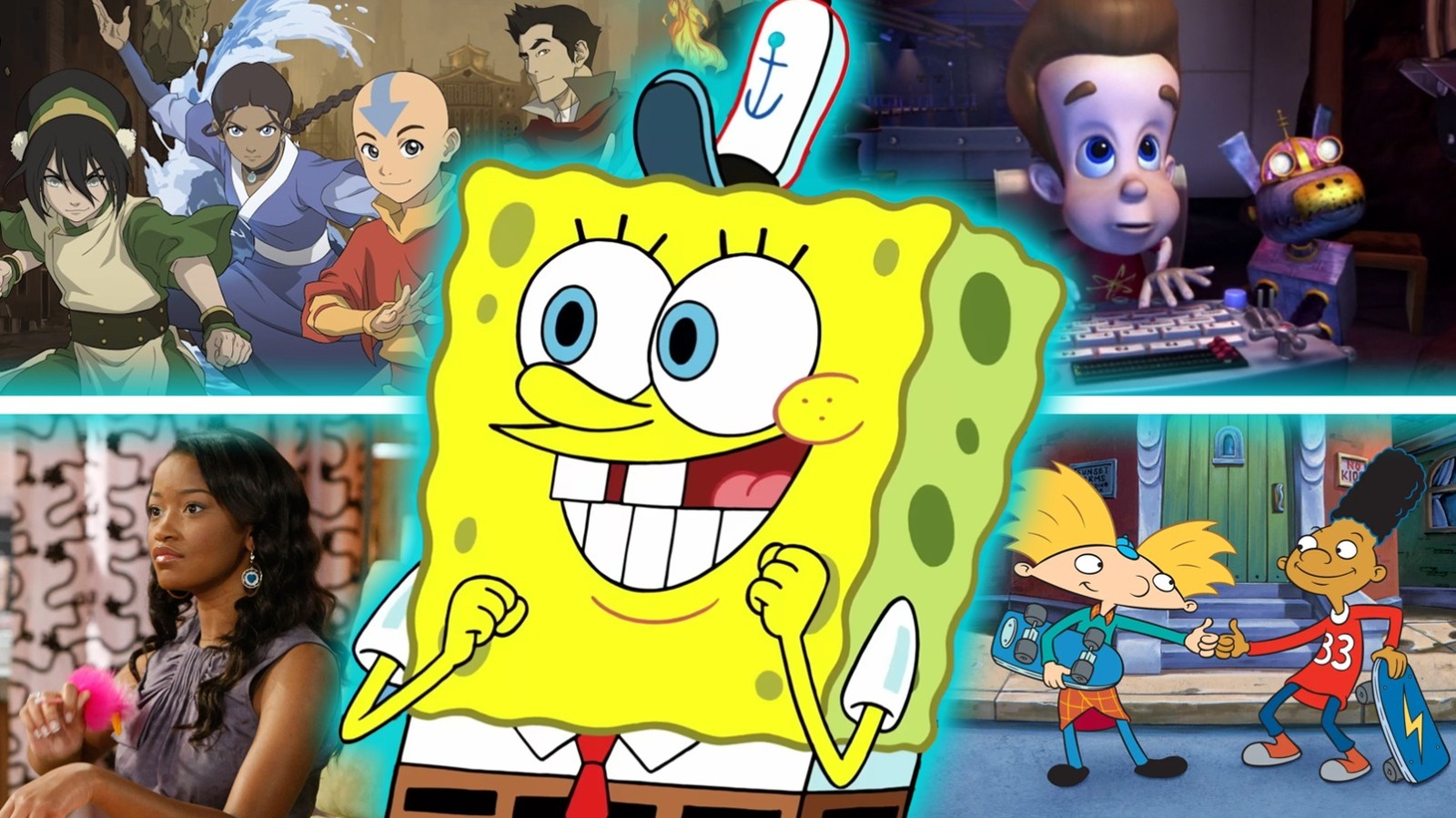
At its apogee, there was something almost ineffable about Nickelodeon as a brand. Other major kid-oriented networks had clear-cut concepts: Cartoon Network was a network for cartoons, Disney Channel was the place to go if you were a Disney fan. Meanwhile, the majority of young viewers didn’t even necessarily know what the name “Nickelodeon” meant. And yet, between the Nicktoons, the Nickelodeon sitcoms, and other turn-of-the-century institutions, it was easy to have a sense of what Nickelodeon was all about.
It’s particularly fascinating to look back at the 2000s, which saw the Paramount-owned children’s TV channel phase from the experimentation-friendly Nicktoons golden age of the ’90s to a period of imperial ratings dominance before veering into corporate-jerked uncertainty in the 2010s. That transitional period saw Nickelodeon air some of the very best family-oriented American television ever, including shows that both it and its rivals have since struggled to imitate.
On this list, we’re celebrating the 15 greatest Nickelodeon shows of the 2000s, between humongous megahits, underseen gems, and an all but inevitable top two.
Rocket Power
Created by the legendary duo of Arlene Klasky and Gábor Csupó, who are also behind several other shows on this list, “Rocket Power” is a sunny, warm-colored tribute to the ’90s and 2000s heyday of extreme sports.
Set in the fictional Southern California town of Ocean Shores, the show follows vain and self-obsessed 10-year-old Otto Rocket (Joseph Ashton), his zine-writing older sister Regina “Reggie” Rocket (Shayna Fox), videomaking enthusiast Maurice “Twister” Rodriguez (Ulysses Cuadra and Gilbert Leal), and tech genius Sam “Squid” Dullard (Sam Saletta, Gary LeRoi Gray, and Sean Marquette). Together, the four kids pursue their shared passion for virtually every extreme sport under the sun, from skateboarding to surfing to biking to skiing.
While not as sharp and rich in character nuance as the best Klasly Csupó productions, “Rocket Power” is a fun, beautifully-animated, irresistibly charming concoction, with a nostalgia-harnessing power so tremendous that it can make you feel wistful about a childhood hanging out at your dad’s beachside burger shack even if you grew up on the Arctic ice.
Danny Phantom
Between “The Fairly OddParents,” “T.U.F.F. Puppy,” and “Bunsen Is a Beast,” Butch Hartman has historically specialized in silly animated comedies aimed at younger kids. But from 2004 to 2007, one Hartman-created animated series broke significantly from that mold: “Danny Phantom.”
This cult favorite Nickelodeon show centers around Daniel “Danny” Fenton (David Kaufman), an awkward 14-year-old teenager who lives with his ghost-hunting parents Jack (Rob Paulsen) and Maddie (Kath Soucie), and has been pretty much raised by his level-headed older sister Jazz (Colleen O’Shaughnessey). While fiddling around with a portal created by his parents to access a parallel dimension known as the Ghost Zone, Danny accidentally gets his DNA fused with ectoplasm and becomes a half-human, half-ghost hybrid.
From there on out, “Danny Phantom” spins three seasons of sprightly and inventive villain-of-the-week plots as Danny uses his newfound powers to fight against malicious apparitions. And not only are those weekly adventures a hoot, but the show also exhibits a surprising level of sophistication in its writing, giving enough development to Danny, his friends, and his family to reach genuinely moving depths as the seasons progress.
ChalkZone
Created by Bill Burnett and Larry Huber and remembered for its highly catchy opening theme song, the enormously underrated “ChalkZone” chronicles the loopy adventures of Rudy Tabootie (E. G. Daily), a fifth-grader whose passion for drawing and art often overshadows his school responsibilities. While in detention one day, he discovers a piece of magic chalk that transports him to the titular zone — a realm populated by everything ever drawn in chalk. There, Rudy reconnects with Snap (Candi Milo), a character drawn by him at eight years old, and embarks on numerous adventures with his best friend Penny Sanchez (Hynden Walch).
It’s a setup that leads to expertly constructed secret-magical-realm storytelling, buoyed by a sweet-natured whimsy that was unusual for Nicktoons of that era and gives “ChalkZone” an almost elemental staying power. That’s not even getting into the sheer psychedelic beauty of the ChalkZone itself, which intersects perfectly with the simple and gentle art style displayed in the show’s normal world.
Winx Club
Nickelodeon’s answer to the magical girl genre, the Italy-U.S. co-production “Winx Club” left a huge mark in the lives of a whole generation of tweens who had little else like it in Western animation. Created by Italian animator Iginio Straffi, the show eventually got a long-running Nickelodeon-produced revival in the 2010s, but was animated in Italy by Rainbow SpA during its 2004-2009 seasons.
The influential, massively popular, oft-imitated original run of “Winx Club” centered on a group of friends who form the titular club at the Alfea College for Fairies, including leader Bloom (Molly Quinn in the show’s U.S. version), a teenage girl from Earth whose discovery of her fairy lineage provides the show’s kickoff point. Together with her friends, Bloom attends magic school and grows up, all while the Winx girls work to protect each other and their loved ones from evil.
A sprawling high fantasy epic teeming with dense mythology and set in an expansive, (literally) multidimensional world, “Winx Club” proved that Nickelodeon could acquit itself just as well in the serialized adventure genre as it did in goofy comedy — while still offering enough vibrant, all-ages fun to stand alongside any Nicktoon.
The Naked Brothers Band
Widely remembered as the show that introduced the world to Nat and Alex Wolff, “The Naked Brothers Band” was created by their mother, filmmaker and actress Polly Draper, who also wrote and/or directed most episodes. An offbeat live-action tween comedy that incorporated meta elements through a highly dynamic mockumentary format (with both Nat and Alex playing themselves), the show offered a fascinating alternative to the Dan Schneider formula of standardized multi-camera sitcom antics, instead prioritizing nimble farcical plotting, character-based humor, and thoughtful coming-of-age storytelling.
The plot of “The Naked Brothers Band” functions as a fictionalized satire of Nat and Alex’s real lives, positioning them as the leaders of the titular teen rock band, with original songs written by Nat himself (and sometimes by Alex). The show emulates rock movies of the ’60s and ’70s, taking cues from the audiovisual stylings of the Beatles and the Monkees. This foundation allows Draper and company to comment on the absurd challenges faced by kids in showbiz while also employing the talent and energy of the cast of real-life kid musicians to create a rollicking “School of Rock”-esque musical-comedy extravaganza.
The Wild Thornberrys
Another notorious Klasky Csupo production that helped define Nickelodeon’s original output at the turn of the 21st century was “The Wild Thornberrys.” Centered on Eliza (Lacey Chabert), Nigel (Tim Curry), Marianne (Jodi Carlisle), Debbie (Danielle Harris), and Donnie Thornberry (Flea), a nomadic motorhome family that travels around the world shooting a nature documentary TV series, the show helped clue in millions of kids to the beauty of wildlife and the importance of preserving it — and that’s only the first of its achievements.
Although “The Wild Thornberrys” started in 1998 and aired many of its best episodes in the ’90s, more than half of its run occurred in the 2000s. That run consists of an endless supply of delightful mini-adventures, each making sterling use of the show’s globetrotting ambience, with an invaluable underlying message about the importance of respecting different places and cultures. Boasting highly eccentric and original character design (there’s a reason Nigel’s face endures as a meme to this day) and some of Klasky Csupo’s most fluid and expressive animation, the show also had one of the most amusing and compelling family dynamics of any kids’ show ever, with each character getting to indulge their own flavor of kookiness.
True Jackson, VP
Another example of a show that didn’t air entirely in the 2000s but still counts as a central part of that decade for Nickelodeon is “True Jackson, VP.” Originally released between 2008 and 2011, the series stars Keke Palmer as True Jackson, a stylish teenager who, while selling lemonade in New York’s fashion district, draws the attention of fashion entrepreneur Max Madigan (Greg Proops) for her skillful customizations of his designs, and gets hired as the youth apparel vice-president at his fashion house.
Although it may look on the surface like a “Drake & Josh” and “iCarly”-esque slapstick-com for younger kids due to its multi-camera setup, “True Jackson, VP” was created by Andy Gordon, a veteran of grown-up alt-comedies like “Just Shoot Me!” and “NewsRadio.” In fashioning a show for Nickelodeon audiences, Gordon et al. mixed the requisite madcap silliness with the classic tenets of workplace sitcom writing, prioritizing sharp dialogue, character richness, sturdy situational scaffolding, and cast chemistry — such that the Mad Style offices become a believable, compelling, endlessly renewable comedic environment. Of course, it doesn’t hurt to have a superstar like Palmer leading the charge, and you could easily trace back every recent Keke Palmer box office hit to the charisma she displayed on this show.
My Life as a Teenage Robot
Some of the shows on this list were massive, generation-defining cultural phenomenons, but not every great Nickelodeon show of the 2000s was necessarily a huge hit. Just look at “My Life as a Teenage Robot.” From its premature cancellation and the belated dumping of its final season on Nicktoons, you’d think it was a dud. But in reality, it’s an endlessly endearing coming-of-age tale brought to life with memorable designs and singular animation.
Created by Rob Renzetti, the series focuses on XJ-9 a.k.a. Jenny Wakeman (Janice Kawaye), a powerful robot created by the elderly scientist Dr. Nora Wakeman (Candi Milo) with the purpose of protecting the earth. Although she’s used to her heroic routine and loves Nora like a mother, Jenny yearns deeply to live the life of a normal teenage girl. This sets the stage for endlessly witty send-ups of teen drama tropes, as well as all manner of exciting, moving, and surprisingly lore-heavy sci-fi adventures. In fact, there’s an argument to be made for “My Life as a Teenage Robot” as the show that best splits the difference between the comic edginess and the action-based Saturday-morning-cartoon antics that defined Nicktoons in their prime.
Ned’s Declassified School Survival Guide
If the glut of “zany” Nickelodeon live-action sitcoms had their anarchic potential hemmed in by the staidness of the multi-camera format, the thrillingly unbound “Ned’s Declassified School Survival Guide” was the one moment in which form actually met content. Created by Scott Fellows, the show was presented as an instructional video-esque manual on the most invaluable tips that every tween should carry with themselves to survive middle school, but even that unique concept was just the tip of the iceberg when it came to the tireless creativity.
Set in the world’s most surreally chaotic school, the series offers two 11-minutes segments per episode. It’s a format that allows it to emulate the lightning wit of the best Nickelodeon cartoons, packing every scene with anything-goes gags ranging from the physical to the verbal to the absurdist to the meta, while still affording plenty of development to a wonderfully vibrant cast of characters. No other live-action Nickelodeon series of the period was on the same level in terms of either writing or directorial resourcefulness.
As Told by Ginger
In retrospect, “As Told by Ginger” may well be the single most mind-boggling show to have existed within the classic Nicktoons crop — and it’s one of the most notably forward-thinking kids’ animated series ever. Several of its network contemporaries had sharp writing and adult-friendly humor, yes, but a cartoon that takes after the tone, rhythms, poignant themes, and even the visual style of a live-action teen dramedy, complete with rotating wardrobes from episode to episode? It was, and still is, all but unheard of.
It wouldn’t have worked, of course, if “As Told by Ginger” didn’t have the storytelling acuity to match its one-of-a-kind ambition. Thankfully, it very much did. Created by Emily Kapnek and animated with customary brilliance by Klasky Csupo, the series understood contemplative junior high student Ginger Foutley (Melissa Disney) and her various friends and acquaintances as intimately as any teen show has ever understood its characters. Ginger’s whirlwind struggles with the ups and downs of teen social hierarchy were by turns lively, messy, melancholy, aspirational, and uncannily relatable. But across three seasons, they never made for anything less than TV excellence.
The Adventures of Jimmy Neutron, Boy Genius
To get it straight out of the way: Yes, “The Adventures of Jimmy Neutron, Boy Genius” had ugly animation — not through any fault of the animators themselves, who worked miracles of expressiveness and humor with their limited resources, but due to its very nature as a low-budget show largely made with consumer-grade software. But the very fact that a series with such consistently unappealing visuals could become a generational classic should tell you something about its brilliance on other fronts.
Simply put, the “Jimmy Neutron” TV series — spun off from the Oscar-nominated 2001 film — had the best comedic writing of any Nickelodeon series of its time, if not ever (rivaled only by a certain surrealist masterpiece sitting at #2 on this list). With its relentlessly tongue-in-cheek incursions into satirical sci-fi punctuated by unhinged character eccentricity, it was essentially a crash course for kids on the fundamentals of timing, setup-and-punchline structure, verbal wit, screwball back-and-forth, and the importance of great line deliveries. It’s also a great show for fans of “Young Sheldon.”
Invader Zim
“Invader Zim” marked the improbably successful adaptation of the style of its creator, edgy horror-comedy cartoonist Jhonen Vasquez, to the format of a double-segmented half-hour toon for kids. Nominally for kids, anyway: Largely overlooked by the 2-to-11 contingent yet immensely popular among older viewers, “Invader Zim” now stands as an instance of miraculous, near-unfathomably adamant commitment to an artistic vision free of any prudence or pandering.
Built around Zim (Richard Steven Horvitz), an obnoxious alien from an expansionist species who arrives to Earth believing he’s been entrusted with its conquest (without realizing that his society is just desperate to send him as far away as possible), the show gleefully combined such commercial no-nos as bleak storytelling, existential humor, absurdist world-building, deliberately off-putting designs, no messages, a somber color palette, and an expensive, highly elaborate animation style. It only got away with it for two seasons, but talk about a blaze of glory.
Hey Arnold!
The classic template for a ’90s-to-2000s animated comedy was that of a suburban nuclear family home surrounded by picket fences and nosy neighbors. But, between 1996 and 2004, the Craig Bartlett-created “Hey Arnold!” changed the script, electing as its protagonist a boy raised by his grandparents in a boarding house, and focusing boldly and lovingly on all the bustling, labyrinthine intricacies of urban life.
This, mind you, was but one of the rules of TV animation that “Hey Arnold!” rewrote. This surprisingly mature show about living in the big city was utterly unafraid to explore every nook of its premise, which saw nine-year-old Arnold Shortman (Lane Toran, Phillip Van Dyke, Spencer Klein, and Alex D. Linz) and his friends get involved in the life of a different Hillwood resident in each episode, learning more about their (fictional) city’s dense, interwoven history in the process.
Breadth was matched by depth, asvery character on “Hey Arnold!” was a beautifully-wrought creation, full of personality and psychological shading, from the kids (chief among them Francesca Marie Smith’s Helga Pataki, one of the best animated characters ever) to the adults around them. It was wry, hilarious, humanist, and frequently heartbreaking. In short, it’s just plain incredible television.
SpongeBob SquarePants
“SpongeBob SquarePants” has not been a good show for 21 years, which now account for more than 80% of its total (and still ongoing) 330-episode run. But in those three original, Stephen Hillenburg-run seasons prior to 2004’s “The SpongeBob SquarePants Movie,” it was quite arguably the single best thing on TV — and bear in mind that those seasons aired concurrently with “The Sopranos.”
What is “SpongeBob,” really, if not the “Sopranos” of cartoons? It’s impossible to overstate the sheer firestorm of intelligence, idiosyncrasy and invention that Hillenburg and his fellow writers and animators (as well as a voice cast led by one of the best voice actors of all time) concocted during the series’ golden era, brazenly borrowing from the unlikeliest of cultural sources to create week after week of gonzo surrealist dry comedy that felt almost too genius to be on a kids’ network. Thankfully, it was on a kids’ network, thereby introducing millions of elementary-school-age viewers to the delirious, brain-rewiring joys of avant-garde animation. And “Band Geeks,” by the way? Not just one of the best “SpongeBob” episodes but maybe the single best 11-minute segment of any cartoon ever.
Avatar: The Last Airbender
Prime “SpongeBob SquarePants” would be the crown jewel of any other network’s history, but when it comes to Nicktoons, it has to contend with the arguable best American animated series of all time — it’s either it or “The Simpsons,” and “The Simpsons” is not nearly as tight a body of work. Yes, the best Nickelodeon show of the 2000s is “Avatar: The Last Airbender,” the series that set the still-reigning standard for all Western high fantasy shows.
When it comes down to it, there is just no other modern show aimed at either kids or adults that rivals “Avatar” for carefully-assembled, perfectly-paced, profoundly rewarding epic fantasy storytelling where every character feels like a person who could walk off the screen; on a buildup-and-payoff level alone, the work of creators Michael Dante DiMartino and Bryan Konietzko, head writer Aaron Ehasz, and the rest of the writing staff across every season of “Avatar” makes even something like “Game of Thrones” look ramshackle by comparison. Add in the gorgeous anime-inspired animation, the delightful sense of humor, the world-building dense enough to swim laps in, the thoroughly researched fight choreography, the swoon-worthy music, and the genuinely searing approach to heady themes of war, oppression, and resistance, and it’s little wonder that “Avatar” changed television forever.



Leave a Reply