


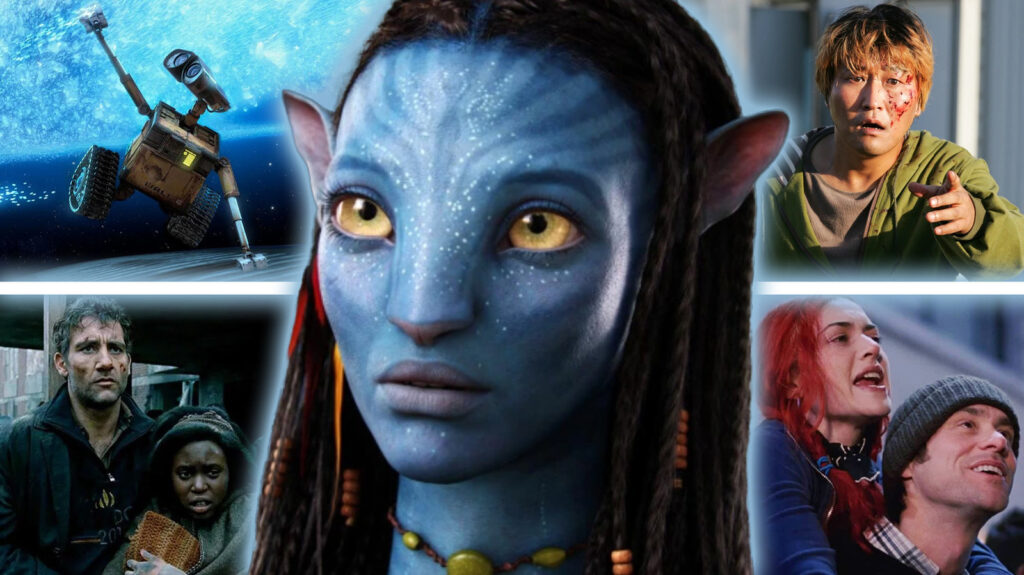

The 2000s were a golden era for science fiction. Advancements in moviemaking technology allowed filmmakers to create more immersive worlds and futuristic characters. This culminated with “Avatar” at the end of the decade, one of the most ambitious sci-fi movies of all time. James Cameron ushered in new tech to make an alien species feel like it was right there standing in front of the camera — and that still only scratches the surface of what was accomplished during this time.
It goes without saying that the best sci-fi movies of the 2000s continued doing what the genre does best: commenting on the world today with ideas only possible tomorrow. Whether it’s “The Host” honing in on pollution or “Minority Report” showcasing a terrifying future where people are arrested for crimes they haven’t committed yet, these films give us a lot to think about. And not for nothing, but they also tend to be a lot of fun in the process.
Here are the best sci-fi movies of the 2000s, ranked.
15. Avatar
Tastemakers like to say that “Avatar” is the most popular film no one remembers. But it really shouldn’t be hard to remember a name like “Jake.” However, “Avatar” deserves more credit than it often gets, because even if the story’s a dime a dozen, “Avatar” spawned a brand new franchise in an entertainment landscape that’s often too reliant on pre-existing intellectual property.
It feels like James Cameron used a basic story outline as an excuse to play around with new, emerging VFX technology. Actors like Sam Worthington and Zoe Saldaña were able to provide photorealistic performances so that every detail of their face can still in their Na’vi skins. This is all possible thanks to Weta Digital, which would go on to work with the new “Planet of the Apes” movies (and their realistic apes) as well as a slew of Marvel movies.
Plus, with a box office haul in the billions, “Avatar” got people excited to see an original sci-fi flick in theaters. There’s something to be said about that, and for pushing the medium of film forward, “Avatar” is absolutely one of the best sci-fi films of the 2000s.
14. Treasure Planet
Of course, not every science fiction film winds up being of “Avatar” proportions. Some go unappreciated during their time, which is what happened with “Treasure Planet.” It’s a notorious Disney flop that retells Robert Louis Stevenson’s “Treasure Island” but with space ships instead of pirate ships.
While it’s often considered one of Disney’s final 2D animated projects, it actually has more 3D than you might think. The movie’s gorgeous to behold, like when Jim Hawkins (Joseph Gordon-Levitt) surfs through space with nebulae in the background. The beating heart of the film is the friendship between Jim and John Silver (Brian Murray). Jim finally finding a father figure within Silver, who encourages to become the man he was always destined to be, is sure to bring a tear to your eye. “Treasure Planet” has garnered a cult following since its release, so while the prospect of a follow-up (or even a live-action remake) seems far off, we can at least enjoy what we have now.
13. Save the Green Planet!
2003’s “Save the Green Planet!” is the source material for 2025’s “Bugonia,” which wound up with a Best Picture nomination at the 2026 Oscars. However, if you like that film, you really should give “Save the Green Planet!” a shot. It’s the same premise, where a conspiracy theorist hatches a plot to kidnap a CEO, believing they’re actually an alien determined to destroy Earth who must be stopped.
The film’s a masterclass in combining multiple genres at once: science fiction, thriller, horror, and comedy. It’s a wild ride the entire time as your sympathies swap from one character to the next as you learn about each one and what they’ve done to others. If any film deserved a remake, it’s this one, considering the concept of conspiracies has only grown more prevalent in the 20 years between “Save the Green Planet!” and “Bugonia.” Once you watch both, you can dissect how the endings differ and determine which one is more depressing in your mind.
12. Primer
A lot of science fiction tends to focus more on the “fiction” rather than the “science.” All you have to do is have a character say “quantum” a bunch of times and call it a day. But “Primer” is the rare, glorious exception.
Writer, director, and star Shane Carruth actually has a degree in mathematics and worked as an engineer before making “Primer.” The film follows two guys who accidentally invent a form of time travel and then discuss the moral ramifications. It’s the very definition of hard sci-fi that cares deeply to get the facts right (or as right as they can be about as something as theoretical as time travel).
You might need an explainer to sort through all the various timelines in “Primer,” but it’s a wildly inventive piece of cinema — and it only cost $7,000 to make. Whether you’re looking for something outside of the mainstream or are a filmmaker trying to see how you can make a cool movie with not much money, “Primer” is worth the watch.
11. A.I. Artificial Intelligence
Steven Spielberg is responsible for some incredible science fiction films, from “Close Encounters of the Third Kind” to “Jurassic Park.” As a result, 2001’s “A.I. Artificial Intelligence” tends to get lost in the mix. If you can look past the divisive ending of “A.I.,” you’ll find something utterly captivating in there.
For starters, Stanley Kubrick was going to direct the film at first before it got into Spielberg’s hands. Following Kubrick’s death, Spielberg pushed forward and made sure to infuse some Kubrickian influences in the story. The result is something that has Spielberg’s grandeur and emotion with Kubrick’s stone-cold logic and darkness.
A robot capable of love, David (Haley Joel Osment), aims to be a real boy so that he can finally love. There’s a longing for acceptance throughout the film that even us humans can relate to, as we all feel isolated from one another occasionally. It may not have been the kind of film people expected out of Spielberg at the time, but there’s something special here that’s worth appreciating, almost as if Kubrick and Spielberg were both literally behind the camera making this haunting film.
10. The Host
Director Bong Joon-ho never passes up an opportunity to provide social commentary. His Best Picture winner “Parasite” famously explored dynamics between varying social classes, and his 2006 kaiju movie, “The Host,” uses the conventions of its subgenre to explore environmental degradation. The creature’s only created due to American forces dumping formaldehyde into a South Korean river, which is actually based on a true event (sans monster, of course).
The power dynamics seen in “The Host” still hit home all these years later. Not only is the United States responsible for creating the monster, but when Song Kang-ho (Park Gang-du) learns too much, scientists emerge to lobotomize him to keep him quiet. It’s not merely a monster movie where you witness a bunch of gore and carnage. The creature’s a manifestation of the very real evil that exists when countries brazenly commit acts of violence against other nations without a second thought. “The Host” follows in the giant footsteps of “Godzilla,” using monsters to provide insight into the world we currently live in.
9. WALL-E
There’s no scarcity of children’s movies with robots in them. Robots are fun! But few of them have ever offered the kind of depth showcased in Pixar’s “WALL-E.” There are plenty of “WALL-E” moments that go right over kids’ heads, like the ever-looming danger of corporate greed threatening the very nature of our existence. Earth has become a desolate wasteland, with WALL-E (Ben Burtt) cleaning up all the trash until it finds signs of plant life emerging once again, allowing humans to return.
In addition to the social themes, “WALL-E” is also just a pitch-perfect love story, as WALL-E becomes smitten with EVE (Elissa Knight). Meanwhile, all of the humans on a spacecraft have basically become robots themselves. They don’t do anything other than sit around and watch screens, and the movie’s B-plot focuses on them reclaiming their humanity.
Don’t get me wrong; “WALL-E” is still a lot of fun with ample jokes for kids to enjoy. But it exemplifies what Pixar does best. It takes kids’ movies conventions and pushes them to their limits to provide a story that will actually get children (and their parents for that matter) actually thinking about what they saw and hopefully discuss it after.
8. Donnie Darko
Disaffected teenagers everywhere rejoiced when “Donnie Darko” became a cult favorite. It explores ideas surrounding time travel, offering a very different story from what the sci-fi subgenre typically offers. Donnie (Jake Gyllenhaal) barely escapes a terrible accident and then discovers that reality will end in 28 days. Along the way, he experiences terrifying visions of someone in a rabbit costume haunting him. Without giving anything away, the ending of “Donnie Darko” will have you immediately wanting to rewatch the film to figure out just what the heck was happening the whole time.
What’s amazing is that time travel almost feels secondary to “Donnie Darko.” Instead, the film hones in on ideas of alienation, particularly what any teenager inevitably feels while coming of age. He doesn’t fit in with his family and friends and fears dying alone. But of course, we all need to learn to rely on others, and that’s precisely the journey Donnie embarks on.
7. Moon
Science fiction tends to be synonymous with giant spectacle. You expect to see robots fighting aliens or something fantastical. “Moon” takes a step back, using sci-fi concepts to tell an incredibly intimate story that lives and dies by Sam Rockwell’s central performance as Sam Bell. He’s an astronaut who’s spent three years on the moon and discovers another version of himself that could be a clone. Either way, he needs to figure out what’s going on.
The titular setting on the moon enhances Sam’s feelings of isolation. He’s been by himself for so long and just wants to see his wife and kid again, but the idea of another him being out there calls into question all these ideas surrounding identity and how unique we all really are, especially from the perspective of an all-powerful company.
Are we all disposable cogs in a machine where if we die, a corporation will just hire someone to replace us the next day? “Moon” disposes of the spectacle, and uses its genre to tell a story inherently human.
6. Spider-Man 2
Most superhero movies wind up being considered science fiction by virtue of having cool lasers and such. But “Spider-Man 2,” which remains the best superhero movie of all time, genuinely feels like it’s trying to say something about science. Otto Octavius (Alfred Molina), who becomes the villainous Doc Ock, is trying to provide limitless energy to the world when an experiment gone wrong fuses mechanical tentacles to his back. His work threatens all of New York, forcing Spider-Man (Tobey Maguire) to stop him.
Doc Ock is a dark reflection of what Peter Parker wants to be. He has immense intellect, and yet he can’t see how his work can harm others. While this is happening, Peter’s struggling with his powers seemingly going away, and he decides maybe New York would be fine without Spider-Man.
“Spider-Man 2” has spectacle to spare. The train sequence remains one of the most expertly choreographed set pieces ever in an action movie. But “Spider-Man 2” doesn’t forget the humanity in both its heroes and villains, and that’s something sorely missing from the superhero genre as of late.
5. Sunshine
“Sunshine” simultaneously provides a “man vs. nature” narrative with humanity needing to reignite a dying sun with a classic “man vs. man” storyline. When the crew of the Icarus II stumble upon the initial spacecraft that was supposed to save Earth, they come upon a man, Pinbacker (Mark Strong), who wants to see humanity die out.
“Sunshine” offers more than just an engaging story. Everything about it is a feast, from the visual effects, which director Danny Boyle went to great lengths to make as much practical as possible, to the sonic qualities. The soundtrack is incredibly underrated, and even just audio cues like the noise from the radio transmitter stand out to where it’s more than just mere background noise. It informs the story and environment the characters find themselves in.
Watching “Sunshine” today, you may be taken aback by the incredible acting ensemble, including Cillian Murphy, Michelle Yeoh, Rose Byrne, and Chris Evans. But there’s so much more here to appreciate when it comes to cinematic journeys through space.
4. Eternal Sunshine of the Spotless Mind
Christopher Nolan’s “Memento” almost killed “Eternal Sunshine of the Spotless Mind” before it was made, and it’s a good thing it didn’t. While both films are about the nature of memory, “Eternal Sunshine” uses its central premise to offer profound insights on the nature of relationships. Joel (Jim Carrey) and Clementine (Kate Winslet) break up, and each one undergoes a procedure to lose all their memories of the other person. It’s a way to numb the pain, and yet, they each manage to find their way back to one another.
There’s no “happily ever after” here, despite having a somewhat optimistic message by the end. There’s a ton of pain throughout the film, but that pain is necessary to grow as a human being. The unique story is complemented wonderfully by Michael Gondry’s inventive filmmaking techniques.
Environments change in a manner done completely in-camera, and handheld cameras lend the film an even greater sense of urgency and intimacy. All of this is in service of a raw story that shows how suffering is needed for growth.
3. Minority Report
After the divisive “A.I. Artificial Intelligence,” Steven Spielberg returned to more action-oriented sci-fi with 2002’s “Minority Report.” The film hones in on a future where crime is predicted by individuals with hyper-advanced abilities, so “criminals” are arrested before the crime is carried out. However, Chief John Anderton (Tom Cruise) discovers that he’s going to commit a crime and sets out to prove the system is flawed.
The film tackles lofty concepts like the nature of free will, but watching the movie today, it’s astonishing how much it foresaw about the future. Spielberg hosted an “idea summit” with experts to determine what a realistic future of the United States might look like. As such, you have ideas like targeted advertising when John’s walking through a mall.
More hauntingly, some individuals believe real-world AI could be used to predict crime before it happens. Little do they know there’s an entire movie showcasing why that’s a bad idea.
2. District 9
There’s been talk of a “District 9” sequel for years, but honestly, the original film is such a masterclass in using science fiction to tell all-too-real stories. Drawing up South African apartheid, the fictional universe in the film sees aliens land in South Africa, who are promptly put up in internment camps, separated from humanity. Bumbling bureaucrat Wikus van de Merwe (Sharlto Copley) gets exposed to stranger alien material and begins morphing into one of the insect-like creatures, forcing him to put aside his prejudices to escape government capture.
The film’s presented in a documentary format so anything otherworldly is given an air of reality. That’s nothing to say of Copley’s performance, who’s a sniveling dweeb at first but then grows to understand the aliens he was once fine with isolating from important resources.
But “District 9” is the best showcase for what science fiction does so well. Apartheid in South Africa ended in 1994, but it’s still vital to remember that excluding people of other races still happens in the world today. Through the lens of sci-fi entertainment, it becomes less likely for these events to be forgotten.
1. Children of Men
“Children of Men” doesn’t have aliens or artificial intelligence. Instead, it exists within the dystopian subgenre, depicting the year 2027, where infertility runs rampant and humanity is on the cusp of collapse. However, bureaucrat Theo (Clive Owen) gets tasked with escorting a refugee to safety, who just so happens to be pregnant with what could be the final hope for the human race.
There’s a lot to “Children of Men” that hits close to home in our current societal landscape. There’s reference to a pandemic that killed Theo’s child years prior, and in the aftermath of said pandemic, the United Kingdom turned into a totalitarian state that’s hostile toward immigrants.
Thematic resonance aside, “Children of Men” is chillingly beautiful to behold. The cinematography from Emmanuel Lubezki is gorgeous, and its use of long takes, allowing you to really sit with these characters and their world. “Children of Men” presents a low-tech vision of the future that may not be what most people think of when they hear “science fiction,” but its emphasis on characters allows it to sit with you long after its over.