


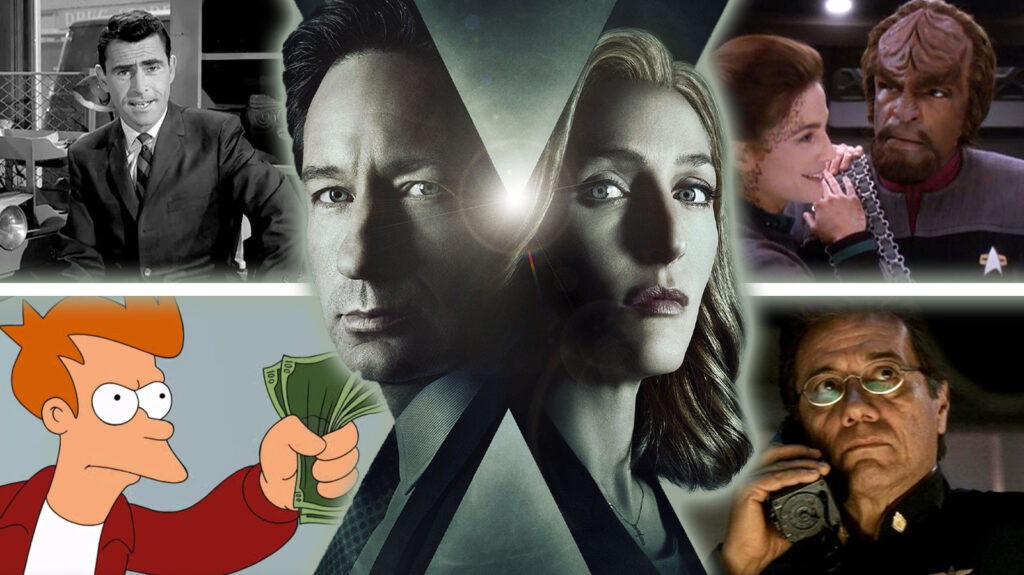

One of the most enduring genres available on the television medium, dating as far back as 1949’s “Captain Video and His Video Rangers,” is science fiction. Since then, the genre has been something of a constant, often pushing the boundaries of popular storytelling as television has evolved. Over the subsequent decades, sci-fi has marked the time, with many shows, even cult classics, earning particularly vocal fandoms. Some sci-fi television properties are multigenerational, reinvented and relaunched to better align with contemporary audience sensibilities.
Simply put, we love sci-fi TV shows, from the big bombastic spectacle to the more character-driven possibilities of the genre. At the same time, sci-fi is extremely malleable, capable of nonsensical comedies, soul-searching dramas, and escapist action. With so many different creative directions for the genre, there is a plethora of series to highlight, but we’ve narrowed it down to a handful of standouts.
Here are the 15 best sci-fi shows of all time ranked, exemplifying the enduring excellence of the genre.
15. Orphan Black
Premiering in 2013, “Orphan Black” is a strong, character-focused sci-fi thriller which explores the moral implications of human cloning. The series focuses on con artist Sarah Manning (Tatiana Maslany), who watches her doppelganger killing herself in Toronto. Assuming her double’s identity, Sarah discovers that, not only is she a clone, but there are numerous other clones of herself in North America and Europe. To make matters worse, Sarah and her clones are being hunted by the authorities and a murderous religious cult.
“Orphan Black” really is a showcase for Tatiana Maslany’s acting talents, and she consistently delivers across the series’ five-season run. In lesser creative hands, the show could’ve come off as a one-note campy tale, but the series blends its lighter and darker narrative elements masterfully. The show starts out as something of a mystery behind the cloning premise and who is hunting the clones, evolving into a full-on thriller. Led by a commanding performance from Maslany, “Orphan Black” is densely packed with plenty of plot twists to keep audiences hooked.
14. Futurama
After creating “The Simpsons,” Matt Groening turned his brand of animated comedy to the 31st century for the 1999 series “Futurama.” The show opens with pizza deliveryman Philip J. Fry (Billy West) accidentally getting cryogenically frozen in 1999 and revived in 2999. Fry gets a job with Planet Express, a company that handles all sorts of deliveries across the galaxy. As Fry gets to know his new co-workers and acclimate to life in the future, he falls in love with his captain, Turanga Leela (Katey Sagal).
“Futurama” is far from being just a sci-fi riff on “The Simpsons,” offering its own brand of comedy and memorable ensemble cast. Initially airing on Fox, the series has been revived and subtly reinvented multiple times since its debut, eventually finding a current home on Hulu. For all the recurring tropes and gags, “Futurama” always feels like it has something new to say while getting the audience genuinely invested in its main characters. One of TV’s most unexpected comfort shows, “Futurama” has used its sci-fi world to regularly and hilariously skewer the inanities of modern life.
13. Rick and Morty
Another wacky sci-fi animated comedy, “Rick and Morty” has been a staple on Cartoon Network’s Adult Swim programming block since it premiered in 2013. The series follows mad scientist Rick Sanchez and his grandson Morty Smith as they explore different dimensions and other worlds. This often involves explorations of the multiverse, with Rick’s zany inventions usually fueling the duo’s misadventures. The show also expands to the rest of the family as they get caught up in Rick’s antics, including Morty’s parents and older sister Summer.
The pairing between the outrageous and clearly deranged Rick and chronically anxious and withdrawn Morty makes for a great comedy team at the core of “Rick and Morty.” This elevates the often pop culture-fueled humor, with the creative freedom given by Adult Swim to the show letting the stories run wild. At the same time, the show knows when to lean into genuinely emotional moments, often drawn from feelings of vulnerability and insecurity from its main characters. Irreverent and frequently veering into absurdist and dark humor, “Rick and Morty” has certainly earned its widespread success from its freewheeling sci-fi stakes.
12. Star Trek: The Original Series
The show that started it all, “Star Trek: The Original Series,” as it became retroactively known, debuted in 1966. Created by Gene Roddenberry, the show followed the USS Enterprise, a starship in the United Federation of Planets, exploring the galaxy on a five-year mission. Led by Captain James T. Kirk (William Shatner), the crew carried out missions throughout the cosmos, regularly encountering new life and new civilizations. This often places them against hostile entities and organizations, with the crew’s quick-thinking usually saving the day.
There is a strong argument that “The Original Series” is the best “Star Trek” show, including its pioneering presence on television. Even beyond spawning a franchise that’s lasted for over six decades, the far-reaching influence of “TOS” cannot be understated. From stories that ranged from escapist fare to headier philosophical tales with pointed social commentary, “Star Trek” marked a breakthrough for sci-fi storytelling on television. That influence doesn’t continue without “TOS” being an exceptional show in its own right, full of memorable characters and storylines that loom large over the genre.
11. Doctor Who
Just as American television has had “Star Trek” as a longstanding sci-fi franchise since the ’60s, British television has had “Doctor Who.” Premiering in 1963, the show features a humanoid extraterrestrial known simply as the Doctor traveling through time and space in their vessel, the TARDIS. The Doctor is accompanied by a line of companions, while the Doctor themselves continually regenerates into new physical forms whenever their current body expires. Through their journeys, the Doctor defeats all sorts of monsters and other threats to humanity as they explore the space-time continuum.
With over 60 years of history, “Doctor Who” is a sci-fi institution that has gently reinvented itself with every passing regeneration of its protagonist. Befitting its origins, the show has a very British sense of humor about it, even as it gets surprisingly scary at times. While the series largely retains its enduring continuity, there are different places curious viewers can start watching the long-running classic. Unafraid of getting wonderfully weird with its time-bending tales, “Doctor Who” is a cornerstone in sci-fi television that has thrilled generations worldwide.
10. Black Mirror
There’s just something about the science fiction genre and the anthology storytelling format that go well together. The British anthology series “Black Mirror” makes that distinction clear, serving as the heir apparent to the legacy left by “The Twilight Zone” and “The Outer Limits.” Premiering in 2011, the show is comprised of standalone stories that offer their own sharp commentary on the state of society. A particularly prominent recurring theme is technology and digital media’s impact on identity and the rapidly shifting state of affairs.
There is a noticeable bleakness throughout “Black Mirror,” often driven by humanity’s capacity for self-obsession and its accompanying consequences. The creators really nail the series’ dark tone, with the show working best when it leans into those grimmer elements punctuated by black humor. Bringing these stories to life are reliably good ensemble casts, with the show only growing more ambitious after it was picked up by Netflix in 2016. A solid anthology series with a tech focus that hits close to home, “Black Mirror” is a twisted masterpiece.
9. Babylon 5
One of the most richly conceived space opera television series is “Babylon 5,” created by J. Michael Straczynski. Airing for five seasons from 1993 to 1998, the show takes place in the 23rd century, with humanity developing faster-than-light travel and beginning to colonize beyond the solar system. As humans find their place within galactic society, they maintain the titular space station with several allied extraterrestrial civilizations. The personnel on the station not only find themselves caught up in complicated interstellar politics and hostilities but pitted against a totalitarian Earth Alliance.
Though contemporary ’90s reviews of “Babylon 5” were awful, the show’s legacy has improved significantly over time. Looking past the dated visual effects, the series features an increasingly ambitious story that blends sci-fi spectacle with a complex web of political tension and intrigue. Each season feels like a full-on level up for the story and scale of the show without losing sight of its main characters. A true sci-fi epic with its own imaginative world-building, “Babylon 5” is one of the more underrated ’90s genre shows.
8. Star Trek: Deep Space Nine
The third live-action “Star Trek” series, “Deep Space Nine,” took things in a much darker direction than its predecessors. Premiering in 1993, the show is named for its primary setting, a space station strategically located near a wormhole shared by the Federation and the local Bajoran government. Starfleet officer Benjamin Sisko (Avery Brooks) commands the installation, which eventually becomes the focal point of the Dominion War. The conflict tests the Federation and its allies as Sisko leads their forces against an insidious coalition for the fate of the galactic power balance.
Unlike the preceding “Star Trek” series, “DS9” wasn’t focused so much on exploration as it was maintenance and, eventually, wartime combat. Though the Dominion War storyline caused tension behind-the-scenes, it provided a rare glimpse at the Federation caught in the midst of an all-out war. This storyline also broke the mold for the “Star Trek” franchise at the time, giving audiences a lightly serialized story rather than the episodic format of prior series. Presenting fans with some of the best “Star Trek” villains of all time, “DS9” saw a more mature and morally ambiguous approach to the franchise.
7. Stranger Things
One of the best Netflix original shows of all time, “Stranger Things” became a bonafide global phenomenon across its five-season run. The show is centered on the small Indiana town of Hawkins during the ’80s, which includes a large federal government laboratory on the outskirts of town. A girl known as Eleven (Millie Bobby Brown) with extraordinary psionic powers escapes from the lab and seeks refuge in town while she’s hunted by the government and military. Befriending a group of local kids, Eleven becomes Hawkins’ best hope when monsters from an extra-dimensional portal in the lab invade the world and threaten the community.
Admittedly, “Stranger Things” works better when it leans more into overt horror rather than science fiction, but its sci-fi elements still play a vitally prominent part of the story. The show starts out as an engrossing small-town story that escalates into an explosive blockbuster-scaled series, steadily expanding the scope and mythos. But beyond the ’80s nostalgia and monstrous thrills, the show works because the friendships at its core feel real and earned between the main characters. “Stranger Things” has been such a huge hit since season 1, and even in weaker seasons, it maintains a baseline of entertaining quality that stands a cut above its contemporaries.
6. Lost
Easily one of the best network television shows of the 21st century is “Lost,” which premiered on ABC in 2004. The show opens with a bang, as an airliner crashes on a remote island, leaving a small group of survivors. As the ensemble regains their bearings, they realize that the island harbors dark and deadly secrets that defy conventional explanation. As the characters try to survive and find a way off the island, flashbacks reveal each of their backstories prior to the crash.
A noteworthy observation about “Lost” is that the story isn’t bound to a single, clear genre, but it definitely contains prominent sci-fi elements. Concepts like time travel, the intricacies of the Dharma Initiative, and the bizarre anomalies that the survivors encounter all place the show within the realm of science fiction. This comes with a healthy dose of the supernatural as the show’s mysteries progressively grow more complex as the story continues. A puzzle box of a show right through to its controversial series finale, “Lost” is a rewarding enigma to delve into.
5. The X-Files
Providing audiences with one of the spookiest and most nostalgically ’90s theme songs of all time, “The X-Files” blends the supernatural with a crime procedural flair. The show features FBI agents Fox Mulder (David Duchovny) and Dana Scully (Gillian Anderson) as they investigate paranormal activity around the United States. Mulder is particularly obsessed with uncovering a government conspiracy involving the presence of extraterrestrials on Earth linked with his sister’s abduction. This puts both agents at risk in between solving cases as sinister forces move to suppress the truth at any cost.
“The X-Files” offered a relatively more grounded approach to the sci-fi genre, balancing its fantastical elements with Scully’s skeptical perspective on the existence of the paranormal. So much of the show’s appeal is derived from the rapport between Mulder and Scully maintaining that balance. But the show also regularly veered into sci-fi horror, with many of the best “The X-Files” episodes terrifying tales disconnected from its overarching mythos. A ’90s classic that perfectly evokes the era while dealing with aliens and government cover-ups, “The X-Files” brings an effective procedural perspective to the otherworldly.
4. Cowboy Bebop (1998)
No, we’re not talking about the 2021 live-action remake produced by Netflix but the original anime series that premiered in 1998. The show is set in a future where humanity has colonized most of the solar system but lawlessness runs rampant on the interplanetary frontier. Bounty hunters track down the most notorious criminals, with the show’s protagonist Spike Spiegel and his crew trying to bring in the biggest bounties. However, Spike and his friends’ pasts each catch up to them in often dangerous ways reminding them that they can’t outrun themselves.
There’s a lot of tonal colors that make up “Cowboy Bebop,” with the anime blending sci-fi neo-noir and modern jazz in equal measure. But the real strength to the series is that every “Cowboy Bebop” episode feels unique, ranging from neo-Western stories and crime thrillers to slapstick comedy and even outright horror. The series is a showcase for the entire anime medium, atmospherically rendered and with a memorable main cast to keep audiences coming back for more. “Cowboy Bebop” is over 20 years old and better than ever, blending tones and influences within its overarching sci-fi action story.
3. The Twilight Zone (1959)
Anthology shows existed before “The Twilight Zone,” notably with series like “Alfred Hitchcock Presents,” but they’d never be the same after Rod Serling’s seminal classic debuted in 1959. Each episode featured a standalone story that has various characters stumbling into paranormal events, often menacing and defying the conventional laws of reality. This ranges from aliens with varying designs on Earth and humanity to everyday people traveling through time to revisit their past. Episodes could range from sentimental stories to terrifying tales, often with a memorable twist ending, each touching on different themes including isolation and regret.
To be sure, a lot of episodes in “The Twilight Zone” didn’t involve science fiction at all, but many of them did. Throughout the original series’ five-season run, “The Twilight Zone” boasted numerous celebrity appearances, many before the actors became famous, with many turning in strong performances. But the show’s real strength was its tightly imaginative writing, with the vast majority of the episodes written by Serling himself. A groundbreaking and enormously influential show, “The Twilight Zone” remains a timeless demonstration of the creative possibilities in television storytelling.
2. Star Trek: The Next Generation
While the wider “Star Trek” franchise has produced many great sci-fi shows, the one that towers above the rest is “Star Trek: The Next Generation.” Premiering in 1987, the show takes place approximately a century after the events of “The Original Series,” following the exploits of the Enterprise-D. Captained by Jean-Luc Picard (Patrick Stewart), the crew explores the cosmic unknown on behalf of the United Federation of Planets. This leads them to discovering distinct cultures, the wonders of the galaxy, and several harrowing threats and enemies that could destroy them.
After enduring admittedly weaker early seasons, reputedly fueled by turmoil and bad blood behind-the-scenes, “TNG” coalesced into the franchise’s ethos in excelsis. The show takes the backdrop of unique worlds and civilizations across the cosmos and uses them to illustrate different tales about the human condition. At the same time, “TNG” offers a greater sophistication in storytelling with this formula while providing light plot threads that carry over to subsequent episodes. “The Next Generation” has plenty of essential episodes that any sci-fi fan really owes it themselves to watch.
1. Battlestar Galactica
Few people could’ve anticipated that the 21st century reboot of “Battlestar Galactica” would be as unequivocally great as it turned out to be. Starting with a two-part miniseries event in 2003, the story continued with a series that ran for four seasons on Syfy. The reboot starts off with Cylons, malevolent androids created by humanity, nearly wiping out their creators with a devastating sneak attack. The human survivors form a flotilla led by the aging battlecruiser, Galactica, in search for a new home while being pursued by the Cylons.
Compared to its campy ’70s source material, the reboot takes a more grounded and gritty approach to the sci-fi story. But the series’ biggest boon is showrunner Ronald D. Moore’s tight focus on the complex character relationships in between the grueling battle between the humans and the Cylons. This is coupled with a healthy sense of paranoia and betrayal, with even the writers unsure who would be a Cylon. A classic story given a complete tonal revamp far exceeding the source material’s quality, “Battlestar Galactica” is the definitive space opera.