


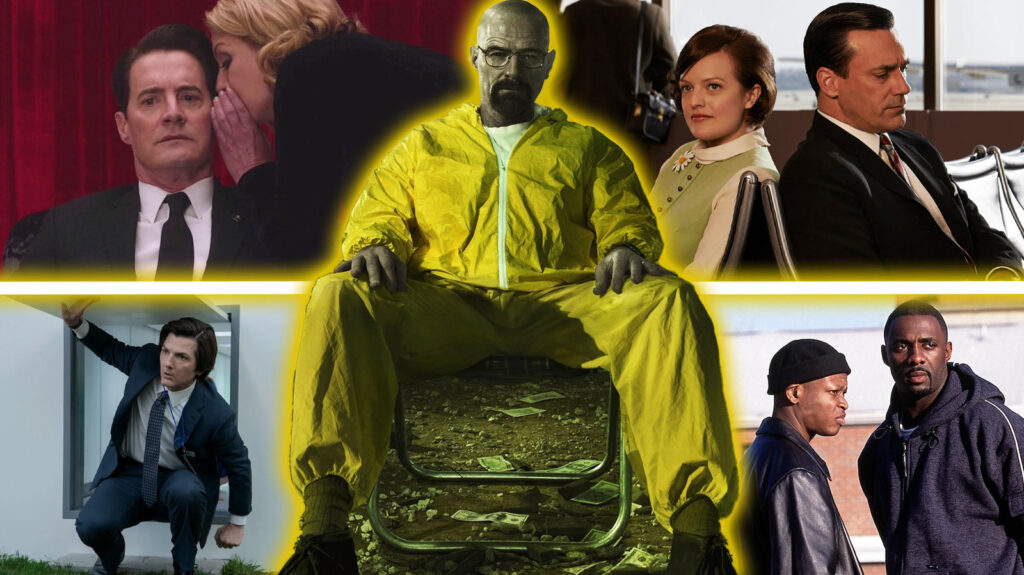

If you ask a group of average TV fans to define the style of the Golden Age of Television, they’ll likely note — and praise — many of the same things. They’ll reference morally complex characters like Walter White or Dexter Morgan, the complicated, serialized storytelling of thrillers like “Breaking Bad” or sci-fi shows like “Severance,” or even the bleakly diagnostic portraits of American life seen everywhere from the cold boardrooms of Waystar Royco to the warm New Jersey mansion of Tony Soprano. Few of them will bring up pacing.
This isn’t just because pacing is a relatively unsexy and difficult-to-judge aspect of storytelling. When executed well — as exemplified in countless dramas from the Golden Age of Television — a slow burn series will captivate you as much as shows like “Beef” or “The Boys” and leave you with a feeling of exhilarating satisfaction so similar that it’s hard to remember or appreciate in hindsight the time it took to get there. Pacing is the unsung hero of the modern prestige drama, so we felt it was only right to sing its praises through the slow burn TV shows that use it best.
Here are the best slow-burn TV shows of all time, and we’ve ranked them too.
15. Patriot
Of all the shows on this list, “Patriot” might be the biggest risk for those unfamiliar with its premise. It appears, at first glance, to be a relatively straightforward spy thriller. “Joe Pickett” star Michael Dorman leads this short-lived, late-2010s Amazon Prime Video series, playing the role of CIA agent John Tavner. At the start of the series, John is tasked by his handler-slash-father with using a non-official cover to smuggle money to an American-backed Iranian politician.
While this is pretty standard plotting for the spy thriller subgenre, “Patriot” gradually reveals itself to be a devastating (and weirdly hilarious) psychological tragicomedy about a lost soul struggling with the expectations of his family and the moral injury of working for the government. Oh, and it’s also kind of a folk musical.
14. Mindhunter
13. Midnight Mass
Of course, Netflix subscribers looking to spend an afternoon or two in a slow burn series could venture beyond the crime genre and enjoy “Midnight Mass,” another exceptionally paced drama on offer from the streamer. Created by modern horror master Mike Flanagan, the miniseries invites viewers onto the dreary Crockett Island, where faith seems to represent redemption and danger in equal measure.
At the heart of the story is Riley Flynn (“Criminal Minds” and “Friday Night Lights” actor Zach Gilford), a man who had escaped the spiritual grip of the religiously fanatical island to live a decidedly secular life across the country — only to return a broken man after serving a four-year prison sentence for killing a young girl in a drunk driving accident. Empty yet all but redeemed by the only justice he believes in, Riley’s homecoming confronts him with the apparently supernatural Father Paul (Hamish Linklater). Dread-inducing and life-affirming at the same time, “Midnight Mass” is a devastating slow burn that’ll still raise your heart rate.
12. Hannibal
It’s still kind of hard to believe that NBC let “Hannibal” happen. In addition to smuggling a graphic psychosexual thriller to network TV audiences through the guise of what essentially looks like a “Silence of the Lambs” prequel series, it managed to gradually stretch itself beyond the limits of the necessarily accessible police procedural format. By the time it ended in 2015, the narrative shape of “Hannibal” more closely resembled a prestige drama like “Dexter” than it did a network counterpart like “The Blacklist.”
This was inevitable for Bryan Fuller’s adaptation of Thomas Harris’ original novels, which more prominently featured the character Will Graham. In the series, Graham (Hugh Dancy) is an FBI profiler who, on the surface, appears to be a brilliant investigator — in reality, his gift for stepping into the minds of serial killers has left his sanity stranded on the razor’s edge. His psychological care is tragically entrusted to Dr. Hannibal Lecter (Mads Mikkelsen), a sociopathic killer who will ultimately leads them both down a dark path they can never return from.
11. True Detective
As an anthology series, “True Detective” offers viewers a slow burn with a quicker definitive payoff than most other shows on this list. While one could technically start anywhere and enjoy a similar experience with regard to its pacing, one season in particular stands out.
“True Detective” has a rather infamous reputation among TV fans for delivering seasons that range dramatically in quality. The first season of “True Detective” was originally intended to be a novel or a stageplay, which might explain why creator Nic Pizzolatto was able to execute its slow, meditative pace to such remarkable effect. With career-best performances from both Matthew McConaughey and Woody Harrelson as Louisiana detectives dragged into a uniquely disturbing case, the series uses its runtime to explore their fractured psychologies with unnerving nuance. The result is a crime drama that compels beyond the crime itself, with a darkly hypnotic worldview you just can’t deny.
10. Fargo
Based on the 1996 Coen Brothers film of the same name, FX’s “Fargo” immerses audiences in the snow-covered Midwest, where the mundane and the murderous exist side by side. Creator Noah Hawley masterfully adopts the Coens’ narrative style for long-form storytelling, expanding their world in satisfying and occasionally profound ways. Though the show and the movie don’t share a narrative (and can thus be enjoyed independently of one another), Hawley carries over the singular spirit of maladroit malfeasance that fans of the movie will love.
“Fargo” is a crime drama anthology series like “True Detective,” but its season-to-season hit rate is far more consistent. In our opinion, its best season remains its first, which starred Martin Freeman as hapless insurance salesman Lester Nygaard and Billy Bob Thornton as Lorne Malvo, the drifting, Cormac McCarthy-esque hitman who descends upon his town. Thornton (who had previously starred in the Coen Brothers’ “The Man Who Wasn’t There”) drew widespread acclaim for his performance as Malvo, earning a Golden Globe award and an Emmy nomination in 2015. Malvo is still one of the series’ best characters overall, and it’s credited with reviving Thornton’s career for projects like “Goliath” and “Landman.”
If you’re looking for the slowest of slow burns “Fargo” has to offer, however, you’re welcome to start with season 3. Fellow Emmy nominee Ewan McGregor leads the season’s ensemble as twin brothers locked in a dangerous feud. Though its pace is glacial compared even to other “Fargo” stories, season 3 is nonetheless compelling, and it ultimately leads to a climax that ranks among the series’ best episodes.
9. Twin Peaks
Mark Frost and David Lynch’s “Twin Peaks” has a complicated legacy. At its worst, after Lynch left the series behind during its 2nd season, the show became almost a goofy caricature of itself. Not even Lynch himself could stand to watch it. However, when he first helped introduce audiences to this bizarre, small town of secrets and murder, “Twin Peaks” stood out as one of the most distinct television shows ever broadcast, thanks almost entirely to the filmmaker’s singular, Lynchian storytelling style that heavily employs surrealist imagery and defiantly slow pacing.
The simplest way one could describe the series is as a supernaturally-tinged detective thriller following the strange murder of a young girl named Laura Palmer (Sheryl Lee) in the small, blatantly paranormal town of Twin Peaks. The investigation of FBI Dale Cooper (Kyle MacLachlan) is soon caught in a web of conspiracies, spirits, and hidden worlds that pick at the very seams of his reality.
8. Severance
With a burn so slow that Ben Stiller couldn’t even stick around to see how it ends, “Severance” is still shaping up to be one of the greatest science fiction dramas of the 2020s. For the uninitiated, the Apple TV series takes place in a chronologically and geographically opaque society where life is all but dominated by the fictional megacorporation Lumon Industries. Adam Scott stars as Mark Scout, one of the company’s many employees who have chosen to undergo a controversial procedure known as “Severance,” which bifurcates a worker’s mind so that they essentially have an entire separate psychology and life contained within Lumon’s walls.
As a mystery box show, “Severance” takes its time getting viewers up to speed even with what the characters know about the world they live in (we still don’t even know what year it is) and is even more restrained when it comes to unveiling the secrets they attempt to uncover. It further expands beyond simple sci-fi tension to explore bizarre and often unsettling philosophical questions surrounding identity, memory, personality, grief, love, and most of all one’s relationship to their career. This existential twist is part of why “Severance” already demands multiple viewings.
7. The Leftovers
Of course, we can’t gush about slow burn mystery box shows without giving due praise to Damon Lindelof, a TV creator who built a career telling stories so baffling they border on antagonistic. And yet, even when he forces the audience to move with him one agonizing step at a time, the journey is too memorable to miss.
After wrapping up his work on ABC’s “Lost” (and before moving on to the miniseries “Mrs. Davis,” HBO’s “Watchmen,” and the DC Comics crime drama “Lanterns”), Lindelof set about adapting Tom Perotta’s novel “The Leftovers,” which explores human society after 2% of the population mysteriously vanishes from existence. An intimate ode to life’s greatest and most uncomfortable mysteries, “The Leftovers” ventures far beyond the initial story to create a TV show unlike anything you’ve ever seen before. As “The Leftovers” winds from one unpredictable and unexplainable moment to the next, you’ll find it difficult to leave behind.
6. The Wire
Frequently hailed as one of the greatest television series ever made, “The Wire” basically defined the modern slow burn drama for audiences in the early 2000s. While most cop stories on TV were snappy procedurals with cases only as complex as their runtime would allow, David Simon’s seminal crime drama took viewers way down into a world of genuine moral complexity. It was a narrative feat that could only be accomplished thanks to HBO’s boundary-pushing television philosophy.
“The Wire” explores the devastating impact of the war on drugs on the communities of Baltimore, Maryland, through the eyes of men and women on both sides of the law. Police officers like Dominic West’s McNulty aren’t simply righteous crimefighters, but deeply flawed and morally questionable instruments of a broken system; criminals like Michael K. Williams’ Omar Little or Idris Elba’s Stringer Bell are fully fleshed-out people with motivations you can’t dismiss as mere selfishness.
5. Succession
Despite being arguably one of the greatest television shows of the 21st century, “Succession” has an odd reputation among newer viewers. Online, you’ll find many of them confused by its rarely disputed pedigree, scratching their heads at why a show is so popular despite its “boring” depiction of boardroom brawling (stripped of the sensational thrills and mythology of shows like “Billions”) and its use of such stilted, awkward, and crude dialogue. By the time they get to the 1st season finale, however, they usually begin to understand the true scope of “Succession.”
Unlike other corporate thrillers, “Succession” isn’t an escapist fantasy of wealth, sex, and power — it’s a punishing tragedy about the inescapable moral rot of our institutions. The series follows the Roy family as they struggle to design the future of their waning media empire while thwarting threats from all sides — including from within their own bloodline. Every single season is a masterwork of patient storytelling, with Jesse Armstrong giving the audience and the characters themselves ample time to absorb the consequences of their selfish actions. As a result, the focus of the series is never on the inevitable, external moral reckoning that awaits the Roys as they destroy their relationships and their company one stupid decision at a time. Instead, we see the constant internal reckoning that comes at the cost of auctioning off your soul to the highest bidder.
4. The Americans
Premiering on FX in 2013, you might think that “The Americans” would need a slower pace in order to get a mostly U.S. audience to root for Russians in a Cold War-era spy thriller. That’s only half the battle — and the beauty — of the series.
“The Americans” stars Keri Russell and Matthew Rhys as KGB officers who have spent over a decade in the U.S. developing a shared, deep-cover “life” that includes two children who are completely unaware of their parents’ true allegiance. This creates the kind of drama you’d expect, with the family becoming increasingly endangered as the lie proves inevitably fragile.
As the series progresses, however, the true tension at its core comes from its exploration of marriage and identity. It’s this subversive angle on time-worn political thriller tropes that makes “The Americans” one of the greatest political thrillers of all time.
3. Mad Men
Convincing someone to watch “Mad Men” in the 2020s is a huge ask. Who in their right mind would want to immerse themselves in a world where wealthy men indulge themselves in greed and lust at a time in America when such appetites were rewarded? And yet, it’s because “Mad Men” is so far from aspirational that, even a decade after its finale, it remains one of the most vital and relevant stories about America ever told.
“Mad Men” deconstructs the facade of the American ideal by placing a magnifying glass over Don Draper (Jon Hamm). He’s an advertising genius who has used his knack for storytelling and salesmanship to construct a plausible yet paper-thin identity that slowly burns away with each moment of weakness the audience is allowed to watch. The series, which ironically has a reputation among some TV fans for being all style and no substance, asks the viewer to question whether the same could be said about America itself.
2. Better Call Saul
The best slow burn drama of the last decade, “Better Call Saul” exhibits a mesmerizing kind of patience. The premise of the “Breaking Bad” spin-off is so deceptively simple that it borders on uninteresting — after all, beyond Bob Odenkirk’s undeniable charisma in the role, why should anyone really care how “criminal” attorney Saul Goodman got to be the way he is when he’s first called upon by Walter White?
Enter Jimmy McGill, the true star of the series. Despite embarking on a path toward becoming Saul Goodman, he couldn’t be more unrecognizable. When “Better Call Saul” begins, he’s humble in appearance and behavior (for the most part), selflessly devoted to caring for his ailing brother Chuck (Michael McKean), and capable of maintaining a positive relationship with another attorney (Rhea Seehorn’s Kim Wexler).
What could have been a cash-grab case-of-the-week courtroom drama that follows Saul as he gets various crooks out of prison is instead a tragic story about the gradual, almost invisible decay of a man who slowly gives in to his desire to let go of the moral boundaries constraining his meager life. If “Breaking Bad” revealed a supposedly “good” man’s true nature by confronting him with certain death and stripping him of the quiet life he was pretending to be happy with, “Better Call Saul” makes the case that a quiet life is better than an even quieter spiritual death.
1. Breaking Bad
As “Pluribus” fans are remembering (or are perhaps learning for the first time), nobody does a slow burn television show like Vince Gilligan. The undisputed master of this style made his mark with “Breaking Bad,” a deceptively brisk crime thriller that takes five seasons to explore the 18-month rise and fall of Walter White in intimate detail.
The genius of the show’s pacing is the writing team’s ability to execute multiple levels of storytelling with the same precision. Taking even “Fly,” the series’ most notoriously contained episode, for example, one can see this clearly. While moving through the simple episodic black comedy of Walt (Bryan Cranston) and Jesse’s (Aaron Paul) attempts to kill a buzzing fly that’s contaminating the state-of-the-art lab they use to cook meth for their new boss Gus Fring (Giancarlo Esposito), the episode also escalates a major seasonal subplot (Jesse’s conflict with their new business arrangement), revisits major events from the previous season (Walter’s role in the death of Jesse’s girlfriend), and explores the series’ core dramatic question at length.
This peerless multi-level narrative execution is on display in almost every episode of “Breaking Bad,” allowing it to reap the full rewards of its pace without letting the audience feel the slightest bit of drag. Every moment feels both earned and vital to the fate slowly creeping toward its characters. “Breaking Bad” isn’t just a masterclass in how to keep a slow burn drama compelling — it’s the blueprint for making the most of television as a medium for storytelling.