


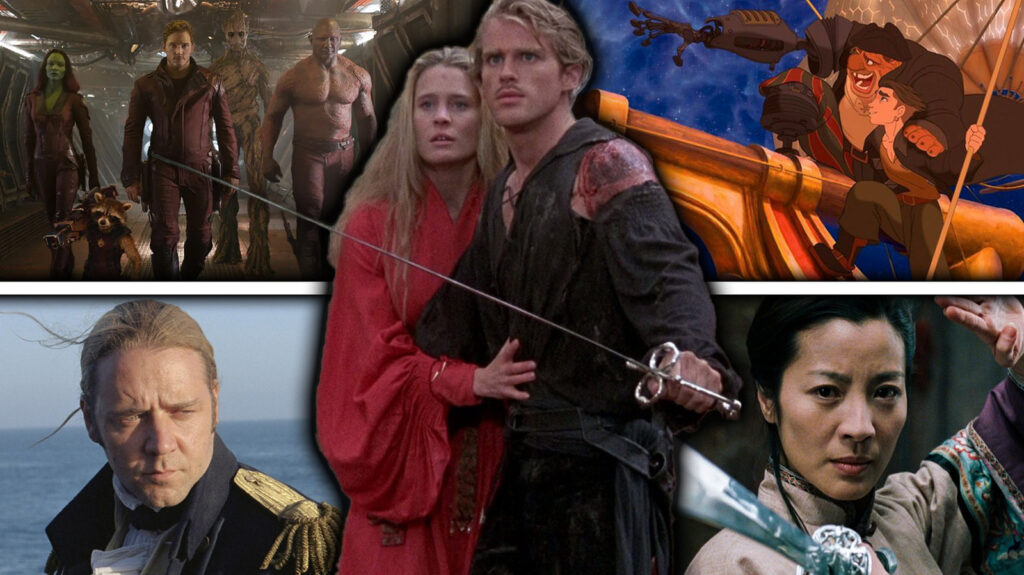

Hailing at least as far back as the mid-19th century and defined by storytellers like Alexandre Dumas, the swashbuckler is one of the most beloved yet oft-misunderstood subgenres in cinema. They might regularly feature hunts for lost fortunes or artifacts, but you wouldn’t call “National Treasure” (nor any of the films it resembles) a swashbuckler movie. At the same time, while pirates and swashbucklers might be colloquially interchangeable (and, indeed, the best pirate movies of all time are largely swashbucklers), they are not inextricably linked. A Napoleonic soldier is as fit for the subgenre as a space-faring vigilante.
What we’ve assembled below are the greatest examples of the swashbuckler, representing the wide range of stories that can be told through this subgenre. Broadly bound by shared themes of romance, roguish heroism, and dazzling swordplay, they prove just how particularly enchanting and thrillingly escapist the swashbuckler can be.
These are the best swashbuckler movies of all time.
15. The Road to El Dorado
Critics were slow to idolize “The Road to El Dorado” when it was first released in 2000. The DreamWorks animated family feature had the misfortune of having to follow on the heels of the Disney Renaissance, though this was a fate the former studio (notably co-founded by ex-Disney exec Jeffrey Katzenberg) arguably courted by hiring “Aladdin” screenwriters Ted Elliott and Terry Rossio, as well as the all-star music team behind “The Lion King,” Elton John, Tim Rice, and Hans Zimmer. Suffice it to say, many reviewers found the film to be amusing but disappointing in comparison to other animated family adventures.
In hindsight, however, “The Road to El Dorado” was a flash of the irreverent humor that would one day make “Shrek” a hit. Kevin Kline and Kenneth Branagh portray two bumbling con artists who masquerade as gods to, essentially, exploit the titular lost city and its people. It’s a story with a dubious moral core at best — and yet, that’s what makes it one of the most underrated animated movies ever made. The film hilariously embraces how awful its heroes are when it begins, and it takes great delight in tormenting them until they turn from their selfish ways. Elliott and Rossio are the unsung heroes of “El Dorado,” though this won’t be the only time we’re singing their praises on this list.
14. The Count of Monte Cristo (2002)
Alexandre Dumas is arguably the all-time greatest storyteller in the swashbuckler subgenre, and it should be no surprise to readers that his work inspired two films that made the cut for this ranking. His 19th-century novel “The Count of Monte Cristo” has been adapted into well over two dozen films and TV shows since 1912, most notably by Rowland V. Lee in 1934. For the purposes of this list, however, we selected the 2002 adaptation, as it best balances the action and melodrama of a swashbuckler.
Directed by Kevin Reynolds (director of the History Channel series “Hatfields & McCoys”), this “Monte Cristo” stars Jim Caviezel (“The Passion of the Christ”) as the scorned Edmond Dantés, whose betrayal at the hands of his friend, Ferdnand Mondego (Guy Pearce), gives way to one of the most classic revenge stories ever told. Reynolds and screenwriter Jay Wolpert emphasize swordplay action and roguish humor, creating a cinematic experience later echoed by “The Pirates of the Caribbean” franchise. It’s also worth noting that this film features a young Henry Cavill in one of his first roles (he had to fulfill a bizarre condition to play young Albert Mondego).
13. Treasure Planet
The swashbuckler is a deceptively constrained subgenre, enduring centuries of storytelling evolution, despite relying on the aesthetics and tropes of a bygone world. But that world is clearly one audiences continue to embrace, and films like “Treasure Planet” prove that such a past can be projected centuries into the future to create new, anachronistic worlds audiences had yet to imagine.
This 2002 Disney animated film is a relaxed adaptation of Robert Louis Stevenson’s 19th-century novel “Treasure Island,” taking the basic premise, characters, and plot points and re-contextualizing them in a far-flung, science fiction future. Aliens and interplanetary travel exist alongside the aesthetics of the golden age of piracy in the 18th century. Joseph Gordon-Levitt leads the voice cast as young Jim Hawkins, an inn-keeper’s son who embarks on a dangerous treasure hunt across the galaxy.
Despite being Walt Disney Animation’s biggest ever flop at the time, the film has a solid reputation as one of the studio’s most underrated works. It was nominated for Best Animated Feature at the 2002 Academy Awards, losing to Hayao Miyazaki’s groundbreaking classic “Spirited Away.”
12. Guardians of the Galaxy
Like “Treasure Planet,” James Gunn’s seminal 2014 superhero blockbuster “Guardians of the Galaxy” quietly employed — and in some cases subverted — swashbuckler tropes to tell arguably the greatest space pirate story of all time. Chris Pratt was ingeniously cast against type as Peter Quill, a human taken from Earth by a band of rogue mercenaries and treasure hunters, eventually being inducted into their crew of “Ravengers” as the quasi-anonymous, “legendary” Star-Lord. The film sees Quill assembling a team of other misfits after he unwittingly steals an infinity stone.
“Guardians of the Galaxy” is a tough film to place on a list like this, given that it undercuts the customary melodrama for the sake of several solid jokes. It’s also the only film on this list not to feature even a hint of swordplay (unless you count Drax’s big blades). That said, there’s no denying its rightful place in contemporary swashbuckling cinema. “Guardians of the Galaxy” was an unlikely box office smash for Marvel Studios, instantly establishing Gunn as the defining superhero director of our time and laying the groundwork for his eventual takeover of DC Studios.
11. The Mummy (1999)
A winning combination of monster movie thrills and the rollicking historical adventurism of the “Indiana Jones” franchise, “The Mummy” updates the swashbuckler subgenre in singular fashion. Brendan Fraser gives a career-defining performance in the 1999 blockbuster, playing the gruffly sarcastic, shoot-first-ask-questions-later treasure hunter Rick O’Connell. When he’s roped into an expedition into the City of the Dead by foolhardy academic explorers Evelyn and Jonathan Carnahan (Rachel Weisz and John Hannah), Rick and his party find themselves fighting the supernatural forces of a revived ancient Egyptian priest (Arnold Vosloo) with nothing but their wits and weaponry.
“The Mummy” is just one of many attempts at bringing back a classic Universal monster, but you don’t need to watch any other “Mummy” movie to enjoy it. (Seriously, avoid the Tom Cruise film like one of Imhotep’s plagues). On its own, it was a life-changing movie for many ’90s kids, expanding their imaginations while providing a story with enough danger and romance to give the fantasy real weight.
10. The Mask of Zorro
In our oral history of “The Mask of Zorro” (published for the film’s 25th anniversary in 2023), we lauded the film as the last old-school blockbuster to come out of Hollywood. Even at the time of its release in 1998, executive producer Steven Spielberg predicted it would be one of the last practically shot westerns — today, films like the Coen Brothers’ “True Grit” and Quentin Tarantino’s “The Hateful Eight” are rarities. Ironically, in the superhero subgenre that ultimately overtook films of this kind, “Zorro” stands as one of the best and most overlooked works.
Directed by James Bond journeyman Martin Campbell (“GoldenEye,” “Casino Royale”) and written by John Eskow and future “The Road to El Dorado” scribes Ted Elliott and Terry Rossio, “The Mask of Zorro” stars Antonio Banderas as a petty thief who trains under the masked vigilante known as Zorro (Anthony Hopkins) to avenge the death of his brother. The film is best remembered for its acrobatic swordplay, its fiery romantic subplot, and Banderas’ incomparably dashing (and Golden Globe-nominated) portrayal of this classic character. “The Mask of Zorro” was an unmitigated box office hit that spawned a sequel in 2005.
9. The Three Mustketeers (1973)
Perhaps Alexandre Dumas’ most famous novel, “The Three Musketeers” is yet another oft-adapted swashbuckler classic in the exact same vein as “The Count of Monte Cristo.” The best of these is, without question, Richard Lester’s boisterous 1973 film, which was produced by Lester’s future “Superman” bosses Alexander and Ilya Salkind.
A great swashbuckler movie must be as light on its feet as its sword-wielding protagonists, and no film on this list executes this as effortlessly as Lester’s. “The Three Musketeers” is a classically comic action adventure masterpiece with a simple moral framework, kinetic action sequences, and beautiful cinematography. It’s a true feast for cinephiles who love older, theatrical performances especially — the star-studded ensemble cast is led by Oliver Reed (“Oliver!,” “Gladiator”), Frank Finlay (“Othello”), and Richard Chamberlain as the three titular heroes, who are joined by Michael York’s D’Artagnan in their fight against the traitorous Cardinal Richelieu (Charlton Heston). Christopher Lee, Simon Ward, Faye Dunaway, and Raquel Welch (who won a Golden Globe for playing Constance Bonacieux) also star.
8. The Duellists
Countless films explore cycles of seemingly unending violence, but few if any are as genuinely beautiful as Ridley Scott’s directorial debut “The Duellists.” Released in 1977 (two years before “Alien” would hit theaters), the film adapts Joseph Conrad’s short story about two 19th-century Napoleonic French soldiers — Keith Carradine’s Armand D’Hubert and Harvey Keitel’s Gabriel Feraud — who circle one another for over a decade of potentially lethal duels in the wake of a single perceived slight.
Scott somehow manages to translate this story in a manner that’s all at once gorgeous and unglamorous. The swordplay is exciting and unpredictable, yet far from the over-extended, fantastical fight scenes showcased in most swashbucklers. While some may be hesitant to even place it in the subgenre, it is precisely for this restraint that it must be included with distinction, as something of a deconstruction of the melodramatic violence and chivalry the subgenre indulges in. Scott and screenwriter Gerald Vaughan-Hughes’ focus on the cost of fighting as opposed to its potential spectacle allow the director to emphasize beauty in landscapes, performances, and quiet tragedy.
7. Cyrano de Bergerac (1990)
As far as classic stories go, “Cyrano de Bergerac” is one of the most malleable in its subgenre presentation. Edmond Rostand’s late-19th-century play has been commonly regarded and reimagined as a romantic comedy (see the 1987 Steve Martin film “Roxanne”). Others have treated it as a heartfelt period romantic drama, occasionally with music (as can be seen in the 2021 Peter Dinklage film “Cyrano”) or a dark psychological exploration of truth, identity, and loneliness (as was seen in James McAvoy’s Broadway production).
Where the 1990 French adaptation by director Jean-Paul Rappeneau stands out, aside from the sheer mastery of its execution of the source material alone, is how it emphasizes Cyrano’s identity as both a lover and a fighter. After all, you don’t cast a swashbuckling stalwart like Gérard Depardieu (featured in adaptations of “The Count of Monte Cristo” and “The Man in the Iron Mask”) if you aren’t going to let him swing a sword.
Disgusted by his appearance and pining after the beautiful Roxane (Anne Brochet), Cyrano concedes to expressing his boundless love the only way he can, by helping a more handsome man (Vincent Perez’s Christian) win her heart. Otherwise, he spends his time proving the pen and the sword can be mighty in equal measure, and just as deadly too.
6. Crouching Tiger, Hidden Dragon
Readers might not immediately consider “Crouching Tiger, Hidden Dragon” a swashbuckler film — even though it not only possesses all the expected elements including swordplay, romance, and a period setting, but executes each to an even greater degree than some of its more traditional peers.
The 21st-century exemplar of the Chinese wuxia genre, this 2000 epic was directed by Ang Lee three years before he would take on the American blockbuster “Hulk.” It stars martial arts legends Chow Yun-fat (“The Killer,” and, notably for readers of this list, “Pirates of the Caribbean: At World’s End”) and Michelle Yeoh as deadly warriors secretly hiding their true feelings for one another. A quest to recover a legendary blade serves as a thrilling vehicle for a story that’s ultimately about the pain of love — and, also, getting kicked in the face multiple times. “Crouching Tiger, Hidden Dragon” pushed the limits of martial arts filmmaking in 2000, and it remains an action spectacle unlike any other as a result.
5. Captain Blood
“Captain Blood” doesn’t simply make the cut for this list by virtue of being one of the first earliest swashbuckler films ever made. The 1935 film was written by prolific early golden age screenwriter Casey Robinson and directed by Michael Curtiz, an equally accomplished filmmaker who would go on to direct the peerless romantic drama “Casablanca,” as well as another one of the greatest swashbuckler films of all time.
The latter film came as a result of Curtiz’s partnership with actor Errol Flynn (made famous for a single role in particular that is so iconic, many readers have likely guessed what the other Curtiz-Flynn film on this list is). The pair worked together on a dozen films over the course of about six years, starting with “Captain Blood.” Flynn is nothing short of electric as Peter Blood, the titular, unlikely doctor-turned-pirate in this surprisingly evergreen adventure story. It’s grand, satisfyingly unpredictable, and solidly action-packed even by contemporary standards, and is a must-watch for any fan of pirate swashbucklers in particular. In 1936, “Captain Blood” was nominated for an Academy Award for Best Picture.
4. The Adventures of Robin Hood
We agonized about what order we should place “Captain Blood” and “The Adventures of Robin Hood.” Some readers may understandably feel “Captain Blood” deserves the edge for being slightly closer to a quintessential swashbuckler, but “The Adventures of Robin Hood” is almost as close in spirit, and it’s the superior work in far too many ways to ignore.
Directed by Michael Curtiz and William Keighley and shot in bright Technicolor, the 1938 film stars Errol Flynn as the titular character, providing the film with a magnetically roguish tone that would become synonymous with cinematic swashbucklers at large. His performance is inarguably definitive, and it can be safely said that most people — when conjuring an image in their heads of the classic Robin Hood — imagine either Flynn or a portrayal heavily inspired by him. Further, it isn’t hyperbolic to suggest that this performance inspired many others referenced on this very list — particularly the leading man of our #2 selection. Like “Captain Blood,” “The Adventures of Robin Hood” was nominated for Best Picture.
3. Master and Commander: The Far Side of the World
2. The Princess Bride
“The Princess Bride” very nearly nabbed the top spot on our list. It’s difficult to justifiably rank it under any film of its kind regardless of the context, given that it is widely regarded as a near-perfect adventure movie. (Seriously, if you haven’t seen it yet, what are you even doing here?) While we ultimately chose to give that spot a more culturally definitive swashbuckler, that shouldn’t impeach the undisputed greatness of Rob Reiner’s fantastical masterpiece, nor should it undercut its impact and legacy in the decades since its release in 1987.
Set within the imagination of a young Fred Savage (being told a bedtime story by the great Peter Falk), “The Princess Bride” dances from genre to genre so gracefully that it accomplishes something for every type of film fan. Mandy Patinkin’s vengeful swordsman Inigo Montoya gives the story plenty of action and violence; Wallace Shawn’s Vizzini is at the center of one of the funniest scenes in Reiner’s filmography; and Cary Elwes’ Westley — with Robin Wright’s Princess Buttercup — create a moving romance, the enchantingly earnest nature of which can’t help but draw even the most cynical viewer into the heart of the story. It’s certainly a bittersweet watch in the wake of Reiner’s tragic death in 2025, but it remains a testament to his uniquely dynamic skillset as a filmmaker.
1. Pirates of the Caribbean: The Curse of the Black Pearl
No contest, “Pirates of the Caribbean: The Curse of the Black Pearl” is the defining swashbuckling blockbuster of the 21st century. It is undoubtedly the first film anyone thinks of when they think of the subgenre. Released the same year as “Master and Commander,” it has become one of the largest and most culturally enduring franchises in the history of cinema, spawning four direct sequels – all five films have collectively grossed over $4 billion worldwide.
While everyone has their own personal ranking of the “Pirates” films, “The Curse of the Black Pearl” is widely considered the best. Written by the ever-reliable Ted Elliott and Terry Rossio and directed by Gore Verbinski, it immediately captured the devil-may-care vibe of Errol Flynn’s swashbucklers, updated for a modern audience and used as the foundation for a tale with elements of romance, horror, and fantasy. This singular combination is, of course, embodied by Johnny Depp’s once-in-a-generation performance as the impossibly charismatic Captain Jack Sparrow. His work single-handedly takes the film from being a competent period adventure film to a fresh, industry-shaking blockbuster that no studio — not even Disney themselves — have been able to precisely recapture.