


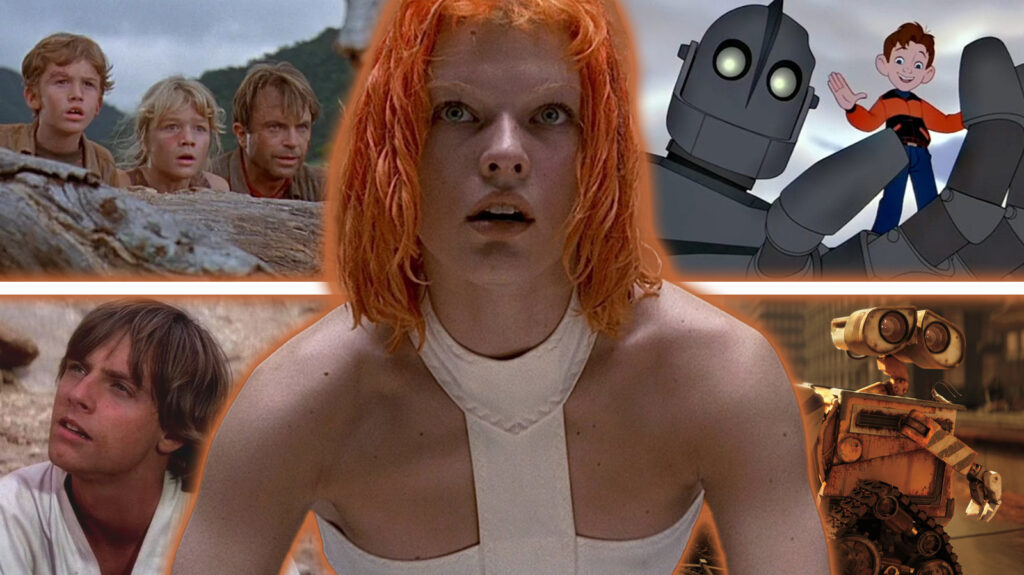

Rewatching our favorite films and TV shows can bring us comfort during a difficult time. Revisiting a beloved story or characters can connect us to our pasts where things might have been a little better for us. Plus, along with this feeling of relaxation and stimulation, we’re also giving ourselves a sense of control. Despite the horrors persisting in the real world, repeated viewings are an escape where we know that we’ll be happy with the results.
When it comes to the science fiction genre, fans can probably name thousands of examples of rewatchable movies. And we’re not just talking about the ones that need a rewatch or two to fully unlock all of their secrets. This time around, we’re focused on the proven crowd pleasers that even the broader audience beyond the hardcore sci-fi faithful could get into. Basically, if you’re looking for a good time at the movies (or during a movie night at home), then these are the most rewatchable sci-fi films to put on over and over again.
WALL-E
While another movie on this list may invoke terror at the thought of the rise of the machines, Disney and Pixar’s “WALL-E” could cause you to embrace it, especially if the robots are as cute as the titular trash-compacting pal. But beyond the “Hello, Dolly!” dance numbers, the sweet robot romance, and the adorable cockroach companion, this film contains a very important cautionary tale about consumerism, greed, and disregard for the environment affects on our planet.
In the 2008 animated feature film from “A Bug’s Life” and “Finding Nemo” director Andrew Stanton, WALL-E is a sentient robot tasked with cleaning up the Earth after the human race abandoned it. During a seemingly routine day, another more advanced robot called EVE arrives in his sector to find signs of life that would would allow the humans to return. But after he shares with her that he found a living seedling, the duo find themselves aboard the starliner Axiom among its pampered human passengers. However, when the ship senses their way of life coming to an end, it tries to stop WALL-E, EVE, and the Captain from initiating the protocols to return the fleet to Earth.
Demolition Man
Like the passengers of the Axiom, the citizens of San Angeles in 2032 are oblivious and non-violent. But when psychopathic killer Simon Phoenix is broken out of a cryo-prison and unleashed on the unsuspecting city, the SAPD are forced to reanimate another prisoner who knows a thing or two about Phoenix’s tactics and isn’t afraid to engage in some reckless abandon while apprehending him. Enter Sergeant John Spartan AKA The Demolition Man.
“Demolition Man” starring Sylvester Stallone and Wesley Snipes is a great action movie. The explosions and fight choreography exudes blockbuster film energy. But it’s the sci-fi elements integrated into the satirical underlying message that made it such a cult classic for so many years. There’s also the quirky bits about the world of the future such as Taco Bell surviving the Fast Food Wars and the three seashells. However, its depiction of government overreach creating a “utopia” that doesn’t include the lower classes is certainly something that fans will hopefully continue to rally against in a world that seemingly keeps trying to make it happen.
The Iron Giant
Animated movies gained a reputation of being only for children. Walt Disney and the Looney Tunes did a lot to perpetuate that image, but Bugs Bunny’s parent company Warner Bros. took a huge step towards proving that the medium can speak to all ages in 1999 with “The Iron Giant.”
Loosely based on Ted Hughes’ novel “The Iron Man,” filmmaker Brad Bird of “The Incredibles” and “Ratatouille” fame shares the story of imaginative nine-year-old Hogarth Hughes and the 50-foot-tall robot from outer space that crash lands in an idyllic Maine town. While the two of them become closer, Agent Kent Mansley begins investigating the crash due to Cold War paranoia. Determined to keep his misunderstood friend safe from federal agents, Hogarth enlists beatnik artist Dean McCoppin to help convince everyone that The Giant comes in peace.
Though initially a commercial failure when released, “The Iron Giant” gained critical acclaim for its ambitious themes and beautiful animation. The film also earned a cult following of fans who learned empathy and willingness to accept outsiders, a timeless lesson that more people could stand to learn.
Pacific Rim
Throughout the history of cinema, colossal monsters known as kaiju have run wild and wreaked havoc on various cities around the world. But in Guillermo Del Toro’s kaiju-smashing “Pacific Rim,” the world finally finds a way to fight back. Thanks to humungous mechanical suits called jaegers, the human race manages to even the odds and maybe even eek out a win in this ongoing battle.
Del Toro uses his reverence for the monster movie genre to deliver stunning visuals to bring the fantastical world of jaegers and kaiju to life in this 2013 film. However, the renowned filmmaker also doesn’t skimp on the human element either. The script finds a way to masterfully balance both story elements in order to tell a story about how people can overcome adversity together despite all of their differences, even if that adversity might call for giant robots fighting mythical creatures. Fans who grew up with “Mighty Morphin Power Rangers,” “Godzilla,” and “Mobile Suit Gundam Wing” should have no problem turning this one on over and over again.
The Matrix
AI may be a hot button topic right now, but the concept has always had a place in science fiction. Back in 1999, one of the most prominent figures in the war against artificial intelligence was introduced when The Wachowskis unleashed Neo in “The Matrix.”
Set in a dystopian world where humans have become trapped in a simulated reality, “The Matrix” follows a group of renegade hackers who are trying to free people and start a rebellion against the machines. The story may have expanded into sequels, comic books, and video games over the years, but the original movie was so ground-breaking and masterfully crafted that it shifted the culture in so many ways. Due to its revolutionary special effects (including its risky, signature “bullet time” innovation), deeply philosophical and spiritual themes, and incredibly entertaining story, it quickly became one of the most influential action and sci-fi movies of all time.
Now, as new generations continue to get plugged into its genius, this movie acts as a blueprint for future storytellers and filmmakers just as epics like “Star Wars,” “Lord of the Rings,” and “Star Trek” did before it.
Edge of Tomorrow
“Groundhog Day” starring Bill Murray and Andie McDowell took the time loop to new heights in 1993. Since then, plenty of other films have played with the plot device to achieve varying degrees of success. But one film that definitely came closest is the sci-fi action film “Edge of Tomorrow.”
Based on a popular Japanese novel and manga, the adaptation follows Tom Cruise’s William Cage as he gets stuck in a time loop after getting doused in the blood of the enemy alien race known as Mimics. Unable to die, Cage uses his ability to seek out war hero Rita Vrataski (played by Emily Blunt) and figure out the Mimics’ plan of attack in order to end the ongoing war.
Though it’s totally presented as your typical summer blockbuster, “Edge of Tomorrow” actually ends up being very clever. Plus, with charming leads, a fresh take on time loops, and filmmaker Doug Liman returning to form after roughly a decade since “Mr. & Mrs. Smith” and “The Bourne Identity,” the audience couldn’t stay away from “Edge of Tomorrow.”
The Fifth Element
Part of what makes a movie so rewatchable is its ability to pull the audience into its world at any given moment with interesting characters or an unmistakable visual footprint. While plenty of films can be draws with one or the other, Luc Besson’s “The Fifth Element” is a prime example of a movie that has both in spades. If you were flipping through channels (or, more accurately based on current trends, browsing thumbnails on a streaming service), your eye is sure to catch the rugged Korben Dallas (Bruce Willis), orange-haired and aloof Leeloo (Milla Jovovich), or the flamboyant Ruby Rhod (Chris Tucker) in an instant.
But beyond Besson’s futuristic vision and ripoff of Plato, “The Fifth Element” keeps the action coming. Dallas is on a mission to help the mysterious Leeloo track down four ancient relics needed to stop a great evil from conquering Earth. Every step of the way, the duo finds themselves in some kind of new and exciting chase. And on top of the nonstop action, we also have nonstop camp. Because it doesn’t take itself too seriously, it’s much easier to have fun on this journey through thew 23rd century.
Ghostbusters
Insanely quotable lines are one thing that makes comedies like “Anchorman,” “Monty Python and the Holy Grail,” or “Bridesmaids” fun to rewatch. As the story progresses, you can’t wait to hear your favorite line once again. Sci-fi’s answer to that is “Ghostbusters,” the 1984 film from comedic powerhouses Ivan Reitman, Dan Aykroyd, and Harold Ramis. And though any installment of the franchise is worth a rewatch, it never hurts to go back to the very beginning.
In the movie, Aykroyd and Ramis star alongside Bill Murray and Ernie Hudson as paranormal investigators who bounce around New York City capturing ghosts as if they were exterminating bugs. But when the team encounters the minions of the demigod Zuul who attempt to resurrect an even bigger bad to initiate the apocalypse, they must don their proton packs to face off with the biggest specter they’ve ever encountered in their short careers.
“Ghostbusters” has everything: Human sacrifice, dogs and cats living together, and mass hysteria. But if there’s one thing that this fan-favorite franchise has given us over and over again, it’s the answer to the eternal question, “Who ya gonna call?”
Bill & Ted’s Excellent Adventure
Before Keanu Reeves was The One in “The Matrix,” he was one half of one of the most influential duos from throughout all of space and time. When his Ted “Theodore” Logan joins forces with Alex Winter’s Bill S. Preston Esquire in “Bill & Ted’s Excellent Adventure,” the two best friends from San Dimas, California form Wyld Stallyns, the band that inspires the peaceful utopian society of the future. However, before they can create the music that kicks off this peaceful period of enlightenment, they must pass their high school history presentation. Luckily, a guide from the future played by the legendary George Carlin has bestowed upon them a most excellent tool to aid them with first-hand research: A time traveling phone booth.
Despite including some of the great thinkers of their time like Socrates, Sigmund Freud, and Abraham Lincoln, the 1989 comedy is hardly profound. Instead, it’s silly yet sincere. While some critics were quick to write it off as fluff, Bill and Ted serve as a great reminder that even the most prominent people in history can come from unexpected beginnings.
Terminator 2: Judgement Day
Though there are exceptions, sequels are rarely better than the original. But sometimes a follow-up can become as celebrated as its predecessor and one of the most prominent cases of this is “Terminator 2: Judgement Day.”
James Cameron initially delivered more of a horror vibe in “The Terminator” with the evil artificial intelligence Skynet sending a robot back in time to assassinate the leader of the human resistance before he’s even born. But in the second film in the series, he leans harder into sci-fi by adding more robots to the mix this time around. Now, instead of just his badass mother protecting him, John Connor has his very own Terminator (played by Arnold Schwarzenegger) on his side to face off with the more advanced model sent by Skynet to kill him.
It’s also worth noting that CGI in film was still in its infancy in the early 1990s. Regardless of the rudimentary stages this technology was in at the time, the majority of the special effects hold up even better than some more modern movies. “T2” is worth watching for that aspect alone.
Star Wars: A New Hope
Depending on your level of fandom, every “Star Wars” movie can be the most rewatchable one in the franchise. However, since “Star Wars: A New Hope” is the first piece of George Lucas’ intergalactic puzzle, it’s probably the best candidate for the most universally rewatchable installment of the Skywalker Saga since it largely stands alone.
In the first chapter of the beloved story from a galaxy far far away, the Rebel Alliance is doing what they can to keep the nefarious Galactic Empire at bay. But when Princess Leia is captured after retrieving the plans for the Empire’s ultimate weapon, farm boy Luke Skywalker and Jedi Knight Obi-Wan Kenobi team up with master smugglers Han Solo and Chewbacca the Wookie to save her.
Not only did this film launch a pop culture phenomenon, but the ripples made by “Star Wars” were felt across multiple industries, including special effects (due to the creation of Industrial Light & Magic) and toys (thanks to the unprecedented amount of merchandising associated with the movie). Surprisingly all of this started because of Lucas’ hope to create his own sci-fi film. Luckily, rebellions are built on hope.
Jurassic Park
This goes without saying, but Steven Spielberg is a legendary filmmaker. He revolutionized the modern blockbuster movie through “Jaws,” E.T. the Extra-Terrestrial,” and the Indiana Jones series. But using the tools and techniques pioneered by his peers James Cameron, George Lucas, and their forefathers, he managed to bring dinosaurs back to life in “Jurassic Park.” Somehow, they managed to stand the test of time and look better than modern depictions of the extinct creatures.
In the movie, businessman John Hammond enlists a team of geneticists to resurrect dinosaurs as the main attraction of a wildlife park located on an island near Costa Rica. But during a catastrophic power outage, the island visitors must find a way to survive after the predators including a venomous Dilophosaurus, a pack of Velociraptors, and a massive Tyrannosaurus rex are let loose to run amok.
Life (and Universal Studios), uh, found a way to keep the franchise going after the massive success of the first movie. But none of them have really captured the same magic contained in the original “Jurassic Park” and that’s certainly something worth revisiting over and over again.
Galaxy Quest
Very few parodies have been as well-received as “Galaxy Quest.” The 1999 film affectionately pokes fun at “Star Trek,” its stars, and its fans, but they fully embrace it. In fact, many say that it’s the best “Star Trek” movie. But whether you’re familiar with the fan favorite franchise or not, there’s plenty to love about this movie.
Named after a fictional 1980s sci-fi series, Dean Parisot’s cult classic satire follows the actors that play the crew from the show years after its heyday as they are abducted by the Thermians in an effort to save them from intergalactic warlord Sarris. However, the peaceful aliens don’t realize that the people they’ve tracked down aren’t actually real heroes.
The all-star cast gives excellent performances. The script is smartly written and very fun to watch. Though it parodies fandom culture, it never punches down. In fact, it celebrates fans as the backbone of any great franchise. In times when fans are often disagreeing or complaining about something, “Galaxy Quest” does a great job of reminding us why we became fans in the first place.
Back to the Future
Trilogies are hard to do well. But when you need an example of how to pull it off, look no further than the “Back to the Future” movies. Honestly, all three could go in this slot as a triple feature, since each part delivers an incredible act of Marty McFly and Doc Brown’s story, but we’ll stick with the first of Robert Zebecks and Bob Gale’s masterpiece.
In the first film, 1985 teen Marty accidentally finds himself in 1955 thanks to a time machine created by his eccentric scientist friend. But after he accidentally ruins his parents’ meet cute, he and the 1955 version of Dr. Emmett Brown have to get them together or else Marty ceases to exist.
A tight script, stunning visual effects, and a killer score are perfectly married together to create an unforgettable time travel tale. It also solidified the places of stars Michael J. Fox and Christopher Lloyd (and the Delorean Time Machine) in pop culture history. “Back to the Future” is simply one of the best films ever made, and it deserves to be rewatched as much as possible.
Rocky Horror Picture Show
Pop culture is basically nerd culture now, but science fiction is still a relatively niche interest. But an even more niche genre is sci-fi musicals. Despite that, “The Rocky Horror Picture Show” is probably the most rewatched sci-fi movie (and possibly movie in general) of all time.
Over 50 years after its initially ignored theatrical release, the musical horror comedy based on Richard O’Brien’s stage musical is still in limited release thanks to midnight movie screenings around the world with costumes, call and responses, and often a shadow cast acting in front of the screen. That means that Jim Sharman’s cult classic film about a young couple who meet a mad scientist on rainy night and have their lives turned upside down is the longest-running theatrical release in cinematic history.
But more than that, “Rocky Horror” has become a right of passage and a community gathering for many fans who have felt like outsiders. It’s a cultural touchstone that has roots in the LGBTQ+, counterculture, punk rock, and more. So if you’re going to rewatch this one, it’s definitely best in a theater among fellow fans.