


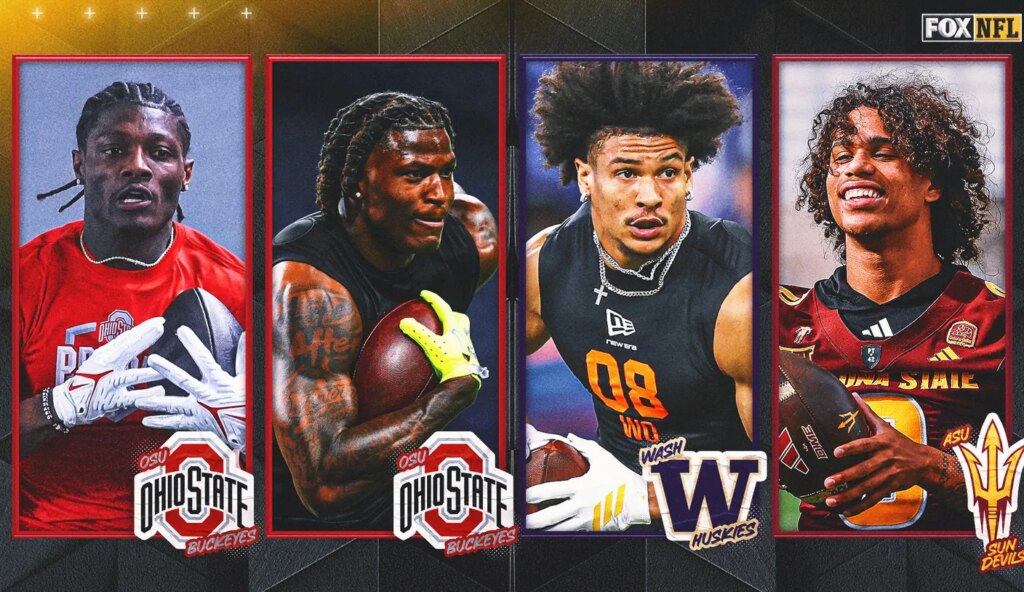
Getting a job playing in the NFL is nothing like getting an entry-level job in any other field.
At the NFL Combine, Texas A&M receiver KC Concepcion was headed into a formal interview with the Philadelphia Eagles. And Philly hit the draft prospect with an exercise he’d never seen before. The Eagles had a machine that dropped three different-colored foam batons. As the batons fell, a coach called out the color that Concepcion needed to catch — and the hand he needed to use to catch it. Left hand blue, right hand red.
Good thing he’s an All-American receiver. Concepcion managed to catch four of five pairings.
“That right there was fun,” he told me at the Adidas “Pro Day” in Portland last month.
At the NFL Combine in Indianapolis, Texas A&M receiver KC Concepcion showed his catching prowess on the field and in team interviews. (Photo by Stacy Revere/Getty Images)
Such is the unique, demanding and sometimes bizarre nature of the NFL draft process, which includes workouts, medical checks and lots of interviews.
When it comes to the interviews, which come one after another, Alabama quarterback Ty Simpson and Indiana QB Fernando Mendoza have the perfect type of mind for the pre-draft process. The same is true of Ohio State safety Caleb Downs, whose interview with one team “was kind of boring with how easy it was for him,” per a scout in the room.
Of course, no matter who it is, these prospects are nervous stepping into a room with NFL evaluators, particularly for the first time.
“The first one — a little nervous, a little anxious. But after that one, it was just rolling,” Ohio State edge Arvell Reese told me in Portland.
Often, prospects can get into a groove. There’s a routine from one team’s interview to the next. And the prospects will answer many of the same questions during their Top 30 meetings. (Each NFL team can invite up to 30 prospects to their facility to conduct interviews, medical checks and on-field workouts.)
“It kind of gets kind of repetitive — just answering the same questions,” Arizona State receiver Jordyn Tyson told me in Portland. “Shoot, you’re talking about yourself, so nobody knows you better than yourself. But, yeah, I’d say it’s going pretty good. Just trying not to shoot myself in the foot and trying to just leave it all on their end.”
Arizona State wide receiver Jordyn Tyson missed drills at the combine due to a lingering hamstring injury, so he wanted to nail the interviews. (Photo by Zach Bolinger/Icon Sportswire via Getty Images)
For the on-field portion, there are the freak athletes whose measurables are perfect, whether it’s at the combine in Indianapolis or at pro day or any of the other venues where players meet with teams. Count Downs and Reese in that category. Let’s also throw in Oregon tight end Kenyon Sadiq and Ducks safety Dillon Thieneman, who absolutely crushed the workout portion of the combine.
Not everyone has it so easy.
“It’s all mental,” a former NFL first-round pick told me. “(You’re in Indianapolis) for days, then you don’t get on field until the end. … I graded out higher because some guys just couldn’t handle all the days stacked on each other.”
Every measurement matters — even, as it turns out, the things you can’t exactly measure.
The experience is a microcosm of what can be so terrible and so thrilling about these liminal months when football players are “prospects” — not college football players or NFL players. They get measured. They get interviewed without end by teams, by media members and by marketing reps.
The invasive probing transcends the average job interview.
“They’re doing background checks on your childhood stuff, so at this point, your whole life is sort of a job interview,” Downs told me. “So I can’t say this three-month process is my job interview. Your whole life is pretty much a job interview.”
Here’s what we learned about the process while speaking with several of the draft’s top prospects — and some of the people who are preparing and evaluating them.
Getting the body right for the workouts
Excel Sports Management has a gym in Southern California where Washington receiver Denzel Boson spent weeks training for the combine and his pro day, with consultant coaches on-site to provide comprehensive preparation. Almost all the likely first-rounders spend their time training at their agency’s facility.
After that, the draft process is about doing everything except playing football: watching it, drilling it, discussing it.
There’s a clear dichotomy between the offseason drills that NFL veterans are doing and the ones that the incoming rookies are doing. Look at Instagram, where you can see current NFL players running functional drills to help them improve at their position. And then look at the combine, where you see a set of drills that have rightfully earned the event the nickname “the Underwear Olympics.”
As antiquated as these general drills might seem, they measure a certain kind of athleticism, which draft prospects can and should hone prior to showing up in Indianapolis. So that’s where their attention shifts: learning proper form for the 40-yard dash, the broad jump and the three-cone drill.
Downs, however, pushed back on that idea.
“I’m trying to get ready to go play football, so that’s what my workouts are tailored to,” he told me in March. “Just try to make sure that when I get to camp I’m ready to play ball. That’s the most important thing, so that’s really what I’m focused on.”
But Downs is an anomaly, a surefire top-10 pick. Not everyone can get away with that mentality.
Carnell Tate, the consensus top receiver in the draft and Downs’ college teammate, said he might be doing new drills, but he’s keeping the same routine he had at Ohio State.
“It is basically my college routine,” Tate told me. “It’s just, I’m not in college no more at Ohio State.”
For many players, draft prep extends beyond their training routine.
Miami All-American edge rusher Rueben Bain Jr. said he is cutting out fried foods and excess sugar from his diet. And he’s more regimented about when he eats — changing his meal schedule. It helps that he’s hired a private chef.
“It’s more consistent,” Bain told me in Portland in March. “It’s something I kind of tighten up on, and being a little bit more serious about my approach, rather than just doing it here and there and kind of slacking off.”
Getting the mind right for the interviews
The most universal elements of the interviews are the film study and install.
NFL teams will put up film from a player’s college career and quiz him on what went right or wrong. And then the players will often need to learn a series of plays: the install. Sometimes, they get these plays onsite. Sometimes, they’ll get a small playbook ahead of a meeting. The players will have to prove they’ve retained the information, as best they can.
“This process is all about me,” Tate told me. “Teams watch your film and see what you retain from your previous school and see what you could have done better. And then they just pick out like, ‘Why did this work? Why didn’t this work?’ I’ve just been watching my film and making sure I know my play in and out — knowing why I messed up here or knowing why I did something good here.
“And then they just install a play for me — or a couple plays — and see what I can retain from that meeting, and then go put it on the field or go put on the board.”
Ohio State’s Carnell Tate is the consensus top receiver in the 2026 draft. (Photo by Jason Mowry/Getty Images)
Players lean on different resources to prepare themselves for their interviews. There are formal interviews at the NFL Combine and Top-30 visits. But informal interviews happen throughout the process, with evaluators striking up a conversation with a prospect at an all-star game (like the Senior Bowl), at the combine and at their pro day.
Players might even get a random phone call from time to time. Teams may contact an unlimited number of incoming rookies up to three times per week, for up to one hour at a time, per NFL rules. Teams are not allowed to contact college players until they have declared for the draft — or are no longer eligible to keep playing in college.
When teams can finally speak with players, any morsel of information could prove important. That means an interview is lurking behind every corner.
“I think you’ve just got to be yourself,” Arvell Reese told me. “It’s hard to put on the act and it’s hard to lie. So I feel like being yourself is the easiest thing to do. So when I’m meeting with all the teams, I just be myself.”
As best they can, prospects prepare thoroughly.
Take Boston, for example. He spent time with Excel consultant Ricky Proehl, who played receiver in the NFL for 17 years and is now the head coach of the UFL’s St. Louis Battlehawks. Proehl worked with Boston on and off the field to make sure he had the tools to take on the rigors of the draft process. That includes interview prep, drill prep and pro day design.
“Teams bring you in for an official visit,” Proehl told me by phone. “They want to see how much you can retain. They’ll give their offense, they’ll give formations, concepts or routes, different things, and then they want to see how much you can retain. So we’ll go over different scenarios.”
When not coaching the UFL’s St. Louis Battlehawks, Ricky Proehl prepares NFL prospects for the draft. He was a third-round pick in 1990 and played receiver in the NFL for 17 years. (Photo by Dilip Vishwanat/UFL/Getty Images)
Boston said he and Proehl can’t go over every NFL system. But they can work to build fundamental skills and concepts around receiver positions, offensive formations and defensive coverages. The receiver studied on his iPad with a magic pencil to work through the defenses. He and Proehl made a cheat sheet of all the defenses to review.
“You can’t expect every team to be the same or have the same terminology, but you can get the rules kind of down in your head when it comes to the O’s and the X’s and all those different things,” Boston told me.
In the case of some of the top Ohio State prospects, they might work with an agency consultant. But they also have easy access to a former NFL head coach. Matt Patricia, who served as the Lions’ head coach from 2018 to 2020, is now the Buckeyes’ defensive coordinator.
“Coach Patricia did a great job giving us the time we needed to make sure that we’re ready to go out and articulate the way that we need to. So a lot of appreciation for him for finding the time to do that,” Downs told me. “Mock interviews. Zooms about the film they’re going to show and the questions they’re going to ask. Trying to get those opportunities to answer the questions on the test before they’re asked.”
Ryan Day on coaching Ohio State; Caleb Downs, Carnell Tate’s potential

(2026 NFL Draft: Top 150 Overall Prospects)
The interviews will extend beyond football. When it comes to getting to know a prospect as a person, teams have different philosophies and methodologies, particularly when addressing sensitive issues or legal matters.
One scout told me he’d save the difficult questions for when he felt like he knew a prospect, in large part because he didn’t think he’d get an honest answer prior to that point. That scout said: “(A prospect will say) way more if he knows you care. … You’ll get everything you want by establishing relationships.” Another scout told me he’d ask the difficult questions to see if players would lie — and, sometimes, they would, which the scout knew from his research.
For the most-prepared prospects, the chalk talk is actually the highlight of the draft experience. They get to meet some of the smartest minds in football and pick their brains.
“It’s been awesome,” Downs told me. “Honestly, I feel like my mind is what separates me, and just being able to share that and have conversations about things. And also just learning is always such a huge thing for me, just putting myself in positions to learn. And there’s no higher football than the NFL, so it’s a great opportunity to learn from the coaches that are there and try to expand my mind.”
For prospects, there’s no better feeling than nailing an interview.
“I just feel like knowing you crushed a meeting,” Washington running back Jonah Coleman told me at Adidas Pro Day. “After you come out of a meeting or after you get off the Zoom, just knowing that you crushed it — that has been the best part.”
(Inside Adidas Rookie Pro Day with Fernando Mendoza, Other Top Prospects)
Expect the unexpected.
The draft process is infamous for producing absurdity and even inappropriate behavior. Thankfully, that practice has grown less pervasive. But there is still plenty of silliness.
It was one thing for people to debate over whether Joe Burrow’s hand size mattered. (Which happened!) It’s another thing for evaluators to ask about sexual orientation, murder weapons or … whether a player finds his mother attractive.
One former NFL player said that, when he interviewed with the Cleveland Browns, they took the tape from his junior season rather than his senior year — and only asked about his worst plays. It was a painful and unnecessarily contentious meeting. What was that scout’s intention? Unclear.
But on the plus side — after the pro day and combine — a draft prospect might never have to run the 40-yard dash again. Or catch foam batons dropped from a machine.
“The pro day’s over, combine’s over, you’re not gonna have to train for that anymore. Now it’s back to football,” Denzel Boston told me.
That’ll come after the draft — when prospects finally become players again.