
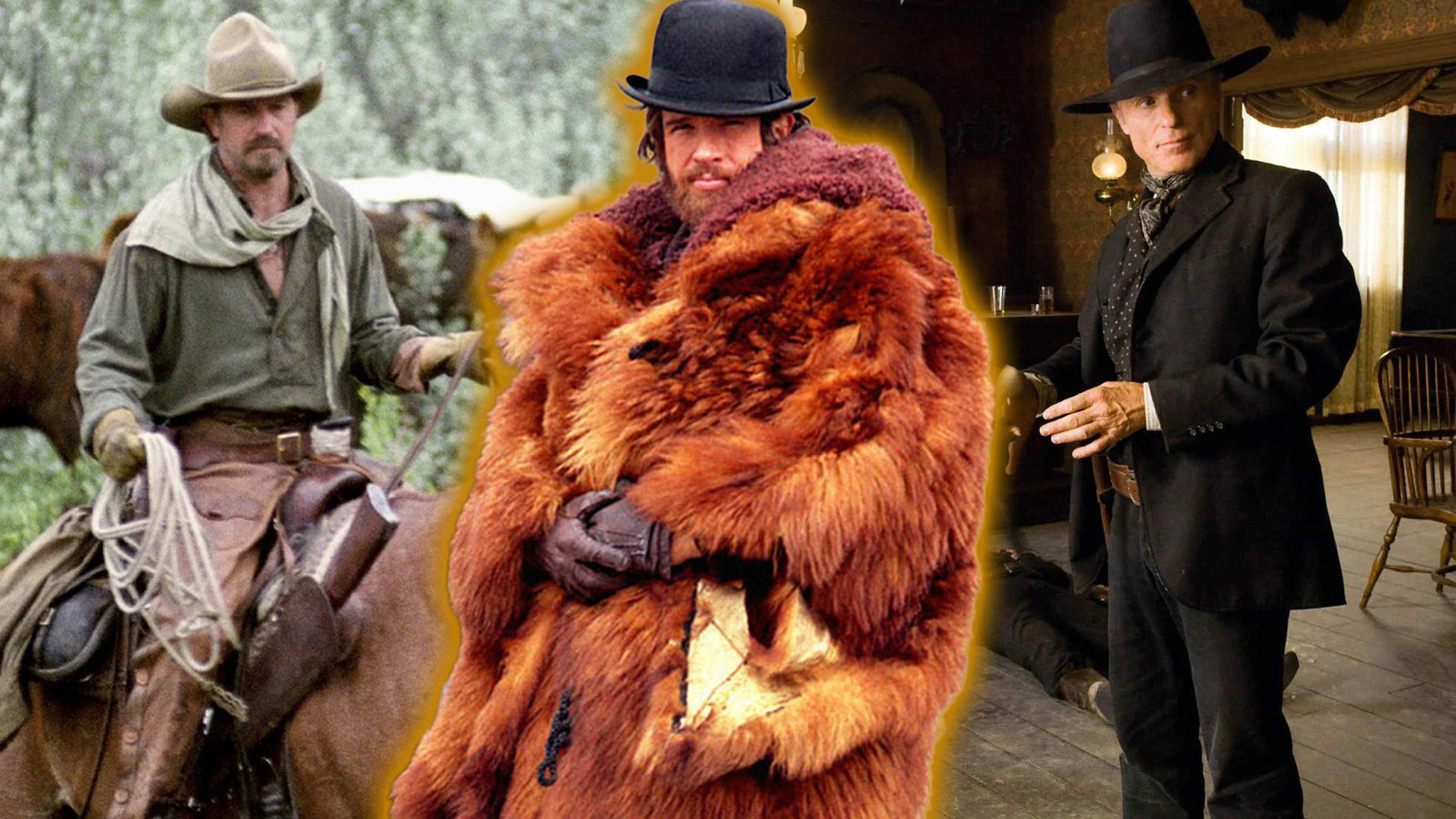
The Western genre is nearly as old as the film medium itself, dating as far back as 1903’s “The Great Train Robbery.” Over the subsequent century, countless Western movies have been made worldwide, so it’s only natural that many have since gotten lost in the shuffle. This isn’t an indictment of their quality but more of an indicator of the genre’s increasingly crowded field. There are plenty of fantastic Westerns that nobody seems to mention anymore, but they deserve to be in the modern discourse about the genre.
Of the Westerns that we’re listing here, some were acclaimed and commercially successful upon their theatrical release but have fallen by the wayside over time. Other entries on this list include underrated Westerns you need to watch, some of which failed to connect with audiences upon their debut. Regardless of their box office earnings or critical accolades, these are genre films that just don’t get a proper amount of attention now.
Here are the 10 best Western movies nobody talks about anymore and deserve to get more modern recognition.
The Gunslinger (1950)
With his stentorian voice and square-jawed good looks, Gregory Peck often played characters carrying a noticeable sense of dignity about them. That makes his starring role in the 1950 Western “The Gunfighter” all the more against-type, playing infamous gunslinger Jimmy Ringo. Carrying the reputation as the fastest draw in the west, Ringo is forced to defend himself from numerous challengers trying to be recognized as a quicker draw. World-weary from a life of violence and killing, Ringo’s past catches up to him when he visits his wife Peggy (Helen Westcott) in a frontier town.
While some might not rank “The Gunfighter” among the best Gregory Peck movies, it certainly provides him with one of his more nuanced roles. Peck isn’t playing a clean-cut heroic archetype this time around, but he’s someone carrying a history of violence constantly on his shoulders. Similarly, there is a postmodern quality to the story, particularly in how it deconstructs the mythic image of the quickdraw gunslinger. A proto-revisionist Western, especially for a movie released in 1950, “The Gunfighter” is an underrated Gregory Peck classic.
3:10 to Yuma
Author Elmore Leonard’s 1953 short story “3:10 to Yuma” is best known nowadays for the 2007 critically acclaimed Western starring Russell Crowe and Christian Bale. But Leonard’s story was first adapted for the big screen with a 1957 movie of the same name starring Glenn Ford and Van Heflin. Ford plays notorious outlaw Ben Wade, who is arrested with the help of local rancher Dan Evans (Heflin) after a recent stagecoach robbery. Evans agrees to escort Wade to a train bound for Yuma prison, with the two men bonding as they are pursued by Wade’s murderous gang.
Overshadowed by its remake, the original cinematic adaptation of “3:10 to Yuma” is a fantastic take on Leonard’s tale. The rapport between Ford and Heflin makes up the emotional core of the film, especially how coolly Ford plays his outlaw character. The action is well-staged too, particularly the climactic race to the train station as Wade and Evans move while under fire from Wade’s merciless outlaws. Moving at a propulsive pace, the 1957 “3:10 to Yuma” is all killer, no filler in bringing its Wild West road story to life.
The Comancheros
One of the more underrated and overlooked John Wayne movies, 1961’s “The Comancheros” is based on the 1952 novel of the same name by Paul Wellman. Wayne stars as Texas Ranger Jake Cutter who is pursuing gambler Paul Regret (Stuart Whitman) after the latter killed a Louisiana judge’s son in a duel. This pursuit is sidelined when an outlaw gang of Comancheros supply hostile indigenous tribes with guns and whiskey endangering settlements along the frontier. Cutter and Regret have to learn how to work together to infiltrate the Comanchero camp and dismantle their smuggling operation.
“The Comancheros” essentially sets the mold for other prisoner-cop movie dynamics popularized by “Midnight Run.” Wayne and Whitman have an easygoing rapport, despite being on opposite sides of the law while the action is engagingly staged. But couched in between Wayne’s more celebrated projects like “Rio Bravo” and “The Man Who Shot Liberty Valance,” the 1961 film feels neglected by modern audiences. Backed by a rousing original score composed by Elmer Bernstein, “The Comancheros” is one of the best John Wayne films.
The Great Silence
Sergio Leone was far from the only Italian filmmaker making Westerns throughout the ’60s, with Sergio Corbucci also putting his own stylish spin on the genre. After helming 1966’s “Django,” the controversial spaghetti Western that inspired “Django Unchained,” Corbucci directed and co-wrote the much bleaker “The Great Silence” in 1968. The movie stars Jean-Louis Trintignant as a mute gunslinger known simply as Silence who defends a town from a murderous troupe of bounty hunters hired by a local land baron. Leading the bloodthirsty killers is a particularly vicious gunman appropriately nicknamed Loco (Klaus Kinski), with the two gunfighters set for a fierce showdown.
With its snowy environments and moody cinematography, “The Great Silence” is one of the most atmospheric ’60s Westerns. However, the heightened violence for its era and the movie’s dark ending affected it receiving a wide theatrical release overseas, including in the United States. This resulted in “The Great Silence” flopping at the box office, at least as far as worldwide earnings were concerned. A spaghetti Western highlight and certainly one of Corbucci’s best movies, “The Great Silence” is a hauntingly good feel-bad Western.
The Ballad of Cable Hogue
While filmmaker Sam Peckinpah might be best known for directing gratuitously violent movies, like the controversial ’60s Western “The Wild Bunch,” he helmed plenty of gentler projects too. Among these is the 1970 film “The Ballad of Cable Hogue,” starring Jason Robards as the titular Wild West drifter. After discovering a significant wellspring in a seemingly worthless stretch of desert, Hogue hastily purchases the land but runs into all sorts of hijinks in town. This includes Hogue going into business with a wandering reverend (David Warner) and striking up a romance with local sex worker Hildy (Stella Stevens).
One of the best Westerns of the 1970s, “The Ballad of Cable Hogue” is among Peckinpah’s most overlooked work. There are rivalries and feuds that Hogue gets caught up in, but without the showstoppingly brutal set pieces present in Peckinpah’s other movies. Instead, the film is more of an overtly screwball comedy that uses the last days of the Wild West as its backdrop. Anchored by a strong lead performance from Robards, “The Ballad of Cable Hogue” is Peckinpah at his most underrated.
McCabe & Mrs. Miller
Filmmaker Robert Altman made an entire career of subverting cinematic archetypes and genres, whether it be war movies like “M*A*S*H” or a neo-noir such as “The Long Goodbye.” With his 1971 film “McCabe & Mrs. Miller,” which he directed and co-wrote, Altman provided a thoroughly postmodern Western. Warren Beatty stars as gambler John McCabe, who takes advantage of a Washington boomtown mistaking him for a gunslinger to become its de facto leader. Joining into business with sex worker Constance Miller (Julie Christie), McCabe grows richer, attracting the attention of a ruthless land baron and his hired guns.
For “McCabe & Mrs. Miller,” Altman trades heavy on atmosphere while he depicts a frontier town in the final days of the Wild West. There is a hazy quality to the cinematography, backed by moody songs provided by Leonard Cohen, helping underscore that striking tone. And true to many Altman stories, this is a Western with no clear heroes, with McCabe often resorting to underhanded means to survive when he finds his ruse dangerously unraveling. One of the best revisionist Westerns that everyone should watch at least once, “McCabe & Mrs. Miller” maintains the appeal of the genre while completely subverting it.
Duck, You Sucker!
When it comes to filmmaker Sergio Leone, his Western movies provide an embarrassment of riches. The most underrated and overlooked of the bunch is 1971’s “Duck, You Sucker!,” set in the midst of the 1910s Mexican Revolution. The movie has Irish explosives expert John Mallory (James Coburn) coerced by outlaw Juan Miranda (Rod Steiger) into launching a bank robbery, unaware it’s being used as a political prison. This makes them both heroes of the revolution, with Juan becoming more involved in revenge as the escalation claims his family’s lives.
“Duck, You Sucker!” isn’t ranked as highly as Leone’s other movies but it still packs an explosive punch. The action is stylishly staged and composer Ennio Morricone provides another rousing score, while the pace is more propulsive than Leone’s preceding movie “Once Upon a Time in the West.” James Coburn and Rod Steiger make a strong unlikely duo grounding the emotional stakes, with Coburn as cool as ice in his performance as Mallory. While nowhere near as celebrated as the “Dollars” trilogy or “Once Upon a Time in the West,” “Duck, You Sucker!” is still an enjoyable Western romp from Leone.
Dead Man
Another consistently effective counter-culture filmmaker like Robert Altman is Jim Jarmusch, who wrote and directed the 1995 revisionist Western “Dead Man.” Johnny Depp stars William Blake, an accountant who kills the jealous lover of a woman he gets involved in self-defense with shortly after arriving at a frontier town. Wounded from the shootout, Blake’s time is limited as the bullet in his body gradually moves towards his heart, while bounty hunters pursue him for the killing. As Blake prepares for his inevitable death, he is guided by Native American healer Nobody (Gary Farmer), learning about the grave injustices committed against the indigenous populations.
A psychedelic, or acid, Western movie, “Dead Man” is one of the best Western movies of the 1990s. Filmed in a moody monochrome, Jarmusch stages his Western as a surreal tour of self-actualization and acceptance with impending mortality. There is a meditative quality to the movie in exploring these themes, while Depp brings a subdued lead performance as Blake. Easily the strangest and most poetic movie on this list, “Dead Man” challenges its audience to rethink what’s possible from a Western while retaining its familiar setting and tropes.
Open Range
Filmmaker Kevin Costner has been starring and directing Western projects since his perfect role in “Silverado” in 1985. After seeing his career ebb and flow throughout the ’90s, Costner returned to the genre as the director, producer, and star of 2003’s “Open Range.” Costner plays Charley Waite, a former Bushwacker who participates in a cattle drive led by the grizzled Boss Spearman (Robert Duvall). While stopping in the frontier town of Harmonville for supplies, the cattlemen incur the wrath of dictatorial landowner Denton Baxter (Michael Gambon) leading to a fierce showdown.
Compared to his previous efforts like “Wyatt Earp,” Costner takes a more subdued and grounded approach with “Open Range.” There are plenty of sweeping shots of the landscape and characters who appreciate the value of silence rather than having to talk all the time. This is punctuated by Costner staging one of the best shootouts ever in the movie’s climax as forces inevitably collide. Moving at a poetic pace and with a strong ensemble cast led by Costner, Duvall, and Annete Bening, “Open Range” is a return to form for its filmmaker and star.
Appaloosa
In addition to starring in the project, Ed Harris stepped up as the director, producer, and co-writer of the 2008 movie “Appaloosa.” Harris plays marshal Virgil Cole, joined by his deputy and best friend Everett Hitch (Viggo Mortensen) in maintaining the law in the New Mexico Territory. The pair take on villainous rancher Randall Bragg (Jeremy Irons) as he terrorizes the town of Appaloosa with his gang of hired killers. Along the way, Cole romances a young widow named Allie French (Renée Zellweger), though Allie’s provocative ways challenge Cole and Hitch’s friendship.
“Appaloosa” is a solidly crafted Western movie, with Harris not trying to so much subvert or reimagine the genre as put his own stamp on it. He and Mortensen make for a magnetic on-screen duo while Irons is in his element playing the story’s sneering antagonist. The action is also well-executed, delivering all the intensity and quickdraw fury that comes expected with the genre. A criminally underrated Western that nobody saw, “Appaloosa” is fantastic effort from Harris on multiple creative fronts and well worth taking the time to watch.


Leave a Reply