
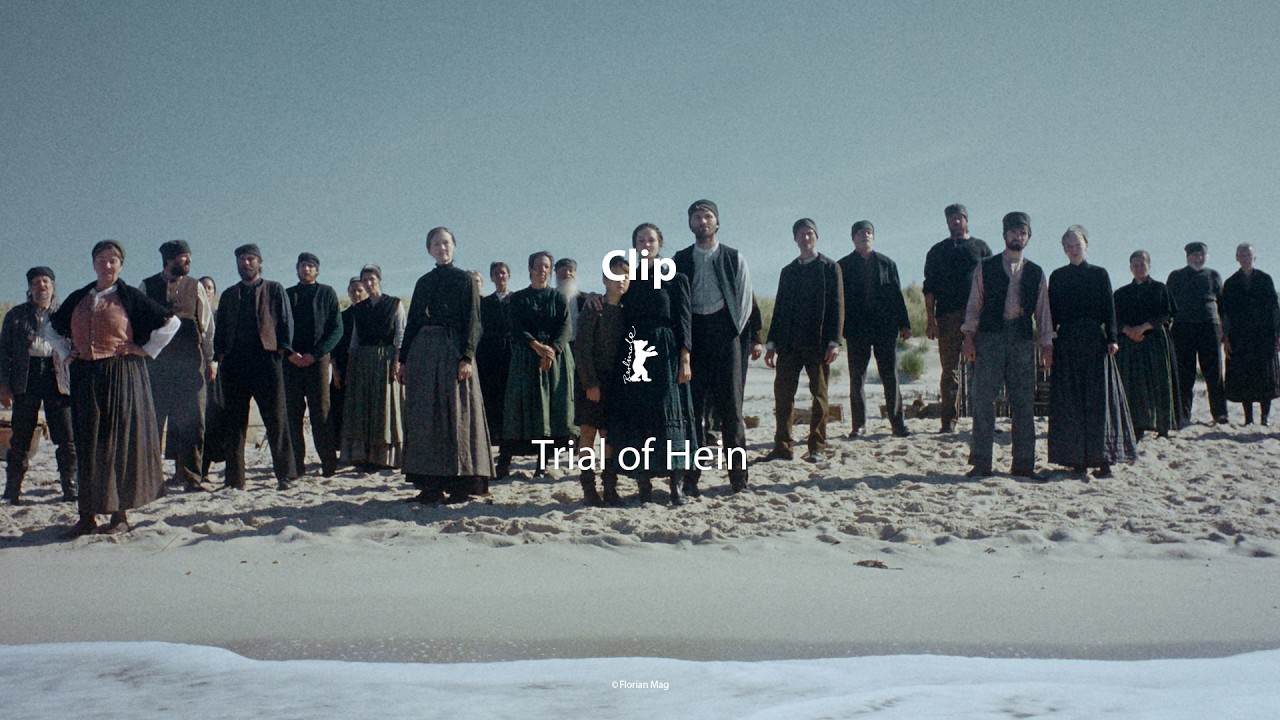
He came back after 14 years. The village decided he was nobody.
Hein returns to his remote North Sea island village after 14 years on the mainland. No one recognises him — not his closest friends, not his family. The community convenes a trial to determine whether he is who he claims to be. Shot in roofless cottages on Norderney island in a Brechtian fable register, the film uses memory, identity, and belonging as a queer homecoming allegory drawn from Stänicke’s own rural German upbringing.
Why It Is Trending: Berlinale Perspectives Opening Film Wins the Teddy Jury Award and Goes Straight to International Sales
Trial of Hein opened the Berlinale Perspectives competition on February 13, 2026 — the section dedicated to debut fiction features — and won the Teddy Jury Award at the same festival. Heretic, the Athens-based sales house behind Slovenia’s 2026 Oscars entry, boarded the film before the premiere. Strand Releasing acquired North American rights ahead of New Directors/New Films in New York; Paradis Films acquired France; DCM distributes in all German-speaking territories. The screenplay was developed at the Berlinale Talents Script Station in 2022 with a Wolfgang Kohlhaase Scholarship. Stänicke has confirmed the film took ten years from first idea to Berlinale premiere — and that it felt unexpectedly timely again by the time it was done.
Elements Driving the Trend: The Brechtian roofless houses — one or two walls per cottage, functioning as stage scenery — were born from budgetary constraint and became the film’s most distinctive visual statement. Screen Daily called it a film of great formal beauty and thematic riches; Cineuropa praised its Rashomon-esque interrogation of memory, calling the refusal to be flashy its greatest strength. Film Lincoln Center positioned it in the tradition of The Return of Martin Guerre. Paul Boche’s intense, haunted central performance holds the film’s deliberate ambiguity in place throughout. Stänicke grew up queer in a small rural German town in the 1990s — and the queer-memory dimension of the film, memories of who you truly were denied by a community insisting on an older self, is the film’s most emotionally direct dimension.
Virality: The Berlinale Perspectives opening position and immediate Teddy Award win drove strong international press. Heretic’s multi-territory sales momentum within weeks of the premiere confirms sustained arthouse buyer interest.
Critics Reception: Screen Daily — assured, enigmatic, great formal beauty; Cineuropa — reaches into the viewer’s soul; The Film Stage — rigorous, emotionally rewarding ending, can feel drawn-out at two hours; ICS Film — promising but academic; ION Cinema — frustratingly still. Hollywood Reporter called it a haunting enigma of memory and identity. Variety confirmed the North America/France sales the same day.
Awards and Recognitions: Teddy Jury Award, Berlinale 2026. Berlinale Perspectives Opening Film. New Directors/New Films 2026, New York. Wolfgang Kohlhaase Scholarship. US release April 2026 via Strand Releasing. France: Paradis Films. German-speaking territories: DCM. Israel: Lev Cinemas. World sales: Heretic.
Trial of Hein is one of the most formally confident and internationally distributed German debut features of 2026 — a Berlinale-awarded queer fable that has already found its global arthouse audience.
What Movie Trend Is Followed: The Queer Homecoming Parable Finds Its Most Formally Radical German Expression
Trial of Hein belongs to the tradition of identity-return narratives — The Return of Martin Guerre, Dogville, Rashomon — that use the question of who a person is to expose what communities demand people perform. Stänicke’s contribution adds an explicitly queer autobiographical foundation: he grew up unable to be himself in a small German town, moved away, accepted himself, and returned home with emotions the film documents. The North Sea island is every community that enforces identity as conformity. The trial is the mechanism by which communities make that enforcement institutional.
Trend Drivers: A Queer Memory Film Dressed as a Folk Fable The card game motif — Hein once excelled at it, now seems to have forgotten, a game built on bluffing — is the film’s sharpest thematic compression. Friedemann and Greta’s refusal to speak — those who know most, say least — is its most precise observation about how community complicity works. The film never confirms whether Hein is truly Hein, keeping the viewer aligned with the community’s uncertainty throughout. Stänicke’s short film history — including Gay Goth Scene — signals a director who has been working toward this queer fable for years.
The Brechtian staging that keeps audiences at intellectual distance is both the film’s greatest formal risk and the device that makes its final emotional turn land hardest.
What Is Influencing Trend: Berlinale Perspectives has become the international arthouse circuit’s most reliable platform for formally ambitious queer debut features. Heretic’s track record with Perspectives titles — Little Trouble Girls, now Trial of Hein — demonstrates a proven pipeline from Berlin Teddy Award to global arthouse distribution. German-language debut cinema has achieved remarkable international reach, with formally spare, identity-focused films finding audiences well beyond German-speaking markets.
The queer folk fable — placing LGBTQ+ experience within fable and allegory rather than realism — is one of contemporary queer cinema’s most commercially viable formats.
Macro Trends Influencing: Stänicke’s own observation — that he feared he was “too late” with the theme, then found the world had “reversed” by the time the film was done — is the film’s most significant political contextualisation. A film about communities that collectively deny the identity of someone who changed in ways they didn’t sanction arrives in a global political moment of heightened hostility to queer identity. New Directors/New Films in New York positions the film at the ideal intersection of US arthouse audience and critical infrastructure for sustained discovery.
The queer identity parable has rarely been more commercially viable or more politically necessary simultaneously.
Consumer Trends Influencing: Strand Releasing’s co-president called it “style reminiscent of Dogme and influences of classic cinema” — exactly the critical positioning that drives the US arthouse audience it needs. The Teddy Award functions as a reliable discovery signal for queer cinema communities globally. The Dogville and Return of Martin Guerre comparisons communicate formal ambition to arthouse buyers and audiences immediately.
Audience Analysis: Arthouse Audiences, Queer Cinema Communities, and Berlinale Discovery Networks The core audience is 25–55 — arthouse viewers who follow Heretic’s slate and the Berlinale Perspectives tradition, queer film festival audiences responding to the Teddy Award signal, and the New Directors/New Films crowd drawn to formally adventurous international debuts. The two-hour runtime and theatrical pacing will test viewers seeking conventional momentum; those who surrender to its fable logic will find formal intelligence and genuine emotional depth. The queer memory reading — the community insisting on a self you no longer are — gives the film its most immediate personal audience pathway.
Final Verdict: Trial of Hein Is a Formally Assured, Thematically Urgent Debut — a Queer Fable the Berlinale Recognised and the Arthouse World Has Already Embraced
Stänicke delivers a debut of real formal conviction — the roofless houses, the card game metaphor, the Rashomon structure, the Teddy Award-winning queer reading all cohere into a film that knows exactly what it is doing and why. Boche’s haunted performance holds the ambiguity together. The two-hour runtime tests patience. The academic register keeps some viewers at arm’s length. Neither prevents a debut that multiple major critics called the arrival of a significant new voice. The film is about the moment you stop pretending to be who you once were — made by a director who knows that moment from the inside.
Audience Relevance: For Anyone Who Has Returned Home and Found It No Longer Fits Hein’s experience is universally legible and specifically queer simultaneously — the fable structure allows both readings to coexist. Anyone who has stood in a former home and felt like a stranger understands the film before a word is spoken.
What Is the Message: The Community Decides Who You Are — Until You Decide Otherwise The film’s ending — Hein’s letter, his choice not to stay — delivers the fable’s argument with full emotional weight: the self a community denies you is worth more than the belonging they conditionally offer.
Relevance to Audience: A Universal Fable That Is Also Specifically Queer The Teddy Award is not incidental. The community’s collective amnesia about Hein’s closest childhood relationship with Friedemann is the film’s most precisely queer observation — communities that deploy memory as enforcement against identities they don’t sanction are doing something the film documents with political clarity and emotional honesty.
Social Relevance: A Film About Exclusion That Arrived at the Right Moment Stänicke started the project a decade ago fearing it was too late; by premiere it was urgently timely again. A fable about narrow-minded communities built on denial and collective lies about who belongs — in 2026 — needs no further contextualisation.
Performance: Boche Carries the Ambiguity; Froissant and Schüle Hold the Community’s Complicity Boche’s intensity and haunted stillness make Hein’s identity genuinely uncertain — the performance never overplays the answer. Froissant’s Friedemann — the one who knows most and says least — is the film’s most uncomfortable presence. Schüle’s Greta holds the community’s complicity in its most domestic and most damaging form.
Legacy: A Debut That Signals a Filmmaker of Rare Promise Trial of Hein will travel the international arthouse circuit for years. The Berlinale Perspectives opening slot, Teddy Award, Heretic worldwide sales, and New Directors/New Films premiere form exactly the trajectory that builds long-term reputations. Heretic’s head of sales called Stänicke “a talent to watch on the international stage.” Paradis Films called it “the arrival of a new voice.” Both are right.
Success: Teddy Jury Award, Berlinale Perspectives Opener, New Directors/New Films Teddy Jury Award, Berlinale Perspectives 2026. New Directors/New Films 2026, New York. US distribution: Strand Releasing, April 2026. France: Paradis Films. German-speaking territories: DCM. Israel: Lev Cinemas. World sales: Heretic. Supported by MOIN Film Fund, Nordmedia, Hessen Film.
The film’s cultural trajectory is already set — the awards, the sales, the festival platform all point to sustained international arthouse discovery for years to come.
Trial of Hein is the film Kai Stänicke needed a decade to make — and the Berlinale made clear it was worth the wait.
Industry Insights: Heretic’s back-to-back Berlinale Perspectives success — Little Trouble Girls in 2025, Trial of Hein in 2026 — confirms the Athens sales house as the arthouse circuit’s most effective pipeline for formally ambitious queer debut features from Europe to global distribution. Audience Insights: The Teddy Award functions as the most reliable discovery signal for queer arthouse cinema audiences globally — and Trial of Hein’s combination of formal ambition, queer biography, and Berlinale prestige gives it multi-year festival and streaming discovery momentum. Social Insights: A fable about communities that use collective memory to enforce conformity and exclude those who changed — arriving in 2026 — does not need to be explicitly political to land as an urgent political statement. The film understands this, and deploys its allegory accordingly. Cultural Insights: Trial of Hein positions Stänicke in the tradition of formally precise, identity-driven German arthouse cinema — spare, theatrical, philosophically serious — while adding a queer biographical specificity that gives the academic formal register its most personal and most accessible emotional dimension.
Trial of Hein proves that the self a community refuses to recognise is still the self that matters — and that the moment you stop pretending is the beginning of the only story worth telling.
Summary: One Man, One Island, One Community That Refuses to Remember
-
Movie themes: Identity and memory’s fallibility, community as enforcer of conformity, queer self-acceptance, the cost of returning as the person you actually became, and the specific violence of collective denial.
-
Movie director: Kai Stänicke — Berlin-based debut director, trained at X Filme Creative Pool — delivers a formally precise queer fable drawn from personal biography, ten years in development, formally audacious in its Brechtian staging and emotionally resonant in its Teddy Award-winning queer reading.
-
Top casting: Boche carries the film’s central ambiguity with haunted intensity. Froissant’s Friedemann — complicit silence — is the film’s most uncomfortable performance. Schüle’s Greta holds the domestic face of the community’s denial.
-
Awards and recognition: Teddy Jury Award, Berlinale 2026. Berlinale Perspectives Opening Film. New Directors/New Films 2026, New York. US distribution Strand Releasing, April 2026.
-
Why to watch: A formally daring Berlinale-awarded queer fable about identity, memory, and the communities that weaponise both — with Brechtian roofless-house staging, a Rashomon structure, and an emotional ending that earns every minute of its demanding two-hour build.
-
Key success factors: Stänicke’s queer biographical authority plus Boche’s performance plus Berlinale Perspectives platform plus Teddy Award plus Heretic’s worldwide sales infrastructure — a combination that gives a German debut feature the international arthouse reach it fully deserves.
-
Where to watch: US theatrical via Strand Releasing, April 2026. France: Paradis Films. German-speaking territories: DCM. International arthouse festival circuit continuing.






Leave a Reply