
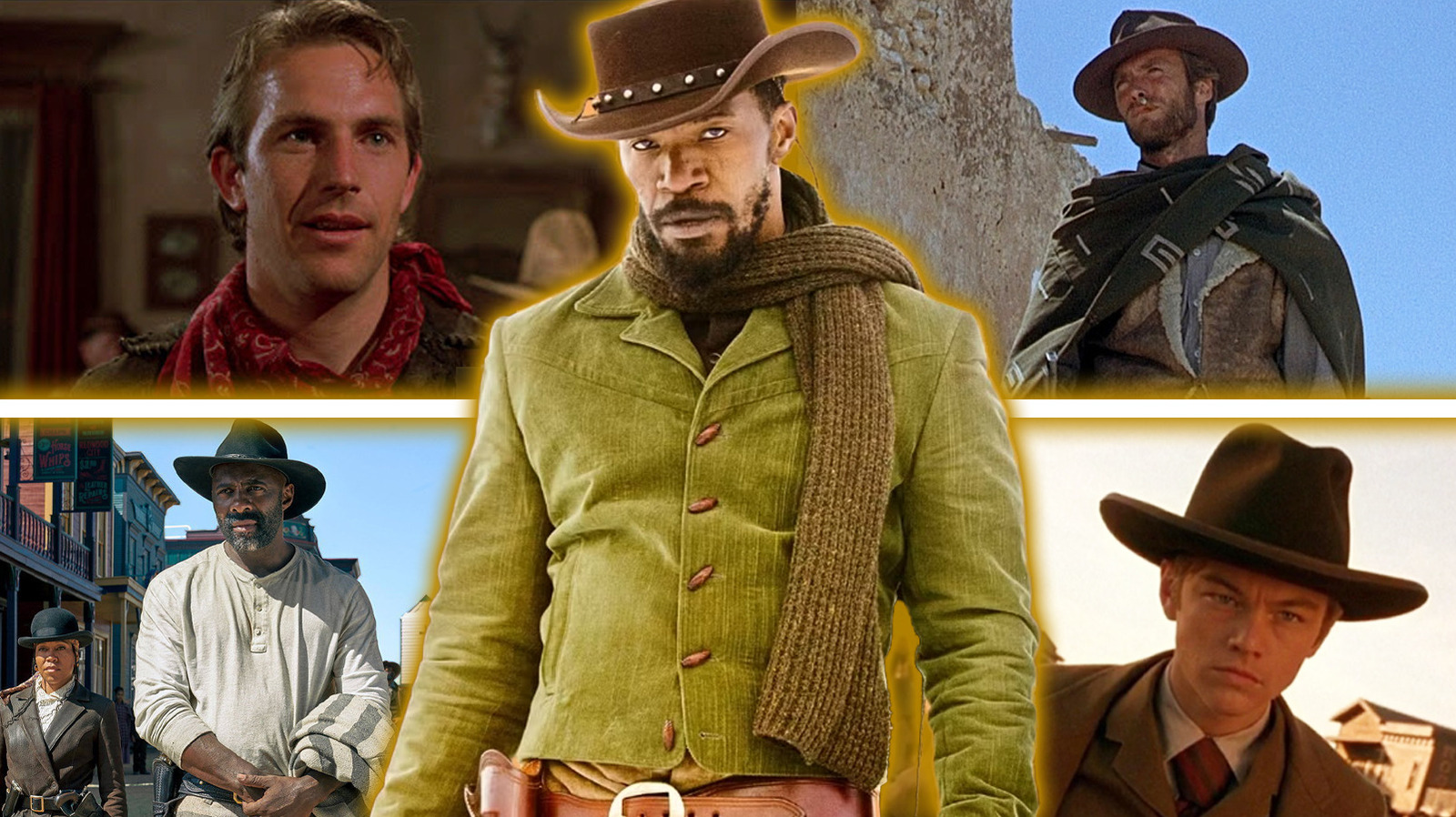
For as many hit films that he’s written and directed, “Django Unchained” is still Quentin Tarantino’s biggest movie. A revisionist Western set primarily in the antebellum South, the movie follows bounty hunters Django (Jamie Foxx) and his mentor Hannibal Schultz (Christoph Waltz). The gunslinging duo cross paths with all sorts of unsavory figures while bucking systemic racism throughout the country as they try to rescue Django’s wife (Kerry Washington). The 2012 movie is packed with Tarantino’s stylish flair and sharply crafted dialogue while embracing and reinventing many genre tropes.
As with all of his movies, Tarantino wears his influences visibly on his sleeve and many of those films certainly align with the themes and sensibilities in “Django Unchained.” Whether it’s spaghetti Westerns that clearly inspired Tarantino or other genre movies with counter-culture protagonists, there are plenty of films like the 2012 blockbuster starring Foxx. Some take the proceedings with the punk rock energy embodied by Django while others are deadly serious with their stakes.
Here are the 12 best movies like “Django Unchained” to keep the stylish Western thrills and offbeat interpretations coming.
For a Few Dollars More
Tarantino cited director Sergio Leone as deeply affecting his own films, and this includes Leone’s “For a Few Dollars More.” The middle installment of Leone’s unofficial movie trilogy starring Clint Eastwood as a man with no name, the 1965 film has Eastwood’s character nicknamed Manco. After El Indio (Gian Maria Volonté) is broken out of his prison by his gang, Manco and Colonel Douglas Mortimer (Lee Van Cleef) set out to collect the bounties on them. This leads to the two gunfighters infiltrating Indio’s gang under the auspices of helping them carry out a large bank heist.
Really, any of Sergio Leone’s Westerns could fill up this list, including “The Good, the Bad and the Ugly” and “Once Upon a Time in the West.” What makes “For a Few Dollars More” stand out for the purposes of this article is that it revolves around bounty hunters more explicitly like “Django Unchained.” Eastwood and Van Cleef are both as cool as ice as gun down any outlaws that get in their way and happen to have a hefty prize on their heads. Leone would arguably make better Westerns later but none as concisely paced and masterfully presented as “For a Few Dollars More.”
Django (1966)
When it comes to movies that inspired “Django Unchained,” one of the most overt is Sergio Corbucci’s 1966 spaghetti Western “Django.” The movie stars Franco Nero as Django, a mysterious gunslinger seen dragging a coffin along the Mexican-American border. After rescuing a sex worker named María (Loredana Nusciak), Django and his new companion arrive at a border town menaced by rival gangs. As Django becomes involved with both outfits, it becomes clear that he’s out for revenge against one of the gang leaders, Jackson (Eduardo Fajardo).
Compared to Leone’s movies, Corbucci tended to go more graphically violent with his own spaghetti Westerns. This is particularly true of “Django,” which still brings a surprising brutality that packs a punch 60 years after its theatrical debut. Nero is absolutely magnetic as the titular gunfighter, with his icy stare and fiery determination lighting up the screen. More than just naming his own protagonist after the character, Tarantino would bring in Nero to play a similarly mysterious figure in “Django Unchained” to underscore the two movies’ connection.
The Great Silence
Another overlooked Corbucci classic is 1968’s “The Great Silence,” set in the isolated frontier town of Snow Hill. During a harsh blizzard, residents are forced to steal to survive, with the corrupt banker Henry Pollicut (Luigi Pistilli) hiring mercenaries to kill them in the name of the law. Intervening with murderous land grab is mute gunslinger known simply as Silence (Jean-Louis Trintignant), who has his own grudge against Pollicut. Leading Pollicut’s pack of legally protected killers is a sadistic gunfighter known as Loco (Klaus Kinski).
Compared to his earlier work with “Django,” Corbucci really dials up the bleak tone and cynical themes in “The Great Silence.” The movie’s snowbound setting not only makes it more visually striking but elevates the sense of desolation throughout the film. Given that its protagonist lives up to his nickname, much of the movie relies on its moody cinematography and a steady suspense paid off by its action set pieces. An underrated Western that you need to watch, regardless of its similarity to “Django Unchained,” “The Great Silence” is a grim masterpiece.
The Wild Bunch
Filmmaker Sam Peckinpah made American Westerns grow up quickly through blood and fire with his 1969 movie “The Wild Bunch.” Set in the twilight days of the Wild West in 1913, aging outlaw Pike Bishop (William Holden) leads his gang on a botched heist in Texas. After narrowly escaping an ambush led by his old associate Deke Thornton (Robert Ryan), Bishop leads the surviving members of his gang to take refuge in Mexico. Once over the border, the gang becomes involved in a bloody revolution where Pike leads his old friends to make their last stand.
John Wayne reportedly hated “The Wild Bunch,” put off by the movie’s graphic violence and unsavory lead characters instead of typical heroes. There had been counter-culture Westerns before, led by various antiheroes, but none quite as gleefully brutal as Peckinpah’s flick, at least as far as Hollywood was concerned. Decades later, the movie’s gruesome finale is still shockingly brutal to watch, revolving around mounting human carnage with no quarter given. Tarantino’s Django might have his own memorably blood-soaked gunfight, but nothing matches the sheer devastation as the climax to “The Wild Bunch.”
Butch Cassidy and the Sundance Kid
A far gentler revisionist Western also released in 1969 was “Butch Cassidy and the Sundance Kid.” Starting in 1899, the movie chronicles the outlaw story of Butch Cassidy (Paul Newman) and the Sundance Kid (Robert Redford) as they pull off heists on a local train company. Pursued by a relentless posse hired by the company, Butch and Sundance decide to flee to Bolivia to evade the law. As they resume their criminal activities, the pair of outlaws find themselves in bigger trouble than they had anticipated in South America.
So much of the charm to “Butch Cassidy and the Sundance Kid” is the palpably amiable rapport between Newman and Redford. The two actors provide a solid friendship that pops off the screen and crackles with a charismatic energy. This endures throughout the duo facing challenges to their gang’s leadership, being hunted by the law, and right through to the ending when they go out in blaze of glory. A reminder that not all revisionist takes on the genre have to be so self-serious, “Butch Cassidy and the Sundance Kid” offers an easygoing ride.
High Plains Drifter
Clint Eastwood has made an entire career out of playing Western antiheroes, and that distinction is at its most salient in “High Plains Drifter.” In addition to directing the 1973 film, Eastwood stars as a nameless stranger who arrives at the remote mining town of Lago. The desperate townspeople hire the stranger to defend them from an impending gang of marauding outlaws but harbor dark secrets themselves. This leads to a showdown with the entire community falling under the stranger’s judgement as the town is literally run red.
Just as he was incensed by “The Wild Bunch,” John Wayne wrote Clint Eastwood an angry letter over “High Plains Drifter” and its depiction of conniving frontier communities. To that point, there are no real heroes in the 1973 movie, just sordid pasts and plenty of lethal vengeance. Just as Django overturns the villainous plantation he visits in “Django Unchained,” the stranger lays this cruel community bare. A stirring sophomore directorial effort from Eastwood, you’re not a Western fan if you haven’t seen “High Plains Drifter.”
Blazing Saddles
When it comes to Black gunslingers shaking up the racist status quo, no Westerns do it better than the 1974 comedy “Blazing Saddles.” Directed and co-written by Mel Brooks, the movie has the frontier town of Rock Ridge targeted by corrupt government official Hedley Lamarr (Harvey Korman) for a land grab. To dishearten the prejudiced population, Lamarr appoints Bart (Cleavon Little), a condemned Black man, to serve as the community’s new sheriff. Working with the famed gunfighter Jim the Waco Kid (Gene Wilder), Bart not only wins the town’s support but brings Lamarr to justice.
The satire of “Blazing Saddles” still has bite over 50 years later, both hilarious and shockingly raw all at once. With so much of its humor mired in offensive racial biases and raunchy gags, Mel Brooks thought he’d get killed over “Blazing Saddles.” Though the content still raises an eyebrow, that embrace of controversy is precisely what’s made the movie stand the test of time and such an effective spoof. A completely postmodern takedown of the Western genre, largely in good fun, “Blazing Saddles” is the funniest Wild West comedy by a country mile.
Silverado
Before he was headlining them as the lead actor and director, Kevin Costner had a memorable supporting role in the 1985 Western “Silverado.” Costner plays condemned gunslinger Jake, who is rescued from his execution by his older brother Emmett (Scott Glenn). Reaching the frontier town of Silverado with several new allies, the brothers contend with its corrupt sheriff Cobb (Brian Dennehy). In addition to Cobb and his deputies, the heroic ensemble find that the town is run by sinister rancher Ethan McKendrick (Ray Baker), who has his own private army.
Kevin Costner once called his Western role in “Silverado” perfect, and it’s easy to see why he regards it so fondly. Among his more seasoned co-stars, Costner’s character is the wild and fun-loving young gun, a part that he clearly relishes in playing. This elevates what is very much an unabashedly old school take on the genre, with plenty of action and clear villains to root against. Written, directed, and produced by Lawrence Kasdan, “Silverado” is very much a back-to-the-basics Western and is all the more enjoyable for it.
Tombstone
When it comes to fun Western movies released within the past 40 years, it doesn’t get much better than “Tombstone.” The 1993 movie chronicles Wyatt Earp (Kurt Russell) and his brothers relocating to the titular Arizona town to run a saloon and gambling emporium. Along with Wyatt’s friend Doc Holliday (Val Kilmer), the group strikes up a feud with the vicious Cowboys gang. This culminates in a gunfight at the O.K. Corral and subsequent vendetta that shakes both factions to their core.
Slickly made and anchored by a stellar ensemble cast, “Tombstone” is the most fun Western released in the ’90s. Compared to contemporaries like “Dances with Wolves” and “Wyatt Earp,” the 1993 flick is a reminder that the genre can still just provide audiences with a freewheeling good time. As great as the cast is, “Tombstone” features Val Kilmer’s best performance as the irascible Doc Holliday. Thoroughly entertaining and sumptuously executed, “Tombstone” revisits an iconic moment in Wild West history with escapist aplomb.
The Quick and the Dead (1995)
Though primarily known for horror and superheroes movies, filmmaker Sam Raimi took the reins for the 1995 Western “The Quick and the Dead.” The movie stars Sharon Stone, who also produced the project, as a vengeful gunfighter known simply as “the lady” by the other characters. The lady arrives in the frontier town of Redemption to participate in its lethal quick-draw dueling competition for a chance to take on its corrupt mayor John Herod (Gene Hackman). Other colorful figures join the deadly contest, including reformed outlaw Cort (Russell Crowe) and Herod’s alleged son (Leonardo DiCaprio).
Just the final shootout in Sam Raimi’s “The Quick and the Dead” is one of the best action scenes ever. But even before that, the movie boasts Raimi’s usual stylish sensibilities, helping set it apart from other Westerns. Interestingly, Raimi’s hiring was Sharon Stone’s one condition to star in “The Quick and the Dead,” and that proved to be a wise creative decision. One of the most slickly presented movies of its genre, “The Quick and the Dead” gives Tarantino a run for his money in terms of visual flair.
The Hateful Eight
Quentin Tarantino’s “The Hateful Eight” started out as a continuation of “Django Unchained” before it became its own separate Western. The 2015 movie features bounty hunters Marquis Warren (Samuel L. Jackson) and John Ruth (Kurt Russell) escorting notorious outlaw Daisy Domergue (Jennifer Jason Leigh). After the group is joined by aspiring sheriff Chris Mannix (Walton Goggins), they shelter from a blizzard at a stagecoach way station in the Wyoming Territory. The ensemble finds the remote location filled with untrustworthy figures as they try to weather the storm and figure out if the other characters are in cahoots with Domergue.
Tarantino was inspired by the classic sci-fi movie “The Thing” when he devised “The Hateful Eight,” with its wintry isolation and mounting paranoia. Those thematic qualities are present for the Western, playing out like chamber play until violence inevitably breaks out among the characters. As usual, Tarantino packs his movie with an absolutely stacked cast, including several familiar faces from “Django Unchained,” albeit in a much different light. A worthy genre follow-up to his preceding Western, Quentin Tarantino’s “The Hateful Eight” is one of his more underrated movies.
The Harder They Fall (2021)
The 2021 Netflix original movie “The Harder They Fall” draws heavily from actual historical figures from the 19th century Wild West. The movie follows Nat Love (Jonathan Majors) pursuing Rufus Buck (Idris Elba) for murdering his parents while he was child. This is complicated by Buck kidnapping Love’s lover Mary Fields (Zazie Beetz) and demanding Love carry out a bank heist to pay him back from robbing him earlier. Following the heist, the gunfighters converge on the town of Redwood for an explosive showdown as shocking truths are revealed.
Backed by an all-star cast, “The Harder They Fall” is an entertaining flick that brings fresh energy to the genre. Filmmaker Jeymes Samuel, who also co-wrote and produced the movie, sets up visually striking shots and set pieces around his complex characters. Whenever the action does let loose, this film dials things up to 11 to deliver on impressively staged gunfights. “The Harder They Fall” is a stylish Western that makes for a fun watch and deserves more attention than it got upon its debut.




Leave a Reply