
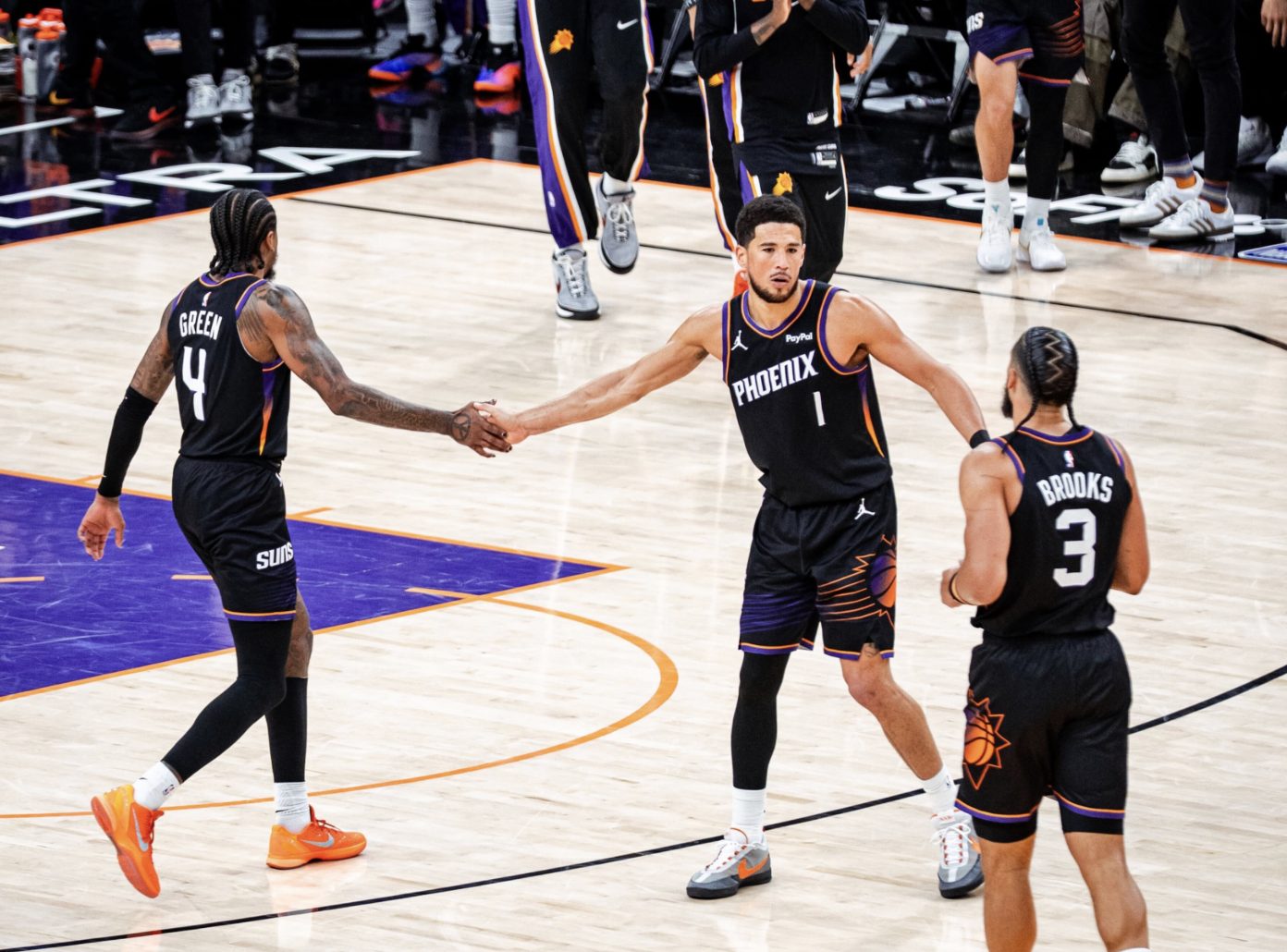
On paper, the Phoenix Suns should be a better team than last year.
For the first time since Monty Williams and Chris Paul were still in town, the Suns have continuity heading from one season into the next, including the same head coach and largely the same core.
They may also stand to improve from healthier seasons for Jalen Green and Dillon Brooks, upgrading from Royce O’Neale to Miles Bridges at the starting 4-spot, another year of familiarity under Jordan Ott, and internal development from youngsters like Rasheer Fleming, Khaman Maluach and Oso Ighodaro.
However, just because the individual pieces seem better, it doesn’t mean they’ll fit together as well as last year’s surprising 45-win squad. Looking at the fit of this year’s roster, particularly with the team’s projected new starting lineup, there are some questions about whether Phoenix’s whole will remain greater than the sum of its parts, even after upgrading some of those parts.
Here are the three biggest concerns for the Suns heading into the 2026-27 campaign.
Last year, the Suns were not only an efficient 3-point shooting team, ranking 12th in the NBA in 3-point percentage, but they were also a high-volume one, ranking fifth in both 3-point attempts (40.8 per game) and makes (14.8 per game).
Unfortunately, as much as the Suns still have willing shooters, it’s tough to see them matching last year’s 36.1 percent mark from downtown. Trading away two of your three best 3-point shooters will do that, both in terms of volume and efficiency.
Even with the cost-effective addition of Luke Kennard to address some of the void, swapping Grayson Allen and Royce O’Neale for Miles Bridges and Kennard leaves Phoenix on the wrong side of that 3-point exchange:
- 2025-26 Grayson Allen: 34.9% on 455 attempts (159 makes)
- 2025-26 Royce O’Neale: 40.8% on 520 attempts (212 makes)
- 2025-26 Luke Kennard: 47.9% on 245 attempts (117 makes)
- 2025-26 Miles Bridges: 33.3% on 445 attempts (148 makes)
- 2024-25 Grayson Allen: 42.6% on 350 attempts (149 makes)
- 2024-25 Royce O’Neale: 40.6% on 441 attempts (179 makes)
- 2024-25 Luke Kennard: 43.3% on 261 attempts (113 makes)
- 2024-25 Miles Bridges: 31.3% on 450 attempts (141 makes)
That’s quite a lot of efficiency and volume to lose!
But it gets even more concerning when you look at the Suns’ projected starting five. Devin Booker will always have gravity because he’s Devin Booker, but his 3-point shot — especially as a pull-up shooter — has never really materialized. So even though he’ll help space the floor by attracting attention as Phoenix’s offensive engine, his 33 percent shooting from deep over the last two years isn’t a great start.
Jalen Green has been a high-volume gunner with no conscience throughout his career, but rarely an efficient one. He’s averaged 7.4 attempts per game for his career, but his 35.4 percent shooting during his last year in Houston was a career high. Last year in Phoenix, he dropped back down to 31.3 percent in his 32-game stint.
Similarly, Dillon Brooks was coming off a career shooting year in his final season in Houston, and unlike Green, he made an impressive 39.7 percent of his 6.3 3-point attempts per game that year. Unfortunately, he dropped back down to 34.4 percent shooting on similar volume last season, and because he’s a career 35.3 percent shooter from deep, there’s a chance his career year in 2024-25 was just an outlier.
Miles Bridges is yet another willing shooter, but also an inefficient one. He’s a career 33.8 percent shooter from downtown despite taking 5.2 of them per game, and he’s only reached the 35 percent threshold from deep once in his seven NBA seasons.
It’s kind of tough to see how the Suns are going to be able to space the floor — or make defenses pay for committing to stop the drives with spray-out 3s — when this is Phoenix’s projected starting lineup:
- Devin Booker: 35.2% from 3 for his career, 33.0% last year
- Jalen Green: 33.9% from 3 for his career, 31.3% last year
- Dillon Brooks: 35.3% from 3 for his career, 34.4% last year
- Miles Bridges: 33.8% from 3 for his career, 33.3% last year
- Mark Williams: 5 3-point attempts in his entire career
The Suns won’t be shy about getting 3s up. But will they actually make enough to make opponents pay for helping over on their drives? Or will they get the “let him shoot, we’ll grab the rebound” Josh Okogie treatment?
Fortunately, Phoenix’s bench unit should supply some help on the 3-point front. Collin Gillespie made a franchise-record 232 3s last year, and although it was his first and only year in the NBA where he was a consistent rotation player, he’s been a 40 percent 3-point sniper since he first started shooting on a Fisher Price hoop.
Gillespie’s 40.1 percent shooting on 7.2 attempts per game last year made him the roster’s only proven 3-point marksman until Luke Kennard joined the party. Obviously Jordan Ott and the Suns will be hoping that Kennard — the second-most efficient 3-point shooter in NBA history — can help pick up some of that slack with a sizable uptick in attempts. But part of the reason Kennard is so efficient is that he’s extremely selective with his shot profile.
As Lakers expert Anthony Irwin pointed out on the Suns After Dark Podcast, if LeBron James and JJ Redick couldn’t convince Luke Kennard to launch more 3s, it’s hard to see his volume drastically changing in Phoenix, especially coming off the bench.
Gillespie and Kennard may be enough for that second unit, especially since they’re both plus passers and movement threats. Pairing them with another high-IQ playmaker and connector like Oso Ighodaro should make for a tough cover, even if Ighodaro has no jump shot to speak of.
If Jordan Goodwin can build on his career year (37.1 percent on a career-high 4.3 attempts per game), Rasheer Fleming shoots like he did from mid-February onward when he entered the rotation (40.5 percent) and Khaman Maluach can shoot like he did at Summer League (8-for-20), the Suns’ bench unit should be able to space the floor just fine, even if Ighodaro, Ryan Dunn and Koa Peat are non-threats (or downright non-shooters).
Unfortunately, those guys aren’t the ones who will be playing upwards of 30 minutes a night, so unless Green and/or Bridges finally breaks through as an efficient shooter, Brooks bounces back, and Booker has one of his rare good shooting years from deep, the Suns’ starting five may struggle to pose much of a threat beyond the arc.
The Suns have size. It’s just that, for the second year in a row, most of their size lies with the younger guys who will have to worm their way into the rotation. And once again, the starting five will be pretty undersized, even after upgrading from Royce O’Neale (generously listed at 6-foot-6) to Miles Bridges:
- Devin Booker: 6-foot-5
- Jalen Green: 6-foot-4
- Dillon Brooks: 6-foot-7
- Miles Bridges: 6-foot-7
- Mark Williams: 7-foot-1
Having a legit 7-footer at center is good, but Williams is a pretty underwhelming shot-blocker considering his size and lengthy arms. Both Brooks and Bridges are strong and sturdy enough to guard opposing 4s, but they’re still slightly undersized for that position, and that may matter on the defensive glass. Booker is adequately tall for a 2-guard, but Green is slightly small for a 2-guard.
Those problems extend to the second unit as well, to a certain extent. Collin Gillespie held up well defensively, but he’ll always be a target on switches at 6-foot-1. Luke Kennard is 6-foot-5, but he’ll also be targeted constantly because he’s a defensive sieve. Jordan Goodwin plays like a power forward, but even his determination and grit only goes so far at 6-foot-3. Even Oso Ighodaro is somewhat undersized for a center at 6-foot-11, even if that helps him as a more mobile, switchable big.
Thankfully, Rasheer Fleming is 6-foot-9 with Whomping Willow limbs, and Khaman Maluach is 7-foot-2. They’re both expected to play more significant roles in Year 2, and Ott needs to act accordingly, since he routinely trotted out undersized lineups last year rather than give the rookies more runway.
There should be no excuses this time around; those big, long, athletic kids need to play!
That’s especially true if some of Phoenix’s other plus-sized players don’t get a fair crack. Haywood Highsmith is probably on the outside looking in, and although he’s only listed at 6-foot-5, he’s got a 7-foot wingspan. He isn’t nicknamed “The Locksmith” for nothing.
Ryan Dunn (6-foot-7 with a 7-foot-1 wingspan) and Koa Peat (6-foot-8) are bigger, longer, strong, athletic wings who could lend some size if they earn minutes, but it’s hard to see where they slot in as a third-year player entering a potential make-or-break season and a rookie, respectively.
The Suns have three capable bigs and a few plus-sized wings, but most of them are youngsters who will be coming off the bench at best, and their starting lineup is still undersized, especially at the 3 and the 4. Hopefully they can do a better job of taking care of the defensive glass, but teams with size and length are still likely to give Phoenix problems.
Again, we hate to keep harping on the Miles Bridges trade and the fit of the Suns’ starting five before they play even a single game together. But surrounding Devin Booker with three non-shooters, two of whom get severe tunnel vision, doesn’t seem like the optimal way to build around him, especially when their starting center took 98 percent of his shot attempts inside the paint last year.
In order to make this work and make up for Phoenix’s lack of shooting, that starting five will need to put pressure on the rim, and they’ll need to share the ball with the type of playmaking that guys like Dillon Brooks have never shown, and guys like Jalen Green have only shown in occasional flashes.
Bridges is a decent passer, but as a third or fourth option, he’s not going to be some point forward running the show. He can function as a secondary playmaker, but his primary objective has always been scoring…which overlaps with Green and Brooks, who are fellow inefficient scorers.
Just look at how the Suns’ starting lineup fares in assist-to-usage ratio among players at their own position (per Cleaning The Glass):
- Devin Booker: 57th percentile
- Jalen Green: 29th percentile
- Dillon Brooks: 1st percentile
- Miles Bridges: 50th percentile
- Mark Williams: 12th percentile
Now look at the bench unit:
- Collin Gillespie: 78th percentile
- Luke Kennard: 86th percentile
- Jordan Goodwin: 64th percentile
- Oso Ighodaro: 91st percentile
- Ryan Dunn: 65th percentile
Nobody is saying the Suns’ second unit is better or more talented than the starters, but they might have an easier time building cohesion because they have more shooters and more serviceable passers. Khaman Maluach and Rasheer Fleming ranked near the bottom of the bunch as low-usage rookies, and Koa Peat is obviously a rookie as well, but the main decision-makers in the second unit are better about sharing the ball in their respective roles.
Because of this, being able to attack the rim is really what might determine how efficient Phoenix’s offense is, especially with a starting lineup that might face cramped spacing. Remember, despite being a top-five team in 3-point attempts and makes last year, the Suns still ranked 17th in offensive rating. This year’s team is built on more physical players to drive and crash the boards even harder, but that 3-point attack will probably be more limited.
That puts a ton of importance on the Suns have multiple players who can not only drive to collapse opposing defenses, but actually finish around the rim. That’s how Jalen Green was billed last summer, and it’s a quality that’s been highlighted with the additions of Miles Bridges and even rookie Koa Peat this summer.
However, there seems to be a misconception about how much of a difference Green and Bridges will actually make on that front. Outside of dunks, Bridges is a subpar finisher at the rim. He converted nearly 86 percent of his 76 dunk attempts…but only 53.1 percent of his 262 layup attempts. And that’s before mentioning that his rim efficiency and attempts have been trending downward over his last four seasons:
- 2021-22: 68% at the rim on 504 attempts (6.3 attempts per game)
- 2023-24: 65% at the rim on 415 attempts (6.0 attempts per game)
- 2024-25: 65% at the rim on 329 attempts (5.1 attempts per game)
- 2025-26: 64% at the rim on 317 attempts (4.1 attempts per game)
In fairness, Bridges does get into the paint and takes most of his shots from the “short midrange,” which is 4-14 feet from the basket. He did rank in the 69th percentile at his position in shot frequency from there, and he converted 48 percent of those looks, which ranked in the 85th percentile. Phoenix will be hoping we’re just splitting hairs between “rim attempts,” where Bridges struggles, and the “short midrange,” where he can actually help.
Unfortunately, that alone won’t collapse a defense, especially since Bridges ranked 85th among all players last year in drives per game. As a team, the Suns ranked 16th in drives per game, despite Devin Booker averaging the fifth-most drives in the league. Jalen Green ranked 39th, Dillon Brooks ranked 80th, and the Suns will probably miss Grayson Allen’s 10.4 drives per game, which ranked 47th.
Several Suns players will need to see an uptick in drives, but even if they do, the passing will need to be on point, because most of the starting five struggles at the rim. In fact, outside of Mark Williams, the Suns don’t really have anybody who’s going to consistently put pressure on the rim and actually finish around the basket:
- Devin Booker: 40th percentile in rim frequency, 63rd percentile in accuracy
- Jalen Green: 56th percentile in rim frequency, 25th percentile in accuracy
- Miles Bridges: 50th percentile in rim frequency, 38th percentile in accuracy
- Dillon Brooks: 12th percentile in rim frequency, 44th percentile in accuracy
The same goes for their bench unit:
- Collin Gillespie: 5th percentile in rim frequency, 7th percentile in accuracy
- Luke Kennard: 22nd percentile in rim frequency, 94th percentile in accuracy
- Jordan Goodwin: 51st percentile in rim frequency, 12th percentile in accuracy
- Rasheer Fleming: 32nd percentile in rim frequency, 2nd percentile in accuracy
- Ryan Dunn: 75th percentile in rim frequency, 46th percentile in accuracy
The Suns’ three centers all ranked in the 73rd percentile or better among NBA bigs in rim frequency, but none of them creates much of their own offense. If they’re being served up on a silver platter in the pick-and-roll or on dump-offs, great! Otherwise, they’re not going to put much pressure on the rim outside of their natural functions as bigs.
That places even more of an emphasis on the aforementioned playmaking, and being able to drive into the teeth of a defense and find the open man in the dunker spot or on the perimeter.
It’s an area where the Suns have historically struggled since their return to relevance in 2021. Over the last six years, they’ve ranked 28th, 30th, 25th, 30th, 30th and 30th in the league in rim frequency. They should rank higher this year, and even being average in this respect would go a long way.
However, if the Suns can’t to get to the rim or finish there, then defenses won’t be forced into rotations, and at that point, Phoenix may struggle to generate open 3s…which they desperately need, since they lack elite snipers in their starting five. Conversely, because their starting five lacks shooters, opponents might be able to overplay the drives, daring the Suns to shoot while neutering an already average group of rim attackers.
It’s an ugly chain reaction that could sorely hamper Phoenix’s offense, which was already subpar last season. If Green can tap into more of his cutting and Bridges can have a throwback season as a driver and finisher at the rim, maybe the Suns will put enough pressure on the rim to open things up and generate easier 3-point looks.
But if they can’t, and if the playmaking isn’t enough beyond Booker, or and the shots are tougher on a group of subpar shooters as a result…Phoenix could very easily be looking at a situation where they’ll need to quickly reconsider their starting lineup, both for the short-term and the foreseeable future beyond that.
For more of Gerald Bourguet’s Suns work, check back with Sports360AZ on a weekly basis, subscribe to his Patreon articles and podcast at Suns After Dark, or follow him on Twitter.






Leave a Reply