
US | 2024–2025 | 6 Episodes | 21–22 min | Comedy, Drama
When Life Stops Making Sense, Your Oldest Friend May Be the Only Person Who Understands
Pete and Carroll have been best friends for most of their lives, but friendship does not automatically provide answers when adulthood begins to feel directionless. Six months after a traumatic night changes their relationship, the two men are still struggling with what happened, what it says about them and whether either has found a convincing reason for what should come next.
The Long Long Night turns that uncertainty into a darkly comic study of lifelong friendship. Instead of treating middle-aged men as people who have already figured themselves out, Barret O’Brien allows Pete and Carroll to be confused, defensive, idealistic, ridiculous and emotionally dependent on each other. Their friendship becomes the place where some of their biggest questions about purpose, responsibility and adulthood finally have to be confronted.
➡️ Movie Insight: The Long Long Night makes male friendship the center of an existential comedy. Pete and Carroll cannot solve every problem facing them, but they cannot completely abandon each other either. Their attempts to find purpose reveal how much of their identity has been built around having the other person there.
Why This Series Matters Right Now: Male Friendship Is Becoming More Emotionally Honest
Stories about male friendship have traditionally relied heavily on banter, competition and shared adventures, often allowing emotional intimacy to remain underneath the surface. The Long Long Night moves that intimacy much closer to the center by giving Pete and Carroll problems they cannot simply joke, drink or fight their way through.
Their conversations become a space for anxiety about purpose, morality, masculinity and whether two ordinary people can meaningfully improve a world whose problems feel impossibly large. Comedy prevents those questions from becoming overwhelmingly solemn, but it does not make them insignificant. The series allows two men to be emotionally lost without presenting that uncertainty as a failure of masculinity.
➡️ Why It Matters: Male friendship stories are expanding beyond buddies having fun together. They increasingly allow men to depend emotionally on one another while confronting uncertainty, loneliness and fear. The Long Long Night makes that vulnerability part of the friendship rather than something the friendship needs to hide.
Should You Watch It?: Come for Two Lifelong Friends Who Feel Completely Lived-In
The strongest reason to watch is Mark Duplass and Barret O’Brien. Pete and Carroll do not feel like characters who have recently been introduced for the benefit of an audience; their conversations have the shorthand, irritation and strange rhythms of people who have known each other long enough to understand exactly how to annoy one another.
That authenticity has an obvious foundation because Duplass and O’Brien are themselves longtime friends. Their real history gives the fictional relationship an unusual ease, while the stripped-down production allows small changes in tone, hesitation and body language to carry more weight than a larger production might permit.
➡️ Viewing Recommendation: Watch The Long Long Night for the chemistry between Mark Duplass and Barret O’Brien. Its pleasures come from conversation, discomfort and the strange intimacy of knowing another person for decades. Viewers who enjoy small-scale independent comedy with darker emotional undercurrents should find its friendship especially compelling.
Why Everyone Is Talking About It?: Real Friendship Became the Creative Experiment
The most distinctive story surrounding The Long Long Night is how closely the production and subject matter overlap. Duplass and O’Brien knew each other long before creating the series, and the project developed out of their own friendship before becoming a six-part independent production. That history makes the show itself feel like an extension of its central idea: what happens when two men with decades of shared history actually examine the relationship between them?
The series has also become part of a larger conversation around independent television. After appearing on the festival circuit, including Tribeca and SXSW, it reached audiences through independent distribution and became an example of television being produced outside the traditional studio-streamer pipeline. Its small scale is therefore not simply an aesthetic choice; it is part of what the project represents.
➡️ Viral Potential: The real friendship between Duplass and O’Brien gives the series an unusually authentic promotional story. Audiences can watch fictional best friends while knowing that decades of genuine history exist underneath the performances. That creator-audience authenticity gives a tiny independent series a conversation hook much larger than its production scale.
Why The Long Long Night Stands Out: Two Men Are Allowed to Have No Idea What They Are Doing
Pete and Carroll want their lives to matter, but wanting purpose and knowing how to create it are very different things. Their attempts to respond to enormous social and personal problems repeatedly collide with their own limitations, making their idealism both sincere and absurd.
That contradiction gives the series its distinctive tone. Pete and Carroll can care deeply about the world while behaving foolishly within it. The Long Long Night does not need to mock their desire to be better people because the comedy comes from how spectacularly complicated trying to become better can actually be.
➡️ Cinema Insight: The series allows male uncertainty to become both funny and emotionally serious. Pete and Carroll are not heroes who discover a simple purpose and transform their lives. They are ordinary men discovering that adulthood may require continuing forward without ever receiving a complete answer.
Movie Trend: Male Friendship — When Your Best Friend Helps You Find a Way Forward
Male friendship is becoming richer territory for independent storytelling because filmmakers are increasingly interested in what happens after the easy camaraderie ends. The question is no longer simply whether two men enjoy being together, but whether their friendship can survive grief, failure, emotional vulnerability and dramatically different ways of dealing with adulthood.
Pete and Carroll represent that evolution particularly well because their relationship is simultaneously supportive and destructive. They understand each other better than most people ever could, yet that knowledge also gives them enormous power to wound each other. Finding a way forward therefore means determining whether friendship is something they can rely upon or another part of their lives that has to change.
➡️ Movie Trend: Male Friendship stories are becoming more willing to show emotional dependence between men. The best friend can be the person who keeps you going and the person capable of hurting you most. The Long Long Night finds its comedy and sadness inside that contradiction.
Viewer Profile: Adults Who Know Friendship Changes as You Get Older
The core audience is likely to be viewers who appreciate intimate independent television built around character rather than conventional episodic plotting. Fans of Mark Duplass’ earlier work should immediately recognize the interest in awkward conversations, flawed people and emotional situations that move unpredictably between comedy and discomfort.
The series should connect particularly strongly with adults who have maintained friendships across decades. Those relationships carry accumulated history that newer friendships cannot replicate: old versions of yourself, abandoned ambitions, private jokes, disappointments and memories that another person may understand better than anyone who entered your life later.
|
Viewers of intimate independent comedy and character-driven television |
|
|
Audiences interested in male friendship, middle-age uncertainty and emotionally unconventional comedy |
|
|
Broad adult audience with particular relevance to viewers interested in contemporary masculinity and friendship |
|
|
Broad middle-income and professional audience |
|
|
Independent-film and television viewers interested in relationships, creativity, social questions and emotionally grounded storytelling |
|
|
Indie comedy, dramedy, mumblecore, limited series, character studies and dialogue-driven television |
➡️ Audience Insight: The strongest audience connection comes from recognizing what happens to friendship across time. Long-term friends remember versions of us that partners, colleagues and newer friends may never have known. The Long Long Night turns that accumulated history into both emotional comfort and conflict.
What This Series Means for the Industry: Indie TV Can Be Made More Like Indie Film
The Long Long Night is particularly interesting as an industrial experiment because its creative model rejects the assumption that meaningful television requires traditional television infrastructure. A motel room, two central performers, personal recording devices and a strong relationship can provide enough material for an entire episodic project when the concept is sufficiently focused.
That opens possibilities for filmmakers who previously might have considered independently producing a feature but assumed episodic television required network or streaming financing. Small-scale series can instead emerge from filmmaker-driven production models and reach audiences through alternative distribution, allowing creators to retain greater control over unconventional work.
➡️ Industry Insight: Independent television can adopt the creative freedom and production economy traditionally associated with independent film. The Long Long Night demonstrates that episodic storytelling does not always require industrial-scale infrastructure. Strong characters and a distinctive creative voice can become the production model.
Creative Analysis: Two Friends Turn One Terrible Night Into Six Episodes of Reckoning
The Long Long Night uses restriction deliberately. Rather than expanding Pete and Carroll’s crisis into a conventional ensemble comedy, the series keeps returning to the two men and the event that fractured their relationship, gradually allowing different interpretations of that night to emerge.
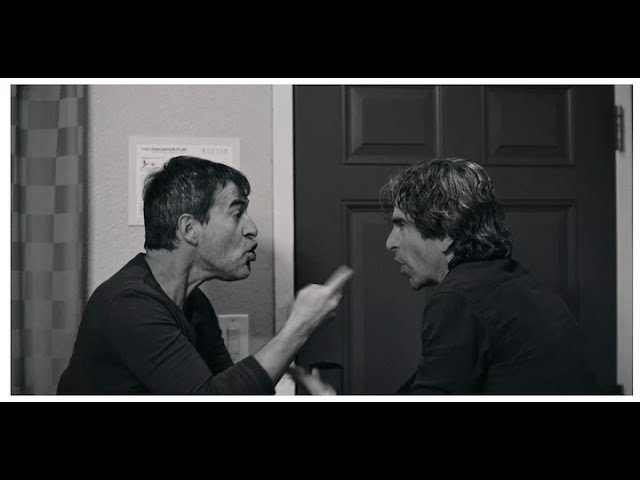
The structure also separates past and present visually. The long night itself unfolds through black-and-white sequences, while the later attempts to understand what happened appear through contemporary communication and video messages. Memory and interpretation consequently become part of the visual storytelling.
Storytelling: One Night Keeps Changing Every Time They Remember It
The six-episode structure gradually reconstructs the event that separated Pete and Carroll rather than explaining everything immediately. Present-day communication provides one version of what happened while flashbacks reveal additional information, allowing audiences to continually reconsider both characters.
That fragmentation suits a story about friendship because arguments between longtime friends rarely involve only the immediate disagreement. Every new conversation carries previous conversations inside it. The series turns that accumulated history into its narrative engine.
Direction: Barret O’Brien Makes Smallness Part of the Point
O’Brien embraces the limitations of the project rather than disguising them. The intimate spaces, video messages and concentrated focus on two performers make the series feel closer to something personally recorded than conventionally manufactured television.
That intimacy suits the material because Pete and Carroll are attempting to explain themselves as much to each other as to anyone watching. The camera becomes almost another participant in their relationship, capturing rationalizations, confessions and performances of confidence that occasionally reveal something more vulnerable underneath.
Performances: Real Friendship Makes Every Argument Feel Older
Mark Duplass brings Pete the restless, awkward emotional energy that has defined much of his independent work. His ability to make sincerity and absurdity exist inside the same moment is particularly useful for a character whose desire to live meaningfully can push him toward increasingly questionable conclusions.
Barret O’Brien provides the complementary energy Carroll needs. Because the actors share genuine history, their disagreements rarely feel like exchanges between performers waiting for dialogue cues. They feel like arguments between people who already know what the other person is going to say and are irritated before he finishes saying it.
Visual Style: Black and White Separates the Night From Everything After
Using black and white for the central night gives the past its own visual identity. The choice creates immediate separation between the event itself and the later attempts by Pete and Carroll to explain, justify or reinterpret their behavior.
The contemporary material has a different immediacy through digital communication. Moving between those visual modes reinforces one of the series’ central tensions: what happened and what people later tell themselves happened are not necessarily identical.
Themes: Purpose, Masculinity, Guilt and the Need to Matter
Pete and Carroll are struggling with a problem that extends far beyond their friendship: how can ordinary individuals believe their lives have meaning when the world’s problems appear impossibly large? Environmental collapse, inequality and social responsibility become part of an existential crisis about whether personal action actually changes anything.
Masculinity sits inside that crisis because both men must negotiate vulnerability alongside the instinct to intellectualize, joke or perform certainty. Their friendship gives them somewhere to express those fears, even when neither possesses the emotional vocabulary necessary to resolve them cleanly.
What Makes It Different: The Creators Put Their Own Friendship Inside the Experiment
The most distinctive creative element is the overlap between fiction and reality. Duplass and O’Brien are not merely actors attempting to manufacture decades of friendship; they bring their own history into a fictional relationship about what decades of friendship actually mean.
That does not make Pete and Carroll interchangeable with the performers playing them, but it gives the series an emotional texture that would be difficult to reproduce artificially. The creative experiment becomes inseparable from the relationship that made the experiment possible.
➡️ Creative Insight: The Long Long Night turns creative limitation into emotional intimacy. Its small scale keeps audiences unusually close to Pete and Carroll while their friendship begins revealing its fractures. The real history between Duplass and O’Brien gives that fictional relationship an authenticity no production budget could manufacture.
If You Liked The Long Long Night (2024–2025): More Stories About Male Friendship, Purpose and Trying to Figure Life Out
These three titles similarly explore adult relationships through intimate, character-driven storytelling where humor and emotional uncertainty frequently occupy the same space.
Friendship (2025) by Andrew DeYoung: Male Connection Becomes an Obsession
Craig’s ordinary suburban existence changes when he becomes fascinated by his charismatic new neighbor Austin. What begins as the possibility of a new male friendship gradually reveals how desperately Craig wants connection and how poorly equipped he is to handle the emotional expectations surrounding it.
➡️ Why It Connects: Friendship and The Long Long Night both examine male relationships without treating friendship as emotionally simple. Men want connection but do not always possess the tools necessary to understand what they expect from one another. Both use uncomfortable comedy to expose the vulnerability underneath male companionship.
Language Lessons (2021) by Natalie Morales: A Screen Becomes the Space for Real Connection
Adam and Cariño begin communicating through online Spanish lessons, but their relationship gradually moves beyond its original purpose as personal circumstances change what they need from one another. The deliberately stripped-down digital format allows conversation itself to become the story.
➡️ Why It Connects: Language Lessons shares The Long Long Night’s belief that lo-fi digital communication can create emotional intimacy rather than diminish it. Both place enormous dramatic weight on faces talking through screens. Mark Duplass also brings his distinctive combination of awkwardness, humor and vulnerability to both projects.
Biosphere (2023) by Mel Eslyn: Two Men May Be All Each Other Has Left
Billy and Ray appear to be the last two men alive, confined together inside a biosphere while the outside world has become uninhabitable. Their friendship becomes inseparable from survival as an increasingly strange situation forces both men to reconsider masculinity, identity and what they mean to one another.
➡️ Why It Connects: Biosphere and The Long Long Night both use an intimate two-man setup to ask unexpectedly large questions. Global problems become personal through friendship, while masculinity is treated as something flexible enough to examine rather than simply perform. Mark Duplass again uses comedy to make existential anxiety approachable.
➡️ If You Liked Insight: Friendship turns male connection into uncomfortable obsession, Language Lessons finds intimacy through digital conversation and Biosphere uses two men to explore enormous existential questions. The Long Long Night sits naturally beside them because friendship becomes both its comic engine and emotional laboratory. Together they show how small-scale storytelling can reveal surprisingly large truths about human connection.
Final Verdict: Sometimes Your Oldest Friend Is the Person Who Knows How Lost You Really Are
The Long Long Night works because Pete and Carroll’s friendship never needs to be explained from the beginning. Decades appear to exist between their sentences, allowing affection, irritation, resentment and dependence to overlap in ways that feel recognizable to anyone who has maintained a friendship across different stages of adulthood.
Barret O’Brien and Mark Duplass use that authenticity to build something deliberately small but emotionally ambitious. Pete and Carroll cannot fix the world, and they may not even be particularly good at fixing themselves, but their confused attempts to matter reveal why friendship can remain essential precisely when nobody has a convincing answer about what comes next.
➡️ Final Verdict: The Long Long Night turns two men talking into a surprisingly expansive comedy about purpose, friendship and adulthood. Duplass and O’Brien’s genuine history gives every argument an extra layer of credibility. Its biggest achievement is making uncertainty feel like something friends can survive together.
Quick Facts: The Long Long Night at a Glance
|
Mark Duplass as Pete, Barret O’Brien as Carroll |
|
|
Karen Pittman, Sheri Foster |
|
|
Approximately 21–22 min per episode |
|
|
Independent six-part television series |
|
|
Tribeca, SXSW and independent television showcases |
|
|
Independent digital distribution, including Kinema and US streaming/digital platforms |
|
|
Male Friendship — When Your Best Friend Helps You Find a Way Forward |
|
|
Two lifelong friends struggle to find purpose and repair their relationship after a traumatic night changes both of their lives |
|
|
Real-life longtime friends Mark Duplass and Barret O’Brien play fictional lifelong friends whose relationship is tested by an existential crisis |
|
|
Male friendship, purpose, masculinity, guilt, social responsibility, vulnerability, mental health, adulthood |
|
|
An intimate dark comedy where genuine friendship chemistry turns two men arguing about their place in the world into an unusually personal study of male connection |
Final Insights: Male Friendship Is Becoming One of the Most Interesting Spaces for Vulnerability
Male friendship stories are changing because emotional intimacy no longer has to remain hidden beneath the adventure. Contemporary independent film and television can allow men to discuss fear, purpose, failure, guilt and loneliness while still preserving the banter and absurdity that make friendships feel authentic. The result is not simply a softer version of the buddy comedy; it is a more complete understanding of what friendship between men can contain.
The Long Long Night pushes that development further by connecting fictional friendship with genuine creative partnership. Duplass and O’Brien’s relationship existed long before Pete and Carroll, and making the series ultimately became another chapter in that real friendship. That makes the project especially representative of a future in which intimate stories can emerge from authentic creator relationships and reach audiences without needing to pass through traditional television structures.
➡️ Final Insight: Male Friendship stories are moving beyond companionship toward genuine emotional interdependence. The Long Long Night shows that men can be funny, foolish, vulnerable and deeply important to one another at the same time. Its lasting insight is simple: sometimes finding your way forward begins with having someone beside you who remembers where you came from.






Leave a Reply