


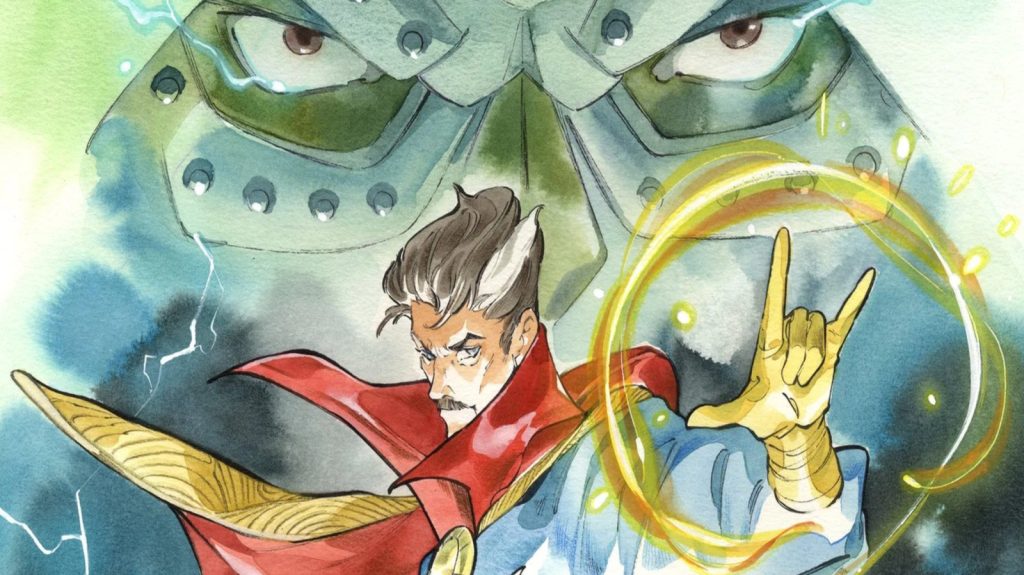

Doctor Victor von Doom is a master of magic, so little surprise he’s often crossed paths with the Sorcerer Supreme, Doctor Stephen Strange. Their first meeting, and the foundation for their mutual respect, was in 1989’s “Doctor Strange and Doctor Doom: Triumph and Torment,” one of the essential Doctor Doom comics every Marvel fan should read.
Written by Roger Stern, one of the best writers in the 1980s Marvel Comics bullpen, and drawn by Mike Mignola, future creator of the “Hellboy” universe, “Triumph and Torment” is indeed a triumph. It was published in the “Marvel Graphic Novel” line, itself designed to tell standalone and more mature stories featuring Marvel’s character stable.
Doom’s usual nemeses, Reed Richards and the Fantastic Four, are nowhere to be seen. While, conceptually, Doom needs Richards, tales like “Triumph and Torment” prove how he can hold individual stories without the FF. “Triumph and Torment” is also one of the most convincing arguments for Doom being more than a villain.
In Doom’s debut, Stan Lee and Jack Kirby’s “Fantastic Four” #5, it’s established he had, during his and Reed’s time at college, been obsessed with dark magic and built a machine to enter the nether world, which blew up and scarred him. His fuller origin in “Fantastic Four Annual” #2 revealed his ambition was to contact his mother, Cynthia von Doom, a witch who died during his childhood. Cynthia’s trunk of magical secrets begat Victor’s own knowledge of sorcery.
A 1971 story in “Astonishing Tales” #8 (by Gerry Conway and Gene Colan) then revealed that every Midsummer’s Eve (when the liminal walls between worlds are the thinnest), Doom battles the forces of Hell to free his mother’s soul, only to reach a stalemate. So, in “Triumph and Torment,” Doom does the unthinkable and asks for help.
Doctor Strange and Doctor Doom: Triumph and Torment, explained
In “Triumph and Torment,” both Strange and Doom partake in a contest of the world’s greatest sorcerers held by Strange’s god-like patrons, the Vishanti. Strange wins with Doom placing second — a familiar place for him, but it works in his favor. Per contest rules, Strange must grant a “boon” of Doom’s choosing, and Doom wants Strange’s assistance in freeing his mother’s soul.
“Is one woman’s soul beneath the notice of the Sorcerer Supreme?” Doom asks a surprised Strange, who in turns questions why Doom never requested his help before. “I will bear any ordeal, Strange, but Doctor Doom does not beg,” he replies. That pride is ultimately crucial to Doom’s plan to free Cynthia.
In Hell, facing the overwhelming power of the demon lord Mephisto, Doom seemingly trades Strange’s soul for his mother’s. But Cynthia, a noble woman, refuses and spurns Victor — a sacrifice that secures her place in Heaven. Doom finally frees his mother and outwits her devilish captor. This plan both flatters and damns Doom’s character. He values his mother’s safety more than her love for him, but his own pride most of all.
“Triumph and Torment” helps itself stand alone by exploring Doom and Strange’s origins, so you can understand both men completely from this one story. Their journeys are also quite similar, as physical injuries prompt both men to venture high into the Himalayas seeking mystical knowledge. The book retells Cynthia’s death, and Victor’s childhood, via Doom’s attendant Boris. Along with the reader, Strange realizes that beneath Doom’s cold armor lies a child of tragedy. Upon taking his mask for the first time, Doom swears that pain and compassion are for lesser men — but his plan to free his mother, and what it costs him, prove otherwise.
Triumph and Torment foreshadowed Mike Mignola’s Hellboy
Mike Mignola’s art in “Triumph and Torment” makes Doctor Doom, his castle, and Latveria feel more truly gothic than in any other comic. Knowing Mignola went on to create a demonic superhero, too, it’s hard not to compare “Triumph and Torment” to “Hellboy.” Mignola drawing Strange and Doom facing down demons feels like a “Hellboy” test run in the same way his Batman comic “Sanctum” was.
In the documentary “Mike Mignola: Drawing Monsters,” Mignola admitted he felt out of place drawing typical Marvel superhero books during the 1980s. “I’m not cut out to draw superheroes (…or) cars and buildings, most of the stuff that comics are made of,” Mignola explained. He’d much rather be drawing monsters, which is why “Triumph and Torment” was a perfect assignment for him. Mignola’s penciling especially comes to vibrant life once Doom and Strange enter Hell.
Far from looking identical, the demons all have different skin tones, weapons, and proportions. Some have wings, one is a humanoid torso on a giant serpent’s tail, etc. Inker/colorist Mark Badger, rather than using a single background color for Hell, employs red-orange-yellow-green gradients. Mixed with Mignola’s heavy shadows, it looks truly creepy, ethereal, and dangerous, like the typical fire and brimstone version of Hell but made even stranger. Compare this to the scary and lonely underworld in Mignola’s 2010s series “Hellboy in Hell,” and you can see an artist who grew.
Of course, the greatest achievement in “Triumph and Torment” is Doctor Doom’s. In “Astonishing Tales” #8, Doom’s goal to free his mother from eternal damnation is presented as a Sisyphean task he’ll never achieve. Thinking he could break the laws of Hell is a sign of Doom’s immense self-regard and ambition — and incredibly, he eventually did it.