


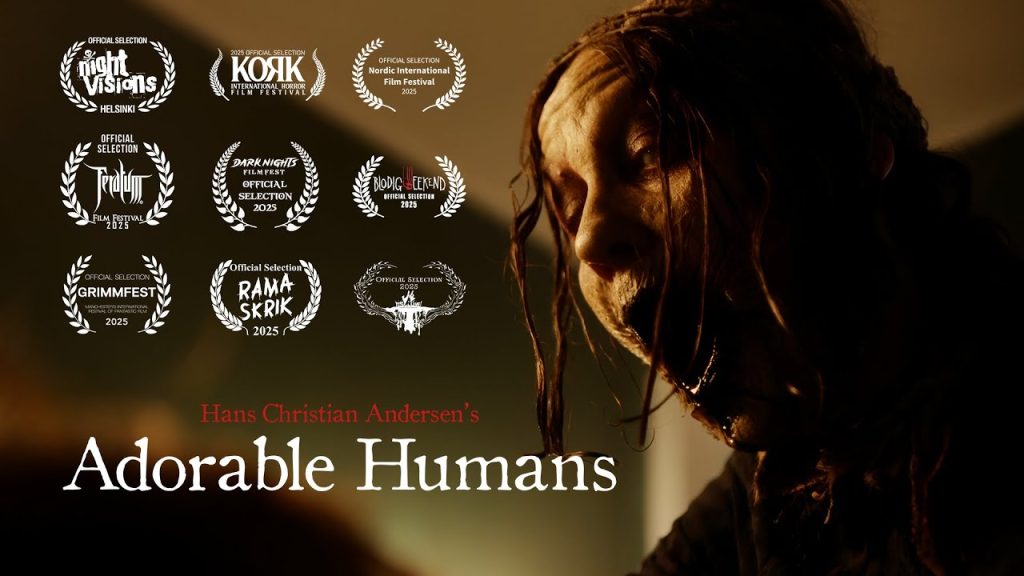
Denmark | 2025 | 1h 57m | Horror Anthology
Hans Christian Andersen’s Fairy Tales Were Never Meant to Be Safe
Four interconnected horror stories drag Hans Christian Andersen’s fairy tales back toward their darker origins, transforming familiar ideas about love, loss, fate and longing into unsettling contemporary nightmares.
Rather than adapting one Andersen story, Adorable Humans brings together four: The Dead Man, The Story of a Mother, The Snow Queen and Auntie Toothache. A mysterious mirror destabilizes a couple’s new beginning, a care worker discovers disturbing secrets while tending to a dying man, grief pushes a mother toward horrifying choices, and an ambitious musician discovers that creative inspiration can demand a terrible price.
Directors Anders Jon, Kasper Juhl, Michael Kunov and Michael Panduro give each chapter its own personality while sharing enough creative DNA to make the anthology feel like one increasingly disturbing world. Made for roughly €70,000, the film uses Andersen not as nostalgic literary decoration but as permission to explore mortality, obsession, loneliness, sexuality, grief and the cruelty hiding beneath apparently civilized lives.
➡️ Movie Insight: Adorable Humans demonstrates how familiar cultural stories can become new again when filmmakers recover the darkness audiences have forgotten.
Should You Watch It?: Fairy-Tale Horror for Viewers Who Prefer Their Stories Beautifully Uncomfortable
Adorable Humans is particularly well suited to viewers of Scandinavian horror, psychological horror, body horror, literary adaptations and anthology films. Anyone fascinated by darker reinterpretations of fairy tales will find plenty to explore, but its greatest appeal comes from watching four filmmakers discover different kinds of horror inside Andersen’s emotional universe.
This is not comforting fairy-tale nostalgia. The film moves between psychological unease, grief, sexuality, supernatural suggestion, grotesque imagery and body horror, while its anthology structure means individual chapters deliberately shift tone and intensity. Festival descriptions and reviews have particularly emphasized its disturbing imagery, psychosexual dimensions and darker treatment of Andersen’s material.
➡️ Viewing Takeaway: Watch it if you want fairy tales reclaimed as strange adult stories about desire, mortality and what happens when ordinary people lose control.
Why Everyone Is Talking About It?: A €70,000 Horror Experiment Became an International Festival Winner
The remarkable story surrounding Adorable Humans is not simply that four Danish directors transformed Hans Christian Andersen into horror—it is how far such a small production has travelled. Produced for roughly €70,000, the film moved through an international genre-festival run that included Fantaspoa, Night Visions, Grimmfest, Feratum and other events before securing a worldwide digital launch for August 31, 2026.
That journey matters because the movie provides a strong example of how distinctive concepts can help microbudget genre cinema cross borders. Andersen gives audiences an immediate cultural reference point, but the horror reinterpretation supplies the hook: instead of reproducing familiar fairy-tale imagery, the filmmakers reveal how psychologically brutal many of these stories already were. Its festival awards turned that premise into tangible creative momentum.
Awards
-
2026 A Night of Horror International Film Festival — Winner, Best International Director
-
2025 Nordic International Film Festival — Winner, Best Nordic Feature
-
2025 Feratum Film Festival — Winner, Best International Feature
-
2025 Feratum Film Festival — Winner, Best International Screenplay
-
2025 Feratum Film Festival — Winner, Best International Director
-
Dark Nights Film Fest — Midnight Spotlight Award for Cinematography
-
Infierne de los Andes — Best Film
5 wins are recorded by IMDb, while additional festival recognition includes cinematography and Best Film honors documented by the festivals themselves.
➡️ Awards Insight: The recognition shows that the film’s strongest asset is not simply its provocative Andersen concept but the filmmaking craft that turns an extremely limited budget into internationally competitive genre cinema.
Why Adorable Humans Stands Out: It Finds the Horror Andersen Already Put There
Many contemporary fairy-tale revisions work by radically changing their source material. Adorable Humans takes a more interesting route: it argues that darkness was already embedded in Andersen’s stories. Death, sacrifice, loneliness, obsession and emotional suffering are not modern additions but foundations that the filmmakers can translate into contemporary psychological and physical horror.
The four-director structure strengthens that idea. Instead of demanding that Andersen produce one consistent kind of fear, the anthology allows grief, desire, bodily transformation, creative frustration and supernatural uncertainty to become different entrances into the same emotional landscape. Grimmfest described the result as four loosely interconnected psychosexual dramas that retain the spirit of Andersen while radically reworking the stories.
➡️ Standout Insight: Adorable Humans succeeds by treating fairy tales not as childhood memories to corrupt, but as adult anxieties that were disturbing from the beginning.
Movie Trend: Dark Fairy-Tale Horror — Familiar Stories Are Becoming Dangerous Again
Contemporary horror increasingly treats myths, folklore and fairy tales as flexible cultural material rather than untouchable classics. The attraction is powerful: audiences already understand the symbolic language of mirrors, witches, beautiful strangers, death, transformation and impossible bargains, allowing filmmakers to destabilize something viewers think they already know.
Adorable Humans pushes that movement toward literary reclamation. Instead of building another conventional monster mythology, it returns to one of Europe’s most recognizable storytellers and asks what happens when modern horror filmmakers emphasize the alienation, cruelty and emotional suffering beneath his work. That approach places Andersen beside contemporary horror rather than safely inside children’s culture.
➡️ Movie Trend Insight: Horror is discovering that some of its richest future material may come from exposing the unsettling meanings hidden inside stories audiences already know.
Viewer Profile: The Dark Story Explorer — Familiar Stories Feel Better When They Become Unpredictable
The Dark Story Explorer is drawn to movies that transform recognizable cultural material into something stranger, more adult and psychologically challenging.
|
Audience ProfileDescription |
|
|
Horror, folk-horror, psychological-horror and dark-fantasy viewers |
|
|
Arthouse, festival and Scandinavian-cinema audiences |
|
|
Primarily adult viewers, approximately 18–44 |
|
|
Broad middle-income cultural and entertainment consumers |
|
|
Film-curious, culturally engaged, literary and genre-aware |
|
|
Genre festivals, specialty streaming, international cinema, horror discovery and unconventional adaptations |
These viewers are interested less in conventional scares than in discovery. They want filmmakers to take familiar material somewhere unexpected, and Adorable Humans rewards that curiosity by moving between recognizable Andersen ideas and contemporary anxieties surrounding grief, relationships, ambition, bodies and mortality.
➡️ Audience Insight: The ideal viewer already knows fairy tales can be dark and wants filmmakers willing to show just how dark they can become.
What This Movie Means for the Industry: Cultural Heritage Can Become Global Genre IP
Adorable Humans demonstrates an alternative way of thinking about literary adaptation. Famous stories do not necessarily require blockbuster budgets, prestige-period production or literal retellings. Publicly familiar cultural material can instead provide independent filmmakers with recognizable foundations upon which radically different genre experiences can be constructed.
Its trajectory is particularly relevant for independent producers. A roughly €70,000 Danish anthology progressed from genre festivals toward an announced worldwide digital release across iTunes/Apple TV, Amazon Prime, Google TV and regional services. That suggests a practical model in which a strong cultural hook, clearly defined genre identity and festival validation can help very small productions become internationally marketable.
➡️ Industry Insight: Distinctive concepts can allow microbudget local filmmaking to travel globally when cultural familiarity and strong genre positioning reinforce each other.
Creative Analysis: Four Directors Turn One Literary Legacy Into a Shared Nightmare
The anthology works through contrast rather than complete stylistic uniformity, allowing each filmmaker to interpret Andersen through different emotional and horror languages while recurring ideas about fate, loss and human vulnerability hold the film together.
Storytelling — Four Nightmares, One Emotional World. The interconnected anthology structure allows four different Andersen adaptations to function independently while gradually creating a broader meditation on people confronting forces they cannot fully control.
Direction — Collaboration Without Losing Individuality. Anders Jon, Kasper Juhl, Michael Kunov and Michael Panduro approach different stories while maintaining enough tonal and visual continuity for the film to operate as a feature rather than merely a compilation.
Performances — Ordinary People Make the Horror Stranger. Albert Rudbeck Lindhardt, Mille Maria Dalsgaard, Mie Gren, Peter Høgsbro, Sus Wilkins and the ensemble keep the supernatural and grotesque material anchored in recognizable human anxieties.
Visual Style — Beauty and Discomfort Share the Frame. Cinematographers Tobias Scavenius and Fredrik Aleksander Grøvdal Sundbye give the film a cohesive visual identity despite the multiple directors, with their work receiving the Midnight Spotlight Award for Cinematography at Dark Nights Film Fest.
Themes — Fate, Acceptance, Love and Loss. Beneath the horror mechanics sits a recurring question about what people will sacrifice when grief, desire, loneliness or ambition makes ordinary reality unbearable.
What Makes It Different — Andersen Without the Safety Net. The film does not merely attach horror imagery to famous stories; it uses contemporary horror to reconnect audiences with the unsettling emotional territory embedded in Andersen’s writing.
➡️ Creative Insight: Its strongest creative achievement is making four different horror visions feel like fragments of the same uncomfortable argument about what fairy tales were always trying to tell us.
These films share Adorable Humans’ interest in turning folklore, familiar stories, historical beliefs and apparently ordinary lives into unsettling examinations of bodies, grief, desire and psychological collapse.
The Ugly Stepsister (2025) by Emilie Blichfeldt: Cinderella Becomes a Brutal Competition for Beauty
Elvira lives in the shadow of her beautiful stepsister and becomes increasingly willing to mutilate and transform herself to compete for a prince’s attention. Blichfeldt converts Cinderella into grotesque body horror while examining beauty standards, envy and the physical price of becoming socially desirable.
➡️ Why It Connects: Like Adorable Humans, it discovers contemporary horror inside a fairy tale audiences thought they already understood.
The Devil’s Bath (2024) by Veronika Franz & Severin Fiala: Folk Horror Turns Despair Into Historical Nightmare
Set in 18th-century Austria, the film follows Agnes as marriage, isolation and increasingly unbearable psychological distress pull her toward a horrifying path. Franz and Fiala use historical reality, religious belief and folk-horror atmosphere to create something more disturbing than a conventional supernatural story.
➡️ Why It Connects: Both films reveal how old European stories and beliefs can expose timeless fears about isolation, suffering, morality and death.
Sister Midnight (2024) by Karan Kandhari: Marriage Turns Into a Surreal Feral Transformation
Uma enters an arranged marriage in Mumbai only to discover that domestic conformity does not suit her at all. What begins as an abrasive marital comedy gradually mutates into something stranger, darker and increasingly feral, allowing social expectations and female frustration to become surreal genre material.
➡️ Why It Connects: Like Adorable Humans, it allows recognizable human frustrations to slide unexpectedly from everyday reality into grotesque, supernatural and darkly comic territory.
The Damned (2024) by Thordur Palsson: Isolation Turns Survival Into Supernatural Guilt
During a brutal 19th-century Icelandic winter, a widow and her isolated fishing community face an impossible moral decision after a ship wrecks offshore. Survival, guilt, folklore and paranoia gradually become indistinguishable as the community begins questioning whether something supernatural has followed their choice.
➡️ Why It Connects: Both movies use Northern European darkness, moral anxiety and supernatural uncertainty to show ordinary people becoming trapped by forces larger than themselves.
Adorable Humans has an unusually strong central idea and enough visual and thematic ambition to transcend its microbudget origins. Its greatest strengths are the concept, collaborative direction, cinematography and willingness to let Andersen’s stories become psychologically uncomfortable rather than simply transforming them into conventional supernatural horror.
As with many anthology films, individual chapters will inevitably connect differently with different viewers, and the tonal movement between psychological drama, body horror, sexuality, grief and supernatural suggestion can make the overall experience deliberately uneven. Yet that unpredictability also reinforces the film’s identity: this is less a single horror story than four filmmakers testing how much darkness they can uncover inside one literary legacy.
➡️ Final Verdict: 4.1/5 — An ambitious, visually assured microbudget anthology that proves Hans Christian Andersen still has nightmares left to discover.
|
Horror / Anthology / Dark Fairy-Tale Horror |
|
|
Fate, grief, love, loss, obsession, mortality and transformation |
|
|
Anders Jon, Kasper Juhl, Michael Kunov, Michael Panduro |
|
|
Anders Jon, Kasper Juhl, Michael Kunov, Michael Panduro; inspired by Hans Christian Andersen |
|
|
Country / Countries of Origin |
|
|
Albert Rudbeck Lindhardt, Mille Maria Dalsgaard, Mie Gren, Peter Høgsbro, Sus Wilkins, Marinus Refnov, Adam Ild Rohweder, Iben Skau |
|
|
5 wins recorded by IMDb, plus additional documented festival recognition |
|
|
Best Nordic Feature; Feratum Best International Feature, Director and Screenplay |
|
The film was produced for approximately €70,000 and is scheduled for its worldwide digital premiere on August 31, 2026, with the announced rollout including iTunes/Apple TV, Amazon Prime, Google TV and regional digital platforms.
Adorable Humans works because it recognizes that fairy tales survive not because they are comforting but because their emotional fears remain recognizable. Love can become obsession, grief can become desperation, ambition can consume its owner and death remains the one force no storyteller can completely domesticate.
Its larger significance lies in what this approach makes possible for contemporary genre filmmaking. Cultural heritage does not have to remain preserved behind glass: filmmakers can reinterpret familiar stories for new generations, new anxieties and entirely new audiences while still respecting the emotional truths that allowed those stories to survive.
➡️ Final Insight: The future of fairy-tale cinema may belong not to making old stories safer, but to rediscovering why they frightened people in the first place.