
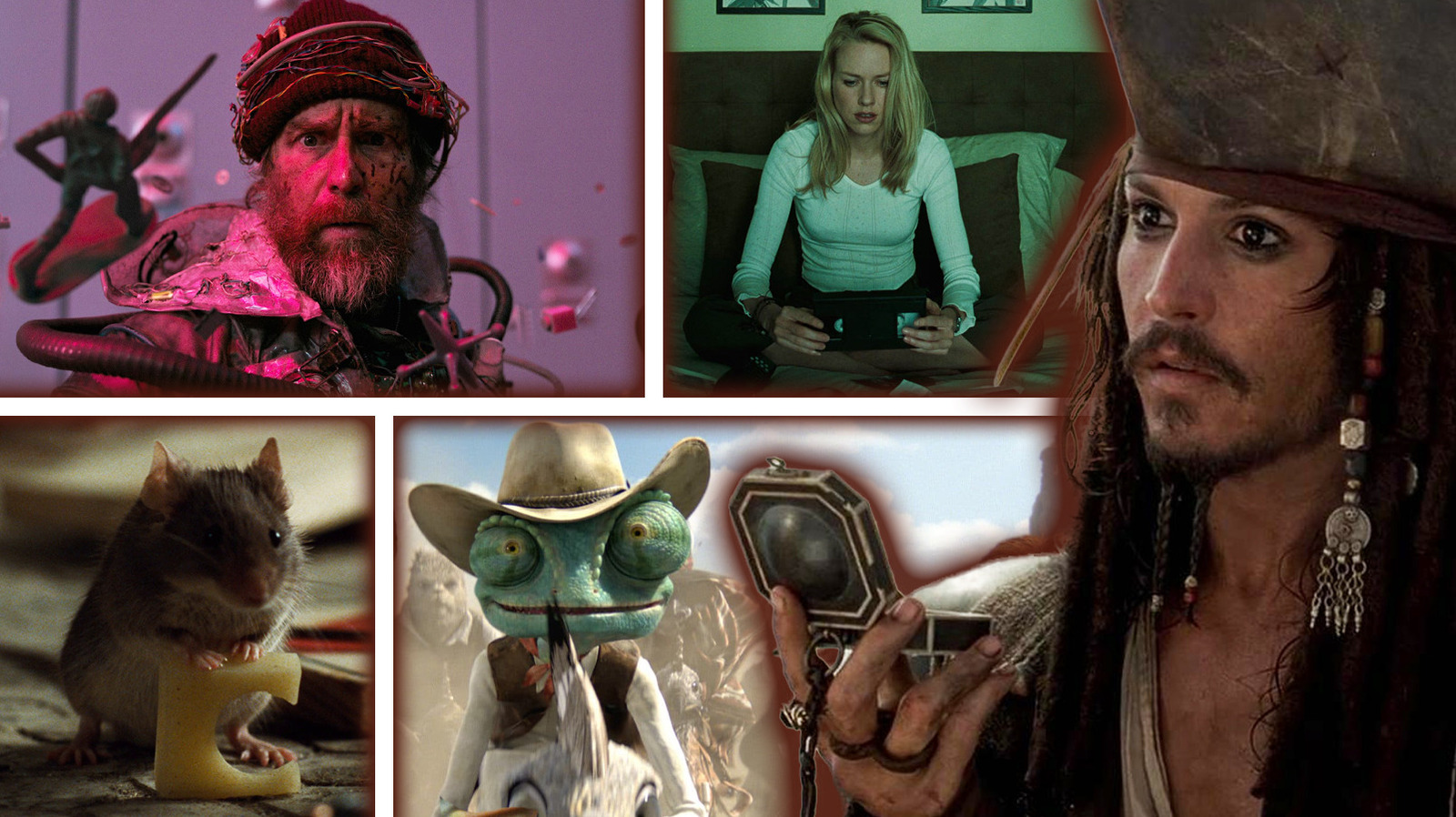
Gore Verbinski has yet to make a bad film. He’s made 11 features so far, and the worst among them are merely okay. That’s no small feat, considering that even legendary filmmakers like Steven Spielberg and John Carpenter have duds like “Always” and “Village of the Damned” on their resumes.
Still, while Verbinski’s made nearly half a dozen stone-cold classics, the rest of his movies range from the very good to the pretty meh. The constant throughout, though, is his eye for beautiful details, his desire for visual thrills, and his penchant for anywhere from a splash to a tidal wave of absurdity. He makes movies that feel uniquely his own, and that’s something worth celebrating.
Now keep reading for a look at Gore Verbinski’s movies, ranked from the least good to the absolutely great.
11. The Lone Ranger
John Reid (Armie Hammer) is a lawyer in the late 19th century who finds himself caught up in the hunt for a vicious outlaw named Butch (William Fichtner). It goes sideways and leaves John technically deceased, but a wee bit of supernatural shenanigans sees him rise up, don a mask, and continue the fight for justice. Joining him is a playfully odd Comanche named Tonto (Johnny Depp), and together they ride tall through the American West.
Depending on your tolerance for lead actors with, err, real-world baggage, “The Lone Ranger” might just be a non-starter for some of you. Get past that, though, and you still have to deal with excessive bloat fueled by massive cost overruns, the use of redface in the year 2013, and a film that stumbles with its characters while finding genuine thrills in its action set pieces. It’s the biggest mixed bag of Gore Verbinski’s career and ultimately the weakest of his films because of it.
When it works, it shines, as evidenced by some minor action fun and some truly entertaining antics involving trains. Its effort at deconstructing the myths of the American West also earns praise and consideration, but each step forward is met by another one back in the form of Hammer’s incredibly bland performance as a title character who’s given the short shrift anyway, a nonsensical and unnecessary framing device, and a tonal misstep in regard to race.
10. The Weather Man
Dave Spritz (Nicolas Cage) is a success, of sorts. He’s a local weather man in Chicago, paid well for his brief daily appearances on television and recognized by viewers on the street. Those viewers, though, treat him like a walking shtick, throw drinks at him from moving cars, and ultimately couldn’t care less. He fares no better with his ex-wife and daughter, so when he sees a chance to turn it all around, he leaps at it.
Gore Verbinski’s filmography is rife with movies about death, corruption, and casual cruelties, but “The Weather Man” is arguably his bleakest, meanest film. Some viewers might find that to be a plus, but it ultimately feels far too oppressive and pointless by the time the end credits roll. Dave feels like a character Ben Stiller would have played in the 1990s, a human punchline who’s constantly dumped on for big laughs before finally winning everyone over — except Dave never changes, and he certainly doesn’t earn big laughs.
That’s not to say there aren’t some blackly comic beats here with Michael Caine talking about camel toes being chief among them. The film remains a fairly depressing look at the cruel, lazy ways in which we treat both others and ourselves, and it ends with little to no forward momentum. It’s a downer, but Cage still shines as a man unable to connect with the world and people around him in any meaningful way, and it’s enough to make it one of his best performances and films.
9. A Cure for Wellness
Lockhart (Dane DeHaan) is a financial executive on the rise, but his career path hits a roadblock when he’s tasked with finding and retrieving his company’s CEO from a remote retreat in the Swiss Alps. The so-called wellness spa seems straightforward enough on first glance, but the longer Lockhart stays the more he comes to suspect something foul is in the air — and in the supposedly pure, life-healing waters too.
“A Cure for Wellness” is the second most mixed bag of a movie in Gore Verbinski’s filmography. On the plus side, the film saw Verbinski return to horror nearly 15 years after “The Ring.” It’s undeniably beautiful in its landscapes both real and imagined as it blends the natural with the wholly unnatural beneath an eerie sheen. The mystery it sets up in the first half is a compelling one as it ties into capitalism’s need to squeeze its participants, ie its victims, bone dry. The worlds of finance and wellness aren’t that far apart in feeling necessary, promising returns, and leaving you a mere husk.
The film’s problems come in Verbinski’s love of bloat. A tighter running time might have made the film’s mundane revelations more effective, but as it stands, by the time various threads have reached their end — or just disappeared — the elements of surprise and satisfaction have left the building. It’s somehow both too much and too little.
8. Pirates of the Caribbean: At World’s End
Captain Jack Sparrow (Johnny Depp) is a prisoner of the tentacle-faced Davy Jones (Bill Nighy) and doomed to a life that is no life at all. A greedy man named Beckett (Tom Hollander) now controls the open ocean through force both royally sanctioned and supernaturally endowed. All seems dire, but Will (Orlando Bloom) and Elizabeth (Keira Knightley) are on a mission to rectify both wrongs — and they’re going to need a lot of help.
“Pirates of the Caribbean: At World’s End” was filmed alongside the previous film, hence the cliffhanger ending of “Dead Man’s Chest,” so a lot of that movie’s strengths continue here. Verbinski once again delivers big action set pieces and spectacles blending practical locations with cg assists, and it all looks fantastic. It’s an epic conclusion to an epic trilogy ending a franchise that definitely doesn’t need any more entries and definitely didn’t get two more sequels anyway. (We kid, there are five films in the franchise, and you can see where they land in our ranking of the “Pirates of the Caribbean” franchise here.)
Its placement on the back half of this ranking, though, is due to one word — excess. At 169-minutes, this is the longest installment in the franchise, and it absolutely feels it. What should be a wrap-up instead feels compelled to introduce an abundance of new characters and threads to the point that some viewers are likely to stop seeing and enjoying the trees for the forest. It all becomes a blur, and adding to the problem is an over-reliance on Depp’s charms that always work best as colorful support.
7. Mousehunt
Ernie (Nathan Lane) and Lars (Lee Evans) are brothers in desperate need of money, the easier the better, and they think they’ve found it when they inherit an old mansion from a dead relative. The only thing standing between them and the lifestyles of the rich and famous is the house’s current occupant, a mouse — and the wily rodent has no intention of making it an easy eviction.
Gore Verbinski’s first feature film set the template for much of what followed, but “MouseHunt” still remains a fairly unique entry in his filmography. The film’s leads are ostensibly Lane and Evans, but as protagonists go, they’re both pretty irksome. Instead, it’s the antagonist, the darn mouse, that earns audience cheers of support as it goes roughshod over the brothers’ plans at catching it, killing it, and reaping their financial reward.
The film becomes a Looney Tunes romp with the mouse playing the role of a Bugs Bunny-like interloper doing its best to annoy everyone while still entertaining audiences. The little scamp succeeds thanks to Verbinski’s embrace of chaotic energy in the form of innovative and exciting visuals. We move all through the house, through nooks and crannies, as Rube Goldberg-esque contraptions and contrivances escalate a simple plan into epic destruction. It’s a live-action cartoon nearly 15 years before Verbinski would make an actual animated film, and it marked him as a filmmaker keen on chaos.
6. The Mexican
Jerry (Brad Pitt) is at the bottom of a criminal organization’s food chain, and he wants out. His girlfriend Samantha (Julia Roberts) is demanding the same, but before he can kiss crime goodbye, Jerry is tasked with one last assignment. Head to Mexico, retrieve a young man (David Krumholtz) and an old gun, and return home. Seems simple enough, no?
“The Mexican” is not very well-regarded among Gore Verbinski’s films — it didn’t make the cut on our list of Pitt’s best films or Roberts’ best films either — and it’s easy enough to see why. For one thing, Pitt and Roberts spend most of the film apart, which is an odd choice for what was advertised as a rom com of sorts. The movie can also feel like the definition of tonal whiplash as it jumps from silliness and action beats to genuine tragedy and sadness, sometimes within the same scene. It’s messy, but that approach is by design as a direct correlation to the absolute madness that is love.
Seems trite, we know, but the film follows three love stories at varying stages. One unfolds from the past via flashbacks and voiceover, one starts in sweetness and ends in pain, and one belongs to Jerry and Sam who could probably make things work if they’d just get out of their own way. It’s a lot, especially when combined with action beats, character work, and the best James Gandolfini performance you’ve never seen.
5. Good Luck, Have Fun, Don’t Die
It’s a night like any other in Los Angeles, except this night might just decide the fate of humankind. An unnamed man (a deliriously great Sam Rockwell) walks into a diner with explosives strapped to his chest. He tells the patrons that a select few of them are needed for a mission of utmost importance. It’ll be risky, and they won’t all survive, but they’re also the only hope there is for the future. Who’s in?
It’s been a long decade without anything new from Gore Verbinski, but that dry spell finally ended this year with the arrival of “Good Luck, Have Fun, Don’t Die.” It was worth the wait, as this is the kind of terrifically entertaining big swing that Hollywood rarely takes these days — so yes, expect this to tank in theaters only to be discovered on streaming in a few months by people wishing they’d caught it on the big screen. It’s extremely funny, bitingly sharp, and brutally satirical in its observations on our current trend towards artificial intelligence, and Verbinski’s own thoughts on the intrusion of A.I. into the arts go hand in hand with this film.
Rockwell absolutely shines as a sincere madman, and both he and the film nail the collision of absurd laughs and deadly serious commentary on lives derailed by technology and defeat. Haley Lu Richardson, Juno Temple, Zazie Beetz, and more are along for the ride, all of them terrific, and it’s a minor miracle of a film that tickles your funny bone even as it’s punching you in the gut.
4. Rango
A chameleon on a cross-country road trip — don’t worry, his owner’s driving — accidentally falls out of the car in the Mojave Desert. With nothing else nearby, he sets out for a small animal town called Dirt, but he finds only trouble when he gets there. He convinces the folks there that he’s a tough hombre named Rango (voiced by Johnny Depp), and soon he’s dealing with a conspiracy behind a drought, a villainous rattlesnake named Jake (Bill Nighy), and a deceitful mayor (Ned Beatty).
While it’s not unheard of, it’s still fairly uncommon for live-action feature film directors to take a detour into animation. Gore Verbinski did just that with his eighth movie, “Rango,” and the results are pretty extraordinary. His sense of visual lunacy translates beautifully to animation even as the story unfolds in the fairly grounded world of a pseudo-spaghetti western with a splash of conspiracy-laden thrills.
That’s right, this kids movie is riffing on the likes of both “A Fistful of Dollars” and “Chinatown,” making it subversive kiddie entertainment that never neglects the fun. Sharp, bright computer animation brings the world and characters to life alongside voice actors like Isla Fisher, Alfred Molina, Harry Dean Stanton, Timothy Olyphant, and more. Characters are rich in detail, the script is fun, and Verbinski even delivers some truly spectacular action sequences. It’s more than a mere homage to westerns (although it’s enough of one to earn a spot on our list of the 21st century’s best westerns) and instead stakes a claim as its own thing — a fantastic ride for all ages.
3. Pirates of the Caribbean: Dead Man’s Chest
Will (Orlando Bloom) and Elizabeth (Keira Knightley) see their wedding day interrupted when they’re arrested by Lord Beckett (Tom Hollander) for previous poor choices. Their only chance at avoiding the gallows? Finding Jack Sparrow (Johnny Depp) and bringing both him and his magical compass back to Beckett. Easy enough, except Jack is enduring his own troubles as both the long dead Davy Jones (Bill Nighy) and a giant kraken are pursuing him across the sea.
After the ginormous success of the first film, a sequel became inevitable, and Gore Verbinski’s “Pirates of the Caribbean: Dead Man’s Chest” is every bit as good as its predecessor. All of the main players return, and while both Bloom and Depp continue with what they started in the first film, it’s Knightley who gets the best glow-up, as Elizabeth is finally allowed to cut loose as a woman capable of holding her own in the action sequences.
Verbinski once again delivers with giant, mostly practical set pieces that are often filmed on real locations. There’s a tactile, old school feel to the action that enhances every beat, but it’s equally impressive on the digital effects front. Davy Jones’ face is anchored by tentacles that still, two decades later, sit as one of the greatest VFX accomplishments ever. It looks stunning, and the character feels every bit a part of this world. This is a rare blockbuster sequel that gets everything right.
2. The Ring
A group of teenagers watch a spooky tape and meet grisly ends exactly one week later. A journalist (Naomi Watts) trying to investigate the deaths watches the same tape and receives a mysterious phone call with a voice saying only, “Seven days.” Racing against time, and with both her husband and young son having watched it too, Rachel struggles to solve the mystery, end the curse, and save their lives.
Hollywood can’t resist remaking great foreign films from overseas despite the majority of them paling beside the (frequently) non-English originals. Gore Verbinski’s “The Ring” is a rare exception that takes a great horror film and arguably surpasses it. Hideo Nakata’s “Ring” is a creepy, weird, and iconic entry in the J-horror canon — Japanese horror films inspired by local culture of both the supernatural and pop varieties — and it didn’t appear to be an easy target for a Western redo. But Verbinski and writer Ehren Kruger nail their remake by focusing on universal elements, ideas, and fears.
The core of the tale involves a girl still irked by both her life and death whose psychic rage transcends the barrier between the living and the dead. The mystery reveals an incredibly sad and tragic story, but Verbinski doesn’t let his film get bogged down in the drama. He uses it to modulate emotion while ramping up the terror with grotesque deaths, unsettling imagery, and some legitimately terrifying sequences — one of which lands high on our list of the scariest scenes ever. Supernatural horror and our analog lives (of the time) collide for a still effective nightmare.
1. Pirates of the Caribbean: The Curse of the Black Pearl
It’s the early 1700s, and the open ocean is a wild free-for-all between military ships, pirate vessels, and the occasional supernatural shenanigans. A pirate named Barbarossa (Geoffrey Rush) abducts a British governor’s daughter named Elizabeth (Keira Knightley) as part of a dastardly plan, and only her childhood friend Will (Orlando Bloom) and the legendary Jack Sparrow (Johnny Depp) can save her.
Movies about pirates were all the rage in the early to mid-20th century, but they died an ignoble death in later decades with the likes of “The Pirate Movie” and “Cutthroat Island.” Action/comedy fans, though, know that Jackie Chan’s “Project A” films kept the genre alive as one of the best action comedies of the 1980s. Still, no one expected swashbuckling cinema to come roaring back to life as impressively as it did with 2003’s “Pirates of the Caribbean: The Curse of the Black Pearl.” Knock Bloom if you must, but he’s a sturdy hero type while Knightley gets to sink her teeth into a tough damsel in distress. Depp, meanwhile, finds just the right balance of silliness and seriousness with his character, and it’s easy to see why Sparrow became a sensation.
The film is a perfect storm of talents both on the screen and off with Gore Verbinski bringing his creatively chaotic eye to a dormant genre — with a film based on a theme park ride, no less — and delivering epic levels of genuine fun. Massive set pieces, on-location filming, an abundance of charisma and wit, and a real sense of adventure pervade the movie from start to finish. Its two-hour-plus running time sails right by thanks to every piece of a giant production coming together in unison to deliver a purely entertaining adventure at sea.






Leave a Reply