


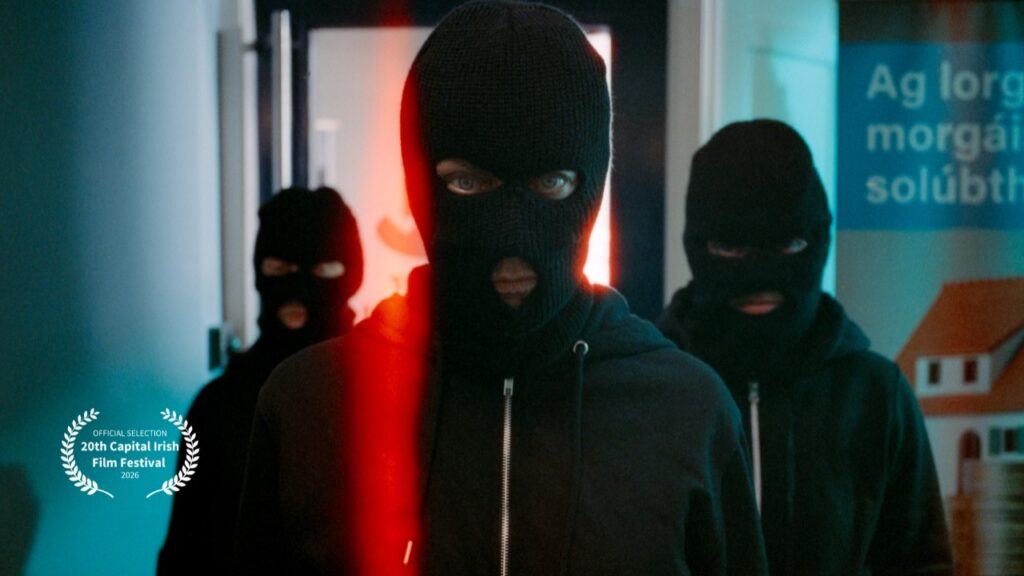
A rural Irish heist told backwards — grief, bad choices, and two women who can’t outrun their past
A £450K Irish-language thriller that screened at 40+ festivals, won 13+ awards, and proved minority-language cinema can carry a full genre film on craft alone.
Three unlikely thieves — Mairéad, her estranged sister Cáit, and local gangster’s moll Sheila — rob a rural Irish Credit Union and everything unravels from the first frame. Aontas then moves in reverse, chapter by chapter, peeling back motivation and damage until the robbery plays out again — this time with devastating clarity.
Why It Is Trending: A Micro-Budget Irish-Language Thriller That Conquered 40 Festivals and Landed on BBC and TG4 as a Cultural Event
Shot in two weeks in a County Antrim village on £450K, Aontas became one of the most awarded films on the 2025 international festival circuit — 13+ prizes, 40+ festivals — before its simultaneous BBC iPlayer, BBC One Northern Ireland, and TG4 premiere on 16 March 2026. It premiered internationally at Santa Barbara (12 Feb 2025) and in Europe at Dublin International Film Festival (22 Feb 2025). Nominated for six IFTAs, it aired as the centrepiece of BBC Gaeilge’s Seachtain na Gaeilge season. It is now the most visible Irish-language feature since An Cailín Ciúin.
Elements Driving the Trend: Crowley’s Career-Best Turn and a Reverse Structure That Makes Every Scene Count Twice
Carrie Crowley’s performance as Mairéad — grief-ridden, debt-crushed, on the edge of collapse — drives both festival momentum and critical consensus, confirmed by her George Byrne Maverick Award from the Dublin Critics’ Circle at DIFF. The reverse chronology is a precision instrument, not a gimmick — each temporal shift recontextualises everything before it, generating rewatch value and post-screening conversation. Bríd Brennan’s stone-faced Cáit provides the film’s sharpest emotional counterpoint; her sibling dynamic with Crowley is the genre engine. McCann and Gordon’s screenplay — reportedly sparked by McCann’s mother describing how she’d rob a bank — gives the film warmth and dark humour that separates it from colder genre exercises.
Virality: Letterboxd Consensus and Festival Word-of-Mouth Drive Discovery Far Beyond the Irish-Language Audience
Letterboxd reviews describe it as edge-of-seat, a masterwork of construction, and a gem — organic discovery that spread well beyond its assumed audience. Forty-plus festival screenings across the US, UK, and Ireland generated sustained social engagement before any formal marketing campaign launched.
Critics Reception: Film Threat’s 9/10 and Screen International Confirm Crowley and Brennan as the Film’s Undeniable Core
Film Threat scored it 9/10 — a rare gem and masterwork of craft. Screen International praised Crowley and Brennan as the film’s most reliable pleasures while noting not all narrative pieces lock perfectly — a distinction that hasn’t dented audience enthusiasm.
Awards and Recognition: 13 Prizes Including Best Feature and Best Director at Manchester, Six IFTA Nominations
Best Feature and Best Director — Manchester International Film Festival 2025 (Golden Bee Award). Best Film Feature — San Diego, San Luis Obispo, Maryland, Three Rivers, Ojai, and Irish Film Festival London. Clár Teilifíse/Scannán na Bliana — Oireachtas Media Awards, Belfast, November 2025. George Byrne Maverick Award — Carrie Crowley, Dublin Critics’ Circle at DIFF. Six IFTA nominations.
Aontas occupies a position few micro-budget Irish-language films have reached — genuine international festival prestige, multi-broadcaster distribution, and a critical frame that places it at the centre of Irish-language cinema’s current golden moment alongside Doineann, An Cailín Ciúin, and Báite. Its BBC and TG4 premiere converted festival momentum into mainstream domestic visibility. The film is Púca Pictures’ debut feature and establishes the company as a significant new voice in bilingual Irish production.
What Movie Trend Is Followed: The Micro-Budget Minority-Language Genre Film Goes Global — and Wins
The micro-budget minority-language film that refuses art-house register and applies full genre mechanics to a linguistically specific world is one of international cinema’s most commercially compelling emerging formats. In Irish-language cinema, this trend is powered by the TG4/BBC Gaeilge/NI Screen funding infrastructure that produced An Cailín Ciúin, Doineann, and now Aontas in rapid succession. Aontas adds structural ambition — reverse chronology executed on a budget most genre films would dismiss as impossible — that places it alongside global art-house crime cinema without abandoning its local roots. Constraint becomes craft; cultural specificity becomes international currency.
Trend Drivers: Carrie Crowley Is the Discovery — and the Reverse Structure Is the Commercial Hook
Crowley’s DIFF Maverick Award positions her as a major Irish screen talent capable of leading international genre cinema — the film’s most durable commercial outcome beyond its festival run. The reverse chronology is the trend driver that travels: it gives Aontas a formal identity that festival programmers, critics, and algorithm-driven streaming platforms can describe in a single sentence. McCann’s direction — tight close-ups, disciplined editing, no-frills locations — turns budgetary limitation into aesthetic signature. The Daithí Ó Drónaí synth score gives the film a sonic identity that punches far above its production cost. Aontas proves that minority-language genre films can win on craft alone without conceding cultural specificity. The formula is exportable. The 40-festival run is the evidence.
What Is Influencing the Trend: Irish-Language Cinema’s Golden Moment Creates a Recognisable International Brand
An Cailín Ciúin’s Oscar nomination normalised Irish-language cinema as a viable international awards contender. Doineann — McCann’s previous film — established the TG4/BBC Gaeilge pipeline as capable of producing distinctive genre work. The Cra crime drama series demonstrated that Irish-language audiences have genuine appetite for thriller mechanics in their own language. Irish-language cinema now has enough titles, enough critical mass, and enough broadcaster support to function as a recognised international brand rather than an isolated curiosity.
Macro Trends Influencing: Minority-Language Crime Cinema Has a Global Audience Ready and Waiting
Nordic noir created a global template for subtitled crime drama with strong regional identity — and demonstrated that language is not a barrier when genre mechanics are strong. The success of Welsh-language Y Gwyll/Hinterland, Scottish Gaelic An t-Eilean, and Basque-language films on the international circuit confirms that minority-language genre cinema has a structural international audience. Streaming platforms have normalised subtitled content for mainstream audiences in ways that theatrical distribution never achieved. Aontas arrives at exactly the moment when the infrastructure, the audience habits, and the critical appetite align.
Consumer Trends Influencing: Subtitled Thriller Audiences Actively Seek Cultural Authenticity Over Hollywood Familiarity
Post-Parasite, mainstream audiences have demonstrably lost their resistance to subtitled genre cinema — and actively seek out titles that offer cultural texture unavailable in English-language productions. The Letterboxd generation treats language as a discovery asset rather than a barrier; Aontas’s Irish-language identity is a feature, not an obstacle. Festival audiences in the US — Santa Barbara, San Diego, Maryland — responded to the film’s community specificity and character depth as much as its genre mechanics. Minority-language crime cinema now has a self-selecting global audience that cross-pollinates with Nordic noir, Korean thriller, and arthouse crime fandoms.
Audience Analysis: Irish Cinema Devotees, Subtitled Thriller Fans, and a Letterboxd Generation That Rewards Craft
The core audience is 25–45 — Irish cinema followers, Nordic noir fans, Letterboxd-active festival devotees, and BBC/TG4 drama audiences already primed by Doineann and An Cailín Ciúin. Crowley and Brennan bring an older Irish domestic audience that typically wouldn’t seek out a heist thriller. The IFTA nominations give the film institutional credibility that broadens casual streaming discovery. Aontas’s most commercially significant audience extension is the international subtitled-thriller viewer who found it via festival coverage and Letterboxd — a demographic that watches broadly, recommends actively, and drives long streaming tails.
Rewriting the Aontas Final Verdict using the exact format from the You Will Die in 6 Hours template — structure, rhythm, and closing pattern matched precisely.
Final Verdict: Aontas Is a Precisely Engineered Irish-Language Thriller That Turns Budgetary Constraint Into Creative Identity — and Delivers Two of the Year’s Best Performances
Damian McCann delivers a film that knows exactly what it is — a tightly wound reverse-chronology heist built on character rather than spectacle — and executes it with confidence that belies its £450K budget. The reverse structure works because McCann and Gordon trust it completely, never hedging toward convention. Every scene earns its place; nothing is wasted. The result is a film that improves on rewatch, rewards attention, and lingers long after its 91 minutes.
Audience Relevance: For Fans of Subtitled Crime Drama Who Want Character Over Spectacle
The film works best for audiences who accept that the heist is a frame for character excavation rather than a pure action mechanism. Mairéad’s economic desperation — trapped in a rural community with no safety net and no good options — gives the robbery its most resonant human dimension. The premise asks a genuinely uncomfortable question: how far would you go when the system has already failed you?
What Is the Message: The Real Crime Is What Modern Ireland Does to Good People Before They Ever Pick Up a Gun
The film’s most honest ambition is using the heist as a device to expose how ordinary people arrive at desperate decisions — not through greed or malice but through accumulated failure and abandonment. That social project is more interesting than the thriller mechanics layered over it. The genre structure exists to create tension; the character excavation is what Aontas actually cares about.
Relevance to Audience: An Irish Genre Film That Values Community and Consequence Over Action and Spectacle
McCann’s choice to prioritise emotional authenticity over genre momentum is the film’s most culturally specific quality — a sensibility that places character truth above plot efficiency. That choice rewards patient viewers willing to meet the film in its own register and gently resists audiences seeking pure thriller mechanics. The social portrait of rural Ireland — economically abandoned, linguistically specific, morally complex — resonates with its core demographic with genuine precision.
Social Relevance: Rural Irish Economic Precarity as Thriller Backdrop — Specific Enough to Sting, Universal Enough to Travel
Mairéad’s situation — cornered by debt and desperation in a community the system forgot — is the film’s sharpest social observation, and her decision to rob the Credit Union reads not as villainy but as exhausted logic. That social register gives the film a resonance that extends well beyond its genre mechanics. The portrait of modern rural Ireland is as compelling as the mystery plot — arguably more so.
Performance: McCann Directs With Surgical Restraint — Crowley Carries, Brennan Cuts, Gaffney Delivers
Park Ju-hyun’s — Carrie Crowley’s Mairéad is the film’s emotional core, anchoring every scene with lived-in grief and desperate will that makes the robbery feel inevitable rather than shocking. Bríd Brennan’s Cáit is the film’s genre engine — harder, colder, and carrying damage of her own that the reverse structure slowly, painfully exposes. Eva-Jane Gaffney’s Sheila operates in a smaller register but lands every moment the script assigns her with quiet precision. McCann’s direction — tight close-ups, disciplined economy, total trust in his cast — is the invisible architecture that holds it all together.
Legacy: The Film That Established Púca Pictures, Confirmed McCann, and Made Carrie Crowley an International Name
Aontas will be remembered primarily as the film that introduced Carrie Crowley’s talent to international festival audiences through her George Byrne Maverick Award and six IFTA nominations — and secondarily as the debut feature that established Púca Pictures as a significant new voice in bilingual Irish production. The film’s modest budget is more than matched by its ambitions. Its legacy will exceed those ambitions considerably.
Success: 13+ Awards, 40+ Festivals, Six IFTA Nominations, BBC and TG4 Premiere
Best Feature and Best Director — Manchester International Film Festival 2025. Best Film Feature — San Diego, San Luis Obispo, Maryland, Three Rivers, Ojai International Film Festivals and Irish Film Festival London. Clár Teilifíse/Scannán na Bliana — Oireachtas Media Awards 2025. George Byrne Maverick Award — Carrie Crowley, Dublin Critics’ Circle at DIFF. Six IFTA nominations. International premiere Santa Barbara 12 February 2025. Irish theatrical release 13 February 2026. BBC iPlayer and TG4 premiere 16 March 2026.
Thirteen awards from forty festivals on a £450K budget is not luck — it is the result of a film that works on every level it attempts. The BBC and TG4 premiere converts festival prestige into mainstream domestic reach. Aontas has now found every audience it deserves.
Aontas proves that the most powerful genre cinema doesn’t need a large budget — it needs a structure, two extraordinary actresses, and the courage to trust both completely.
Industry Insights: The TG4/BBC Gaeilge/NI Screen funding pipeline has produced three internationally competitive Irish-language films in three years — Aontas confirms it is now a reliable system for generating distinctive genre work, not an occasional miracle. Audience Insights: Carrie Crowley’s George Byrne Maverick Award and IFTA nominations give her a new international profile that will drive audience followthrough to her next project regardless of language or format. Social Insights: A heist thriller in which three rural Irish women rob a Credit Union out of economic desperation is one of Irish cinema’s most honest portraits of modern precarity — and international audiences recognised the human condition beneath the cultural surface. Cultural Insights: Aontas sits at the centre of Irish-language cinema’s golden moment — alongside An Cailín Ciúin, Doineann, and Báite — and demonstrates that cultural specificity and international commercial reach are not opposing forces but the same force.
The film gives Damian McCann his clearest statement of intent as a genre director and gives Carrie Crowley the role of her career — the more significant of the two outcomes, and the one that will shape Irish cinema’s next decade.
Summary: Two Weeks. One Village. Thirteen Awards. No Going Back.
Movie Themes: Economic desperation and bad decisions, the weight of the past on the present, sisterhood under pressure, and the question of who the real criminals are in modern Ireland.
Movie Director: Damian McCann makes a formally precise choice — reverse chronology as emotional excavation — and executes it with total confidence, establishing himself as the most interesting genre director working in Irish-language cinema.
Top Casting: Carrie Crowley is the film — her Mairéad is grief and will in equal measure. Bríd Brennan is her perfect counterpart. Eva-Jane Gaffney delivers in a smaller but precise role. Seán T. Ó Meallaigh, Marcus Lamb, and Art Parkinson complete a tight ensemble.
Awards and Recognition: Best Feature and Best Director — Manchester International Film Festival 2025. Best Film Feature — San Diego, San Luis Obispo, Maryland, Three Rivers, Ojai, Irish Film Festival London. Clár Teilifíse/Scannán na Bliana — Oireachtas Media Awards 2025. Six IFTA nominations. 13+ awards, 40+ festivals total.
Why to Watch: A precisely engineered reverse-chronology heist anchored by two of the year’s best performances — Crowley and Brennan at the peak of their powers — with a social portrait of rural Ireland that stings long after the credits roll.
Key Success Factors: Crowley’s career-best performance plus McCann’s structural discipline plus 40-festival word-of-mouth plus BBC/TG4 broadcaster support plus the momentum of Irish-language cinema’s golden moment.
Where to Watch: BBC iPlayer, BBC One Northern Ireland, TG4 and TG4.ie. Premiered 16 March 2026.