
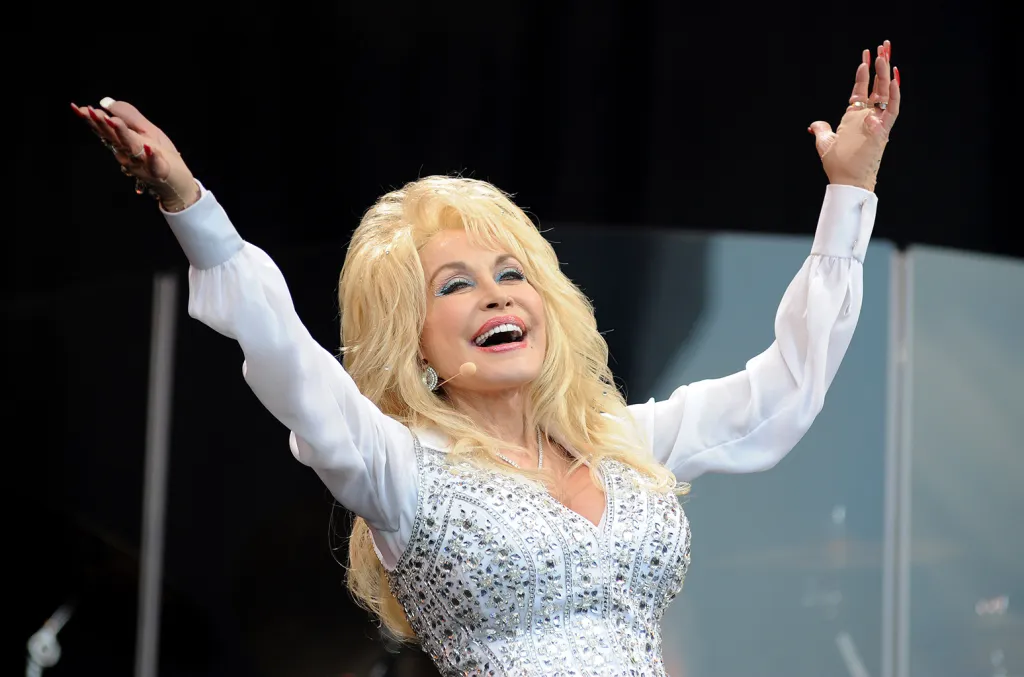
Since releasing her debut solo album, 1967’s Hello, I’m Dolly, Dolly Parton has changed the face of the entertainment industry. Kicking down doors for female performers in both country and pop music, she has soared in the worlds of books, television, philanthropy and movies — and pretty much whatever else she tackled. On Jan. 19, Parton – who has topped the Billboard Hot 100 twice and Billboard‘s Hot Country Songs a whopping 25 times — is turning 80 years old.
Her expansive roster of hits reads like a “best of” list of the 1970s and 1980s, and it remains one of the strongest song catalogs of any singer-songwriter in any genre. As a writer, she has penned everything from poignant, detailed ballads about life in the Great Smoky Mountains, where she grew up, to some of the most defining love songs of all time.
Her prowess as a songwriter and performer is so great, it earned her a historic induction into the Rock & Roll Hall of Fame in 2022 — an accomplishment she almost didn’t accept, telling Billboard at the time that she didn’t feel like she “measured up” to past inductees. A legacy like hers, however, deserves the title of “rock star” no matter what style of music she makes, and the world agreed. She went on to become the second female country artist (after Brenda Lee) to be inducted in both the Rock & Roll and Country Music Halls of Fame. (Parton has also been inducted into the Songwriters Hall of Fame.)
“People usually (say) ‘Dolly rocks’ or ‘you rock’ or ‘you’re a rock star,’” she said. “I thought they just meant that I was cool, and I took that as a great compliment. But now I’m going to have to take it literally!”
In choosing our favorite Dolly Parton songs, we settled on these 25. Many of them came from her own pen, and all of them will “Always” have staying power. To be fair, we could do a list of our favorite Dolly duets, too, but wanted to keep this one solo focused.
Keep reading to see Dolly Parton’s best songs to date below. (Ed. note: A shorter version of this list was published prior to Billboard writer Chuck Dauphin’s passing in 2019.)
-
“Romeo,” Dolly Parton & Friends
Dolly welcomed a group of her fellow women country musicians for this fun, flirtatious track, featuring Mary Chapin Carpenter, Kathy Mattea, Pam Tillis and Tanya Tucker. They have a girls’ night out, trading amorous lines such as “I ain’t never seen a cowboy look that good in jeans” and lobbing lighthearted catcalls at the titular “Romeo,” voiced by Billy Ray Cyrus. The song was included on Parton’s 1993 project Slow Dancing With The Moon. –Jessica Nicholson
-
“The Seeker”
One of the more unlikely Dolly Parton songs to be a hit record, this was a straight-ahead spiritual number. Fans resonated with the message about a person putting one foot forward, though sometimes ending a couple feet back. – Chuck Dauphin
Listen here.
-
“Yellow Roses”


Image Credit: Aaron Rapoport/Corbis/GI With Ricky Skaggs taking creative control of her 1989 album White Limozeen, Parton returned to her country roots with her most traditional album in ages. At the heart of that project was this exquisite ballad, which brought her another Hot Country Songs chart-topper. – C.D.
Listen here.
-
“In the Good Old Days (When Times Were Bad)”
Parton paints a sobering picture of her childhood in rural Tennessee, where children go to sleep hungry even though their father works from sunup to sundown, so much that his hands crack and bleed. But instead of being bitter or bragging about how far she’s come, Parton forgoes the pity party and the victory lap, choosing instead to offer up this loving but unromantic ode to a life forged by hardship. “No amount of money could buy from me the memories that I have of them / No amount of money could pay me to go back and live through it again” she sings on the rousing chorus of this twangy, jangly No. 25 hit on Hot Country Songs. – Joe Lynch
-
“Dumb Blonde”
In 1967, Parton earned her first Billboard Hot Country Singles top 30 hit with this song, written by Curly Putman, that eviscerates a stereotype aimed at women. Parton self-assuredly delivers key lines like “This dumb blonde ain’t nobody’s fool” with a knowingness and bite that convey her intelligence, wit and refusal to tolerate anyone who would judge her solely by outward appearance. The song was also a key musical moment that caught the attention of country singer Porter Wagoner; Parton soon joined Wagoner as a duet partner on his television show and on tour, before going on to achieve solo acclaim. – J.N.
-
“He’s Alive”
Dolly’s 1989 cover of Don Francisco’s late-’70s CCM classic carried one of her all-time most memorable vocal performances, as her trembling first-hand account of the scene of Jesus’ resurrection builds masterfully to a soaring, sumptuous climax that can turn any day of the week into Easter Sunday. Though the studio version on White Limozeen is charmingly bombastic with its dramatic strings, Parton’s definitive “He’s Alive” rendering was probably the one she delivered at the 1989 CMA Awards in front of a gospel choir. “That night… I honestly felt the spirit just fall on me,” she would later say, “and I really think people felt that too.” – Andrew Unterberger
-
“You’re The Only One”

Image Credit: Richard E. Aaron/Redferns One of the few songs on this list not written by Parton, this heartbreaking ballad (written by Bruce Roberts and Carole Bayer Sager) was one of the centerpieces of the period when Parton’s music was beginning to gain favor with a wider audience beyond Nashville. At the time it topped the charts in the summer of 1979, this was Parton’s fifth straight No. 1 on Billboard’s Hot Country Songs chart, and also a top 20 hit on the Adult Contemporary chart. – Hannah Dailey
Listen here.
-
“Islands in the Stream,” Kenny Rogers and Dolly Parton
In 1983, Dolly Parton paired with another golden-voiced country icon, Kenny Rogers, recording what became one of the most lauded collabs in country music history. Written by pop group Bee Gees, “Islands in the Stream” topped both Billboard’s Hot Country Singles chart and the all-genre Hot 100. Parton and Rogers each pour their vocal charms over the song’s flirtatious, devoted lyrics as they each gush about their mutual love, admiration and commitment. The two went on to record several duets together, including 2013’s “You Can’t Make Old Friends.” – J.N.
-
“Sweet Summer Lovin’”
Another song not from the Parton pen (Blaise Tosti did the honors), this one featured some intriguing production that blurred the lines between country and disco, making for one of her more appealing departures of sound. – C.D.
Listen here.
-
“Why’d You Come in Here Lookin’ Like That”
For as many love songs, worship songs and songs of social conscience as Dolly Parton has made unforgettable over the years, she could also rip a mean horndog anthem when called on to do so. White Limozeen lead single “Why’d You Come in Here” finds a lip-licking Dolly fixated on the unexpected appearance of a ne’er-do-well ex of hers, with “big ideas and a little behind.” Coming from any number of hatted male country stars, the song would sound cheesy if not downright creepy, but Dolly finds the pathos in the lasciviousness, pulling off the titular lament in a way sympathetic enough to make the guy feel genuinely guilty for being so darned fine. – A.U.
-
“Light of a Clear Blue Morning”
In this song from her 1977 album New Harvest…First Gathering, Parton proclaimed musical freedom and anticipated happier times ahead. Parton wrote the track after parting ways with musical and business partner Porter Wagoner and deciding to bet on herself as a solo star that could straddle the lines of country and pop. “Now that I have won my freedom/ Like an eagle, I am eager for the sky,” she sang. From there, Parton released the pop-country project Here You Come Again, earning a crossover hit with its titular song. She was named the CMA’s entertainer of the year in 1978. – J.N.
-
“Tennessee Homesick Blues”

Image Credit: Pete Still/Redferns Though the 1984 film Rhinestone didn’t make any list of favorite films from critics that year, the movie’s breakout hit was one that Parton’s fans definitely latched on to. The melody and the instrumentation were very much influenced by her early, more Appalachian-infused work. – C.D.
Listen here.
-
“Just Because I’m a Woman”
On just her second solo album, Parton tackled double standards for men and women with regards to premarital sex—without ever explicitly spelling it out, but without leaving the listener in doubt as to what she was referencing, either. Leave it to Dolly to pen a twangy, defiant song where she cops to making mistakes without begging for forgiveness, where she owns her choices without necessarily celebrating them. In 1968, social norms around sex were changing, and the message resonated—the single went top 20 on Hot Country Songs and influenced decades of anthems from women in country. – J.L.
-
“If You Hadn’t Been There”
There are tearjerkers, and then there’s “If You Hadn’t Been There.” Penned by Parton for her longtime husband Carl Dean, and released within a week of his March 2025 passing, the song’s power comes through its quivering vulnerability. Dolly sounds on the verge of vocally breaking throughout the early verses, but is powered through by the song’s sturdy, piano-led melody and power-ballad drums. She gathers strength as the song builds but still sounds understandably exhausted and vividly fragile by the final repetition of the song’s immaculate, heart-obliterating chorus hook: “I wouldn’t be here/ If you hadn’t been there.” – A.U.
-
“My Tennessee Mountain Home”
Parton wrote plenty of top-tier songs about her childhood in rural East Tennessee, and the title track to her 11th solo album—a No. 15 hit on Hot Country Songs in 1973—is one of her finest. Kids playing with June bugs, young sweethearts stealing kisses after church, vines growing wild on fences—Parton’s detailed lyrics place you right on those Smoky Mountain trails and front porches. Unlike some of her reflections on her impoverished upbringing, this one—where “life is as peaceful as a baby’s sigh”—is as sweet as the honeysuckle. – J.L.
-
“Two Doors Down”
As a country hit, it barely made a ripple — only charting as a B-side to her No. 1 hit “It’s All Wrong, But It’s All Right,” but this Parton composition about a woman wanting to break the chains of the pain of a previous relationship found an audience in the pop world with its bouncy feel and sing-along chorus, giving her a rare top 20 entry on the Hot 100 that wasn’t also a country hit. – H.D.
Listen here.
-
“9 To 5”

Image Credit: Michael Ochs Archives/GI Parton’s trek to pop culture stardom was forever solidified with her performance in the 1980 film of the same name, where she matched wits with Lily Tomlin, Jane Fonda and Dabney Coleman. The song’s title cut was a tribute to all who slaved away too many hours for too little pay, ultimately striking a chord with both country and pop audiences, topping the Hot 100, Hot Country Songs and Adult Contemporary. – H.D.
Listen here.
-
“Coat Of Many Colors”
Sometimes, you have to write your ideas wherever you are at. In 1969, Parton was struck with the inspiration for this nostalgic ballad about a childhood memory, but she didn’t have any paper with her — so she wrote the song on a dry cleaning receipt. Two years later, she took the song to No. 4 on Hot Country Songs, but the song’s impact is still being felt decades later, even serving as the inspiration for a pair of highly-rated NBC TV movies in 2015 and 2016. – C.D.
Listen here.
-
“Love Is Like A Butterfly”

Image Credit: Michael Ochs Archives/GI If Parton needed any affirmation that she was doing the right thing career-wise when she struck out on her own in 1974, this provided that feeling when it topped the chart in the fall of that year. It’s a luscious melody that stays in your head, and perhaps the Dolly Parton song that inspired a fan to go the distance to show his devotion — one fan reportedly had the album cover tattooed on himself. – H.D.
Listen here.
-
“Old Flames Can’t Hold A Candle To You”
While many detractors in country music were talking about Parton’s defection to the pop music world, this 1980 Hot Country Songs No. 1 showed that the singer could still be as “country” sounding as anybody. A song in which Parton is telling her lover not to be threatened by her past, she made this Patricia Sebert/Hugh Moffatt composition a classic. – C.D.
Listen here.
-
“Touch Your Woman”
A 1972 hit for Parton, this was one of her first attempts to record a straight-ahead love song, rather than a nostalgic number dealing with her mountain roots. Some radio stations refused to play the song, deeming it too sexually suggestive. And, to be certain, it was no “Washday Blues,” but the Dolly Parton song definitely helped her to establish herself as one of the top singer-songwriters of her day. – C.D.
Listen here.
-
“Here You Come Again”

Image Credit: Gary Miller/WireImage A rarity on several fronts: For starters, Parton didn’t write the song, and she didn’t even record it first. Her producer at the time heard the song on a B.J. Thomas record, and the song was actually written with Brenda Lee in mind. With all due respect to those legendary artists, Parton delivered a knockout punch to this Barry Mann/Cynthia Weil song with her 1977 version. When you hear that signature keyboard intro, you’re hooked. Audiences agreed, sending the song to No. 1 on Hot Country Songs, No. 2 on Adult Contemporary and No. 3 on the Hot 100. – C.D.
Listen here.
-
“Jolene”
Two very different women helped to inspire this Hot Country Songs chart-topper. There was a little girl who came through Parton’s autograph line following a show — and also a bank teller whom the singer felt was flirting with her husband Carl early on in their marriage. However you look at it, this earnest plea to the other woman became a career-defining song for Parton — and one that she would revisit several times, doing collaborative versions with Pentatonix and goddaughter Miley Cyrus. – C.D.
Listen here.
-
“The Bargain Store”

Image Credit: David Redfern/Redferns This 1975 jewel remains one of her most under-appreciated records. The lyrics — all about the emotional wear and tear of previous relationships, and how they are not going to hold her back from pursuing a new love — were pretty touchy for their time, and some radio stations resisted playing it at first. However, the appeal of the song was too much, giving her not only a No. 1 Hot Country Songs hit, but a top 40 crossover on the Adult Contemporary chart. – C.D.
Listen here.
-
“I Will Always Love You”

Image Credit: Rich Fury/GI for The Recording Academy Simply put, it’s one of the greatest love songs in music history. The inspiration for the song stems from Parton making the decision to cut the professional ties to Porter Wagoner in 1974. In doing so, she crafted a love song for the ages — one that was a hit three (1974, 1982, 1995) times for the singer, and also taken to new heights in 1992 by Whitney Houston on the soundtrack of The Bodyguard. Houston’s version logged an astonishing 14 weeks atop the Hot 100. – C.D.
Listen here.



Leave a Reply