


US | 120 min | Dark Comedy / Crime / Thriller
When Cleaning Up Crime Becomes a Criminal Business
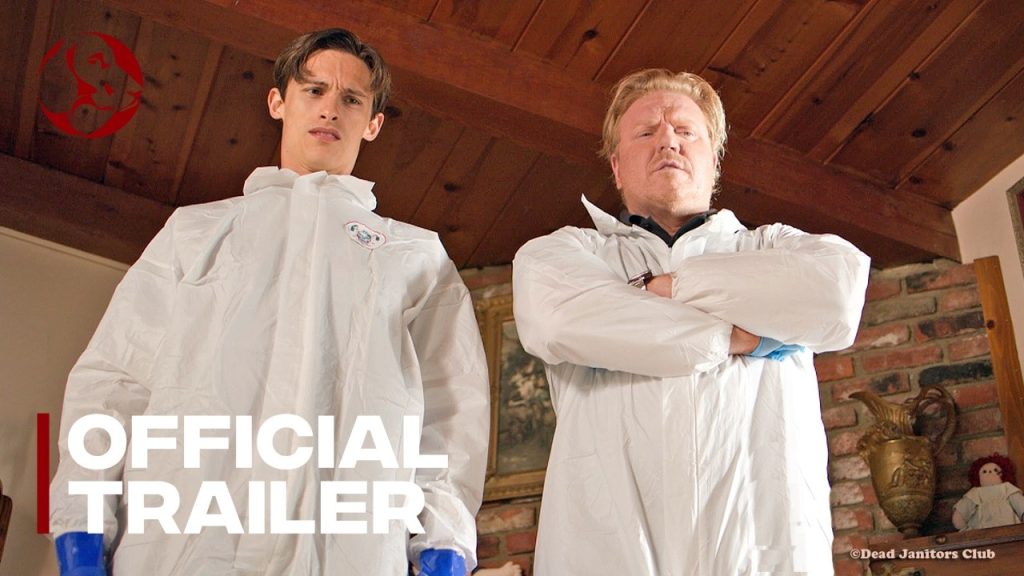
Dead Janitors Club finds its dark-comedy hook in a job most people would rather never think about. Jeff Klima, played by Felix Merback, is broke and looking for a way forward when he becomes involved with crooked cop Dirk, played by Jake Busey, in a crime-scene cleanup operation where blood, death and human disaster are simply part of the working day. Then Jeff takes a mysterious safe from a crime scene and discovers that cleaning up other people’s trouble is very different from becoming part of it.
Directors Devon Downs and Kenny Gage lean into the outrageous contradiction at the center of Jeff Klima’s real-life memoir: this is a world surrounded by death, yet the people working inside it still worry about money, relationships, ambition and getting through another shift. That collision between gruesome reality and ordinary economic survival gives the movie its strongest identity—a true-crime story that often behaves like a workplace comedy after somebody forgot to clean the blood off the floor.
➡️ Movie Insight: Dead Janitors Club turns crime-scene cleanup into the unlikely center of a darkly comic criminal adventure. Its hook comes from treating an extraordinary and disturbing profession as another way for struggling people to make money. The stranger the situation becomes, the more the movie finds comedy in how quickly the horrific can become routine.
Why This Movie Matters Right Now: True Crime Is Getting Messier, Funnier and More Personal
True crime has become one of contemporary entertainment’s most durable categories, but audiences are increasingly familiar with its standard vocabulary: murder investigations, serial killers, courtroom revelations and documentary reconstruction. Dead Janitors Club enters from a much less explored direction by focusing on the people who arrive after the police, investigators and bodies are gone—the workers responsible for physically removing what the crime has left behind.
That perspective gives the film something valuable in an overcrowded true-crime landscape: proximity without following the usual investigative formula. Because Jeff Klima adapted his own memoir, the movie can approach crime through lived occupational experience rather than simply recreating a notorious case. The outrageous material becomes more interesting precisely because underneath the criminal escalation sits something completely recognizable—a young man trying to earn enough money to survive.
➡️ Why It Matters: Audiences have seen countless stories about committing crimes and solving them, but far fewer about the people cleaning up afterward. Dead Janitors Club turns that overlooked profession into a new entry point for true-crime storytelling. The result shows how personal experience can refresh a genre that audiences already think they understand.
Should You Watch It?: For Viewers Who Like Their True Crime With Blood, Bad Decisions and Black Humor
Dead Janitors Club is built for viewers comfortable laughing when a situation probably should not be funny. The movie mixes crime, romance, violence and deliberately raunchy humor around characters whose increasingly questionable decisions keep pushing an already strange occupation toward something much more dangerous.
That tonal mix will not work equally for everyone. The humor is intentionally crude and the film’s critical reception has already identified unevenness in how some of those jokes and later narrative turns land. But viewers attracted to eccentric true stories, morally compromised characters and crime movies willing to embrace their trashier instincts are much closer to the film’s natural audience.
➡️ Viewing Recommendation: Watch Dead Janitors Club if you like crime movies where bad judgment is almost as important as criminal intent. Its strongest attraction is the collision between a genuinely unusual profession and increasingly ridiculous criminal escalation. Expect something grimy, irreverent and deliberately rough around the edges rather than polished prestige true crime.
Why Everyone Is Talking About It?: A Real-Life Cleanup Story Becomes an Indie Crime Comedy
The biggest conversation starter is built directly into the premise: Jeff Klima actually worked in crime-scene cleanup and turned those experiences into the memoir The Dead Janitors Club: Pathetically True Tales of a Crime Scene Cleanup King before adapting the material for the screen. That gives the film the increasingly powerful “this really happened” hook while taking audiences into an occupation rarely placed at the center of a movie.
The film also arrived with a limited theatrical and VOD rollout on August 28, 2026, putting its eccentric true-story premise directly in front of genre audiences. Felix Merback takes the central role of Klima opposite Jake Busey’s crooked Dirk, while Brianna Gage plays Kerry, the tattoo artist who becomes emotionally and dangerously entangled in Jeff’s rapidly deteriorating situation.
➡️ Viral Potential: Dead Janitors Club has an immediately shareable hook because “true story about a crime-scene cleanup crew that gets mixed up in crime” practically sells itself. The combination of blood, bizarre occupational detail and dark humor gives the film plenty of cult-conversation potential. Its strongest word-of-mouth weapon is the realization that the craziest part of the setup begins with someone’s actual job.
Why Dead Janitors Club Stands Out: True Crime Moves Behind the Yellow Tape
Most crime films are interested in what happens before someone dies or who discovers the truth afterward. Dead Janitors Club focuses on a stranger space in between: the people entering a location once the investigation has moved on but the physical consequences remain. That shift in perspective immediately changes how crime looks on screen.
The cleanup profession also creates an unusual relationship with violence. Blood and death cannot remain extraordinary when characters encounter their aftermath professionally, so the movie can explore the disturbing process through which shock becomes routine. That normalization gives its dark comedy a stronger foundation than simple gross-out humor because the characters’ everyday working reality is already absurd enough.
➡️ Cinema Insight: Dead Janitors Club finds a fresh cinematic perspective by looking at crime from the cleanup crew’s side of the tape. Violence becomes labor, blood becomes another workplace problem and death becomes something that eventually has to be scrubbed away. That unusual viewpoint gives familiar crime-movie ingredients a messier and more human perspective.
Movie Trend: True-Crime Dark Comedy — When Real Criminal Experiences Become Unfiltered Entertainment
True-crime storytelling is expanding beyond serious documentary reconstruction and prestige dramatization. Filmmakers are increasingly able to approach real criminal experiences through irony, absurdity and morally uncomfortable comedy, acknowledging something the genre has always contained: real life can become so strange that treating every moment solemnly can actually make it feel less believable.
Dark comedy is particularly effective when the criminal behavior grows from recognizable pressures such as money, work, status or desperation. Audiences understand those motivations even when the characters’ responses become outrageous. That tension creates a new kind of true-crime entertainment where viewers can simultaneously recognize the reality, laugh at the stupidity and remain aware that the consequences are real.
➡️ Movie Trend: True-crime dark comedy is moving beyond sensational criminals toward ordinary people making increasingly extraordinary mistakes. Humor gives filmmakers permission to explore the stupidity, desperation and absurdity surrounding real criminal behavior. Dead Janitors Club fits that shift by turning economic survival, crime-scene labor and spectacularly bad decisions into the same story.
Viewer Profile: For Audiences Who Like Crime Stories With Dirt Under Their Fingernails
Dead Janitors Club is not targeting viewers looking exclusively for sophisticated procedural crime drama. Its audience is more likely to enjoy films where criminals are messy, plans go wrong and comedy emerges from characters becoming increasingly incapable of controlling situations they created themselves.
The true-story foundation broadens that appeal. Crime fans can enter through the illegal operation and cartel danger, dark-comedy audiences through the absurdity, while viewers fascinated by unusual jobs have an entirely different reason to watch: crime-scene cleanup itself.
|
Death, bad decisions and economic desperation are pushed toward deliberately uncomfortable humor. |
|
|
Jeff Klima’s real experiences provide the story with an unusual autobiographical foundation. |
|
|
Morally compromised characters and escalating criminal chaos give the film a rough independent personality. |
|
|
The strange profession, raunchy humor and eccentric situations create cult-film potential. |
|
|
Busey’s crooked-cop role fits the movie’s heightened criminal world. |
|
|
Unusual Workplace Story Fans |
Crime-scene cleanup provides a profession rarely explored from the worker’s perspective. |
➡️ Audience Insight: Dead Janitors Club sits at the intersection of audiences who like true stories and viewers who prefer their crime entertainment unconventional. Its strongest differentiator is not simply crime or comedy but the occupational world connecting them. The cleanup business gives audiences access to something genuinely unfamiliar before the criminal plot even begins.
What This Movie Means for the Industry: Real-Life Stories Are Becoming Indie Cinema’s Competitive Advantage
Independent filmmakers cannot always compete with studios on scale, stars or marketing spend, but they can compete through specificity. Dead Janitors Club demonstrates the value of finding real experiences so unusual that the concept itself becomes a marketing asset. Crime-scene cleanup is immediately visual, inherently uncomfortable and sufficiently unfamiliar to generate curiosity before audiences know anything else about the story.
Having Klima adapt his own memoir strengthens that strategy because the project originates with the person who experienced the world being dramatized. That does not automatically guarantee cinematic success, but it gives independent productions access to details, attitudes and situations that generic screenwriting research may struggle to reproduce.
➡️ Industry Insight: Distinctive real-life experiences can function as intellectual property for independent cinema. A relatively modest production becomes easier to position when audiences immediately understand what makes its story different. Dead Janitors Club shows why specificity can sometimes be more commercially useful to indie filmmakers than trying to imitate larger studio crime movies.
Creative Analysis: Making Death Feel Like Another Day at Work
Downs and Gage build the movie around a powerful tonal contradiction: the environments are gruesome, but the people entering them still have jobs to finish. That allows Dead Janitors Club to move between crime, comedy, horror and romance without completely belonging to any single genre.
Storytelling — One Bad Decision Opens the Next Door
The screenplay begins with the already unusual world of crime-scene cleanup before escalating through Jeff’s involvement with Dirk, the stolen safe, cartel danger and his developing relationship with Kerry. The structure relies on compounding mistakes, allowing an occupational story to progressively transform into a criminal one.
Direction — Finding Comedy Inside the Gruesome
Downs and Gage lean toward heightened dark comedy rather than procedural realism. Their central challenge is maintaining enough danger for the criminal stakes to matter while allowing the absurdity of Jeff’s situation to remain entertaining.
Performances — Felix Merback Grounds the Chaos
Felix Merback carries the difficult task of playing Jeff as someone audiences can follow while his circumstances become increasingly outrageous. Jake Busey’s Dirk provides a more openly crooked counterweight, while Brianna Gage’s Kerry gives Jeff’s story a relationship outside the cleanup operation and criminal spiral.
Visual Language — Blood Becomes Workplace Geography
Crime scenes provide the movie with an inherently graphic visual environment, but the more interesting idea is repetition. What initially looks horrific can gradually become professional space for characters whose job requires them to stop reacting emotionally and start thinking practically.
Sound & Music — Keeping Crime and Comedy in the Same World
The film’s tonal mixture requires music and sound to move between threat, absurdity and grim workplace routine without making those shifts feel completely disconnected. The crime scenes themselves also create opportunities for sound to make uncomfortable environments feel tactile even when the movie is chasing laughs.
Pacing & Structure — From Side Hustle to Criminal Freefall
The narrative’s momentum comes from escalation. What begins as an ethically questionable way to make money becomes progressively harder to contain once the stolen safe connects Jeff’s already unstable working life with a much more dangerous criminal world.
Themes — What People Will Do When Money Gets Tight
Underneath the blood and outrageous behavior sits a straightforward economic pressure: people make dangerous compromises when legitimate options seem inadequate. The movie exaggerates that impulse through criminal comedy, but its starting motivation—trying to make enough money to survive—is deliberately ordinary.
What Makes It Different — The Cleanup Is the Hook
The film does not need to invent an exotic criminal profession because the real occupation is already cinematic. Crime-scene cleanup gives the story its visual identity, dark humor and unusual perspective on violence.
➡️ Creative Insight: Dead Janitors Club works best when the grotesque becomes routine and the routine becomes absurd. Its most distinctive creative asset is the contrast between extraordinary crime scenes and characters treating them as another working day. That tension gives the film a personality conventional crime comedies cannot easily replicate.
If You Liked Dead Janitors Club: True Crime Gets Messy, Funny and Morally Complicated
If Dead Janitors Club connects because it mixes real-world criminal absurdity with people trying to make money in increasingly disastrous ways, these films explore related territory from different directions. Each finds comedy inside crime without pretending that the consequences disappear simply because the situation becomes ridiculous.
Sunshine Cleaning (2008) by Christine Jeffs: Crime-Scene Cleanup Becomes a Family Business
Amy Adams and Emily Blunt play sisters who enter the biohazard and crime-scene cleanup business as a way of improving their financial circumstances. Christine Jeffs takes the profession in a warmer and more character-driven direction, but the occupational connection makes it the most natural companion piece to Dead Janitors Club.
➡️ Why It Connects: Both films discover storytelling potential in the strange reality of people professionally cleaning spaces where terrible things have happened. Sunshine Cleaning finds melancholy and family connection in the work, while Dead Janitors Club pushes the same profession toward crime, danger and much darker comedy.
Pain & Gain (2013) by Michael Bay: The American Dream Turns Criminally Stupid
Michael Bay takes a real criminal case and transforms it into an aggressively heightened dark comedy about ambition, money and men whose confidence massively exceeds their intelligence. Mark Wahlberg, Dwayne Johnson and Anthony Mackie play bodybuilders whose pursuit of wealth becomes an escalating sequence of kidnapping, extortion and catastrophic decisions.
➡️ Why It Connects: Both movies use real events to explore people whose desire for money pulls them into increasingly absurd criminal situations. Dead Janitors Club is smaller and grimier, while Pain & Gain turns the same basic collision between ambition and stupidity into maximalist spectacle.
Fargo (1996) by Joel Coen: Ordinary Desperation Creates Extraordinary Criminal Chaos
Joel Coen’s Fargo remains one of cinema’s defining examples of crime becoming darkly funny because the people committing it are so catastrophically incapable of controlling the consequences. William H. Macy’s financially desperate Jerry Lundegaard begins with a supposedly manageable criminal scheme and discovers that every attempt to solve one problem creates something worse.
➡️ Why It Connects: Dead Janitors Club operates in a rougher and more deliberately raunchy register, but it shares Fargo’s fascination with economic desperation turning ordinary people toward spectacularly bad decisions. In both films, crime becomes increasingly absurd because nobody involved possesses the control they imagine they have.
➡️ If You Liked Insight: These films show why money problems and criminal stupidity remain such productive ingredients for dark comedy. The characters do not begin as criminal masterminds—they become trapped by decisions that keep generating worse decisions. Dead Janitors Club adds crime-scene cleanup to that tradition, giving the genre an unusually bloody workplace twist.
Final Verdict: The Dirty Work Becomes the Main Attraction
Dead Janitors Club has something many independent crime movies spend too much time searching for: a premise that immediately separates it from the crowd. Crime-scene cleanup is already fascinating before the crooked cop, stolen safe, cartel danger and romantic complications begin pushing Jeff’s life toward criminal chaos.
The movie’s deliberately crude humor and uneven tonal swings may make it divisive, but refinement is not really the selling point. Its appeal comes from personality, strange real-life material and the collision between a stomach-turning profession and people still worrying about money, love and opportunity while surrounded by the physical aftermath of violence.
➡️ Final Verdict: Dead Janitors Club is at its best when true crime starts behaving like the world’s worst workplace comedy. Felix Merback gives audiences an entry point into Jeff Klima’s bizarre professional world while Jake Busey’s Dirk pushes that world toward criminal chaos. It is messy by design—and in a movie about cleaning up blood for money, that feels appropriately on brand.
Quick Facts: Dead Janitors Club at a Glance
|
The Dead Janitors Club: Pathetically True Tales of a Crime Scene Cleanup King |
|
|
Dark Comedy / Crime / Thriller |
|
|
Jake Busey, Felix Merback, Brianna Gage, Jake Holley, Ben Whalen, Ginger Lynn Allen |
|
|
Dirk / Jeff Klima / Kerry |
|
|
Girls and Corpses / Shadow Magic |
|
|
A cash-strapped crime-scene cleaner becomes caught in escalating criminal danger after taking a safe from a bloody crime scene |
|
|
Dark-comedy fans, true-crime audiences, cult-film viewers and indie crime fans |
|
Final Insights: True Crime Is Finding New Stories in the People Around the Crime
The future of true-crime cinema does not have to depend on finding another famous murderer or sensational unsolved case. Some of the genre’s most interesting possibilities sit around the edges of crime: cleanup workers, witnesses, journalists, families, lawyers, scammers and ordinary people whose jobs or mistakes bring them unexpectedly close to criminal worlds. Those perspectives can make familiar material feel new because they change whose experience audiences are being asked to follow.
Dark comedy expands that opportunity further. Real criminal stories are frequently chaotic, incompetent and stranger than the polished narratives eventually constructed around them, giving filmmakers permission to acknowledge absurdity without eliminating consequence. Dead Janitors Club represents that direction particularly well because its entire concept begins after the conventional crime story appears to have finished—when somebody still has to walk into the room and clean up the mess.
➡️ Final Insight: True-crime cinema is becoming more interesting when filmmakers stop looking only at the criminal and start exploring everyone pulled into the aftermath. Dark comedy can reveal the economic desperation, stupidity and uncomfortable humanity that more solemn crime storytelling sometimes hides. Dead Janitors Club turns the people cleaning up the story into the story itself.