
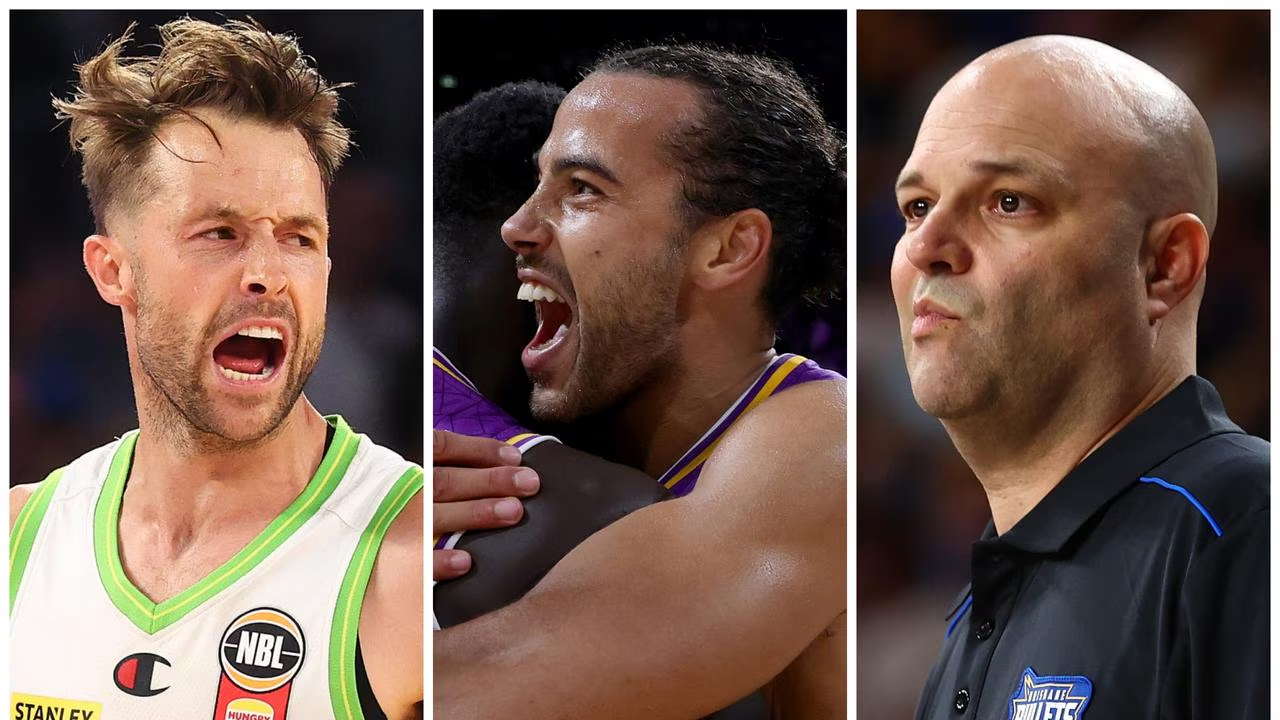
The 2025-26 NBL season is now in the books, and the full report card is in. From championship highs to rebuilding struggles, every club had its own story across a year filled with momentum swings, injuries, breakout performances and major talking points.
Watch live coverage of NBL and WNBL 2025-26 seasons with ESPN on Kayo Sports | New to Kayo? Join now and get your first month for just $1.
Here’s how each team stacked up, from the title contenders to the sides left searching for answers.

This is our NBL Report Card!
SYDNEY KINGS
LADDER: 1st (24-9)
GRADE: A+
SEASON REVIEW
They are the 2025-26 champions, capping one of the most impressive seasons in recent memory.
The slow start now feels overstated. With Kendric Davis and Matthew Dellavedova joining the roster, alongside import Tim Soares, time was always going to be needed to build chemistry. Early results reflected that, with the Kings opening the season 3-5 as questions quickly surfaced around Brian Goorjian and whether he could still lead a title contender.
Those doubts didn’t last long.
From November onwards, the Kings found their rhythm and never looked back, going 21-4 to close the regular season. They led the standings from rounds 11 through 20, playing with control, depth and a clear identity that set them apart as the competition’s benchmark.
The mid-season addition of Torrey Craig, brought in after Bul Kuol’s season-ending injury, proved pivotal. The NBA veteran added balance, defence and experience at exactly the right time, and will be remembered as one of the most influential in-season signings the league has seen.
Even so, the championship was hard-earned. Adelaide pushed the series to five games, testing the Kings at every turn. In the end, their talent and cohesion held firm, delivering the club’s sixth title.
Kendric Davis was at the centre of it all. His season ranks among the best ever by an import, and his Finals MVP performance underlined his ability to take over when it mattered most. If he stays, he has every chance to become the league’s premier player in the years ahead.
Attention now turns to retention. Keeping this group together will be key if the Kings are to go back-to-back. For now, though, they sit alone at the top after a season that will be remembered for a long time.
ADELAIDE 36ERS
LADDER: 2nd (23-10)
GRADE: A-
SEASON REVIEW
It was the biggest off-season move in NBL history, the arrival of then five-time MVP Bryce Cotton after nine seasons with the Perth Wildcats.
Adelaide went all in on 2025-26. They fell short of a first title since 2002, but this campaign should be seen as a genuine step forward, one that points to a stronger, more consistent future.
The season had no shortage of noise. There were on-court flashpoints, including clashes with the Brisbane Bullets, and off-court distractions, with rival figures questioning the club’s stability. Through it all, Mike Wells navigated a turbulent year and still had his side within a single possession of a championship.
Consistency was a hallmark for much of the season. The 36ers never dropped below third and sat top of the ladder across 11 rounds. A late dip saw them go 6-6 to close the regular season, a stretch many link to the departure of Troy Brown Jr and the arrival of John Jenkins, which shifted the team’s balance.
Cotton delivered another remarkable year, claiming his sixth MVP and driving Adelaide into one of the most gripping Finals series in recent memory. Tipped by many to be swept by Sydney, the 36ers refused to fold. Cotton’s game-winner in Game Two became an instant classic, and a resilient Game Four victory put them within touching distance of the title.
They ultimately fell short, but the bigger picture remains encouraging. For a team that dealt with constant disruption and mid-season changes, this was a season of growth. With a more settled off-season, Adelaide looms as a serious contender to go one step further next time.
SOUTH EAST MELBOURNE PHOENIX
LADDER: 3rd (22-11)
GRADE: B+
SEASON REVIEW
Coming into the season, the Phoenix were widely tipped to be solid, without quite breaking into the top tier. It was set to be Josh King’s first full year in charge, and a chance to shape the team in his image.
The start was anything but smooth. The signing of Vrenz Bleijenberg quickly unravelled, with chemistry issues and on-court frustration leading to his release before the season even began. It did little to build early confidence.
What followed told a very different story.
The Phoenix regrouped, bringing in Hunter Maldonado, Wes Iwundu and Defensive Player of the Year John Brown III. Alongside them, Nathan Sobey delivered a career-best season at 35, leading a side that quickly became the most potent offence in the league. They set both franchise and league records for three-pointers, playing with pace, freedom and confidence.
While their position on the ladder shifted at times, they found consistency late. From round 15 onwards, they did not drop below third, establishing themselves as a genuine contender.
Difference-maker champs must re-sign; who edged epic MVP battle — NBL GF player ratings
There were still changes along the way. Maldonado departed after 16 games and later joined the Brisbane Bullets. In response, the Phoenix signed NBA and NBL champion Ian Clark, adding another layer to an already dangerous offence.
Overall, it was a strong campaign. February was the only flat patch, but even then they held steady. A dominant 111–94 win over the Perth Wildcats in the Seeding Qualifier sent them through to a semi-final clash with Adelaide.
Their run ended there, falling 2-1 in the series. Even so, the season stands as a clear success, with plenty to build on.
Attention now turns to continuity. Sobey and Angus Glover are already locked in, while John Brown III is expected to return. With Owen Foxwell heading to Wisconsin, there is also a valuable roster spot to fill.
The foundation is in place. The next step is turning promise into something more.
PERTH WILDCATS
LADDER: 4th (21-12)
GRADE: C+
SEASON REVIEW
Letting Bryce Cotton walk will be remembered as one of the most costly decisions the club has made. Even so, amid ongoing calls for a true point guard, the Wildcats managed to piece together a surprisingly solid season.
It didn’t begin that way.
The signing of Mason Jones, fresh off a G League Finals MVP, was meant to set the tone. Instead, he lasted just five games before being released. Perth moved quickly, bringing in David Duke Jr, who showed promise before an elbow injury sidelined him for two months and disrupted any continuity.
Despite the instability, there were clear positives. Kristian Doolittle produced his best season in Perth colours, averaging a career-high 16.6 points and 7.4 rebounds. Alongside Jo Lual-Acuil Jr, the Wildcats built a strong interior presence, while Dylan Windler stretched the floor with his shooting.
Consistency remained an issue. Their highest ladder position came early, sitting third in round four, but they largely hovered between fourth and fifth for the rest of the season. A strong finish, winning 10 of their last 12 games, secured a top-four spot and built some late momentum.
Their finals run was mixed. A 111–94 loss to the Phoenix in the Seeding Qualifier forced a do-or-die clash with Melbourne United, which they handled comfortably, winning 95-77 behind a dominant 28-point performance from Lual-Acuil Jr.
That set up a series against the eventual champions, the Sydney Kings. The result was a sweep, but it was tighter than it looks on paper. Game One slipped away by a single point, and the loss of Windler to injury proved a turning point.
All told, it was an uneven season, marked by roster turnover and off-court noise. Still, finishing fourth and competing deep into finals gives the Wildcats something to build on.
There is work to do in the off-season, but it is far from a rebuild.
MELBOURNE UNITED
LADDER: 5th (20-13)
GRADE: C
SEASON REVIEW
It was a tale of two halves for the once best team in the league.
They opened the 2025–26 season 9-0 and looked untouchable. By December, though, everything had shifted. What many now call the ‘FIBA Curse’ coincided with a sharp and sudden drop-off.
The off-season additions flew under the radar at the time. Tyson Walker and Jesse Edwards arrived as fresh professionals, joining proven names in Milton Doyle and Finn Delany. Early on, the mix worked. United won 13 of their first 15 games and sat top of the ladder from rounds four to 10, setting the pace and controlling games with confidence.
From there, the slide was hard to explain. Dean Vickerman’s side closed the regular season with a 7-11 run, and the title buzz faded just as quickly as it had built. Injuries played their part. Shea Ili battled ongoing hamstring issues, while Chris Goulding struggled to stay on the floor, disrupting rhythm and continuity.
Even so, United steadied late to finish fifth and found a spark in the Play-In Qualifier. Finn Delany delivered a standout 33-point performance to lift them past the Tasmania JackJumpers and keep their season alive.
It didn’t last. A 95-77 loss to the Perth Wildcats in the Play-In brought the campaign to an abrupt end, closing the book on a season that promised plenty but fell short when it mattered.
After back-to-back Finals appearances in previous years, this felt like a turning point. A reset may be on the horizon, with questions around the roster and even Dean Vickerman’s future. For now, though, the focus remains on what comes next.
It shapes as a defining off-season for the club.
TASMANIA JACKJUMPERS
LADDER: 6th (14-19)
GRADE: C-
SEASON REVIEW
It was a season of change, with key pieces from the 2024 championship side moving on and a new trio of imports brought in to carry the load.
Bryce Hamilton, Tyger Campbell and David Johnson arrived as fresh faces and made an immediate impact. Hamilton, in particular, pushed into early MVP conversations, setting the tone for a team that showed promise from the outset.
That momentum was checked early. Johnson suffered a calf injury and missed several weeks, leading to the arrival of temporary import TJ Starks. He played seven games but struggled to make an impact, averaging 4.7 points, and his role diminished as other overseas commitments took priority.
The JackJumpers had their moments. They climbed as high as third across two rounds early in the season, but consistency proved elusive. More often than not, they sat in sixth, a position they held for much of the year. A below-par 8-9 record at home didn’t help their cause.
There were still clear positives. Debutants Nick Marshall and Josh Bannan both impressed, producing strong seasons despite the team’s overall results. They look set to be key pieces as the club builds forward.
As the season wore on, the reliance on Will Magnay became increasingly evident. With limited frontcourt depth, he was central to everything they did. When he went down after HoopsFest in January, it left a significant gap. Soon after, Hamilton suffered an ACL injury, compounding the damage.
From there, it became a battle of attrition. Injuries mounted, rotations tightened, and players like Ben Ayre pushed through physical setbacks just to keep the team competitive. Despite it all, they still found a way into the Play-In.
That’s where the run ended. A depleted line-up fell 82-68 to Melbourne United, closing the book on a challenging season.
It wasn’t the year they had hoped for, but there is important context. With better health, this group looked capable of going deeper. The return of Sean Macdonald, who re-signed after missing the entire season, adds another layer of optimism.
Now the focus shifts to the off-season. Decisions around the roster, including Will Magnay’s future, will shape what comes next. There is uncertainty, but also genuine upside if things fall into place.
NEW ZEALAND BREAKERS
LADDER: 7th (13-20)
GRADE: D+
SEASON REVIEW
It was meant to signal a new era for the New Zealand Breakers under fresh ownership, with a clear focus on building around local Kiwi talent.
Import Parker Jackson-Cartwright once again led the way, alongside Sam Mennenga, who enjoyed a standout season and earned a two-year extension, a major win for the club’s future.
The new imports, Izaiah Brockington and Rob Baker II, took time to find their feet under head coach Petteri Koponen. Early results reflected that. The Breakers sat 10th between rounds two and five, and while they gradually improved, they never climbed higher than sixth. Consistency remained an issue, with no winning months across the season. Their best stretch came in December at 3-3.
There were signs of growth, but their ceiling wasn’t high enough to match the league’s top sides.
A late addition helped. Tai Webster arrived after Izayah Le’Afa suffered a season-ending injury, providing a needed spark off the bench. He combined well with Carlin Davison, who took a strong step forward in his second season and delivered a career-best year.
Pressure continued to build around Koponen. Some felt it was harsh, given the ownership’s commitment to local talent, but others questioned whether the right pieces were targeted. Players like Yanni Wetzell, Finn Delany and free agent Flynn Cameron were all seen as missed opportunities.
It wasn’t all negative. The Breakers claimed the inaugural NBL Ignite Cup, defeating Adelaide and securing a $300,000 prize, a highlight in an otherwise inconsistent campaign.
Looking ahead, there is reason for optimism. Mennenga and Jackson-Cartwright are locked in for next season, forming a strong foundation. Brockington finished the year in excellent form and made a case to return, though there is no certainty around his future.
The priority now is appointing a new head coach. Judd Flavell had been the frontrunner before opting for a move to Japan. Former coach Mody Maor is in the frame, but prising him away from a successful stint with Nagasaki Velca won’t be easy.
There is a direction in place. The next step is getting the pieces right.
ILLAWARRA HAWKS
LADDER: 8th (13-20)
GRADE: D-
SEASON REVIEW
The reigning champions returned for the 2025-26 season with a dramatically reshaped roster after the departures of Trey Kell III, Darius Days, Lee Hyun-Jung and Lachlan Olbrich, key figures in their title run.
On paper, the off-season arrivals were significant. Headlined by three-time NBA champion JaVale McGee, the Hawks added size, pedigree and expectation in equal measure. McGee delivered individually dominant performances, but the fit raised ongoing concerns, particularly around spacing, roles and defensive structure.
The guard rotation also saw turnover. JaQuori McLaughlin arrived as an unknown quantity but struggled to adjust to the NBL and departed after a handful of games. He was replaced by scoring guard Q.J. Peterson, who offered more production but couldn’t steady a side already dealing with inconsistency and growing on-court tension.
Head coach Justin Tatum also welcomed back Sam Froling, returning from a season-ending ACL injury suffered during the finals campaign. With a healthy core in place, there was hope for a strong reset and a push back up the ladder.
It never quite materialised.
The Hawks failed to finish a round higher than seventh across the entire season. February provided their only winning month at 3-2, but overall it was a disappointing defence of their title.
The challenge of repeating as champions in the NBL once again proved difficult, particularly with so much roster movement. McGee’s arrival looked strong in isolation, but alongside Froling it created structural challenges that were hard to solve night to night.
There were individual positives. Will Hickey continued his steady rise despite an early eye injury, while Tyler Harvey struggled to replicate his usual impact in a reshaped roster.
With the season effectively slipping away, attention turned to the future. Tatum and management now face key decisions around trimming the roster and reshaping the group around their core pieces.
It was a harsh fall from champions to also-rans, but not without lessons. If the right adjustments are made, a rebound in 2026-27 is still firmly in play.
CAIRNS TAIPANS
LADDER: 9th (9-24)
GRADE: F
SEASON REVIEW
It was meant to be a new era for the Cairns Taipans, fresh ownership, new investment, and a push towards becoming a genuine championship threat after a difficult 2024-25 campaign.
The arrival of Jack McVeigh, the league’s marquee million-dollar man, set the tone early and sent a clear message that the club was ready to compete.
But the momentum stalled there.
Visa issues forced the Taipans to miss out on import guard Ashton Hagans, leading to a reshuffle that brought in Andrew Andrews. The veteran guard carried heavy responsibility from day one. He led the league in assists alongside Bryce Cotton, but also topped the turnovers list, a reflection more of workload than intent, as he was asked to do far too much.
The second import, Admiral Schofield, struggled to make an impact. An NBA veteran on paper, his season never got going, with reports of a lingering hip issue possibly explaining his limited mobility and output.
On paper, there were pieces to work with. Marcus Lee, Reyne Smith and Sam Waardenburg formed a solid local core alongside the imports, but the puzzle never came together.
‘Meant the world to me’: Kings hero’s admission on ‘hateful’ past, turning point in title charge
Cairns peaked early, sitting as high as fourth after round two, but quickly fell away. They dropped to 10th for seven straight weeks before settling at ninth for most of the season. The losses were heavy and frequent, with over a dozen defeats by 20 points or more. October was particularly brutal, finishing 0-7, followed by a 2-9 stretch to close the year.
Injuries didn’t help. Waardenburg missed significant time with foot issues, while Alex Higgins-Titsha was ruled out for the season with a hand injury.
It marked another difficult year for head coach Adam Forde, who is yet to confirm his future. Given the Taipans’ 29-61 record across the past three seasons, change may be on the table as the club weighs up a fresh direction.
The one clear positive was McVeigh. He delivered an outstanding season and justified his status as the centrepiece of the rebuild. With him now locked in for another year, Cairns must build properly around him.
The challenge now is urgency. Last season’s 101-day gap without a roster move cannot be repeated. If this group wants buy-in from fans again, the response in the off-season needs to be immediate and decisive.
BRISBANE BULLETS
LADDER: 9th (6-27)
GRADE: F
SEASON REVIEW
It was a season to forget for the Brisbane Bullets, with little going their way from the opening tip.
Concerns emerged early around the appointment of Stu Lash as head coach, despite his lack of prior experience in the role. Those doubts only deepened as the season unfolded, with the team often lacking clear structure and identity.
Instability carried through the import rotation. Javon Freeman-Liberty signed, left, then returned within weeks, only to be limited to a handful of games due to a persistent hamstring injury.
There were some early positives from the club’s young core. Jacob Holt, Taine Murray, Alex Ducas and Tristan Devers all showed glimpses of promise when called upon, providing energy through difficult stretches.
But the setbacks kept coming. Casey Prather was in strong early form before a season-ending knee injury, while Lamar Patterson also went down, further depleting an already stretched roster.
Former MVP Jaylen Adams arrived as a marquee signing, but his stint ended after 13 games amid off-court issues, and he did not return to the league.
A 5–13 start led to Lash stepping down, with assistant Darryl McDonald taking over in difficult circumstances. Results did not improve, as the Bullets struggled to stay competitive with a heavily depleted rotation.
The season also featured a notable flashpoint against the Adelaide 36ers, where import Terry Taylor was involved in an incident that saw 36ers forward Nick Rakocevic put in a headlock. It became one of the more talked-about moments of the year.
Injuries continued to pile up. Dakota Mathias managed only a brief stint before a shoulder issue ended his run, while Tyrell Harrison also battled concussion setbacks.
A late-season bright spot came with the arrival of Hunter Maldonado, who produced a strong run of performances despite the team’s struggles. Even in a losing environment, he showed he was more than capable at this level.
From November through February, the Bullets went 2–21, enduring heavy defeats and long losing stretches that placed them among the most difficult seasons in recent memory.
Despite everything, a reset is underway.
The appointment of Will Weaver as head coach brings genuine optimism. With experience at the Sydney Kings and a strong reputation, he offers structure and direction to a group in need of both.
It has been a brutal year, but the path forward now feels more stable.






Leave a Reply