


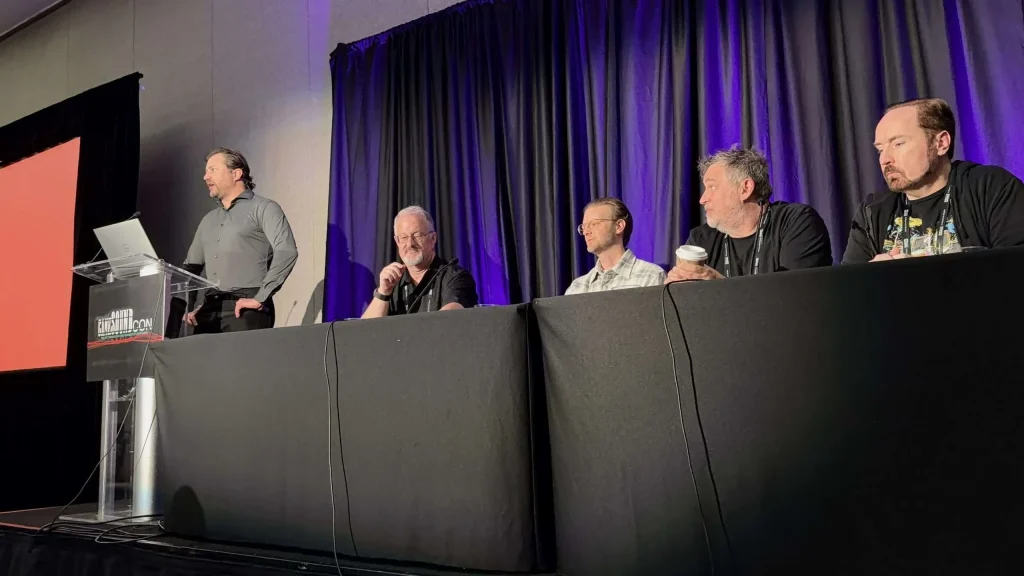
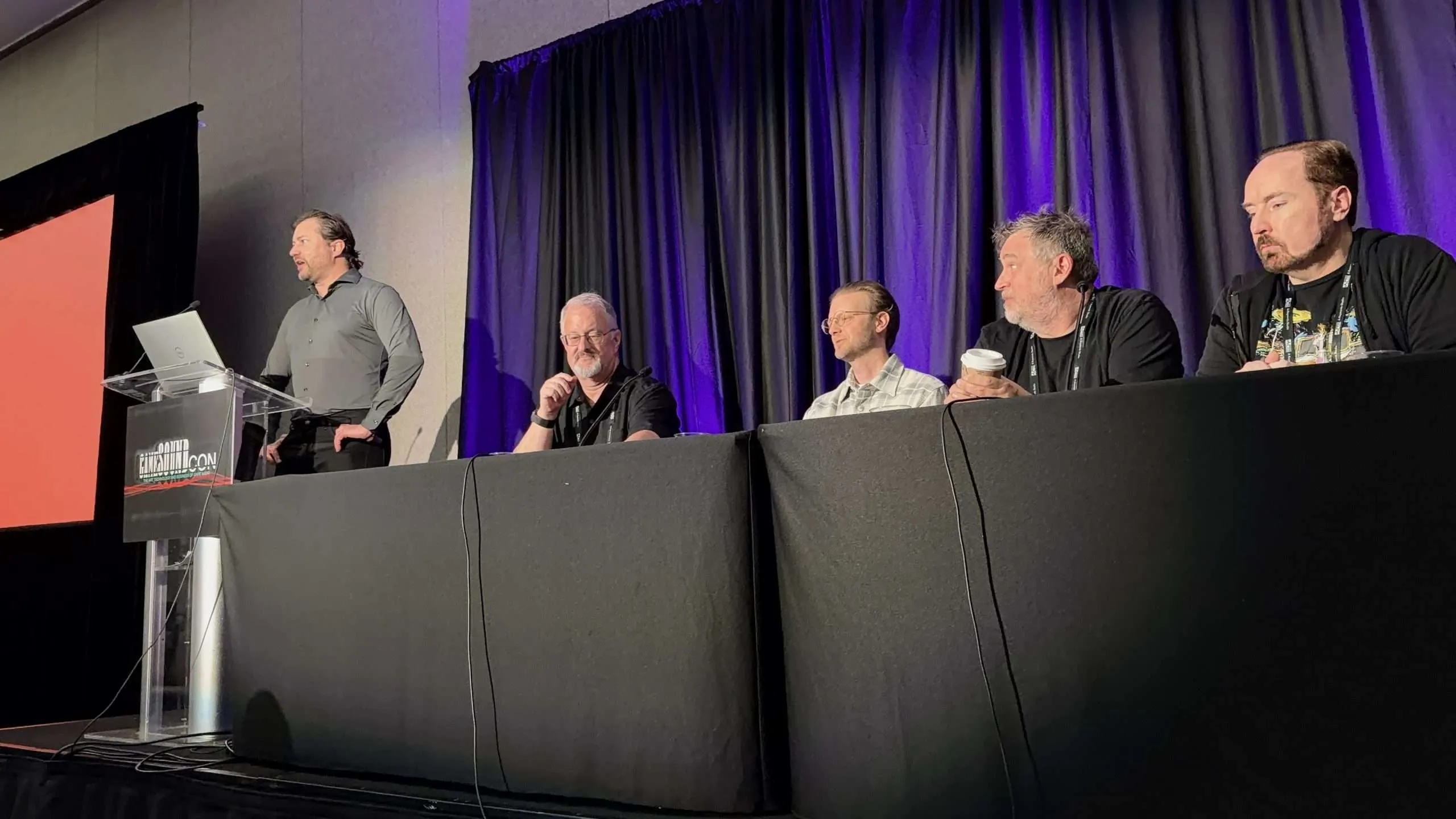
Photo Credit: Digital Music News
Game scores tend to outlive the games they were written for. A franchise score can fill concert halls decades after launch, and a soundtrack can keep streaming long after the game studio has moved on. The question behind ‘Behind the Buyout: Lifetime Royalties for Game Composers,” a GameSoundCon panel on October 21, was why so many composers stop getting paid long before the music stops earning.
This article was created in collaboration with DMN partner Materia Music.
Materia Music CEO Sebastian Wolff moderated the panel focused on game composers. The lineup covered most of the royalty chain, a publisher, a performance rights organization (PRO), a record label and a global publishing administrator. Wolff set the tone for the panel early. “Make sure that you’re planning in decades and really maximizing the value of your music, maybe even beyond the buyout,” Wolff told the room.
He also took the room’s temperature to gauge how acquainted the audience is with music rights. After asking who was affiliated with a PRO, Wolff noted that a similar panel a decade ago drew “a lot of question marks from the audience,” calling the change “so good to see. Still, after asking who had ever been paid by Harry Fox, SoundExchange, or the MLC, Wolff was blunt—”there’s still a lot of work to do.”
Ask where a song’s money comes from and the honest answer is that it comes from two places, and most composers only know about one. Every recording carries a composition copyright, managed by the publishers, and a master copyright, managed by labels. Hegarty walked through how the streaming era reshuffled mechanical royalties, with DSPs now paying the MLC rather than labels. Eames adds that the MLC is US-only, so royalties generated abroad need separate collection.
The wrinkle for most game composers is that most original game music is commissioned as work for hire, so the studio who commissioned the work owns both sides. Eames put the stakes on the composer’s contract. “Your agreement is going to define whether or not you get any back-end royalties, because there’ll be different forms of a buyout,” he said. Eames compares it to a friend’s statement, that “the music business is a river of nickels.”
Stephens says the current reality is that “a river of nickels has turned into billions of micro-pennies” in the streaming era. “That’s the world we’re living in now,” Stephens explains. He further explains why those ‘micro-pennies’ are hard to chase. PROs license music wherever it’s heard, from streaming services to the bar down the street. “Anywhere where your music is heard publicly is a performance right,” Stephens continues.
Money earned abroad depends on reciprocal agreements between collection societies. Some are well-run, while others are government-run, and a portion of earnings can go to local cultural funds before reaching the home PRO. Transparency around these collections is a recurring issue across the music industry. “As far as what source was paid for what writer from what project, there’s a lot of difficulty that we’re dealing with there,” Stephens continues.
Eames argues that the current system waits for money to show up rather than going out to find it. “The reciprocal agreement framework and network is more reactionary than pro-action,” he states. With roughly 140 collection societies worldwide, each running its own database, unregistered works can simply go unpaid. He was unsparing about who will fix that: “(studios) exist to sell video games. They’re not there to collect money from music royalties.” His conclusion for composers who don’t control their rights was that “you have to become your own policeman, or money’s being left on the table.”
Eames also flagged a growing performance income stream for game composers. Orchestral video game concerts are constantly touring, and registered works can earn local performance royalties from those tours.
Meanwhile, McNellis said master revenue comes overwhelmingly from digital service providers (DSPs), with some sync and a little from physical sales. Composers typically get a small slice of that pie, but he sees the terms moving as original game music continues to generate income outside the game. “We’re starting to see more favorable agreements for composers,” McNellis adds, stating that’s partly because master DSP revenues are leveling off. Producing a game soundtrack album follows the same process as a film or pop record; cues are sequences and mastered, and publishing splits and mechanical licenses are sorted.
The panel’s central case came from McNellis, who called game music publishing “the single largest unmonetized asset in the history of the entertainment business. He described it as “akin to having a Ferrari on blocks in the garage. “You can rev it up, but it ain’t leaving the garage.”
McNellis describes this as an artist-rights issue, noting that “your peers that are working in linear media are buying houses in Malibu.” He has since come to see this as a bigger business problem. His argument rests on mechanics. Streaming a show on Netflix and streaming a game from Xbox, PlayStation, or Steam work the same way.
“You pay a subscription, it streams from a server, it lands at your house, and you determine what you’re watching,” McNellis says. Yet film and TV composers earn performance royalties and game composers largely don’t. He noted that the UK’s PRS has made progress under a rule that treats a download as a broadcast, while in the US a stream already counts as one.
To the objection that games are a different type of media, McNellis concedes that they once were. They “were different when you were playing music off an 8-bit cartridge 50 years ago, and that’s how the contracts are still written.” For composers of modern games, McNellis has a different piece of advice. “The thing that I would encourage everybody to think about is the things that are similar, now the things that are different.”
He framed the stakes as bigger than composers, too. “The video game industry is sitting on a mountain of gold and they’re throwing dirt on top of it,” McNellis argues. As for what linear media pays out in performance royalties versus games: “Whatever the number is for linear media, that number for video games is a .00 decimal.”
“Once music publishing for video games becomes an asset glass, it can be borrowed against, it can be leveraged, it can be sold, it can be monetized, and that can go into gaming budgets,” McNellis concludes. He insists that the fight to achieve this isn’t adversarial. “This isn’t composers versus publishers. This isn’t composers versus developers. It’s not an us versus them problem.”
The panel then pointed to real movement in the industry, starting with cue sheets. Eames says Microsoft required Bethesda to produce them after acquiring the studio, because the company had never compiled them. The exercise exposed how much existed beyond the soundtrack albums he had been registering. “It uncovered this treasure trove of music that, because I wasn’t a player of any of these games, I didn’t know existed,” Eames admits.
Eames says Composer Inon Zur arrived at his office with seven hours of music from a Fallout expansion. “He dumped a huge hard drive in my lap and I have seven hours of music and 123 individual pieces of music that I registered at BMI,” Eames continues. His advice for work-for-hire composers is to write registration into the deal.
“There is a contractual legal obligation that all of that music has to get properly registered in all of the places in which it needs to be registered,” Eames says. His blunt rule is that if a song isn’t registered, “you won’t get paid. End of story.”
The panel highlights Fallout to illustrate the disparity between television and video games. Ramin Djawadi, a BMI composer, collects performance royalties when the Fallout Amazon series streams. Meanwhile, Zur, who scored the games, likely doesn’t see comparable income from that series.
Stephens laid out the licensing progress from BMI’s side. He said Sony struck a deal with PRS in the UK around 2018 that was “essentially paying writers and publishers royalties on these video games.” He says Twitch has been simpler, since the data collected by Twitch makes it easy to see who should be paid. On the US side, he said BMI’s licensing team warned him the talks were hard.
“Sometimes they’ll say, ‘see you in court,’” he recalls. Then BMI signed a domestic license for PlayStation and a few months later, with Microsoft covering GamePass. His reaction to that first deal was a surprise. “Really? I heard this was never going to happen,” he recalls. BMI now pays domestic performance royalties from those sources. “I do feel like progress is being made,” Stephens concludes.
Eames gives the least optimistic account about licensing, which he calls “the YouTube problem.” He says Content ID claims on gameplay videos can set off nasty chain reactions. Influencers fire back, the game’s marketing team gets involved, and the claims can get withdrawn. “Some of the nastiest social media messages I have ever seen in my life are from game influencers who my claims in YouTube have gone against their channel,” Eames says. Once a channel is whitelisted by the developer, any chance to earn money from the music is gone.
Hegarty says that workarounds exist for film and TV content, but that the games industry lacks leverage. “There is not enough pressure coming from our whole community for them to resolve that issue,” Hegarty adds. “It’s not too hard to do, you just don’t want to.”
An audience member asked whether YouTubers and composers can both earn from gameplay videos on the platform. Hegarty says that’s not really possible and that independent composers have little recourse “unless you have a YouTube CMS-enabled partner.” Eames said one-off promotions have shared monetization with fans under conditions such as no claims in launch week, but these deals take active policing.
Speaking on how GamePass downloads compare with Netflix streaming, Stephens said the first step is to “get the license,” with valuation and distribution models to follow. McNellis says that composers should keep asking why a Fallout episode earns performance royalties while the game itself doesn’t; and he was clear: “All composers are looking for is parity.”
For publishers, administrators, and labels, the panel’s message is a practical one. Registration gaps are where the money disappears, so the contractual obligation to register all music, not just soundtrack-album tracks, matters in every work-for-hire deal. Master shares are becoming negotiable. The newly licensed PlayStation and GamePass streams are a first sign that a performance royalty stream for games is possible, even though the valuation and distribution models behind it remain.
Panel Speakers
Sebastian Wolff — CEO of Materia Music, a record label, music publisher, sheet music house, and a live production company. Wolff was previously the technical co-founder of mechanical licensing startup Loudr.
Michael Eames — President of PEN Music Group, an independent publisher and administrator representing composers, songwriters, and catalogs. He was pulled into the game music world around 14 years ago when Bethesda Softworks (ZeniMax) had no music infrastructure and has served as the administrator for their catalog since.
Louis Stephens — Director of Film, TV & Visual Media at BMI, where he works with film, tv, and video game composers and has a particular interest in game royalties. He previously worked at publisher Kobalt and at a production music library Pacific Sound House.
Brian McNellis — President of Lakeshore Records, part of Cutting Edge Group, an institutional investor in music publishing copyrights. He is a former Head of Music at Lakeshore Entertainment and a music supervisor on about 35 games including Cyberpunk 2077. His label has released the Red Dead Redemption 2 and Assassin’s Creed: Valhalla soundtracks.
Dan Hegarty — Director of Royalty Administration and Income Tracking at Word Collections, a global publishing administrator that represents rights rather than taking copyright transfers, with a heavy focus on YouTube collection. Clients include Metallica and Jason Mraz. A drummer by training, he previously worked at the Harry Fox Agency, Warner Music Group, and Concord.