


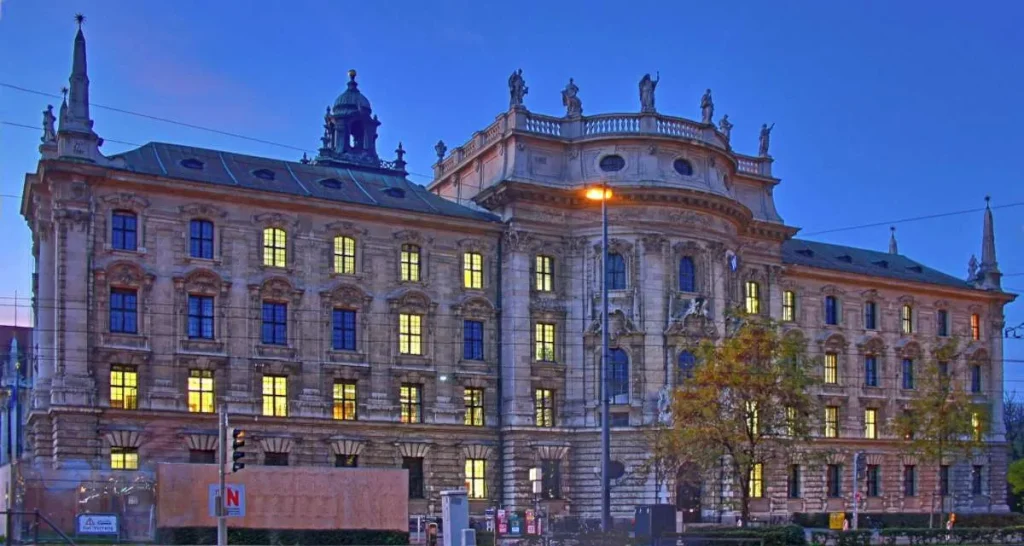


Germany’s Palace of Justice, which houses a portion of the Munich Regional Court. Photo Credit: Richard Huber
Germany’s GEMA has notched another AI legal victory – this time over Suno, which the Munich Regional Court has reportedly ordered to disclose its revenue and pay damages. Meanwhile, the music-generation startup is set to appeal.
GEMA touted its “groundbreaking success” today, after suing Suno closer to 2025’s start. Additionally, although legal documents themselves aren’t usually made available to the public in Germany, the Munich Regional Court provided a detailed breakdown of its decision.
As many are aware, GEMA in the straightforward complaint accused the gen AI platform of, among other things, training on members’ works without authorization and pumping out “audio content that is confusingly similar” to the original tracks.
Behind the argument, the society specifically accused Cambridge-headquartered Suno of committing copyright infringement when training its models in the States. Unsurprisingly, the defendant once again invoked a “fair use” defense, which has actually proven effective in a couple stateside cases.
Moreover, we still don’t have a concrete answer to this all-important question – whether training on IP without permission constitutes fair use, that is.
Nevertheless, the Munich Regional Court, citing the alleged presence of protected elements in Suno outputs, offered a clear-cut interpretation of U.S. copyright law.
“Copies of the musical works were made for the training in the USA,” the court wrote in its German-language summary. “According to the principle of territoriality, US law applies to the copyright infringements occurring within the USA. Since the musical works are present in the outputs, the copies are not covered by the fair use doctrine under 17 USC § 107, as applicable in US law.
“The facts of this case differ significantly from those underlying the Bartz and Kadrey cases,” the court continued, “in which two US courts deemed the training of AI models to be covered by fair use. While in those two cases the training data was not made available to the user, or not substantially so, in the outputs, here the defendant generated outputs substantially similar to the original works after inputting simple and open-ended prompts.”
Put differently, the fair use question is factoring into German legal battles as well, and it seems safe to say that Suno will push back against the findings in its appeal.
As for alleged violations of the German Copyright Act, the Munich Regional Court also found Suno liable for allegedly storing its purportedly infringing models (i.e., models containing and pulling from the GEMA works at hand) on German servers. Beyond the models, Suno is on the hook for allegedly reproducing and publicly performing the allegedly infringing soundalike audio without authorization.
It will, of course, be worth tracking the appeal; GEMA previously secured a legal win over OpenAI, which is likewise appealing. But in the bigger picture, today’s decision represents another important victory for the society, which, far from solely suing AI giants, has rolled out a comprehensive “PLAI” licensing framework.
Besides effectively broadening the scope of Suno’s alleged infringement, said victory seemingly puts Suno’s Warner Music licensing pact in a more precarious spot. At the intersection of this point and the existence of “copyright-hostile countries,” GEMA general counsel Kai Welp called on EU legislators to take action.
“It is astonishing that the AI systems apparently store almost complete works to a considerable extent,” Welp said. “We were able to prove this with our methods and the recent scientific literature also indicates that this is only the tip of the iceberg.
“It is also very pleasing how the legal situation in the USA is assessed, and that we can sue in Munich regardless of where the training takes place. This is a huge step for the creatives. However, in order to effectively enforce our rights and prevent providers from moving to copyright-hostile countries, we will also need the support of the European legislator,” he concluded.