


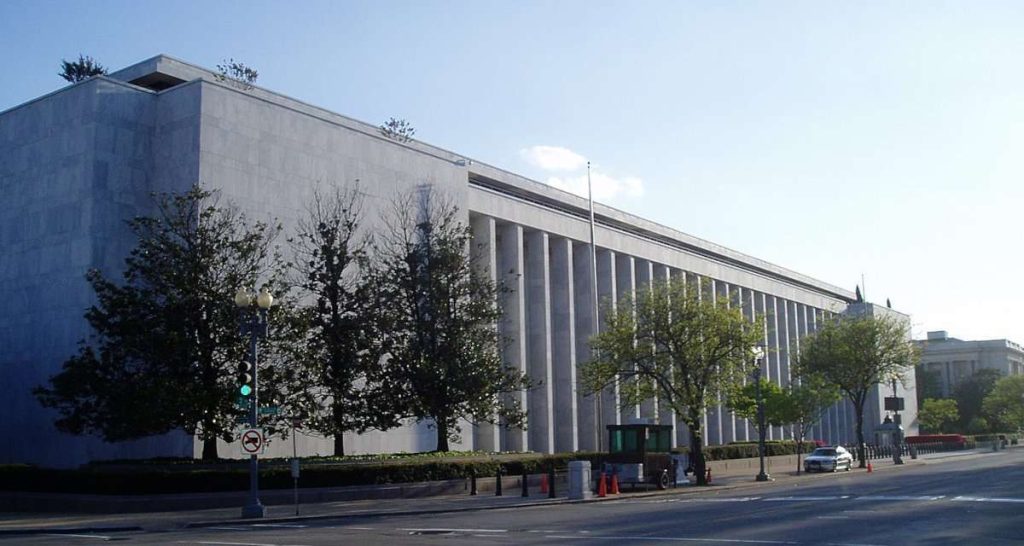


Washington, D.C.’s James Madison Memorial Building, which houses the U.S. Copyright Office. Photo Credit: UpstateNYer
Activist songwriter George Johnson has doubled down on his opposition to the proposed Phonorecords V settlement – including by criticizing the terms themselves and by calling out the alleged “long history of brazen self-dealing” between the NMPA and the RIAA.
Johnson just recently submitted his in-depth comments to the Copyright Royalty Board (CRB), which is in the process of setting statutory mechanical rates for permanent downloads, physical formats, ringtones, and bundles for 2028-2032.
We’ve covered those Phono V proceedings in detail, but the short version is that the major labels, the National Music Publishers’ Association (NMPA), the American Association of Independent Music (A2IM), and others in late June filed a proposed settlement with the CRB.
Therein, the signatory entities expressed their shared belief that the rates “should not be amended except for continuing inflation adjustments.” Unsurprisingly, the proposal didn’t sit right with the likes of Eight Mile Style, Word Collections, the Songwriters Guild of America (SGA), Johnson, and even Stevie Wonder, with each having fired off objections/comments.
Perhaps most notably, the SGA and Word Collections drew attention to the Phono V settlement proposal’s seemingly suggested 2028 base rate of 12 cents – down from 13.1 cents at present.
Now, Johnson is expanding on these and adjacent positions; per the professional, his comments “mirror, track, and join with” those submitted by the above-noted objectors, therefore aiming to “help fill out the record.”
Getting down to it, then, holding “the perpetually static ringtone rate” steady at “24 cents for 19 years from 2009 to 2028 is clearly unreasonable,” according to Johnson, who believes that a bump to 39.1 cents is in order here.
“The Settlement should also be declined on their ‘static’ ringtone proposal alone,” he wrote.
Next, the proposed download and physical rate “is equally inadequate” because “it fails to fully account for inflation” – in part because Phono IV’s own base rate factored for inflation through 2020’s end but not during the highly inflationary 2021-22 stretch.
As such, a per-work rate of 15.65 cents makes sense, Johnson reiterated before taking aim at the “vertical integration and extreme self-dealing between the 3 major labels and their 3 major publishing affiliates.”
“The 3 major labels have gamed the system by misusing the compulsory license and dominating rate-setting,” Johnson drove home. “Furthermore, since the 3 major record labels are negotiating with their own vertically integrated 3 major publishing companies, and inside a public governmental rate-setting tribunal, they’re clearly not negotiating in a free market.”
“And because of this conflict of interest, this also means there is no willing buyer nor willing seller, which also means there can be no effectively competitive market,” he continued.
After providing historical context, Johnson excoriated the royalty-limiting controlled composition clause as “literally the first ‘end run’ around the statutory rate in 1978” and as “no different than the ‘private contract’ MOU in Phonorecords IV.”
Finally, the RIAA and the NMPA allegedly failed to engage in good-faith negotiations with the Phono V settlement objectors; the “NMPA did not even show our proposal to their board members publishers who did not get a chance to vote on it,” Johnson penned.
“NMPA and RIAA’s self-dealing remains a brazen fraud, just like their intentional fraud of not including the years 2021 and 2022 in their second voluntary settlement in Phonorecords IV,” he proceeded.
With that, Johnson concluded by asking the CRB to reject the settlement proposal in its entirety and to recommend the participants “reconvene to negotiate at arms-length for the purpose of establishing consensus on new, reasonable recommendations” for Phono V.
Regarding what comes next, as ordered by the CRB, the same participants and those involved with other rate-setting proceedings have until August 30th to “submit a joint proposed schedule” covering hearing dates and more.