


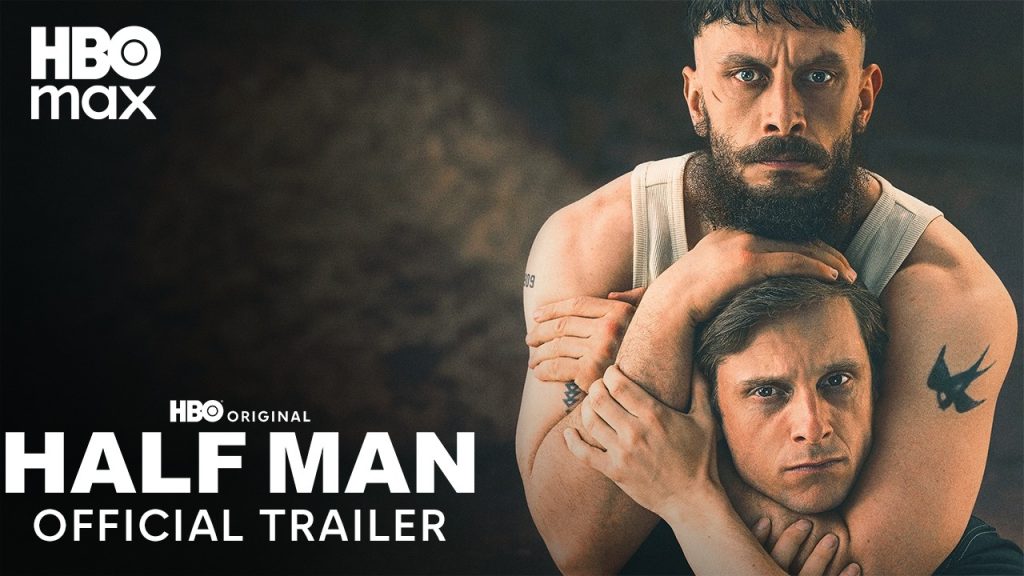
United Kingdom | 2026 | 6 Episodes | Psychological Drama
Two Brothers. Forty Years. One Toxic Bond.
Richard Gadd turns four decades of brotherhood into an emotionally brutal examination of masculinity, dependency and relationships we cannot escape.
Why Half Man Matters Right Now: Masculinity Is Becoming One of Television’s Most Complicated Emotional Subjects
After Baby Reindeer, Richard Gadd returns with another story built around an intensely complicated relationship, but Half Man expands its emotional canvas across almost forty years. The six-part drama follows Niall (Jamie Bell) and Ruben (Gadd), two men who meet as teenagers and develop a brother-like bond that becomes increasingly difficult to distinguish from emotional dependency.
The series begins with rupture rather than nostalgia. Ruben unexpectedly arrives at Niall’s wedding after years of estrangement, and the reunion erupts into violence. From there, the story moves backward through their shared history, examining how friendship, loyalty, resentment, sexuality, family expectations and masculine identity accumulated until their relationship became almost impossible to sustain.
That structure places Half Man inside an increasingly important movement in contemporary television: stories about men that interrogate masculinity rather than simply dramatize it. Instead of treating male friendship as uncomplicated loyalty, Gadd asks how love between men can coexist with competition, domination, shame, dependence and violence.
➡️ Movie Insight: Half Man turns brotherhood into a psychological battleground, asking whether a relationship can remain love when two people have spent decades hurting each other.
Should You Watch It?: One of 2026’s Most Emotionally Uncomfortable Relationship Dramas
Half Man is not an easy series to watch, but that discomfort is central to its impact. The story repeatedly refuses to simplify Niall and Ruben into victim and aggressor. Both men can be vulnerable, manipulative, loving, selfish, frightened and destructive, sometimes within the same relationship.
Jamie Bell’s Niall initially appears to be the gentler counterpoint to Gadd’s volatile Ruben. But as the timeline expands, the series complicates that impression. Niall’s dependency, resentment and capacity for manipulation become increasingly important, while Ruben’s aggression is gradually contextualized through the emotional history surrounding him.
The nonlinear structure is especially effective because viewers encounter consequences before fully understanding their causes. Episode 1 begins with Ruben violently attacking Niall on his wedding day; subsequent episodes travel through university, legal trouble, separation, relationships and eventual reunion, gradually reconstructing the emotional history behind that explosion.
Audience reaction has reflected that intensity. IMDb user responses repeatedly describe the series as brutal, psychologically tense and emotionally exhausting, while particularly praising its writing and performances.
➡️ Viewing Takeaway: Watch Half Man if you want a demanding character drama that refuses easy judgments and treats male friendship as something capable of providing both emotional survival and profound damage.
Why Everyone Is Talking About It?: Richard Gadd’s Baby Reindeer Follow-Up Has Become an Awards Contender
Expectations surrounding Half Man were inevitably heightened by Richard Gadd’s previous television success, but the series has established its own identity through its multi-decade portrait of male intimacy and the performances of Jamie Bell and Gadd.
The awards response confirms that the series has moved beyond being simply a high-profile follow-up. Half Man has received 15 nominations, including recognition from the Primetime Emmys, Television Critics Association, Gold Derby Awards, Dorian TV Awards, Gotham TV Awards, Astra Television Awards and UK’s National Film Awards.
Most significantly, Richard Gadd received a 2026 Primetime Emmy nomination for Outstanding Supporting Actor in a Limited or Anthology Series or Movie. Jamie Bell received a Gotham TV Award nomination for Outstanding Lead Performance, while the series itself was nominated for Outstanding Limited or Anthology Series at the Gothams and Outstanding Achievement in Movies, Miniseries or Specials by the Television Critics Association.
The Dorian TV Awards expanded that recognition further, nominating Half Man for Best TV Movie or Miniseries and Best LGBTQ TV Show, alongside performance nominations for Bell and Gadd. The breadth of those nominations is significant because it recognizes the series both as a prestige drama and as a culturally specific examination of masculinity, sexuality and identity.
Its audience response has also been unusually strong. The supplied IMDb material records an 8.0/10 audience rating, while individual episodes rise as high as 9.3/10, suggesting viewers responded particularly strongly as the brothers’ history became clearer.
➡️ Buzz Insight: Half Man has moved from being “Richard Gadd’s next series” into a major 2026 prestige drama, with its performances and emotionally uncompromising examination of male relationships driving awards attention.
Why Half Man Stands Out: Brotherhood Is Treated as a Love Story Without Becoming a Romance
The most distinctive aspect of Half Man is the seriousness with which it treats emotional intimacy between two men. Niall and Ruben are not biologically related, yet their relationship carries the permanence normally associated with family and the intensity normally reserved for romantic relationships.
That allows Gadd to explore territory television frequently avoids. Male friendships are often represented through loyalty, humor, competition or shared experience. Half Man asks what happens when friendship becomes dependency—when another man becomes so fundamental to your identity that separation feels almost impossible even when remaining together is destructive.
Spanning the 1980s to the present gives that question additional cultural weight. Niall and Ruben do not simply age; the social language available to men for discussing sexuality, masculinity, vulnerability and mental distress changes around them. The series therefore connects personal history with a changing Glasgow and a changing understanding of what masculinity can mean. The official storyline explicitly frames that four-decade journey around the question, “What does it mean to be a man?”
➡️ Standout Insight: Half Man treats male friendship with the emotional complexity normally reserved for romantic relationships, revealing how brotherhood can become love, identity, dependency and destruction simultaneously.
Movie Trend: Masculinity & Male Intimacy — Television Is Rewriting What Male Relationships Can Look Like
Half Man belongs to a broader movement in contemporary drama examining masculinity from inside men’s emotional lives rather than through traditional ideas of strength, success or authority.
Its key distinction is vulnerability. Ruben embodies a recognizable form of volatile masculinity, while Niall initially appears softer and more passive, but Gadd gradually dismantles the idea that either represents a healthier or simpler version of manhood. Both carry insecurities, emotional needs and destructive behaviors that have been shaped by their relationship and the environments in which they grew up.
The four-decade structure makes masculinity itself appear generational. Ideas that could not easily be articulated when the characters were teenagers gradually acquire different meanings as society changes around them. The men age, but the emotional patterns formed when they were young remain remarkably difficult to escape.
That gives Half Man relevance beyond its specific characters. The series participates in a larger cultural reassessment of how men form friendships, communicate vulnerability, process trauma and construct identities around other men.
➡️ Movie Trend Insight: Half Man reflects a shift toward stories that treat male vulnerability not as the opposite of masculinity, but as one of the central forces shaping it.
➡️ Movie Trend: Masculinity & Male Intimacy
Who Should Watch It? (Audience Profile): Viewers Seeking Emotionally Complex Prestige Drama
|
Prestige drama and psychological character-study viewers |
|
|
Baby Reindeer audiences, LGBTQ+ drama viewers and fans of British limited series |
|
|
Primarily adult audiences, approximately 25–54 |
|
|
Culture-engaged viewers interested in psychologically complex television, relationships and contemporary social themes |
|
|
Limited-series viewers, BBC/HBO audiences and viewers drawn to writer-led prestige television |
|
|
Emotional complexity, challenging characters and stories exploring masculinity, sexuality and relationships |
Half Man should particularly appeal to viewers who value character development over conventional plot mechanics. Although violence, legal consequences, relationships and family crises provide dramatic events, the real story is the changing emotional architecture between Niall and Ruben.
It should also resonate with audiences interested in dramas that allow characters to remain contradictory. Neither man can easily be categorized as entirely sympathetic or irredeemable, and the series repeatedly changes how viewers understand earlier moments as more of their history is revealed.
➡️ Audience Insight: Half Man is designed for viewers willing to spend six episodes inside a relationship that is simultaneously loving, frightening, intimate and destructive.
What This Movie Means for the Industry: The Limited Series Is Becoming a Home for Intensely Personal Storytelling
Half Man demonstrates how the prestige limited-series format can occupy territory between cinema and conventional television. Six roughly hour-long episodes provide enough space to follow nearly forty years of one relationship without requiring the narrative machinery necessary to sustain multiple seasons. The source material confirms the six-episode structure and approximately hour-long runtime.
Its production model is equally significant. Half Man brings together BBC Scotland, BBC Studios and Mam Tor Productions, while distribution differs substantially by territory. In the UK, it is available through BBC iPlayer and Sky Go; in the US it streams through HBO Max; Canada has Crave; Australia has Stan; and HBO Max carries it in markets including Germany and France.
The awards recognition demonstrates the commercial value of this model. A deeply specific Scottish story about two men’s relationship has generated nominations across the Emmys, TCA Awards, Gotham TV Awards, Dorian TV Awards and other organizations, showing how culturally specific storytelling can travel internationally when the emotional themes are universal.
For the industry, that reinforces an increasingly valuable strategy: prestige television does not always need expansive worlds or franchise potential. A creator with a distinctive voice, two exceptional central performances and one emotionally complex relationship can provide the entire architecture of an event series.
➡️ Industry Insight: Half Man demonstrates the continuing power of creator-led limited television: intensely local stories can become global prestige programming when culturally specific experiences are built around universally recognizable emotional conflicts.
Creative Analysis: Four Decades Turn One Relationship Into an Emotional Autopsy
The central creative achievement of Half Man is its decision to examine Niall and Ruben’s relationship across almost forty years rather than through a single crisis. The violent confrontation at Niall’s wedding provides the dramatic entry point, but Richard Gadd is less interested in the attack itself than in everything that accumulated before it: friendship, dependence, sexuality, resentment, loyalty, shame and the changing expectations placed upon men.
That long perspective transforms the series into something closer to an emotional autopsy. Each movement through time changes the meaning of what viewers have already seen, gradually revealing that neither Niall nor Ruben can be reduced to a stable role such as aggressor, victim, protector or dependent. Their identities have been constructed partly through each other, which makes separating love from damage increasingly difficult.
Jamie Bell and Richard Gadd are essential to that structure. Their performances allow the characters to change across decades while preserving recognizable emotional patterns underneath, making the series feel less like a collection of historical episodes than one relationship continually mutating over time.
➡️ Creative Insight: Half Man’s greatest creative strength is using four decades to reveal how one formative relationship can become part friendship, part family, part dependency and part emotional wound.
Storytelling: Starting With the Explosion Makes the Past More Important Than the Mystery
Half Man begins with one of the relationship’s most extreme moments: Ruben unexpectedly arrives at Niall’s wedding after years of estrangement and violently attacks him. Rather than explaining the confrontation immediately, the series then moves through different periods of their lives, gradually reconstructing the emotional history that made it possible.
This nonlinear approach changes how viewers judge both characters. Information discovered later can alter the meaning of behavior seen earlier, while moments that initially appear straightforward become increasingly complicated once the audience understands the history surrounding them. The narrative therefore creates suspense without relying on conventional mystery mechanics.
The six-episode format is particularly effective for this structure. Each period becomes another piece of the relationship rather than simply another plot development, allowing the series to explore university life, sexuality, family expectations, legal trouble, separation, adult relationships and eventual reunion without losing sight of its central question: why do Niall and Ruben remain emotionally attached even when being together repeatedly damages them?
➡️ Storytelling Insight: Half Man turns chronology into psychology—the fragmented timeline forces viewers to continually reconsider who Niall and Ruben are as new pieces of their shared history emerge.
Direction: Harry Lighton Keeps the Drama Intimate Even When the Emotions Become Explosive
Harry Lighton’s direction resists turning Half Man into melodrama despite the extremity of some of its confrontations. The emphasis remains on behavior, silence, physical proximity and the shifting power relationship between Niall and Ruben, allowing emotional tension to build before it erupts.
That restraint is important because the series frequently deals with volatile material. Violence, sexuality, dependency and emotional manipulation could easily overwhelm the characters, but the direction keeps returning attention to the smaller interpersonal details that reveal why these two men remain connected.
The multi-decade structure also requires the direction to communicate change without making each era feel disconnected from the others. Locations, relationships and circumstances evolve, but the emotional patterns between Niall and Ruben remain recognizable. Their surroundings change faster than the fundamental dynamic between them.
This gives the series an unsettling continuity: the men grow older, but parts of the relationship remain trapped in the emotional conditions under which it was originally formed.
➡️ Direction Insight: Lighton’s restraint prevents Half Man from becoming defined by its most explosive moments, keeping the focus on the quieter emotional patterns that make those explosions inevitable.
Performances: Jamie Bell and Richard Gadd Refuse to Give the Audience an Easy Side to Choose
Jamie Bell gives Niall an apparent vulnerability that gradually becomes more complicated. His quieter personality initially encourages viewers to position him against Ruben’s volatility, but Bell slowly exposes resentment, dependency, frustration and manipulation beneath that surface. Niall’s softness does not automatically make him emotionally innocent.
Richard Gadd makes Ruben considerably more outwardly dangerous. His physical and emotional volatility can dominate scenes, yet Gadd also reveals the insecurity and need beneath that aggression. The performance prevents Ruben from becoming simply the destructive half of the relationship, forcing viewers to confront the uncomfortable possibility that someone can cause profound harm while remaining profoundly wounded themselves.
The strength of the series comes from how those performances interact. Bell and Gadd continually redistribute sympathy, preventing viewers from settling comfortably into a hero-villain interpretation of the relationship.
Their work has also generated significant awards recognition. Gadd received a 2026 Primetime Emmy nomination for Outstanding Supporting Actor in a Limited or Anthology Series or Movie, while Bell received performance nominations from organizations including the Gotham TV Awards, Gold Derby Awards, Dorian TV Awards, National Film Awards UK and Astra Television Awards. The series has received 15 nominations overall.
➡️ Performance Insight: Bell and Gadd make Half Man compelling because neither performance allows sympathy to remain fixed—the emotional power comes from repeatedly understanding each man without being able to completely excuse either.
Cinematography & Visual Style: Time Changes Around Them While the Emotional Pattern Remains
The visual approach supports Half Man’s movement across decades without allowing period detail to become the primary attraction. Changes in environments, clothing, interiors and social spaces establish the passage of time, but the visual emphasis remains firmly on the characters and their physical relationship to one another.
That becomes particularly important during confrontations. Distance and proximity frequently carry emotional meaning: who approaches, who retreats, who occupies the space and who appears trapped within it can communicate as much about Niall and Ruben’s shifting power dynamic as dialogue.
The changing Glasgow backdrop also gives the series a larger historical dimension. The characters move through a society in which attitudes toward masculinity, sexuality, vulnerability and male relationships are themselves changing. Yet the visual continuity between the men reinforces one of the drama’s central contradictions: society can change considerably while private emotional patterns remain remarkably resistant to change.
Rather than using visual spectacle to announce each era, Half Man allows the accumulated differences between periods to create the sense of a life passing.
➡️ Visual Insight: Half Man uses changing environments to measure time while keeping Niall and Ruben visually connected, reinforcing the idea that the world around them evolves more easily than their relationship does.
Themes & Messages: Masculinity Becomes Most Dangerous When Vulnerability Has No Language
Half Man ultimately uses Niall and Ruben to examine masculinity, emotional repression, sexuality, dependency and the long-term consequences of relationships formed before people understand themselves. Its official framing asks what it means to be a man, but the series deliberately refuses to provide a single answer.
Instead, Niall and Ruben embody different expressions of masculine vulnerability. Ruben frequently converts emotional instability into aggression. Niall appears more controlled, but his vulnerability can manifest through dependency, resentment and manipulation. Neither model provides an uncomplicated alternative to the other.
The series is equally interested in male intimacy. Niall and Ruben’s relationship carries the emotional intensity normally associated with romantic drama—love, jealousy, betrayal, separation, reconciliation and possessiveness—without requiring their bond to fit neatly inside a conventional category. Half Man treats male friendship as emotionally consequential enough to shape an entire life.
Its four-decade structure adds another dimension. Growing older does not automatically resolve the patterns established when the men were young. Social attitudes evolve and the characters acquire new relationships and responsibilities, but unresolved experiences continue influencing how they behave toward one another.
The result is not simply an argument about toxic masculinity. Half Man presents something more complicated: vulnerability itself does not guarantee emotional health if people lack the language, boundaries or self-awareness required to understand what they feel.
➡️ Theme Insight: Half Man suggests that masculinity becomes destructive not because men feel too little, but because powerful emotions can become damaging when they cannot be recognized, communicated or separated from identity.
What Makes This Movie Different?: Male Friendship Receives the Emotional Complexity Usually Reserved for Romance
Stories about complicated male relationships are common, but they frequently organize those relationships around external structures—war, crime, sport, work, competition or shared adversity. Half Man makes the relationship itself the event.
There is no larger genre mechanism required to justify spending six episodes examining why Niall and Ruben need, resent, love and damage one another. Their connection receives the narrative seriousness usually given to marriage, romantic obsession or family breakdown.
The four-decade structure makes that distinction even stronger. Instead of capturing one period of male friendship, Half Man investigates how a formative relationship survives multiple identities: teenage friendship, chosen brotherhood, emotional dependency, estrangement and adult memory. Every stage alters what the relationship means without completely replacing what came before.
That makes the series particularly distinctive within contemporary masculinity dramas. It does not simply ask whether Niall and Ruben’s relationship is toxic; it asks why a relationship capable of causing so much damage can simultaneously remain one of the most meaningful relationships either man has ever experienced.
➡️ Difference Insight: Half Man stands apart by treating male friendship as a lifelong emotional relationship worthy of the same psychological depth, contradiction and narrative importance traditionally given to romantic love.
If You Liked Half Man (2026): Recent Stories About Masculinity, Male Intimacy and Relationships That Shape Identity
Pillion (2025) by Harry Lighton
Pillion follows Colin, a shy young man whose encounter with Ray, the charismatic leader of a motorcycle club, develops into an intense BDSM relationship. Beneath its provocative setup, Harry Lighton uses their relationship to explore masculinity, vulnerability, dependency, power and the difficulty of understanding what someone genuinely needs from another person.
The connection to Half Man is particularly strong because Lighton is also the director of Half Man. Both works resist simplistic definitions of healthy and unhealthy male intimacy, instead examining relationships in which affection and unequal power can exist simultaneously. Pillion is more sexually explicit and darkly comic, but it shares Half Man’s fascination with men discovering that vulnerability does not automatically make relationships simple.
➡️ Similarity Insight: Watch Pillion for another Harry Lighton story where masculinity is dismantled through an intense relationship between two men who need very different things from intimacy.
Plainclothes (2025) by Carmen Emmi
Plainclothes follows Lucas, a police officer assigned to entrap gay men cruising for sex in the 1990s, whose carefully divided identity begins collapsing when he develops genuine feelings for one of the men he is supposed to arrest. The result combines romantic drama and psychological thriller while exploring repression, masculinity, desire and the emotional consequences of performing an identity that contradicts what someone actually feels.
Like Half Man, the film is interested in what happens when male intimacy collides with social expectations surrounding masculinity. Lucas’s conflict is different from Niall and Ruben’s decades-long relationship, but both stories understand that emotional repression does not eliminate desire or vulnerability—it frequently makes those feelings more destabilizing.
➡️ Similarity Insight: Watch Plainclothes for another psychologically tense examination of men caught between emotional intimacy and the identities they believe they are expected to perform.
Sebastian (2024) by Mikko Mäkelä
Sebastian follows Max, a 25-year-old aspiring writer in London who secretly begins working as a sex worker under the name Sebastian, initially treating those experiences as research for his novel. The separation between writer and alter ego gradually becomes less stable as Max discovers that sexuality, intimacy and identity cannot remain safely contained inside the fictional persona he has created.
Its connection to Half Man lies in the way both works dismantle the idea of a single, stable masculine identity. Max believes he can control the boundaries between performance and authentic desire; Niall and Ruben similarly spend years attempting to control emotions that repeatedly exceed the identities they have constructed for themselves.
Sebastian is quieter and more sexually explicit, but both stories recognize male vulnerability as psychologically complicated rather than automatically redemptive.
➡️ Similarity Insight: Watch Sebastian for another contemporary British drama about sexuality, vulnerability and the identities men construct to protect themselves from what they actually feel.
The History of Sound (2025) by Oliver Hermanus
The History of Sound follows Lionel and David, two music students whose shared fascination with folk music leads to an intimate relationship and a journey collecting songs in rural Maine. Their time together occupies only part of their lives, yet the emotional significance of that connection continues long after circumstances pull them apart. Current Canadian availability includes MUBI as well as rental and purchase options, while Germany has multiple digital rental and purchase services.
That makes it an especially useful companion to Half Man. Both stories examine how one relationship between two men can become embedded in identity and memory, continuing to influence adulthood even across separation and changing circumstances.
The History of Sound is considerably more romantic and restrained than Half Man, replacing emotional volatility with melancholy. But the underlying idea is remarkably compatible: some relationships do not need to occupy an entire lifetime to shape the person who lives the rest of it.
➡️ Similarity Insight: Watch The History of Sound for a gentler variation on Half Man’s central idea—that one relationship between two men can permanently divide life into who they were before meeting and who they became afterward.
Recommendation Insight: Start with Pillion for power, masculinity and complicated male intimacy, Plainclothes for repression and forbidden connection, Sebastian for sexuality and constructed identity, and The History of Sound for a male relationship whose emotional influence survives across time.
Final Verdict: A Devastating Portrait of Male Friendship That Refuses to Separate Love From Damage
Half Man is most powerful when it refuses to tell viewers exactly how they should feel about Niall and Ruben. Across almost four decades, Richard Gadd constructs a relationship capable of being loving, possessive, protective, manipulative and violent, sometimes almost simultaneously. The series understands that the relationships that damage people most deeply are not necessarily those without love, but those where love has become inseparable from dependency.
Jamie Bell and Richard Gadd give that contradiction its emotional force. Bell’s quieter, apparently more vulnerable Niall and Gadd’s volatile Ruben initially seem to offer an obvious moral contrast, but the series steadily dismantles it. Both men hurt each other, both need each other, and both carry versions of their shared history that make simple judgments increasingly difficult. Their performances have deservedly become central to the show’s awards recognition, including Gadd’s 2026 Primetime Emmy nomination.
Harry Lighton’s direction complements the writing by resisting unnecessary melodrama. Even when the story reaches violence or emotional collapse, Half Man remains focused on behavior and intimacy rather than spectacle. Its nonlinear movement across decades is equally effective, allowing later revelations to continually alter how earlier encounters are understood.
The intensity can also make the series emotionally exhausting, and its refusal to provide clean moral positions will frustrate viewers looking for an obvious person to support. Yet that difficulty is fundamental to what makes it distinctive. Half Man does not ask which man destroyed the relationship; it asks how two people who mean so much to each other became capable of repeatedly destroying parts of one another.
➡️ Final Verdict: 4.5/5 — An emotionally demanding and exceptionally performed limited series that turns male friendship into a decades-spanning psychological study of love, masculinity, dependency and the damage people carry into adulthood.
Quick Facts: Half Man at a Glance
|
Psychological Drama / Relationship Drama |
|
|
Masculinity, male intimacy, sexuality, dependency, trauma and emotional violence |
|
|
6 episodes, approximately one hour each |
|
|
Jamie Bell, Richard Gadd, Anjli Mohindra, Stuart Campbell, Neve McIntosh |
|
|
Mam Tor Productions / BBC Scotland / BBC Studios |
|
|
2026 Primetime Emmy, TCA, Gotham TV, Gold Derby and Dorian TV Award nominations |
|
|
Masculinity & Male Intimacy |
Viewing Recommendation: Who Should Experience Half Man?
Highly Recommended For
Viewers interested in psychologically complex relationship dramas, contemporary explorations of masculinity, LGBTQ+ storytelling, nonlinear character studies and emotionally demanding British prestige television.
It should particularly appeal to audiences who appreciated Richard Gadd’s interest in uncomfortable psychological territory in Baby Reindeer, as well as viewers who value performances that deliberately complicate sympathy rather than clearly dividing characters into victims and villains.
You May Want to Skip It If
Half Man is unlikely to suit viewers looking for escapist drama, straightforward relationship storytelling or characters who can easily be categorized as sympathetic or unsympathetic.
Its exploration of violence, sexuality, trauma, emotional dependency, manipulation and destructive relationships can also make it an intense viewing experience. The series deliberately spends considerable time inside behaviors that are uncomfortable rather than offering quick emotional resolution.
➡️ Viewing Recommendation: Approach Half Man as an intimate psychological study rather than simply a drama about toxic masculinity; its greatest achievement is showing why two people can recognize that they damage each other and still struggle to imagine who they would be without the relationship.
Final Insight: Some Relationships End Without Ever Leaving Us
Half Man ultimately asks whether growing older is enough to escape the emotional identities we created when we were young. Niall and Ruben move through different decades, relationships and versions of themselves, yet the connection formed between them continues influencing how they understand intimacy, masculinity and belonging.
That gives the series significance beyond its specific relationship. People do not carry only memories of formative relationships; they can carry behaviors, fears, expectations and identities created inside them. Half Man understands that separating from another person may therefore be much easier than separating from the version of yourself that existed with them.
➡️ Final Insight: Half Man suggests that the most formative relationships do not simply become part of our past—they can become part of the emotional architecture through which we experience everything that follows.