


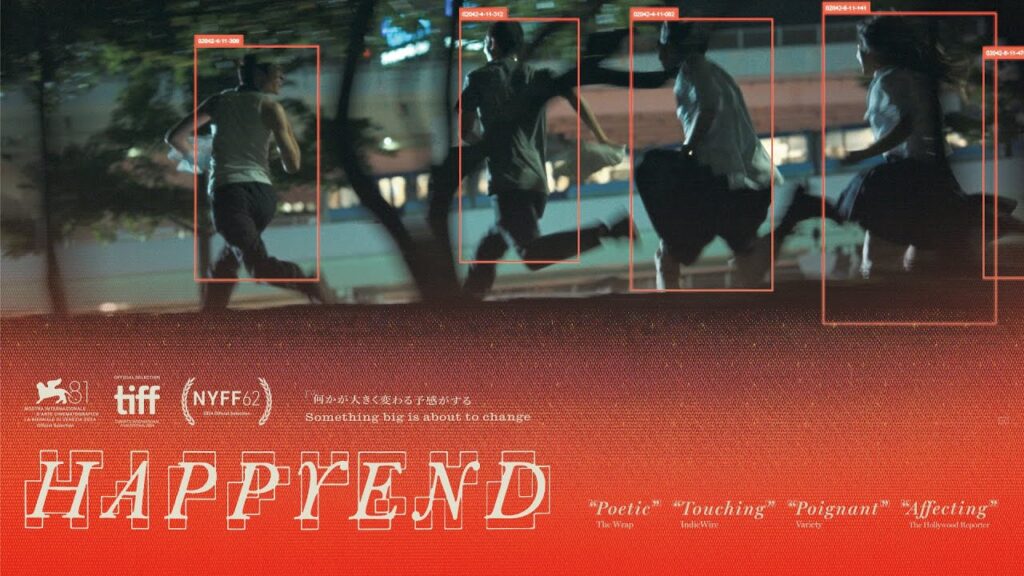
A Dystopian Coming-of-Age Drama Exploring Youth, Surveillance, and Resistance in Near-Future Japan
Blending coming-of-age storytelling with political dystopian fiction, Happyend examines what it means to grow up in a society where surveillance, nationalism, and state control increasingly shape everyday life. Directed by Neo Sora, the film follows a group of high school friends whose carefree final school year is transformed after an innocent prank triggers an escalating culture of monitoring, suspicion, and social division.
The Big Picture: Growing Up Under Constant Surveillance
Happyend is a Japanese dystopian drama written and directed by Neo Sora. Set in a near-future Tokyo overshadowed by the constant threat of a catastrophic earthquake, the story follows two close friends and their diverse group of classmates as they prepare to graduate from high school. After the teenagers play a harmless prank on their strict principal, the school responds by installing an extensive AI-powered surveillance system that fundamentally changes everyday life on campus. What begins as a disciplinary measure gradually evolves into a broader commentary on authority, discrimination, state control, and the erosion of personal freedoms.
As surveillance expands, long-standing friendships are tested by differing political views, questions of identity, and growing social tensions. Several students come from immigrant or mixed-heritage backgrounds, exposing how fear and nationalism can marginalize communities even within modern democratic societies. Rather than presenting a distant science-fiction future, Happyend portrays a world that feels uncomfortably close to today’s reality, where technological monitoring and political polarization continue reshaping public life.
➡️ Implication: Happyend reflects the growing popularity of socially conscious science-fiction that uses near-future settings to examine today’s political and technological challenges. Its exploration of surveillance, youth activism, and civil liberties resonates strongly in an era of expanding digital monitoring.
Quick Facts
|
Drama, Sci-Fi, Coming-of-Age |
|
|
Japan, United States, Singapore, United Kingdom |
|
|
Shina Peng, Ayumu Nakajima, Makiko Watanabe, Hayato Kurihara |
|
|
January 2, 2026 (United States) |
|
|
Zakkubalan, Cineric Creative, Cinema Inutile |
|
|
Approximately $1.08 million |
|
|
Fans of intelligent dystopian dramas, Japanese cinema, coming-of-age stories, and socially relevant science fiction |
What This Story Is Really About: Freedom, Identity, and the Cost of Security
Although Happyend unfolds against the backdrop of a futuristic Tokyo, its real subject is the fragile relationship between freedom and security. The surveillance cameras installed throughout the school become a symbol of broader political and social changes occurring beyond the classroom. As the students confront increasing restrictions, they must also navigate questions of friendship, identity, discrimination, and personal responsibility. Their journey reflects the difficult transition from adolescence to adulthood, where youthful idealism collides with the realities of authority and institutional power.
The film also explores the experiences of young people from multicultural backgrounds living in Japan. Through characters who face prejudice despite considering Japan their home, Happyend examines belonging, citizenship, and the subtle ways fear can divide communities. These personal stories give emotional depth to the film’s political themes, ensuring that its social commentary remains grounded in authentic human relationships rather than abstract ideas.
➡️ Implication: Happyend suggests that the greatest threat to freedom rarely arrives suddenly but through gradual acceptance of increased surveillance and social control. By placing young people at the center of this transformation, the film highlights how future generations will ultimately inherit the consequences of today’s political decisions.
Why This Film Is Worth Discovering: A Powerful Blend of Coming-of-Age Drama and Political Science Fiction
One of Happyend‘s greatest achievements is its ability to balance intimate character storytelling with timely political commentary. Rather than presenting dystopia through large-scale catastrophe or action, Neo Sora creates suspense through everyday experiences that slowly become more restrictive and unsettling. The school setting provides a microcosm for society itself, allowing the film to examine surveillance, nationalism, institutional authority, and youth resistance through relatable personal experiences. Combined with striking cinematography, emotionally authentic performances, and subtle world-building, Happyend delivers a thought-provoking vision of a future that feels increasingly plausible.
➡️ Implication: Happyend demonstrates how contemporary science fiction is increasingly moving away from spectacle toward socially grounded storytelling. By combining coming-of-age drama with political realism, the film offers one of the most compelling explorations of surveillance culture in recent international cinema.
Should You Watch It?: An Outstanding Choice for Fans of Intelligent Dystopian Cinema
Best Suited For: Viewers Who Enjoy Thought-Provoking Science Fiction
-
Fans of socially conscious science fiction grounded in realistic political themes.
-
Viewers who appreciate coming-of-age stories with emotional and philosophical depth.
-
Audiences interested in Japanese independent cinema and contemporary Asian filmmaking.
-
Anyone who enjoys films exploring surveillance, identity, civil liberties, and youth activism.
May Not Appeal To: Viewers Looking for Action-Driven Science Fiction
-
Audiences expecting blockbuster visual effects or large-scale futuristic action.
-
Viewers looking for conventional dystopian adventures centered on rebellion and spectacle.
-
Fans of fast-paced thrillers with constant plot twists.
-
Anyone seeking light entertainment rather than reflective social commentary.
➡️ Implication: Happyend is best suited to audiences who enjoy intelligent, character-driven science fiction that encourages reflection on contemporary society rather than relying on action or visual spectacle.
Why Everyone Is Talking About It: A Dystopian Story That Feels Increasingly Relevant
Happyend has attracted international attention because its fictional future feels remarkably close to the present. Rather than imagining distant technologies or catastrophic events, the film focuses on subtle but meaningful changes that many societies are already experiencing: expanding digital surveillance, increasing political polarization, growing nationalism, and the normalization of monitoring in everyday life. By placing these issues within the familiar setting of a high school, the film transforms global political debates into deeply personal experiences, making its social commentary accessible and emotionally engaging.
The film also marks the emergence of Neo Sora as one of the most exciting new voices in international cinema. As the son of the late composer Ryuichi Sakamoto, Neo Sora has developed his own distinctive filmmaking style, combining intimate human stories with sophisticated political observations. Rather than following traditional dystopian formulas, Happyend builds tension through realism, emotional authenticity, and carefully observed relationships, allowing audiences to imagine how easily today’s world could evolve into tomorrow’s reality.
➡️ Implication: Happyend demonstrates that the most powerful dystopian films no longer rely on distant futures or dramatic technological breakthroughs. Instead, they expose how gradual political and social changes can quietly reshape everyday life.
Audience & Critical Reception: One of the Best-Reviewed International Debuts of the Year
Audience Response: A Coming-of-Age Story with Global Resonance
Audiences have praised Happyend for combining emotional coming-of-age storytelling with thoughtful political commentary. Many viewers have highlighted its authentic portrayal of teenage friendships, its nuanced exploration of identity, and its believable depiction of a society gradually embracing surveillance. Rather than presenting simple heroes and villains, the film encourages audiences to understand multiple perspectives while questioning the long-term consequences of sacrificing personal freedom for perceived security.
Critical Reception: International Recognition for a Major New Filmmaking Talent
Critics have widely recognized Happyend as one of the strongest directorial debuts of recent years. Reviewers have praised Neo Sora’s confident direction, restrained storytelling, and ability to merge social realism with speculative fiction. The film’s festival journey—including selections at the Venice Film Festival, BFI London Film Festival, Marrakech International Film Festival, and numerous other international events—has firmly established it as one of the standout independent films of 2024. Its growing collection of awards further confirms its status as a significant achievement in contemporary world cinema.
➡️ Implication: Happyend illustrates how socially engaged science fiction continues earning international acclaim by addressing urgent contemporary issues through emotionally grounded storytelling. Its critical success positions Neo Sora among the most promising emerging filmmakers working today
Awards & Recognition: One of the Most Celebrated International Debuts of 2024
Happyend established itself as one of the year’s most acclaimed debut features, earning 8 wins and 15 nominations across major international film festivals. The film introduced Neo Sora as a major emerging filmmaker, receiving widespread recognition for its direction, screenplay, performances, and socially resonant storytelling.
Its remarkable festival journey began with a nomination for the Horizons Best Film Award at the Venice Film Festival, one of the world’s most prestigious showcases for innovative international cinema. The film was subsequently selected for competition at the BFI London Film Festival (Sutherland Award), Marrakech International Film Festival (Golden Star), Singapore International Film Festival (Best Asian Feature), Bangkok World Film Festival, Pingyao International Film Festival, Five Flavours Asian Film Festival, and the The Hague Movies that Matter Festival, confirming its status as one of the standout international films of the year.
The film collected several major awards throughout its festival run. Neo Sora received the Observation Missions for Asian Cinema Award at the Golden Horse Film Festival, the Youth Jury Dragon Award at the Göteborg Film Festival, the Young Cinema Award at the Asia Pacific Screen Awards, the New Talent Award at the Hong Kong Asian Film Festival, the Golden Hanoman Award at the Jogja-NETPAC Asian Film Festival, the Jury Award (Roberto Rossellini Awards) at the Pingyao International Film Festival, and the Pylon Award for Best Screenplay at the QCinema International Film Festival. The QCinema jury praised the screenplay for its “sharp exploration of teenage rebellion and the search for identity within a repressive environment,” recognizing its wit and profound social insight.
The film also received significant recognition for its emerging talent. Hayato Kurihara won the Best Newcomer award at the Asian Film Awards, while Neo Sora earned a nomination for Best New Director. Additional nominations included Best Film, Best Screenplay, Best Artistic Achievement (for Lia Ouyang Rusli’s score), Special Citation for Independent Cinema from the San Francisco Bay Area Film Critics Circle, and Best International Feature Film at the Golden Kite Awards.
➡️ Implication: Happyend has emerged as one of the most internationally celebrated debut films of its generation. Its extraordinary festival success demonstrates how socially conscious coming-of-age cinema can resonate across cultures, while firmly establishing Neo Sora as one of the most promising new filmmakers in contemporary world cinema.
Entertainment Trend: Near-Future Dystopias Are Replacing Distant Science Fiction
Happyend reflects one of the most significant shifts in contemporary science fiction: the move away from distant futuristic worlds toward near-future societies that closely resemble today’s reality. Rather than imagining advanced technologies or interplanetary adventures, filmmakers are increasingly exploring how existing trends—artificial intelligence, digital surveillance, political polarization, misinformation, and nationalism—could reshape everyday life within only a few years. This approach makes dystopian storytelling more immediate and emotionally engaging because audiences recognize many of these developments from their own lives.
The film also highlights the growing influence of Asian independent cinema in shaping global science fiction. Unlike many Western dystopian films that emphasize large-scale rebellion or action, Happyend builds its social critique through intimate relationships, everyday routines, and subtle psychological tension. The school setting becomes a microcosm for society, illustrating how surveillance, institutional control, and discrimination gradually become normalized without dramatic upheaval. This human-centered approach reflects a broader trend in international cinema, where speculative fiction increasingly serves as a lens for examining present-day political and cultural realities.
➡️ Implication: Happyend demonstrates how contemporary science fiction is evolving into a form of social realism. By focusing on believable futures shaped by today’s technologies and political choices, films like this encourage audiences to reflect not on what the future might become, but on the direction society is already taking.
Why This Film Matters: A New Generation of Science Fiction Is Exploring Democracy, Identity, and Digital Control
Happyend arrives at a moment when concerns about surveillance, artificial intelligence, political polarization, and shrinking civil liberties have become global conversations rather than distant science-fiction concepts. Instead of imagining an extreme dystopian future, the film presents a society that feels only a few steps removed from the present, making its political and emotional impact especially powerful. By focusing on students whose daily lives are gradually reshaped by monitoring and institutional control, the film shows how freedom is often eroded through small, seemingly reasonable decisions rather than dramatic authoritarian events.
The film also speaks directly to a generation growing up in an age of constant digital observation. Young people today experience unprecedented levels of data collection, online monitoring, algorithmic decision-making, and social surveillance. Happyend transforms these contemporary realities into an emotionally engaging coming-of-age story, asking how friendship, identity, and individuality can survive when privacy becomes increasingly fragile. Rather than offering simple answers, it encourages audiences to question the balance between security, technology, and personal freedom.
➡️ Implication: Happyend demonstrates that the most influential science fiction today is rooted in contemporary reality. By exploring issues already shaping modern society, it transforms speculative cinema into an urgent conversation about democracy, youth, and the future of civil liberties.
What This Film Means for the Entertainment Industry: Socially Conscious Science Fiction Is Becoming a Global Force
For Filmmakers: Science Fiction Is Returning to Political Storytelling
Happyend illustrates how contemporary filmmakers increasingly use science fiction to examine real-world political and social issues rather than distant technological fantasies. The genre has become a powerful platform for exploring democracy, surveillance, inequality, and institutional power through emotionally grounded narratives.
For International Cinema: Asian Independent Filmmakers Are Redefining the Genre
The film highlights the growing influence of Asian independent cinema within global science fiction. Rather than emphasizing spectacle, Neo Sora combines intimate character development with thoughtful political observation, demonstrating how regional filmmaking can offer fresh perspectives on universal concerns.
For Audiences: Young People Are Becoming the Center of Political Cinema
Modern coming-of-age films increasingly position teenagers not simply as protagonists but as participants in wider social and political change. Happyend portrays young people confronting surveillance, discrimination, and institutional authority, reflecting the growing role of younger generations in contemporary civic debates.
For the Industry: Festival Success Continues Launching New Global Filmmakers
The film’s remarkable festival journey—from the Venice Film Festival to the Göteborg Film Festival and the Asian Film Awards—demonstrates how international festivals remain essential for introducing bold new filmmaking voices to worldwide audiences. Neo Sora’s success illustrates how festival recognition can rapidly establish emerging directors on the global stage.
➡️ Implication: Happyend reflects the evolution of science fiction into one of cinema’s most important vehicles for political and social commentary. At the same time, it showcases the growing international influence of Asian independent filmmakers in shaping the future of the genre.
Future Outlook: Near-Future Political Science Fiction Will Continue Growing
As artificial intelligence, digital surveillance, facial recognition, and algorithmic governance become increasingly embedded in everyday life, films like Happyend are likely to become even more relevant. Rather than imagining distant futures, audiences are gravitating toward stories that explore the immediate consequences of technologies already transforming society. This shift is encouraging filmmakers to create more grounded, character-driven science fiction that examines how political decisions and technological innovation influence ordinary lives.
At the same time, the international success of Happyend signals growing demand for globally diverse perspectives within speculative cinema. Asian filmmakers are increasingly contributing distinctive voices to the genre by combining local cultural experiences with universally relevant themes such as democracy, identity, freedom, and social responsibility. As these perspectives continue reaching wider audiences through festivals and streaming platforms, international science fiction is becoming more varied, nuanced, and politically engaged than ever before.
➡️ Implication: Happyend points toward a future where science fiction increasingly serves as a mirror of contemporary society rather than a prediction of distant worlds. Its blend of political insight, emotional storytelling, and near-future realism represents one of the defining directions of modern international cinema.
Final Verdict: A Powerful Coming-of-Age Drama That Turns Today’s Anxieties into Tomorrow’s Reality
Happyend is one of the most impressive international debut films of recent years, combining the intimacy of a coming-of-age drama with the urgency of political science fiction. Directed by Neo Sora, the film explores surveillance, identity, friendship, and civic responsibility through a near-future setting that feels remarkably plausible. Rather than relying on spectacular dystopian imagery, it builds emotional and political tension through everyday experiences, allowing audiences to witness how small shifts in technology and authority can fundamentally reshape society. Supported by exceptional performances, an award-winning screenplay, and an extraordinary international festival run, Happyend establishes Neo Sora as one of the most significant emerging filmmakers working today.
➡️ Key Takeaway: Happyend proves that the most compelling science fiction no longer predicts distant futures—it examines the choices society is making today. Its thoughtful blend of political insight and emotional storytelling makes it one of the standout international films of its generation.
Summary of the Movie: Growing Up in a Society That Watches Everything
Set in a near-future Tokyo under the constant threat of a devastating earthquake, Happyend follows two close friends and their classmates during their final year of high school. After an innocent prank against their principal results in the installation of an AI-powered surveillance system throughout the school, everyday life begins to change in subtle but increasingly troubling ways. As monitoring expands and political tensions grow, friendships are tested, identities are challenged, and the students are forced to confront difficult questions about freedom, authority, discrimination, and personal responsibility. Through their experiences, the film presents an emotionally rich coming-of-age story while examining how technology and institutional power quietly reshape democratic societies.
➡️ Key Takeaway: Happyend transforms an intimate story about adolescence into a timely exploration of surveillance, civil liberties, and identity. Its emotional realism makes its political themes feel immediate, relatable, and deeply relevant.
If You Liked This Movie: More Thought-Provoking Dystopian and Coming-of-Age Films
-
All About Lily Chou-Chou, directed by Shunji Iwai — A visually striking Japanese coming-of-age drama exploring youth, alienation, and identity in the digital age.
-
After Yang, directed by Kogonada — A contemplative science-fiction drama examining memory, technology, and what it means to be human.
-
Monster, directed by Hirokazu Kore-eda — An emotionally layered Japanese drama about childhood, misunderstanding, and social perception.
-
Never Rarely Sometimes Always, directed by Eliza Hittman — A powerful coming-of-age story exploring youth, resilience, and personal autonomy.
-
The Truman Show, directed by Peter Weir — A classic satire examining surveillance, media control, and individual freedom.
-
Children of Men, directed by Alfonso Cuarón — A visionary dystopian drama combining political realism with deeply human storytelling.
Where to Watch: Available on Criterion Channel and Digital Platforms
Following its acclaimed international festival run and theatrical release, Happyend is now available in multiple markets. As of July 2026, the film is streaming on the Criterion Channel in select regions and is also available to rent or purchase through digital platforms including Amazon Video and Apple TV, with availability varying by country. Additional regional streaming and digital options may be available through local distributors. Viewers should check their preferred streaming service or local digital platforms for the latest availability.