


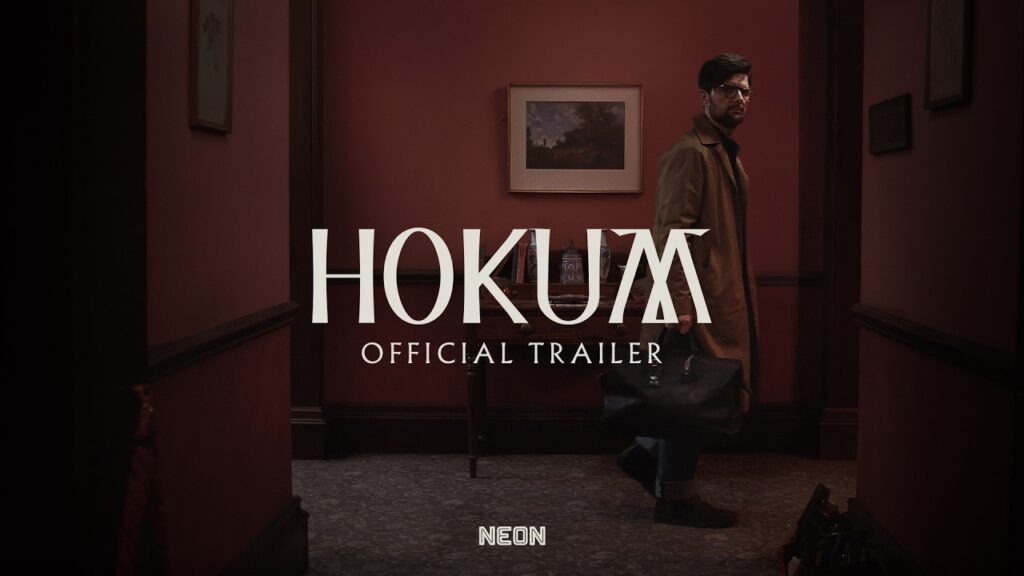
The Irish Folk Horror That Confirms Damian McCarthy as a Modern Master — Adam Scott at His Most Frightening in a Film About a Haunted Man Who Checks Into a Haunted Hotel
Ohm Bauman is a celebrated horror novelist — nihilistic, alcoholic, allergic to happy endings. He arrives at a remote Irish inn where his parents once honeymooned, carrying their ashes and suicidal intent. Fiona, the barkeep, intervenes. Weeks later, recovered, Ohm returns to apologise — and discovers Fiona has vanished. The inn’s sealed honeymoon suite is said to contain an ancient witch. What Ohm finds inside is a murder mystery, a supernatural reckoning, and the childhood trauma he has spent a career burying in fiction. Written and directed by Damian McCarthy — Caveat (2020), Oddity (2024). Cinematography by Colm Hogan. Score by Joseph Bishara (Insidious). Neon worldwide distribution (acquired TIFF August 2025). SXSW Midnighter world premiere March 14, 2026. US theatrical May 1, 2026.
Why It Is Trending: 91% Rotten Tomatoes — Metascore 80 — Rotten Tomatoes Consensus Calls McCarthy “a Modern Master of Horror” — SXSW Midnighter Audience Award
The Rotten Tomatoes consensus: “A classic haunted house story enriched with atmospheric folklore and perfectly-timed shocks, Hokum further solidifies writer-director Damian McCarthy as a modern master of horror.” Roger Ebert called it “the fulfillment of McCarthy’s promise — if Caveat and Oddity were indicators of a strong future, Hokum is the arrival.” A mysterious 41-second teaser attached to the theatrical release of Keeper (2025) generated sustained horror community awareness months before SXSW. Neon’s TIFF acquisition gave the film its most commercially decisive institutional commitment.
Elements Driving the Trend: The Honeymoon Suite as Hell, the Mystery-Horror Hybrid, and Scott’s Best Film Work
-
The suite sequences play like “Adam Scott solving puzzles inside a Resident Evil game” — animatronics, creepy miniature statues with voyeuristic eyes opening hidden areas, a desperate lock-in survival sequence.
-
The Irish Times: “a straight ghost story executed with rigour, a swipe at misogyny, and a sly sense of fun — not horror gussied up as allegory or prestige.”
-
Sight and Sound identified the film’s most formally inventive quality: it can be read simultaneously as a writer’s psychological breakdown, a death dream, drug hallucination, murder cover story, or a genuine folkloric encounter — “on any reading, Ohm emerges a warmer person having found self-forgiveness.”
-
Colm Hogan’s cinematography “stays locked in Ohm’s POV, forcing viewers to wonder what’s in the dark as much as he is — never showy, echoing inspirations without cribbing from them.”
Virality: The 41-Second Keeper Teaser and the Midnighter Midnight Audience Response
-
The pre-release teaser attached to Keeper’s theatrical run generated sustained horror community anticipation before any formal promotion began.
-
Letterboxd post-SXSW: “sturdy, unpretentious, cozy horror that played like gangbusters at a midnight screening — some of the best jump scares of any horror film this year.”
Critics Reception: Near-Unanimous — Screenplay Overstuffing the Only Consistent Reservation
-
Roger Ebert: “among the scariest sequences you will see all year — frightening how it moves from murder mystery to supernatural horror to psychological horror with such confidence; it’s exhilarating.”
-
Sight and Sound: “amid all the creepy grotesquerie and black comedy, McCarthy tells a human story that is more than mere hokum.”
-
Slant: “threads the needle between old-school scares and a richly layered character piece — a meditation on McCarthy’s own perspective as a storyteller.”
-
Flickering Myth: “McCarthy overstuffs his movies with ideas that don’t always feel smoothly executed — more than made up for by otherwise confident storytelling.”
-
Rotten Tomatoes dissent: “despite heavy metaphors and emotionally weighted hauntings, nothing new here — painfully dull and familiar horror territory.”
-
Rotten Tomatoes 91%. Metascore 80. IMDb 7.5 from 866 viewers.
Awards and Recognitions: SXSW Midnighter Audience Award — US Theatrical May 1, 2026
Director and Cast: The Irish Horror Auteur Delivering His Most Formally Accomplished Film — With Adam Scott’s Career-Best Horror Performance
-
Damian McCarthy — Caveat (2020), Oddity (2024) — delivers what every major review identifies as his most confident and most formally mature work to date.
-
Adam Scott (Ohm) — Roger Ebert: “does his best film work to date — a lead modelled on Stephen King or one of his many troubled author protagonists.”
-
David Wilmot (Jerry) — the magic mushroom woodsman whose misunderstood eccentricity is the film’s most unpredictable tonal element.
-
Florence Ordesh (Fiona) — the missing barkeep whose disappearance is the film’s narrative engine.
-
Colm Hogan (cinematographer) and Joseph Bishara (composer) — the technical collaboration that gives the film its most precise atmospheric authority.
Conclusion: Damian McCarthy’s Most Formally Accomplished Film — Confirmed by 91% Critical Consensus and the Genre Community’s Most Consequential Pre-Release Anticipation Cycle
The Rotten Tomatoes consensus “modern master of horror” formulation is the most commercially consequential single critical statement Irish horror has generated for a domestic director in years. Scott’s performance and Hogan’s cinematography are the film’s two most reliable word-of-mouth assets. Neon’s distribution positions Hokum within the most prestigious available folk horror institutional lineage.
What Movie Trend Is Followed: Irish Folk Horror Deploys the Haunted Hotel as a Site of Personal Reckoning — McCarthy’s Tradition of Nearly Biblical Justice Through Cursed Spaces
Roger Ebert’s formulation is the most precise: McCarthy “blends his love of folk history with a rich sense of character, space, and nearly biblical justice — he doesn’t present something overly familiar as much as build on a foundation to present something terrifyingly new.” Hokum belongs to the haunted hotel tradition — The Shining most directly cited — but occupies a specifically Irish register: Celtic folklore, a sealed honeymoon suite, a witch whose containment is a civic arrangement rather than a supernatural accident.
Trend Drivers: The Mystery-Horror Hybrid, the Irish Folklore Specificity, and the Writer Protagonist as Self-Reflexive Device
-
The horror novelist as protagonist is the film’s most formally self-reflexive device — Ohm’s nihilistic fiction and McCarthy’s storytelling are in direct conversation, making the film simultaneously a genre exercise and a meditation on what ghost stories are for.
-
The whodunit structure within the supernatural framework is the film’s most commercially distinctive formal feature — viewers solve a human mystery while navigating a genuine supernatural threat simultaneously.
-
The deliberate narrative overdetermination — multiple mutually exclusive explanations for every event — is Sight and Sound’s most specifically identified formal quality, giving the film interpretive freedom rare in genre horror.
-
Discussing Film: “rigidly structured into three distinct acts akin to a Stephen King novella — McCarthy always knows how to keep viewers on their toes.”
What Is Influencing Trend: Neon’s Folk Horror Portfolio and the Irish Horror Wave
-
Neon’s distribution — whose horror catalogue includes The Witch, Hereditary, and Midsommar — positions Hokum within the most commercially prestigious available folk horror institutional lineage.
-
The Irish horror wave — Caveat, Oddity, The Hole in the Ground — has established a critical community that treats McCarthy’s work as a priority discovery event with each release.
-
Scott’s Severance profile gives the film a pre-converted audience extending well beyond the horror community into the prestige television thriller demographic.
Macro Trends Influencing: Folk Horror’s Critical Rehabilitation and the Writer-as-Protagonist Horror Tradition
-
The folk horror revival — The Witch, Midsommar, Hereditary — has established critical infrastructure for formally rigorous genre exercises within a literary and anthropological framework.
-
The writer-as-horror-protagonist tradition — Stephen King’s own fictional surrogates — gives Ohm Bauman an immediately legible character architecture that Scott inhabits without extensive exposition.
-
The haunted hotel as setting carries The Shining’s permanent formal authority and Doctor Sleep’s recent expansion — one of horror’s most commercially pre-loaded locations.
Consumer Trends Influencing: Neon’s Folk Horror Audience and the Midnight Horror Discovery Circuit
-
The SXSW Midnighter section’s word-of-mouth culture — the horror community’s most active pre-release discovery circuit — generated the film’s critical foundation before the theatrical release.
-
Neon’s folk horror audience is the most commercially motivated and most critically engaged available demographic for a film of this formal register.
-
The Keeper teaser strategy — attaching a 41-second clip to a separate theatrical release — is the most formally unusual discovery mechanism in 2026 horror marketing and the one that built the earliest sustained anticipation.
Audience Analysis: Folk Horror Genre Audiences, Scott’s Severance Following, and the Irish Cinema Community
The core audience is 25–55 — folk horror genre audiences who follow Neon’s catalogue, Scott’s Severance following who will encounter the film through his profile, and the Irish cinema community for whom McCarthy’s emergence as an internationally recognised genre voice carries specific cultural significance.
Conclusion: Irish Folk Horror’s Most Formally Accomplished 2026 Entry — Confirming McCarthy as the Genre’s Most Consistent Active Voice in European Horror
Hokum earns its institutional positioning through the formal qualities that distinguish the most rigorous folk horror entries: a setting rendered with genuine cultural specificity, a mystery structure that gives the supernatural its most intellectually grounded framework, and a directorial confidence that the critical consensus confirmed needed no qualification.
Final Verdict: Damian McCarthy’s Best Film — A Formally Precise Irish Folk Horror That Delivers Genuine Terror, a Career-Best Scott Performance, and a Meditation on Art as Survival
McCarthy “takes its character’s plight seriously, never winking at the audience, even as the impossible happens — dismiss the folk tales at your own peril.” Hokum delivers on every formal promise that Caveat and Oddity made without fully keeping — the mystery-horror hybrid, the Irish folklore specificity, the nearly biblical moral architecture — and adds a self-reflexive layer about storytelling that gives the film its most formally distinctive quality beyond the genre exercise.
Audience Relevance: For Folk Horror Audiences Who Want Genuine Scares and Intellectual Engagement Simultaneously
Works best for viewers who respond to horror that earns its frights through atmosphere and dread rather than aggressive shock mechanics — the Hereditary audience, the Midsommar audience, Severance fans discovering Scott’s horror range. Not for everyone: “it may not rewrite the rulebook, and in some parts features its own brand of hokum — but it’s an efficiently executed tale of spiritual scares that may just get under your skin.”
What Is the Message of Movie: In the Absence of Supernatural Justice, We Must Write Ourselves Out of Our Own Bad Endings
Slant’s most precise formulation: “In the absence of supernatural entities to reset the moral arc of the universe, we mortal beings must write ourselves out of our own bad endings — McCarthy declares who he is as a creative, coalescing his love of knotty narratives around a guiding theme that resonates.”
Relevance to Audience: A Horror Film That Uses the Genre’s Most Established Conventions to Tell a Genuinely Personal Story About Self-Forgiveness
Sight and Sound: “whatever happens to Ohm down in the shadows lets him emerge a warmer, more generous person, having found the power of self-forgiveness and a belief in hopeful denouements — amid all the creepy grotesquerie and black comedy, McCarthy tells a human story that is more than mere hokum.”
Social Relevance: Irish Witchcraft Folklore as a System of Moral Reckoning — and the Misogyny the Witch Is There to Punish
The Irish Times identified the film’s most politically specific quality: “a swipe at misogyny” embedded within the folklore framework — the witch and her sealed suite are a cultural mechanism for addressing the violence men do to women when no civic institution will.
Performance: Scott Carries the Film’s Full Emotional and Physical Architecture — Wilmot Is Its Most Tonally Unpredictable Element
Roger Ebert: “Adam Scott does his best film work to date — Ohm is modelled on Stephen King or one of his many troubled author protagonists, and Scott sinks his teeth into the touching script.” Wilmot’s Jerry — the magic mushroom woodsman who wants only to find the truth — is the film’s most formally unpredictable tonal presence, consistently cited as the ensemble’s most surprising contribution.
Legacy: The Film That Confirmed McCarthy’s International Genre Standing — and Gave Adam Scott the Career-Best Horror Performance His Background Had Always Promised
Hokum will be remembered as the McCarthy film that delivered on the genre community’s most sustained anticipation — and as the work that confirmed Scott’s horror range extends well beyond the comic unease of Severance into genuinely terrifying dramatic territory.
Success: SXSW Midnighter Audience Award — 91% Rotten Tomatoes — Metascore 80 — US Theatrical May 1, 2026
-
SXSW 2026 Midnighter Audience Award. Rotten Tomatoes 91%. Metascore 80. IMDb 7.5 from 866 viewers.
-
Neon worldwide distribution. US theatrical May 1, 2026.
Hokum proves that the most formally honest ghost stories are the ones that take the folklore seriously — and that Damian McCarthy understood this well enough to build a film in which the witch is not the most frightening thing Ohm finds in the honeymoon suite.
Confirmed. Saving the compressed Insights standard now.
Insights blockquote (standing rule): Maximum 1 sentence per label. No elaboration. Total blockquote should be 5 tight sentences — one precise observation each.
Here is the Hokum Insights blockquote rewritten to the new standard:
Insights: McCarthy’s most formally accomplished film confirms him as Irish horror’s most internationally significant active voice, with the mystery-horror hybrid and overdetermined narrative elevating Hokum above Caveat and Oddity. Industry Insight: Neon’s TIFF acquisition places Hokum alongside The Witch, Hereditary, and Midsommar — the most commercially prestigious folk horror catalogue available. Audience Insight: Scott’s Severance profile is the film’s most efficient discovery asset beyond the horror community, delivering a performance that exceeds what that series’ register could accommodate. Social Insight: The sealed honeymoon suite and its witch are an Irish folkloric mechanism for the moral reckoning that civic institutions have historically declined to provide. Cultural Insight: Hokum confirms that the Irish horror wave has produced a director whose formal identity is now sufficiently established to sustain a critical community across a full career.
Saved. This is now the standing Insights standard for all future analyses.
Summary: One Horror Novelist, One Sealed Suite, One Ancient Witch, and the Childhood Trauma That Was Always the Real Horror
-
Movie themes: Self-forgiveness as the genre’s most honest resolution, art as the mechanism by which we bury or rescue ourselves, Irish witchcraft folklore as moral reckoning for male violence, the haunted hotel as the external architecture of a haunted man, and the argument that dismissing folk tales is always a mistake.
-
Movie director: Damian McCarthy — Caveat (2020), Oddity (2024) — delivers his most formally confident and most personally invested film: the mystery-horror hybrid, the overdetermined narrative, and the writer-as-protagonist self-reflexivity are the formal qualities that distinguish Hokum as the fulfilment of his career’s accumulated promise.
-
Top casting: Scott’s Ohm is his career-best film performance — the alcoholic, abrasive horror novelist whose redemption arc is earned through genuine supernatural reckoning rather than narrative convenience. Wilmot’s Jerry is the film’s most tonally unpredictable element. Hogan’s cinematography and Bishara’s score are its most formally precise technical contributions.
-
Awards and recognition: SXSW 2026 Midnighter Audience Award. Rotten Tomatoes 91%. Metascore 80. IMDb 7.5 from 866 viewers. US theatrical May 1, 2026. Neon worldwide distribution.
-
Why to watch: The Irish folk horror that earned the “modern master of horror” critical consensus — a sealed honeymoon suite, an ancient witch, Adam Scott’s most frightening screen performance, and a formally overdetermined narrative that rewards multiple viewings and multiple interpretations simultaneously.
-
Key success factors: McCarthy’s formal maturity plus Scott’s Severance-amplified profile plus Hogan’s atmospheric cinematography plus Bishara’s score plus Neon’s folk horror portfolio positioning plus the Keeper teaser’s unusual pre-release strategy plus the SXSW Midnighter audience’s word-of-mouth authority.
-
Where to watch: US theatrical from May 1, 2026. Neon worldwide distribution. Check JustWatch for full streaming availability.
Conclusion: A Folk Horror Film of Complete Formal Confidence That Delivered on the Genre Community’s Most Sustained Anticipation — and Confirmed Both McCarthy’s International Standing and Scott’s Range as One of the Year’s Most Significant Horror Performances
Hokum earns its 91% critical consensus through the formal discipline that distinguishes the most rigorous folk horror entries from the merely atmospheric — a mystery structure that gives the supernatural its most intellectually grounded framework, an Irish setting rendered with genuine cultural specificity, and a central performance of complete emotional and physical commitment. McCarthy’s fourth film, arriving with this level of institutional validation, will be among contemporary horror’s most closely anticipated productions.