I don’t know about the rest of you all, but I think I’m still recovering from Saturday night’s thriller between Arizona and Utah.
Conferences have changed for a number of reasons, but the loss of a true Pac-12 After Dark vibe has been one of the sadder developments. Shoutout to Utah and Arizona for bringing those feelings back after 2 a.m. on the East Coast on Saturday night.
Fast-forward to this time next year, a narrow loss like the Wildcats just suffered would keep them in the postseason conversation with the 24-team format coming in 2027, rather than on the fence. But beyond the team’s comfort of making the playoff with three or four losses, what does this mean for the offseason coaching carousel?
Let’s break it down.
The Main Event: Does the 24-team CFP Change What’s A Good Job?
In Winston-Salem, this conversation may not matter.
Wake Forest eviscerated SMU on Saturday and shot up to No. 11 in the College Football Playoff rankings on Tuesday night. Handle Georgia Tech and Duke and a rematch with Miami in the ACC championship game may be all that separates the Demon Deacons from a CFP berth.
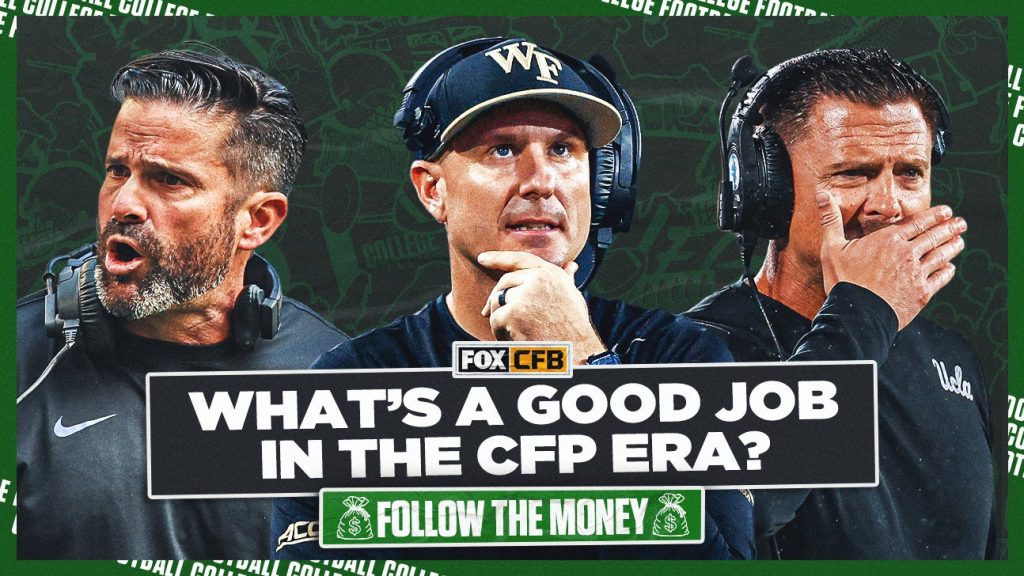
But as head coach Jake Dickert’s success has made him a candidate for almost every open — and soon-to-be-open — job in America, there’s a prevailing sentiment from him and others in similar spots that an expanded postseason field is further flattening the curve across the sport.
Now, is an expanded playoff a perfect fix? Not necessarily.
“I think the odd part — and it’ll be really odd when there’s no conference championships — is, what are we really doing in conferences?” Dickert queried. “Let’s go back to four regional zones, a little bit like the NFL. It just creates more changes.
“But I’m sure coaches like it because ‘Hey, I made the playoffs, I keep my job.’ It just creates a hard line of like you do or you don’t. We’ll see, but that has to be the maximum number of teams, because we keep pushing the season so far back.”
Wake Forest head coach Jake Dickert has the Demon Deacons off to a 9-1 start this season. (Photo by Zach Bolinger/Icon Sportswire via Getty Images)
The 24-team playoff is coming. Like it or not, we’re about 12 months away from some 8-4 or 7-5 team getting real consideration to be part of the postseason. Whether that’s good or bad has merits on both sides.
The access it provides, however, may prove the most dramatic and lasting impact.
The coaching market has always been dictated by where people felt they could win. That’s never been exacerbated more in a world where roster costs are the topic du jour among administrators and industry insiders.
But with an expanded field, there is more opportunity for places like Wake Forest, like Duke, like UCLA — all of whom have coaches that have been or will be in hot demand this offseason — to compete against the sport’s upper echelon, despite perceived resource advantages.
“I don’t care what the number is,” UCLA head coach Bob Chesney told me. “We made a 12-team playoff at JMU. So we’re gonna figure out a way to get into that playoff, regardless of what number you put it at.
“A tournament makes sense to me. The more people you put in, who knows? … But I also get it; you don’t want to dilute it too much either. But the adversities that show up in there, I think, are all good lessons for a lot of people. And you really learn who people are as they have to fight through those.”
Bob Chesney and the Bruins are 10-0 and ranked No. 4 in the country after Week 11. (Photo by Keith Birmingham/MediaNews Group/Pasadena Star-News via Getty Images)
Take Duke head coach Manny Diaz as the poster child of a program that might benefit from an expanded postseason.
A year ago, Diaz’s squad won the ACC at 8-5 thanks in part to a wonky tiebreaker that placed it in the league title game. But the Blue Devils were ultimately boxed out as a conference champion by 12-1 James Madison. That won’t happen under the new format, as the 24-team CFP will award automatic bids to the champions of all four Power Four conferences.
“There’s been such a fundamental change to everything that the 12-team playoff was the perfect solution 10 years ago, when there was a Pac-12, when there was an old Big 12 with Missouri and Texas A&M,” Diaz told me. “It literally would have been exactly what we needed. But it just came too late, and it came through, in my mind, the greed of the super conferences — which is what we have now.
“When you can’t play everybody, it’s not a conference. It’s really two divisions. It’s two conferences into one. Because you have imbalanced conference schedules, you’ve got to expand the playoff interest. Does anybody like it? It’s a necessary evil based off the law of unintended consequences.”
Despite that, Dickert, Chesney and Diaz have been tossed around as names to know for just about every open job in the country. Will they move? That’s harder to answer.
Wake Forest announced a lengthy extension for Dickert that is expected to bolster the Demon Deacons’ NIL funding and assistant coach salary pool. Offensive coordinator Rob Ezell has also agreed to a new extension.
Chesney, while only in Year 1 at UCLA and on the precipice of a CFP berth himself, is reportedly working through contract extension talks with the brass in Westwood. The Bruins’ administration is trying to get ahead of the market for its upstart miracle worker of a head coach.
Diaz, meanwhile, has had his name tossed around in the Florida State search, though given the way his tenure at Miami ended, he’s expected to be choosy about his next move — even if his alma mater and new athletics director Jeff Purinton do call.
Manny Diaz is 25-12 overall as Duke’s head coach. (Photo by Katherine Gawlik/Icon Sportswire via Getty Images)
“When you’re a head coach for the first time, you get asked to interview for a head coaching job for the first time, you’re in awe that you’re being considered,” Diaz said. “It’s a hope, it’s a dream, whatever. But you don’t really know, and it’s really, really hard to know what the job is until you have it. You’re trying to convince everybody that you are worthy of the job.
“After you’ve had the job, you begin to really understand what the job is. Now you get to really look at what it is that you’re actually looking for, and in an interview process, you can be the one actually asking more questions than giving answers.
“I knew for me that I would maybe have one more chance (after being fired at Miami). I had a great job. I absolutely loved being the DC at Penn State. It was an amazing place. … I had the right to be selective and made sure that (Duke) fit some of the lessons that I learned at Miami.”
Industry sources have cautioned about a quieter search season than usual, albeit that might prime a few bigger jobs to open next year.
There’s also a question of whether bigger gigs like Michigan, TCU, USC and Wisconsin — each of which create their own windfall — might make moves.
But with the CFP expanding and the perceived list of big-name candidates slimmer than usual this cycle, there’s reason to believe college football’s biggest overachievers might stay put.
That’s a win for college football fans everywhere.
Best Quote I saw This Week
Who among us hasn’t been frustrated after losing a game? LSU head coach Lane Kiffin certainly was.
While meeting with reporters on Monday to recap the last-play loss to Texas, he was, uh, shall we say, still a touch perturbed about the way things went.
“We’re not gonna f—ing cover the guy and he’s gonna walk in the f—ing end zone?”
Can’t blame the guy. A $50 million roster and you’re 6-4. That’s not going to cut it anywhere, let alone at LSU.
Best Deal I Saw This Week
Beer is here.
It was announced on Thursday that Modelo has become the official beer of the NCAA.
Yes, you read that correctly. The conservative-minded NCAA has a booze sponsor. A bit jarring, eh? Understandable.
The deal is notable for a few reasons, but most importantly, this is part of how the organization is making itself whole for basketball tournament expansion.
The current deal with CBS/TNT Sports is such that the NCAA wouldn’t see an uptick in its rights fees for adding teams to the field. That said, the networks — which also control the NCAA’s corporate sponsorship efforts — agreed to open a number of major advertising categories that had not been available previously in an effort to financially justify the change.
Booze was one of those categories — and now everyone is cashing in.
Cheers, y’all.