



Spoilers for “Ebenezer” follow.
When the ads and pre-release buzz articles began running for “Ebenezer,” the new film directed by Ti West and starring Johnny Depp as Scrooge, the campaign promised that the movie would present Charles Dickens’ “A Christmas Carol” as you’d never seen it before. Yet, now that the film has released and folks (including yours truly) have screened it, it turns out “Ebenezer” is unsurprisingly more or less the same “A Christmas Carol” we all know well. The movie liberally copy-and-pastes whole swathes of Dickens’ text into the script, with writer Nathaniel Halpern even bothering to include the novella’s separation into five staves. However, it seems there’s some larger artistic liberty wiggle room in that “more or less the same” than might appear at first glance.
When West spoke to Entertainment Weekly back in August, he detailed what made Depp’s Ebenezer different than previous adaptations. Amidst talking up things like Depp’s “musicality” as a performer, West also explained how his film would present Scrooge in a more both sides-y manner: “As (Depp’s) Scrooge cuts someone down verbally or as he makes a financial point or withdraws, you do understand why he’s doing it.” That offhand mention of “a financial point” baffled many of us when we first read it, as it certainly did sound like a deviation from Dickens.
Was this Scrooge going to be portrayed as a genius businessman? Instead, the changes “Ebenezer” makes to Scrooge and Dickens’ story are of a smaller nature. They involve portraying a couple small supporting characters as outright villains, thereby giving Scrooge a justification for his misanthropy. The changes may be merely tweaks, yet their larger implications are alarming, especially for a film which doesn’t feel able to support them.
Ebenezer’s Scrooge gets moral justification he doesn’t need
For the most part, “Ebenezer” is a faithful adaptation of “A Christmas Carol.” The largest addition comes in the form of a prologue in which we see Scrooge and his partner, Jacob Marley (Ian McKellen), on their last day together. Marley goes to get some tea while Scrooge observes a beggar outside his window. At the same moment the beggar reveals himself to Scrooge as a fraud conning people out of their donations, Marley drops dead, equating the con artist’s crime with harm done to a true earner in Scrooge’s mind. That Marley (and Scrooge) are just as heartless and dishonest is something the film hopes Dickens’ work gets across, as they don’t go out of their way to underline it to support their addition.
This problem is compounded twice. Once is when it’s revealed that Scrooge’s old benevolent boss Fezziwig was murdered by a street beggar, further teaching Scrooge that charity can be met with violence. Next is when the Ghost of Christmas Future shows Scrooge the vultures who’ve come to sully his legacy after his death, which adds the wrinkle that the two men who sought a donation for the poor at the beginning of the film are actually also embezzlers.
What’s more, they’re in league with a man who’s plotting with the embezzlers to steal Scrooge’s nephew Fred’s inheritance with the production of a forged will. The alarming quality about these inclusions lies in how they seem to give Scrooge more moral justification for his odious behavior that he doesn’t need. It’s a bizarrely tone-deaf addition for a story that’s ultimately meant to be about the virtues of charity.
Ebenezer can’t deal with its new additions because Johnny Depp is in the way
Ultimately (and thankfully), these additions do not derail “Ebenezer,” for the heart of Charles Dickens’ story and his themes remains intact. Although it’s tempting to point fingers at the Skydance corporation for the new ideas, it isn’t the changes themselves that are the problem. After all, Ti West comes from a background of indie horror films, many of which utilize thorny, morally ambiguous characterizations and themes as their stock in trade. “Ebenezer” is indeed partially constructed to emphasize the horror in Dickens’ tale: the three Christmas ghosts are more ghastly and doomed than they typically are. In the more horror-centric version of “A Christmas Carol” the movie seems to want to be, a somewhat justified Scrooge would be a fascinating layer for an actor to play, as it creates a new obstacle for the character to overcome on his journey to selflessness.
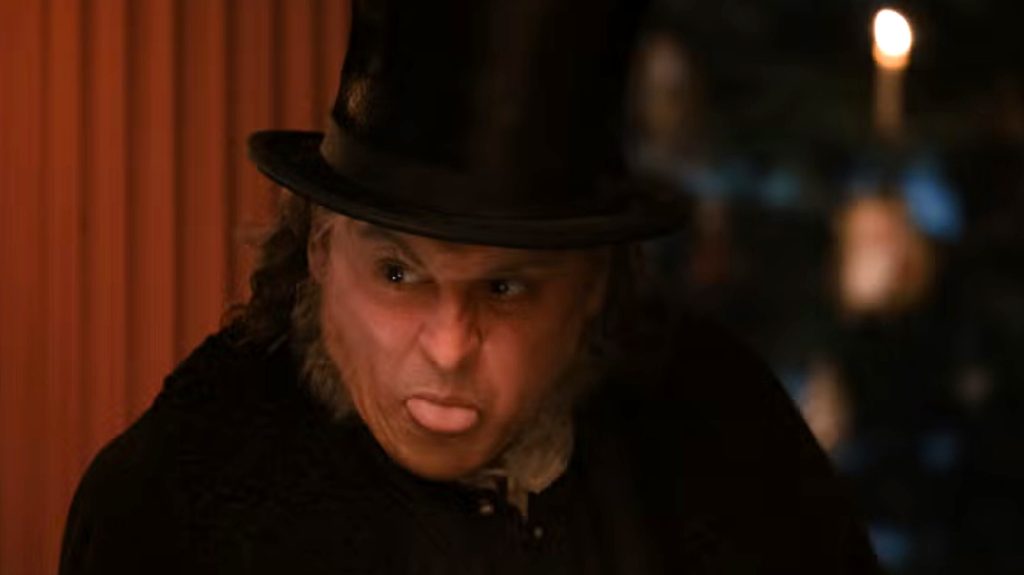
Alas, “Ebenezer” is the Johnny Depp show, and for several reasons, Depp is not up to the task. While it’s arguable that he may not be able to tackle such material at all, it seems like he’s not even interested in trying in the first place. Instead, “Ebenezer” and Depp are too preoccupied with trying to be as likable as possible, which means that his Scrooge rarely gets nasty. He comes off more like an irritable jerk than a man who’s nearly lost his soul, so whatever compelling shadings the changes to the story could’ve presented never materialize. On paper, the possibilities presented by “Ebenezer” range from exciting to alarming. Yet we needn’t fret too much, since the finished film plays things so safely that it’s hard to get riled up about it one way or the other.
“Ebenezer” is in theaters now.