


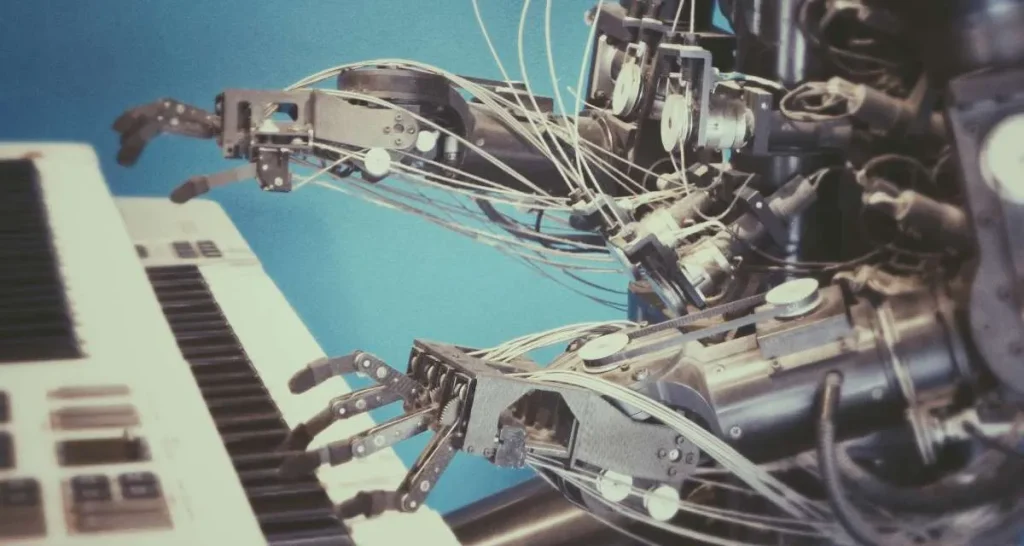


Photo Credit: Franck V.
16 months later, the Korea Music Copyright Association (KOMCA) has walked back its zero-tolerance artificial intelligence policy by allowing the registration of AI-assisted musical works.
KOMCA announced the pivot in a formal release that quickly made way for reports from regional outlets. Turning the clock back to April 2025 for a moment, the society previously opted for a clear-cut no-AI policy: Only works created entirely by humans were eligible for registration, we broke down at the time.
However, KOMCA also left the door open for adjustments – and specifically adjustments concerning the use of AI tools as opposed to platforms dealing in one-stop prompt-based generations. And to reiterate the obvious, quite a lot has changed in the AI arena since early 2025.
Some of the developments – GEMA’s legal win over Suno in Germany and the accelerating stream of machine-made audio on DSPs come to mind – have received plenty of coverage. Others, like the alleged March 2026 discovery of many royalty-bearing KOMCA-registered works pumped out with the help of AI, have flown under the media radar.
According to Tech Times, South Korea’s Board of Audit and Inspection examined 8,540 songs from 29 individuals (for an average of 295 apiece) and found that almost 61% of the sampled works “were likely composed with AI assistance.” 11 CMOs were audited, not just KOMCA, which reportedly pushed back by calling into question the detection tech’s accuracy.
In any event, the stage was evidently set for a registration-eligibility recalibration. Per KOMCA’s new policy, one can, as mentioned, copyright works made with the help of AI but not those generated entirely by a machine.
Where exactly is the line drawn here, and what’s to prevent bad actors from gaming the system by lying about the use of AI? On the former front, it appears that the answer will materialize moving forward; applicants, who are responsible for disclosing any AI assistance in detail, should “retain materials that can verify the creative process and revision history,” per KOMCA.
“When requested by the Association,” the entity continued, “supporting materials related to the creative process must be submitted.”
Regarding penalties for “false reporting,” a variety of possible steps are on the table, KOMCA relayed.
“If false reporting, etc. is confirmed,” a relevant line reads, “measures such as suspension of royalty payments, recovery of improperly received amounts, disciplinary action under the Articles of Association, or termination of the trust agreement may be taken in accordance with relevant regulations and terms.”
Though KOMCA’s registration-process scrutiny remains to be seen, evidence suggests that the society could be thorough.
One day after Lee Si-ha stepped in as KOMCA’s head, multiple Korean organizations (among them KOMCA itself) this past February debuted the K-Music Rights Organizations Mutual Growth Committee, which promptly declared “war” on AI.
At the time, the Committee pointed to objectives of maximizing gen AI training transparency, tackling unauthorized training from there, and labeling machine-created uploads on streaming services.
New registration policy aside, these goals seem to be alive and well; the tagging push in particular is gaining international momentum. Moreover, it was only in late June, during the KOMCA-organized Magok Culture & Tech Festival, that Lee spoke about topics including the “boundary between AI outputs and human-created works.”
“AI is merely a tool,” on-screen text read during his presentation. “The true value of creation lies in the human.”