
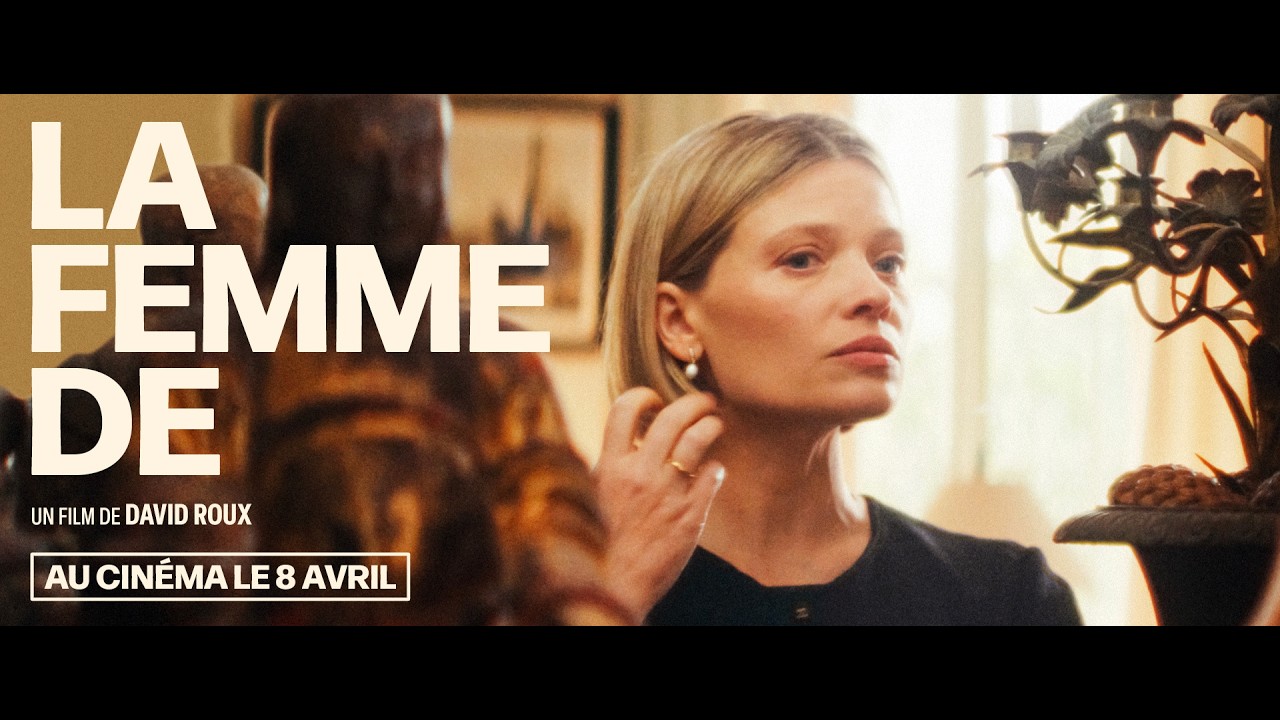
The model wife, the family manor, and the past that cracks everything open
Marianne is approaching 40 in a grand bourgeois manor in Lorraine — envied, devoted, invisible. Her husband’s decisions override her protests without pause. Her past resurfaces in the form of a man (Jérémie Renier) she once knew. A crack opens. What it will cost to step through it is the film’s entire question. Adapted from Hélène Lenoir’s 1998 novel Son nom d’avant, David Roux’s second feature opened in French cinemas on April 8, 2026.
Why It Is Trending: A Domestic Thriller in the Chabrol Register Opens Against a Spring Crowded with French Prestige Drama
Roux’s debut L’Ordre des médecins premiered at Locarno 2018 and circulated internationally before passing largely unnoticed theatrically. La Femme de corrects that — selected for the Festival du Film Francophone d’Angoulême 2025, the Festival de Sarlat 2025, the Festival International du Film de Saint-Jean-de-Luz 2025, and Festival des Oeillades Albi 2025, it arrives in cinemas on April 8 with genuine festival endorsement and a lead performance that French critics have unanimously called a career event for Mélanie Thierry. Roux describes his film as a return to the bourgeois provincial world Claude Chabrol owned — a world, he notes, “that since Chabrol’s death has barely been represented in cinema.” Distributed by Jour2fête. Disney+ France is co-producer.
Elements Driving the Trend: The film’s opening scene sets its entire register: a woman is accosted against a wall in the street, frightened, and then releases — alone, in silence — her fear and humiliation. That compressed statement of patriarchal moral violence is the film’s thesis. Roux chose the 17th-century Maine-et-Loire manor house specifically for its “quietly arrogant, self-assured wealth” — an architectural expression of the trap Marianne inhabits. Cinematographer Quentin Sirjacq’s deliberately grey-toned palette mirrors Marianne’s interior state. Jérémie Renier — who played the lead in L’Ordre des médecins — returns in front of the camera as the figure from Marianne’s past. The film refuses melodrama on principle, operating at a “razor’s edge” of restraint throughout.
Virality: Thierry’s performance generated immediate audience response at Angoulême — the festival described it as greeted with tears and applause. The film’s title, La Femme de (“the wife of”), is itself the feminist argument: a woman identified only by her marital attachment, whose own name is the “before” the novel’s title names.
Critics Reception: Baz’art: a genuine success, never satirical nor melodramatic, a deeply bitter and deeply moving portrait. In the Mood for Cinema: a true domestic thriller of rare mastery, Thierry unforgettable with contained pain that echoes her Connemara work. Critique Film: a revelation — Thierry’s crack in the carapace never tips into excess. Fnac/Leclaireur: the performance is impressive but the mise en scène is rigid and the drama lacks incandescence. Avoir-Alire: restrained to the point of nonchalance, but the performances rescue it. IMDb 6.6.
Awards and Recognitions: Festival du Film Francophone d’Angoulême 2025. Festival de Sarlat 2025. Festival International du Film de Saint-Jean-de-Luz 2025. Festival des Oeillades Albi 2025. French theatrical release April 8, 2026, distributed by Jour2fête. Disney+ France co-production.
La Femme de opens into a French cinema landscape ready for exactly this kind of precise, politically engaged domestic drama — and Thierry’s presence gives it the commercial and critical profile that Roux’s debut lacked.
What Movie Trend Is Followed: The Chabrolian Domestic Thriller Reclaimed as Feminist Moral Portrait
La Femme de belongs to the tradition of French bourgeois domestic cinema — Chabrol’s La Cérémonie, Madame Bovary’s literary descendants — but recalibrates the genre’s satirical edge toward feminist interiority. Roux explicitly distances himself from Chabrol’s “humorous and sarcastic” register in favour of something more grave and more intimate: the focus is not on the bourgeoisie as comic target but on the specific daily experience of a woman whose moral subjugation is so normalised she became complicit in her own disappearance without noticing. The result sits between domestic thriller and character study — a film that French critics consistently invoke Hitchcock and Chabrol to describe while acknowledging it is neither.
Trend Drivers: Roux’s Refusal of Melodrama as Formal Discipline The decision to adapt Lenoir’s novel — described as 70 pages of first scene, cinematographic from the start — was made with the discipline of refusing its most obvious dramatic possibilities. Roux wanted Marianne not immediately sympathetic, her emergence gradual and enigmatic. The film’s claustrophobic architecture — the manor whose walls Marianne cannot leave — is its primary formal device. Quentin Sirjacq’s grey palette gives the film an atmosphere of material wealth and affective poverty that never requires dialogue to establish. Renier’s return in front of the camera creates a metacinematic resonance between L’Ordre des médecins and this film that rewards attentive French cinema viewers.
The film’s political engagement is entirely structural — embedded in Marianne’s story rather than stated as commentary.
What Is Influencing Trend: The French auteur drama centred on bourgeois domestic entrapment has a sustained audience at French festivals and in French theatrical release — a genre with decades of critical infrastructure and loyal audience. The feminist interiority film — focused on the “least spectacular manifestations of patriarchy,” as Roux describes it — is finding increasing critical support in a French cinema moment attentive to female experience. Thierry is at the peak of her critical reputation following Connemara (2025), making this casting commercially astute.
The Chabrol reference positions the film immediately for critics and informed audiences — a signal that communicates genre, register, and quality simultaneously.
Macro Trends Influencing: French cinema’s growing engagement with stories of women’s moral subjugation — from La Cérémonie through Anatomie d’une chute — has built an audience for domestic drama that examines patriarchal violence in its most quotidian, non-spectacular forms. The 40-something female protagonist questioning the life she built is one of French drama’s most commercially viable subject positions. The adaptation of a literary novel (Éditions de Minuit) gives the film cultural prestige that original screenplays for similar subjects often lack.
Consumer Trends Influencing: Thierry’s triple spring 2026 theatrical presence — La Femme de alongside two other films — gives the film exceptional platform visibility in the French market. The Angoulême audience response — tears and applause — positions the film as emotionally impactful beyond its arthouse positioning. Jour2fête’s distribution track record with quality French cinema and Disney+’s co-production investment give the film a release infrastructure matching its critical ambitions.
Audience Analysis: French Arthouse Audiences, Feminist Drama Viewers, and Thierry’s Expanding Fanbase The core audience is 30–60 — French arthouse cinema regulars who follow the Angoulême and Sarlat festival programmes, viewers who responded to Connemara and want more of Thierry’s specific register, and the women’s cinema audience that has made domestic patriarchy films some of French cinema’s most commercially reliable releases. The film’s deliberately restrained register will reward patient viewers and test those seeking conventional dramatic intensity. The Chabrol comparison draws an older, cinephile-literate demographic. Thierry’s growing star profile following Connemara extends the reach.
Final Verdict: La Femme de Is Formally Precise, Politically Serious, and Carried by a Performance That Justifies Every Minute of Its Restraint
Roux delivers a second feature of considerably greater ambition and formal confidence than its modest production context suggests — a film that makes its feminist argument entirely through structure, atmosphere, and performance rather than statement. Thierry gives the film everything it needs to work and more. The film’s most divisive quality — its refusal of incandescence — is also its most formally coherent commitment. It is less than Chabrol because it is doing something different from Chabrol: less sardonic, more painful, more true.
Audience Relevance: For Anyone Who Has Watched Someone Become a Function of a Family Rather Than a Person Marianne’s subjugation is not spectacular — no violence, no obvious cruelty, just a husband whose decisions override her protests without acknowledgement and a social role that absorbed her identity while she managed everything around her. That specificity — the most quotidian, least dramatic form of patriarchal moral violence — is what gives the film its contemporary resonance.
What Is the Message: Complicity in Your Own Disappearance Is Still Disappearance — and the Past Remembers Who You Were The title’s incompleteness — La Femme de, with the “of” completing itself with a husband’s name — is the film’s central argument. Marianne had a name before. The novel is called Son nom d’avant. Renier’s reappearance is the name returning. The film asks what it costs to reclaim it, and refuses to answer cheaply.
Relevance to Audience: A Film Political Without Being a Tract Roux’s stated ambition — to be political without being a pamphlet — is achieved with discipline. The opening scene, Marianne against the wall, says everything the film knows about women’s relationship to public space and patriarchal authority. Nothing that follows needs to be said as loudly.
Social Relevance: The Bourgeois Domestic Trap as Contemporary Feminist Document The manor house, the industrial wealth, the Catholic provincial family — these are not period details but structural ones. The film’s argument is that the specific mechanisms of Marianne’s entrapment operate independently of class and era. Her name was absorbed by her social function. That process is not historical.
Performance: Thierry Is the Film — Restrained, Dense, and Impossible to Look Away From Roux said Thierry needed almost no direction — “she wanted this Marianne to be free.” Her performance operates on the finest possible line between resignation and emergence, never tipping into either excess or passivity. Caravaca’s Antoine is the film’s most quietly damning portrait: a man whose negligence toward his wife reads as unconscious rather than malicious, which makes it worse. Renier’s Johann restores Marianne’s past self to screen with a gentleness that makes his presence the film’s most tender formal choice.
Legacy: Roux’s Second Feature Confirms a Filmmaker With a Distinctive and Necessary Voice La Femme de will be remembered as the film that positioned Roux as the legitimate successor to the Chabrolian tradition — not as a stylist copying Chabrol but as a filmmaker who understood what that tradition was actually about and recalibrated it for a feminist present. Thierry’s performance will be cited in career retrospectives.
Success: Four French Festival Selections, French Theatrical Release April 8, 2026 Festival du Film Francophone d’Angoulême 2025. Festival de Sarlat 2025. Festival International du Film de Saint-Jean-de-Luz 2025. Festival des Oeillades Albi 2025. French theatrical release April 8, 2026, Jour2fête distribution. Disney+ France co-production.
La Femme de gives Marianne back her name — quietly, precisely, and with the full conviction that simple stories are often the most devastating ones to tell.
Industry Insights: Roux’s partnership with Jour2fête and Disney+ France demonstrates that formally ambitious feminist domestic drama can access both arthouse distribution and major streaming infrastructure simultaneously — and that festival endorsement (four selections before theatrical release) remains the most reliable French cinema marketing strategy for this kind of film. Audience Insights: Thierry’s triple spring 2026 theatrical presence — with the critical momentum from Connemara behind her — gives La Femme de an audience positioning that most comparable films in this register cannot access. The Angoulême standing ovation is the most reliable predictor of French theatrical word-of-mouth. Social Insights: A film about the “least spectacular manifestations of patriarchy” — the daily, unspectacular, normalised forms of women’s moral subjugation — is making the argument that what doesn’t look like violence is often the most structurally damaging form of it. That argument lands with particular precision in 2026. Cultural Insights: La Femme de positions Roux as the Chabrol heir French cinema needed — not a satirist of the bourgeoisie but a moralist of its interior life, working with the tools of restraint and formal precision rather than irony and spectacle. With Thierry as his instrument, the recalibration is complete.
La Femme de proves that the most political films are often the ones that never raise their voice — and that a woman’s silence, rendered precisely enough, is its own form of accusation.
Summary: One Manor, One Marriage, and the Woman Who Almost Forgot Her Own Name
-
Movie themes: Patriarchal moral subjugation in its most normalised, non-spectacular form; female identity absorbed by social function; the cost of reclaiming a past self; and the specific violence of a world that erases women through comfort rather than cruelty.
-
Movie director: David Roux — former theatre journalist, debut Locarno 2018 — returns seven years later with greater formal confidence and explicit Chabrolian ambition, recalibrating the bourgeois domestic thriller as feminist moral portrait. His refusal of melodrama is the film’s defining directorial commitment.
-
Top casting: Thierry carries the film with contained force that every French critic called a career event. Caravaca’s negligent husband is the film’s most quietly damning performance. Renier’s gentle figure from the past restores something the film has been mourning since its first image.
-
Awards and recognition: Festival du Film Francophone d’Angoulême 2025. Festival de Sarlat 2025. Festival International du Film de Saint-Jean-de-Luz 2025. Festival des Oeillades Albi 2025. French theatrical release April 8, 2026.
-
Why to watch: The most formally disciplined feminist domestic drama in French cinema this season — Chabrolian in register, original in feminist interiority, and built around a Mélanie Thierry performance that justifies every moment of its deliberate restraint.
-
Key success factors: Thierry’s performance plus Roux’s formal discipline plus four festival endorsements plus Jour2fête’s distribution expertise plus Lenoir’s literary source material — a combination that gives a modest production the critical weight it fully earns.
-
Where to watch: French theatrical release April 8, 2026, via Jour2fête. Disney+ France — streaming date TBC.






Leave a Reply