


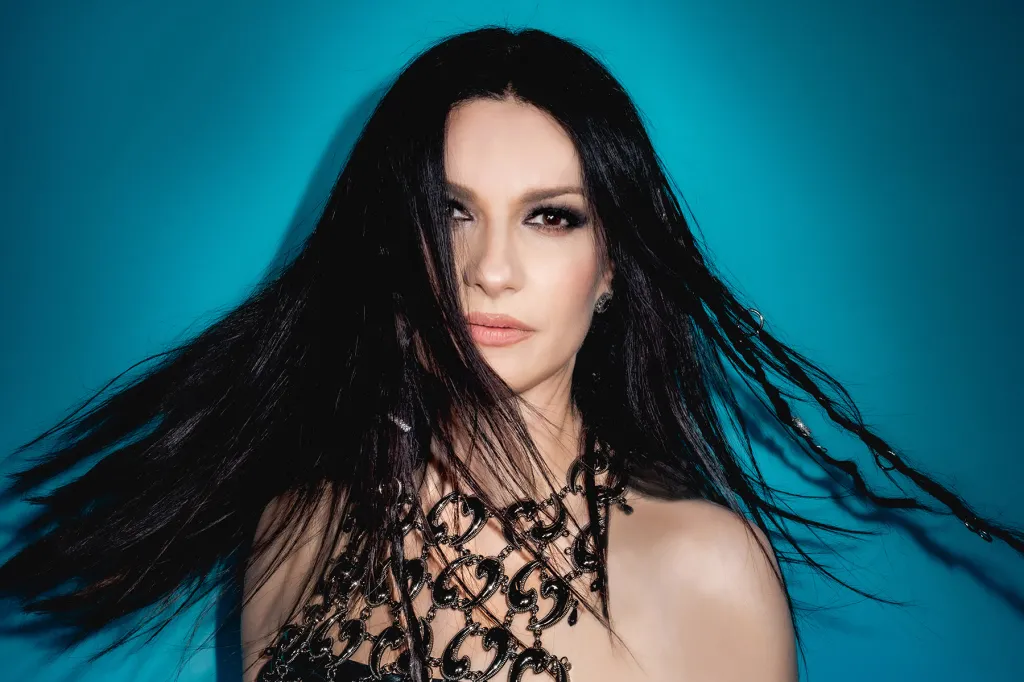
The van pulls up to my hotel, and to my surprise, Laura Pausini is waving from the passenger window, welcoming me to Rome.
I flew all night from New York to interview Pausini about her new album. The original plan was to meet at the Roman Forum, but Italy’s prima diva has come to pick me up herself.
She asks how my flight was, and I tell her that I rewatched Laura Pausini: Pleasure to Meet You — Ivan Cotroneo’s 2022 documentary, which portrays her life in Italy — on the plane. Seeing Pausini in her element is completely different from seeing her in any of the many other countries where she is extremely popular. Over the years, I’ve interviewed her or met her in New York, Miami, Las Vegas, and Seville, Spain; at the lattermost, she was honored as the Latin Recording Academy’s Person of the Year in 2023. But here, in her adopted city of Rome, she radiates a particular pride and brilliance.
“This church that you see here is very important,” she makes sure to tell me as we pass by the Basilica of Santa Maria Maggiore, pointing out that Pope Francis was buried there last April in an event that broke with the centuries-old tradition of burying popes in the Vatican.
Upon reaching the Colosseum, she points out the imposing facade of the nearly 2,000-year-old amphitheater — where she sang in 2020, at a charity event during the coronavirus pandemic — continuing in her role as “tour guide.” Some locals recognize her on this Monday morning in February: “Laura, bellissima!” one exclaims upon seeing her. With her large dark glasses, she can easily go unnoticed. If this was the summer, with the influx of tourists from Spain and Latin America, it would be much more difficult.
These are busy days for Pausini, who from early in her career has sung in both her native language and Spanish, with equal success in both. In the last few weeks, she released Io Canto 2, a collection of covers of Italian pop classics, through Warner Music Italy; performed the Italian national anthem at the opening ceremony of the Winter Olympic Games in Milano Cortina; and at the end of February, she will return to Sanremo, the song festival she won in 1993 and which catapulted her to fame, as co-host.
Pausini will cap off this breathless stretch with the March 13 release of Yo Canto 2, the Spanish-language album of her dual covers project, featuring classics from the pop songbooks of Latin America and Spain. As a tribute to the countries in the region that have welcomed her, and the artists who have inspired her, the 18-song set (plus three more in the deluxe edition) includes tracks as iconic as “Bachata Rosa” by Juan Luis Guerra, “Livin’ La Vida Loca” by Ricky Martin, “Oye Mi Canto” by Gloria Estefan and “Antología” by Shakira.
“For me, it’s a privilege that such an admired and beloved artist as Laura Pausini recorded ‘Bachata Rosa.’ Her voice is beautiful and unique, and she has the gift of imbuing everything she sings with a special sensitivity,” Guerra tells Billboard.


Fabrizio Cestari
The album also includes the previously released singles “Turista” by Bad Bunny, “Mi Historia Entre Tus Dedos” by Gianluca Grignani, and “Eso y Más” by Joan Sebastian, in a duet with Yami Safdie. “Laura is not only one of the best performers in history, but also a generous, sweet and fun woman. Working with her was one of the greatest gifts music has given me,” says Safdie, the young, up-and-coming singer-songwriter from Argentina, adding that she used to listen to Pausini with her mother as a child.
This afternoon, Pausini will be filming the music video for her take on Fito Páez’s “Mariposa Tecknicolor.” She’s also preparing for the Yo Canto World Tour 2026-2027, which kicks off on March 27 in Pamplona, Spain.
With nearly 80 million records sold and 6.5 billion streams globally in her more than 30-year career, according to Warner Music, Pausini is the most universal Italian voice and an undisputed icon of global pop.
“I love working with great singers, and Laura Pausini is one of the best in the world,” says award-winning American songwriter Diane Warren, with whom she shared the Golden Globe and Academy Award nomination in 2021 for best original song for “Io Sì” (“Seen”). “When I wrote ‘Seen’ for the movie The Life Ahead, I thought there was no better artist to write the Italian lyrics and perform it. Performing the song with Laura at the Oscars will always be one of my favorite experiences ever.”
One might think that after so many achievements — also including four Latin Grammys, a Grammy, and the Icon Award at the 2025 Billboard Latin Music Awards, among others — she would feel ready to take a break. But she remains more relevant than ever, with an ambition she confesses she didn’t feel in the early years of her career.
“Laura Pausini has not only built an extraordinary career; she has forged an authentic and lasting connection with audiences around the world,” says Brenda Carrasco, senior vp, marketing & artist strategy at Warner Music. “Her voice is unmistakable, but it is her artistic honesty, her consistency, and her profound emotional connection that truly set her apart.”
Sitting in the Cine3 studio outside of Rome, Pausini discusses her new album and upcoming tour; her relationship with fame, motherhood and her family; and the song that has most impacted her life. (Editor’s note: Answers have been edited for brevity and clarity.)
Fabrizio Cestari
Yo Canto 2 includes collaborations with multigenerational artists, from newcomer Yami Safdie to a veteran like Ricardo Montaner. How did you choose your guests?
I was very interested in seeing the perspective, especially of a young female artist like Yami Safdie, on a song that isn’t from her region. The song we sing together is “Eso y Más” by Joan Sebastian, so it’s Mexican. It’s beautiful for me that we’re three (nationalities), because Yami is Argentinian, Laura is Italian and the original Joan Sebastian, who has left us not only that song, but a whole host of wonderful songs, (is Mexican).
Something different happened with Ricardo. The song I sing by Ricardo Montaner (“Cuando Nacen Amores”) is a song I’ve known since I was a child, because the original version (“Quando Nasce Un Amore”) was Italian, by a singer who is my idol, Anna Oxa. When I traveled to Venezuela for the first time, I heard this song on the radio and I said, “But in Spanish, sung by a man?” And the driver told me, “Yes, of course, that’s a very important song by Ricardo Montaner.” And from then on, I started buying his music, getting to know his voice. He’s fantastic.
You also recorded Bad Bunny’s “Turista.” What did he say when he heard it?
He sent me a wonderful message. He said he never expected me to sing one of his songs, that he loved it. And the words he used are very typical of Benito, because Benito is very sensitive, very gentle, and he also uses very affectionate language when you speak to him, but never fake. I think he’s the kind of person who, if he doesn’t like something, won’t say anything, but if he wants to show you affection, he will. He’s also a little shy, isn’t he? When he speaks to you, he looks you in the eye, at least he always did with me. But he tells you what he feels, and it’s very sweet.
It caught my attention that there are two Gloria Estefan songs, “Oye Mi Canto” and “Hoy.” She’s the only artist who appears twice on the tracklist.
Yes, although “Hoy,” which represents Peru on this album, was actually written by Gian Marco. Everyone knows it from Gloria’s version, but the song is a very personal dedication from Gian Marco to his country, to Lima, when he had to leave it.
When I was in the hospital about to give birth to my daughter Paola, I prepared a playlist to accompany us during her arrival, and the second song was “Hoy,” in Gloria’s version. She was born at that exact moment. February 8 was Paula’s 13th birthday, and I posted a story on social media with Gloria’s version, but with the certainty of paying tribute not only to Gloria, but also to Gian Marco, who were with me during this very special time in my life.

Billboard‘s Sigal Ratner-Arias (left) with Laura Pausini on Feb. 9 in Rome.
Nicolas Loretucci
What can you tell us about the Yo Canto World Tour?
It’s a very new tour for me, because normally I record the album in Italian and the Spanish version is identical, but sung in Spanish. In this case, the Italian album is dedicated to songs by Italian artists and the Spanish album to Spanish (and Latin American) singer-songwriters. That means that when I’m in Spain and North, Central, and South America, I’ll have a different repertoire than what I’ll sing in France, Germany, or Italy.
We’ve already rehearsed and had a lot of fun, because some of the songs we’re singing for Yo Canto 2 are actually Latin American and Spanish classics, and the lyrics and the beat of all the songs aren’t Italian; it’s different from our style. So for us, it was a lot of fun, but also challenging. It made us study, and put our hearts into it.
You’ll also be returning to Sanremo in a few days as a host. How does it feel to be going back?
It’s strange that I said yes to that offer, because they’ve been asking me every year for 15 years and I’ve always said no. I think it’s partly due to the passage of time and the confidence a woman gains as she grows. Also, the person who was the artistic director of Sanremo in 1993 when I won, the person who chose the singers to compete that year — his name is Pippo Baudo and he was also the host — passed away a few months ago, in 2025. And before he went to heaven, I called him to tell him that they had asked me to host Sanremo, and he said to me, “Why are you still hesitating? You’re ready.” I feel protected by those words.
But they adore you there, Laura. Sanremo is your home.
Yes, but Italy is a very demanding country. Besides, I understand. In my case, there’s no other woman who’s had my experience. And so the audience is also experiencing for the first time certain emotions or situations where, you know, you win something and then they want more, always more. The Italian public demands that I always do better, and I feel that pressure a lot… I feel freer when I’m away from home.
Fabrizio Cestari
Many people know you from Sanremo, but you were just a child when you started singing in a piano bar with your dad. What do you remember from that time, and how did it prepare you for what came later?
I’m absolutely certain that the musical dynamics I know, vocally, even now, come from there, from the piano bar. I started when I was eight, and I didn’t know much back then. I just watched my father, who’s a singer, keyboardist, and bassist in a piano bar, and I copied him. I learned what it meant to arrive in the afternoon, set up the instruments. I did my homework with the restaurant’s waiters, and then people would arrive, and I’d stand there with my father and another musician who was with us.
I started singing in English at 12 and in Spanish at 14. My father would translate for me to explain what a song meant. The first one he translated was “We Are the World.” That’s when I understood that songs are written to say something, and it has helped me so much. When I’m on stage, I’m not afraid, and I think it’s because of the piano bar.
I imagine this also instilled a lot of discipline in you as a child.
It still does, because I don’t know if you know, but my father has always traveled with me. When I won the Sanremo Festival, I did my first tour in ’93. And he’ll go on this new tour with me too, even though he’s 80 now. I remember he gave me rules, of course, but I didn’t have one of those fathers who pressures you, who forces you. No.
Besides, my father is very amusing; he used to tell me stories. Even though our trips weren’t long, he’d spend that hour telling me about his life and asking about me, what was happening in my life. And I’ve never been afraid to tell my father anything. I told him about the first time I kissed someone, the first time I made love. I’ve told my father everything. It’s beautiful.
Speaking of family, I know it took you a while to become a mother, and it was something you really wanted. How has motherhood changed you? Has it made you more sensitive in any way?
Only in one way. Sometimes, during the first five years of my daughter’s life, I didn’t want to sing certain kinds of songs because I felt — I don’t want to say dirty, because that’s not the right word — but I wanted to be more saintly than ever. I felt she didn’t deserve a daring mother. After that, I think every woman changes depending on the child she has in her life, because my daughter lets me do the things I do, and I feel completely free with her to be myself. She has a personality that allows me to be who I am.
Fabrizio Cestari
And your daughter has two musicians as parents. (Pausini is married to guitarist and producer Paolo Carta.) Do you think she’ll follow in your footsteps? What advice would you give her?
She might because she plays bass, guitar and piano, and she sings well. She sings very differently from me, and that’s a bit of a relief, because I could never bear it if someone compared her voice to mine. On the other hand, I’ve let her choose what she wants to do, but she knows — because we’ve been talking about it for years — that in our country, in Italy, being the child of a famous person isn’t very easy.
I think that’s true anywhere…
But in the rest of the world, there are children of celebrities who have had respectful careers. Here in Italy, I don’t know anyone and many of them have suffered that, and I obviously don’t want my daughter to suffer. So, I told her this: “You’ll do what you want, but I hope you don’t want to be famous, because it’s a very complicated job.”
What are the three songs that you feel marked, or were extremely important, in your Spanish-language career?
“En Cambio No,” “Víveme,” and I’m a little undecided between “Se Fue” and “Amores Extraños.”
Which of those could you never stop singing?
“En Cambio No.” It’s my favorite song in my repertoire. We wrote it when my grandmother passed away. She waited for me to say goodbye, and that was a unique experience. Anyone who can do that is fortunate. I was in Milan when my mother called to tell me the doctors had said she would be going to heaven that very day. So I got in the car and drove to the hospital in Faenza, the city where I was born. Her eyes were closed, she wasn’t speaking, she was just breathing. I held her hands, and she opened her eyes and said my name. Then she took one last breath and died. It was shocking, but my immediate reaction wasn’t to scream and cry. I dressed her, washed her and we decided how to have the funeral.
Afterward, on my way back to Milan, I cried a lot. When I got home, I thought about how many people are afraid to tell their relatives who they are and then they regret it. I told her everything, but in the days leading up to our final farewell, many in my family cried because they hadn’t. “En Cambio No” is about that. It is dedicated to those who perhaps need someone to tell them: “Don’t be afraid.” Or: “I love you. Don’t worry, I’ll be here.”
What an important and beautiful message. Thank you for reminding us. What does Laura Pausini still have to do professionally?
I don’t know, but while a few years ago that was a question that terrified me, making me think about retiring, today that question is what keeps me going — and the answer “I don’t know” means that something will come. I don’t know what it will be yet, but it will.
