


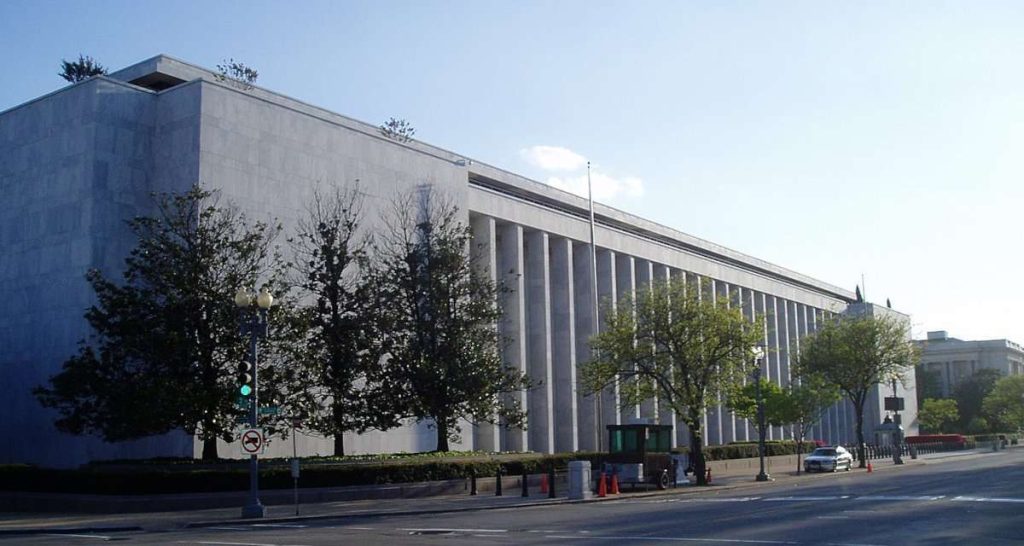


Washington, D.C.’s James Madison Memorial Building, which houses the U.S. Copyright Office. Photo Credit: UpstateNYer
It’s high time the Copyright Royalty Board (CRB) judges approved the proposed Phonorecords V settlement – at least according to the major labels, the NMPA, and the other signatories, which are defending the “reasonable” deal in response to questions centering on different participants’ objections.
Besides the majors and the National Music Publishers’ Association (NMPA), the proposed Phono V settlement has the support of the Nashville Songwriters Association International (NSAI), the Music Artists Coalition, and the American Association of Independent Music (A2IM).
And in those parties’ own words, the proposal (which, if given the green light, would set stateside mechanical rates for permanent downloads, physical formats, and ringtones between 2028 and 2032) would leave the existing Phono IV rates in place “except for continuing inflation adjustments.”
But Word Collections, Eight Mile Style, George Johnson, the Songwriters Guild of America, and even professionals including Stevie Wonder have been pushing back against the terms throughout 2026.
Just to recap – see the above hyperlinked articles for our exclusive coverage of the process’s multiple twists and turns – the objectors have called out the proposed calculations’ alleged omission of key inflation data, the alleged conflict of interest stemming from overlapping label-publisher ownership, and, more broadly, the “unreasonable” rates themselves.
Then, the CRB last month ordered the settling entities to provide “additional information” in the form of responses to questions concerning “missing inflation data,” the aforesaid ownership overlap, whether the objectors were actually afforded a seat at the negotiating table, and more.
And it’s these newly submitted responses – one spanning seven pages and filed by the NMPA, the NSAI, and the Music Artists Coalition; the other running 21 pages and attributable to the majors and A2IM – that delivered the initially mentioned defense of the terms in question.
Unsurprisingly, the in-depth documents touch on many of the same points. Perhaps most significantly, the relevant parties dedicated a substantial amount of ink to attempting to refute the idea that Phono V’s 2028 physical rate will revert from 13.1 cents per work at present to 12 cents (i.e., Phono IV’s opening-year rate).
“To be abundantly clear: this does not mean the rate for 2028 will be 12 cents. It means that the rate for 2028 (or any given year during the Phonorecords V rate period) will be the sum of 12 cents plus the cumulative percentage increase in inflation since November 2022,” the NMPA and others wrote.
“To be clear, the proposed rates for 2028–2032 pick up where the 2023–2027 rates leave off by continuing the annual cost-of-living adjustments already in place according to the formula already in place,” echoed the majors and A2IM.
“Applying the changes in the consumer price index projected by the Congressional Budget Office,” they estimated, “the 13.1-cent rate for 2026 can be expected to increase to about 13.4 cents in 2027 (assuming an increase of 2.4% in CPI) and to about 13.7 cents in 2028 (assuming an increase of 2.3% in CPI) and will continue to be subject to annual cost-of-living adjustments in each subsequent year through 2032. In other words, the 2028 rate is in fact currently projected to be about 13.7 cents.”
What about the idea that all those adjustments omitted CPI data from the highly inflationary 2021-22 stretch, thereby failing to account for actual cost-of-living shifts in their entirety?
Well, addressing this and adjacent topics in more words, the settling parties framed the Phono V proposal as legally bound to the approved Phono IV terms – with the inflation-omission argument therefore allegedly representing “an inappropriate collateral attack on the result of the last proceeding.”
“The 12-cent per work rate agreed to for 2023 in Phonorecords IV was regarded as a reasonable increase to the existing 9.1-cent per-work rate… Importantly, in Phonorecords IV, some songwriters and songwriter groups raised contemporaneous arguments about the omission of CPI-U adjustments for 2021 and 2022, yet the Judges found 12 cents to be a reasonable per-work rate for 2023 and adopted the proposed statutory royalty rates and terms,” the majors and A2IM retorted.
“This settlement does not address CPI-U increases in 2021 and 2022 because it continues, without modification, the structure adopted in Phonorecords IV, in which that question was presented to and resolved by the Judges,” penned the NMPA, the NSAI, and the Music Artists Coalition.
Shifting to ringtones – the proposed settlement would keep this long-frozen rate at 24 cents – the majors and A2IM downplayed the “ringtone mechanical royalty revenue” as “de minimis,” underscored the category’s long-declining sales volume, and criticized a rate hike as “infeasible and dangerous to the already-declining ringtone market.”
Eight Mile’s floated “38.7-cent rate would leave little remaining for other stakeholders who also need to receive a portion of the sale price of ringtones if they are going to sell ringtones,” they claimed.
Time will tell how this and other positions play before the CRB; to reiterate the obvious, different recorded-revenue categories have skyrocketed during the identical window. And one could make the case that “need” and “dangerous” are contradictory as used owing to the depiction of the broader ringtones category as trifling in the bigger picture.
Similarly, the CRB may take issue with the contention that there’s “very little overlap in ownership between the” label and publisher/songwriter participants.
“The common ownership of the three major music publishers existed at the time of every Phonorecords proceeding (and earlier proceedings, when rates were set by other tribunals); yet many of those proceedings did not settle,” the NMPA added.
More pressingly, the settling parties don’t appear eager to voluntarily provide the judges with documents that “demonstrate the settlement reflects an arm’s-length negotiation between willing sellers (licensors) and willing buyers (licensees).”
“The Record Company Participants decline to provide any such documents because Section 801(b)(7) requires the Judges to evaluate the Settlement ‘based on the record before them, if one exists.’ This language expressly permits the Judges to adopt the Settlement in the absence of any record,” the relevant participants spelled out, proceeding to also stress the purported presence of an NDA.
As for where the process goes from here, the Phono V rate-setting battle is heating up on the all-important streaming side as well, the appropriate docket shows. Additionally, the CRB last week handed down a revised case schedule that, in a nutshell, will move things along a bit faster than the schedule proposed by the participants themselves.
Now, the main hearing is expected to kick off on March 22nd, with an initial Phono V determination due (following subsequent steps including closing arguments) sometime before December 17th, according to the schedule.
Interestingly, the proposed schedule mentioned a “virtual hearing,” whereas the CRB in its revised timetable dropped the “virtual” descriptor and pointed only to a hearing.