


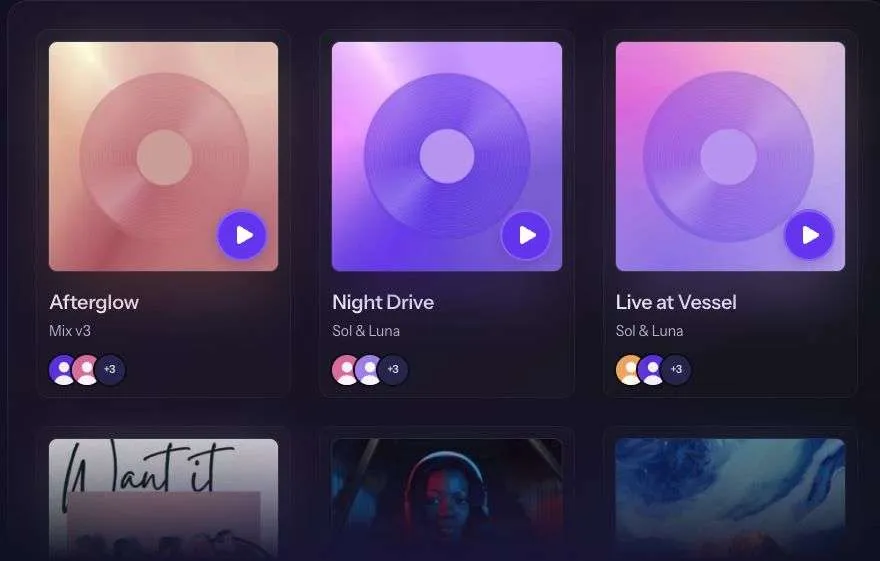
From mix revisions and high-quality playback to file sharing, credits, and final delivery, Flowthru brings the essential work surrounding a recording into one connected environment.
The following comes from Flowthru (fka Sound Credit), a partner of DMN.
The music industry has become increasingly sophisticated at creating recordings, but the systems for managing everything around them have become increasingly fragmented.
You can spend weeks getting a recording right, down to the smallest detail, and then lose half a day trying to figure out which version somebody is talking about.
In addition to building software, I’ve also been a producer and mastering engineer for much of my career, and one thing that has always struck me about the music business is the enormous care we put into the sound of a record, compared with how casually we sometimes handle everything around it.
Let’s walk through a typical process after you record, where the process typically falls apart.
1) You upload it to a storage/file transfer platform that compresses the file.
2) You share a link for collaborators to listen to, but they can’t hear the mix you made or see all the versions.
3) You get texts and emails from different people asking for different levels to be modified in different places.
4) You piece together all of the feedback and do it again and again until you think it’s right.
5) When it’s time to deliver the master, you realize you forgot to get the metadata that your label needs to release it.
6) You piece together split sheets, collaborators’ info, split sheets, mastering metadata, registrations, DDEX, AllMusic, lyrics, ISNI number, and social media assets, and hope it’s all correct.
Sound familiar?? It’s this baffling situation where we spend an enormous amount of time getting every detail of a recording right, only to rely on poorly named files and disconnected conversations to carry it through the rest of the process.
That’s a big part of why we originally built Sound Credit and why Flowthru has become part of the workflow for music professionals at every level, from GRAMMY-winning producer and engineer Boo Mitchell, who’s worked with Bruno Mars and Mark Ronson, to songwriter and vocal producer Makeba Riddick, who’s worked with Beyoncé and Rihanna.
But these aren’t challenges exclusive to major recording artists. Independent producers and studio owners deal with the same problems every day, often without the teams or resources available on major-label projects.
One recent conversation has been particularly useful in clarifying how Flowthru’s features fit together. We spoke with Matt Richens, a producer and engineer who runs Fox Den Studios in Sheffield, England. Matt uses Flowthru as his main listening and file-sharing space for projects he’s directing, and his experience illustrates something important about why we’re building this.
His experience illustrates something important: The value isn’t necessarily in any one feature, it’s in reducing the amount of work people have to do between the parts of making music.
Here are a few major takeaways from the conversation with Matt that I believe are relevant to anyone working in recorded music:
The mix doesn’t stop being a collaboration when the artist goes home
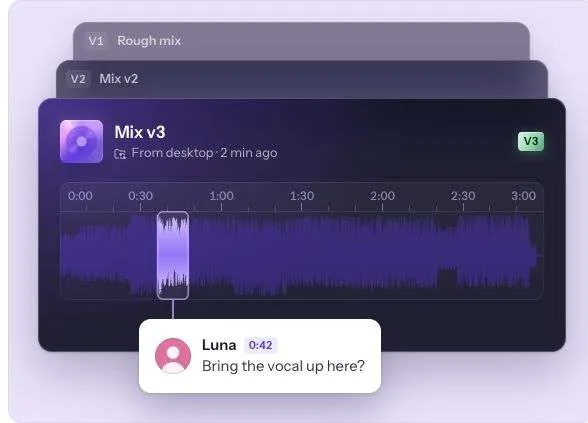

The mixing process was an obvious place to start for us because it’s where so much creative communication happens outside the room.
When an artist listens to a mix, decides the vocal needs a little more space, or hears something in the second verse that isn’t quite right, the producer needs to know two things right away:
1) which version they’re referring to
2) where the change belongs
When that feedback arrives as a collection of messages, even a simple revision can require a surprising amount of detective work.
Matt had been sharing material through Google Drive before moving to Flowthru. He described the limitation pretty simply: “Google Drive just isn’t built for what I’m trying to do.”
He wanted comments and versions to be easier to manage, but he also wanted the experience to feel like it belonged to music. As his work moved from part-time to full-time, so did the admin that went along with it. He had even discussed having a custom sharing system built before finding Flowthru.
On one recent project, a band made extensive use of comments while reviewing its mix, and Matt estimated that he got through the mix on ONE set of revisions where he might normally have expected THREE or FOUR.
Obviously, that’s one producer’s estimate for one project, not a measured reduction that everybody can expect, but still, it shows what we’re trying to make possible.
It’s interesting because Makeba Riddick (Beyoncé, Rihanna), who works as a songwriter and vocal producer, describes the platform in a way that gets at this same problem.
While Matt is approaching it from the production side, Makeba is thinking about the songwriting and vocal production process, and yet they both describe the platform in a way that gets at this same problem. She told us that it “helps her manage all the collaborative variables that get us to a completed song.”
Different responsibilities, but they’re both trying to keep the creative conversation moving without having to constantly reconstruct what’s happening with the music, and Flowthru gives them a versatile place to listen to the recording and leave comments on the music itself. Each version can be kept within the project, so the conversation has some context, and instead of trying to match a text message to a file somebody renamed after downloading it, the producer can return to the recording under review and work from there.
Listening to unfinished music should still feel like listening to music
One of the strangest things about modern music production is how much attention we give to playback quality after a record is released, but while the music is being created, the listening experience often is treated like an afterthought.
As a producer and mastering engineer, I find that disconnect remarkable.
When an artist is evaluating a vocal balance or an EQ decision, shouldn’t they be hearing the recording as intended?? To me, that means more than delivering a high-resolution file, it also means making sure they can easily access the music and understand which version they’re listening to.
Matt noticed that difference with his artists. He told our team that people who had worked with him before and after he switched to Flowthru responded to the experience, especially the feeling that they were opening something closer to a music streaming platform.
Boo Mitchell (Bruno Mars, Mark Ronson) also talked about his own experience with Flowthru, calling out the lossless listening experience, the ability to bounce directly from his DAW, loop sections of a recording, and keep different versions together.
In his words, “It just makes you a better producer and engineer.”
There’s also the constant question of access. When Matt is discussing a new project with an artist, now he shows them Flowthru and explains where their files will live, how he can invite them into the listening process before the first mix is ready, how they can comment directly on a
high-quality, lossless audio file, rather than introducing a new system in the middle of a disagreement about revisions.
I think the presentation is part of the service a producer provides. Someone can do beautiful work in the studio, but the artist still has to experience that work once you send it out into the world.
Flowthru is designed to make the whole experience feel more like listening to music and less like opening an office attachment.
The people behind a record need to be able to keep making them
There’s another practical side of keeping a studio running, though, and it’s one of Matt’s favorite parts of Flowthru: download permissions.
The platform lets him share music for listening while controlling whether the recipient can download the files. For studio sessions, Matt generally makes the day’s recordings downloadable once the session invoice is paid. When he’s mixing, he leaves downloads disabled while the artist reviews the work. Once the final mix is approved and the mixing invoice is settled, he turns downloads on.
It’s a small, simple control with a meaningful consequence. The client can continue listening and giving feedback without Matt having to hand over the finished deliverable before the business side is taken care of. Flowthru isn’t collecting the invoice for him; it gives him a way to manage access in line with the agreement he’s made with the artist.
Antonio Dixon, a producer and songwriter whose credits include Beyoncé, Ariana Grande, and Toni Braxton, talks about the broader side of the platform. What he appreciates is being able to access his music wherever he happens to be, with a place to share it, make comments, handle registration, and keep it protected.
He’s describing more of the work surrounding a song than Matt’s day-to-day mix-review process, but that’s precisely why we wanted to bring these capabilities together. The file you’re sharing today is eventually going to need accurate information for the people preparing it for release.
Growing up in Memphis, I knew music creators who were incredibly good at what they did and still had to work very hard to sustain a career. That’s why I don’t separate the practical business of a recording from the care that goes into making it, and while keeping track of contributors matters, so does giving the people doing the work a reasonable way to protect its value.
Flowthru didn’t begin as a mix-review product, we began with Sound Credit because I was concerned about how easily a recording could become separated from the information about the people who made it.
We built tools for documenting credits and working with songwriting splits because those details often have to be reconstructed long after a session is over. So we thought that getting information into a project while people are still involved is a much more sensible starting point than trying to track everybody down later.
A better default for the work around the music
The reason we’ve expanded from Sound Credit into Flowthru is that these jobs aren’t as separate as the software industry sometimes makes them look:
– The mix that gets reviewed is the same recording that has contributors to document
– The music an artist needs to access eventually ends up being the set of files a producer has to deliver.
– The recording that begins as a rough demo eventually becomes a finished master, passing between music creators and engineers along the way, each needing access to the right version and the information surrounding it.
If every step requires someone to rebuild the context from scratch, we’re asking people to spend their working lives administering things that ought to remain connected.
Flowthru brings every step closer together: listening, feedback, version organization, project access, credit and split tools, and download control.
I don’t want music creators to become better administrators, I want the technology to take the burden of admin off their shoulders.
Less chasing files. Less reconstructing conversations.
More time making records.
Seems like a reasonable thing to build software for, right? That’s the future we’re working toward with Flowthru.
