
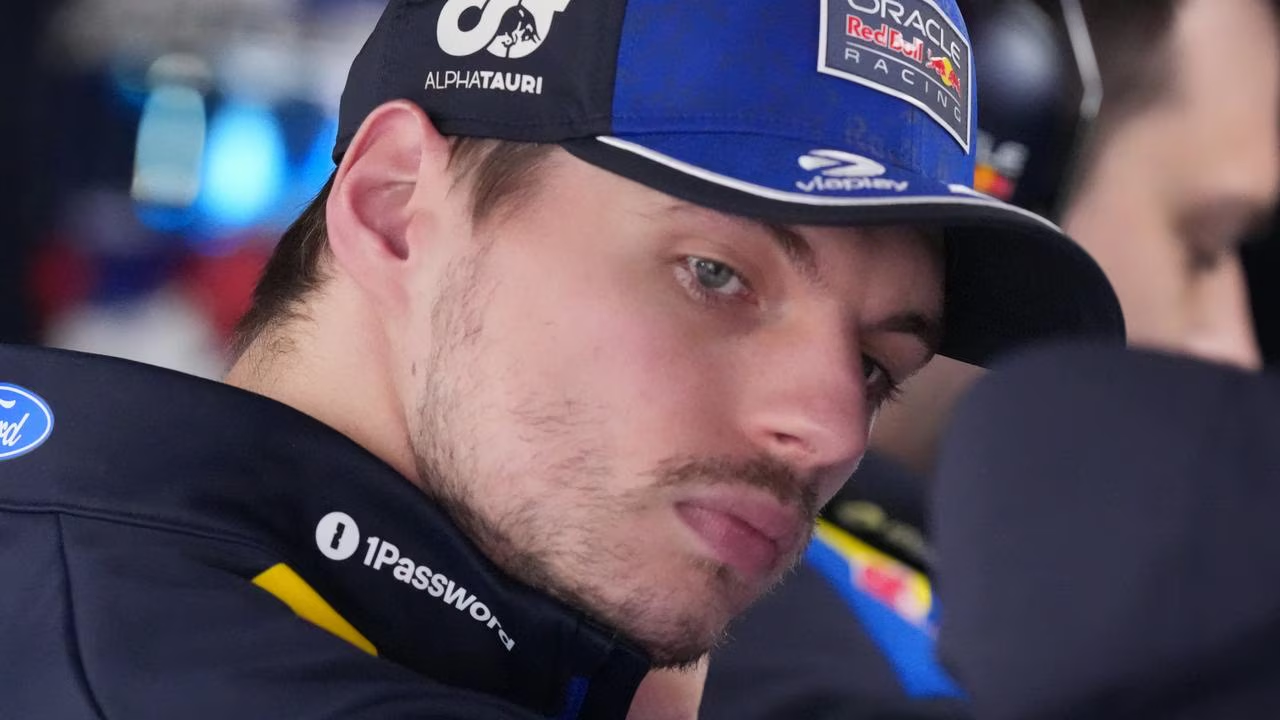
Max Verstappen’s future was always going to be part of the 2025 narrative, but no-one could have expected his arc to bend towards retirement.
But that’s where it’s currently heading.
After three listless rounds under these new rules, Verstappen, arguably the greatest of his generation, is prepared to walk away from the sport that made him a four-time world champion over his dislike of the 2026 engine.

Fox Sports, available on Kayo Sports, is the only place to watch every practice, qualifying session and race in the 2026 FIA Formula One World Championship™ LIVE in 4K. New to Kayo? Join now and get your first month for just $1.
“You just think about: is it worth it, or do I enjoy being more at home with my family (or) seeing my friends more when you’re not enjoying your sport?” he told the BBC.
“I try to adapt to it, but it’s not nice, the way you have to race. It’s really anti-driving. Then at one point it’s just not what I want to do.
“I’m committing 100 per cent, and I’m still trying, but the way that I am telling myself to give it 100 per cent I think is not very healthy at the moment because I am not enjoying what I’m doing.
“I’m trying. I keep telling myself every day to try and enjoy it. It’s just very hard.”
There could not be a more powerful indictment of the Formula 1 regulations as they come up for review in a crunch meeting next week.
There could not be a bigger risk to Red Bull Racing as it flails with an uncompetitive car in the midfield.
And there could not be a more abrupt conclusion to an era that could have stretched for a generation.
PIT TALK PODCAST: Andrea Kimi Antonelli beats Oscar Piastri to victory at the Japanese Grand Prix on a big day for the Italian and a steadying one for the Australian and his McLaren team, while Max Verstappen says he’s weighing up his future in Formula 1 over the sport’s controversial 2026 regulations.
WHAT DOES HIS CONTRACT SAY?
Verstappen’s contract has been the subject of intense scrutiny for years — really since he signed his big-bucks deal at the beginning of 2022.
The seven-year contract is extremely long by F1 standards. What were the odds he would make it to the end of it with unchanged terms?
Of course, like any contract, his has escape clauses baked into it. Reports over the years have shown them to be favourable for the Dutchman.
Last year he would have been able to quit the team had he been outside the top three in the standings around the middle of the year.
This year, presumably with the new regulations in mind, the terms are even better for him, with reports suggesting he can walk if he’s outside the top two.
Given Red Bull Racing’s parlous lack of competitiveness, that clause will surely be available to him by the mid-season break.
These clauses came to light in the context of a mooted move to Mercedes, something Toto Wolff has pursued with various levels of vigour over the last couple of seasons, once it became clear Red Bull Racing’s success cycle had peaked and was beginning to decline.
But today Verstappen isn’t complaining because he wants out of Red Bull Racing. He’s complaining because he wants out of Formula 1.
The formula is antithetical to his racing ideology. Verstappen wants things to be as simple as possible — for there to be as little interference as possible between his right foot and the rear axle.
He wants an accelerator that makes the car faster and a brake pedal that slows the car down. He wants to use his preternatural ability to get 10 tenths from the car. He doesn’t want to be thinking about battery charge.
In that light you can see why these new rules — which have totally neutered qualifying, which have changed the complexion of wheel-to-wheel racing and which have hindered his ability to intimidate other drivers on track — just don’t work for him.
It’s why so much rides on next week’s crunch meeting over the regulations.
It’s unclear, though, whether enough progress can be made to keep him.
Tweaks for this year are likely to be only minor, and if the qualifying problem can be solved, it’ll likely be at the expense of speed, with several seconds added to the average lap time through a big reduction in electrical power.
Big changes could be difficult even in the longer term, particularly given the premise of the power unit — the near 50-50 split between combustion and electrical power — is what attracted the likes of Audi in the first place and with so much money subsequently sunk into the motor.
Though there appears to be consensus that some fundamental elements need to be changed, how much more combustion power relative to the hybrid motor are the manufacturers willing to accept? That could be the defining question for Verstappen’s decision.
Supercars exploring wildcard for F1 star | 02:49
HAS RED BULL RACING CONTRIBUTED TO THE PROBLEM?
Verstappen insists the intensity of his criticism has nothing to do with Red Bull Racing’s lack of competitiveness. He’s realistic enough to know that championship windows aren’t infinite and that he can’t expect to remain at the top of the sport in perpetuity.
Nonetheless, Red Bull Racing’s 2026 decline is significant.
On average this season it’s the fourth fastest team. Excluding Australia, where the newness of the formula meant the gaps were much larger, and that average drops to fifth behind Alpine.
Average gap to fastest, rounds 2–3
1. Mercedes: 0.000 seconds
2. McLaren: 0.488 seconds
3. Ferrari: 0.583 seconds
4. Alpine: 1.133 seconds
5. Red Bull Racing: 1.341 seconds
6. Audi: 1.523 seconds
7. Haas: 1.604 seconds
8. Racing Bulls: 1.763 seconds
9. Williams: 2.473 seconds
10. Cadillac: 3.672 seconds
11. Aston Martin: 3.776 seconds
Even accounting for Red Bull building its engine for the first time — an engine, for what it’s worth, that at least looks in the competitive ballpark — that’s dire.
It stems back to decisions made almost a year ago, when the team was staring down another competitive crisis that eventually left Christian Horner vulnerable to being sacked.
Rather than abandoning the wayward car to focus on 2026, Red Bull Racing committed more development resources to discovering why last year’s model wasn’t delivering the expected results.
“There were all the reasons in the world … to say, ‘Well, you know what? Let’s turn the page. 2025 did not work; let’s concentrate on 2026’,” team principal Laurent Mekies told Beyond the Grid. “You would have been mad to want to do things differently.
“The truth is: nobody wanted to do that in Milton Keynes. Nobody wanted to turn the page. They all wanted to get to the bottom of that 2025 car, get to the bottom of what didn’t work to the level expected and turn things around.
“Yes, they knew there would be a price to pay for later, but that’s how deep the fighting spirit in the team is.”
Those efforts got Verstappen within two points of what would have been the greatest championship comeback in history.
But perhaps the team didn’t expect the price to be quite this steep.
“We thought and we still think it was the right thing to do because we felt that turning the page to 2026 would have been a little bit of an easy escape and wishful thinking that next year will be better, even though we didn’t fully understand what the limitation of 2025 were,” Mekies said. “We didn’t think it was the right way.
“Of course the time and energy we invested for the late push last year, does it have an impact on where you start 2026? Of course it does. Of course we pay a bit of a price today. Do we use it as an excuse? No.
“We are not happy with the starting point, but we think we will get through these difficulties.”
But with Verstappen having nothing to fight for on track, his dissatisfaction with the rules has been able to grow unchecked.
Bearman Japan crash sparks heated debate | 08:19
COULD HE BE CONVINCED TO STAY?
Would an improved car be enough for Verstappen to delay his exit? Despite the Dutchman’s protestations, Mekies thinks it’s his team’s best shot at retaining its superstar driver.
“We are not having the retirement talk with Max right now,” he said. “We are having the hardcore analysis of how to go faster with our car.
“He’s passionate about the sport and he wants to contribute to the sport and to make sure the sport lands in the right place, and hence he’s vocal about the tweak he thinks we need to do.
“Again, as a driver, to make sure that he can be flat out in qualifying and to make sure he can have the good racing. We are not having retirement discussions.
“You need to come to Milton Keynes to see, as we say, the fire behind every door. You will soon realise why I’m smiling right now — because we don’t think about the driver market in 2027.
“We think about getting a fast car, and if we get a fast car, there is no discussion about what Max is doing next year, and hence we are focused on that.”
This is more than just a belief for Mekies. It’s a necessity.
Imagine what Red Bull Racing would look like at the first round of the 2027 season if Verstappen were to leave and if the team were to continue on its current trajectory.
Its line-up would be Isack Hadjar and perhaps Arvid Lindblad who, on their current tallies, have a single podium between them and would be steering a car lapping around 1.3 seconds off the pace.
Hadjar clearly has considerable speed, and Red Bull is optimistic about Lindblad’s potential, but this isn’t the line-up of a Formula 1 powerhouse — not when Mercedes, McLaren, and Ferrari all comprise multiple grand prix winners and likely at least one champion apiece.
It would be — with all due respect to two potential but unproven stars — the most underwhelming line-up in Red Bull Racing’s race-winning history.
But losing Verstappen would be about more than losing just prestige.
“He’s not just a Formula 1 driver; he lives night and day for the sport,” Mekies said. “He completely understands the complex dynamics of a Formula 1 car and of a Formula 1 team.
“Having somebody like that that can support you driving the car development, especially through new regulations like the one we have today, is a huge advantage.
“He has this natural way to get people around him to understand what is important for him in the car and what is, according to him, the biggest lap time reservoir that is untapped around him.
“He has this natural way to drag everyone behind him and to get people to give 101 per cent.
“It’s something to be fast in the car; it’s something else to be outside of the car and to manage to get your team, your people, to give their very best in trying to understand and to solve the limitations that you have.”
Red Bull Racing wouldn’t be losing just a leader but its guiding star.
The blow would be immeasurable.
‘F*** our luck!’ – Russell CRACKS it | 00:30
WHAT HAPPENS NEXT?
Then there’s the intangible significance of Verstappen’s loss to Formula 1.
Despite failing to defend his championship last year, the Dutchman is still the benchmark in Formula 1.
In fact last year’s monumental comeback and fractional defeat only embellished his reputation for the quality of his performances, particularly in the second half of the season. Ironically Lando Norris, title winner by two points, enjoys comparatively little glow from his achievement.
There’s something injustice in the idea that Verstappen could leave the sport before having had the fight truly taken to him.
That’s not to be dismissive of either Norris or Oscar Piastri last season, but given both drivers and their McLaren teams at times appeared to be doing their best to hand Verstappen the title despite having enjoyed a comfortable car advantage for most of the year, neither did enough to truly dethrone him.
Given this year’s champion is almost certain to be crowned without having to go through Verstappen, the same scenario will present itself this year.
A driver doesn’t have to beat Verstappen regularly wheel to wheel to be a worthy champion. The only criterion is to accumulate more points than every other driver to win it.
But the sport’s championship narrative would be done a disservice if there wasn’t a real changing of the guard — if Verstappen wasn’t beaten by his successor just as he beat Hamilton in 2021, just as Hamilton beat Alonso before him, and just as Alonso beat Schumacher before him.
Formula 1 will recover from its contentious set of rules, but Verstappen walking out before his time is up would deal a kind of psychic damage to the story of the world championship that could take years to heal.
Perhaps, though, there’s an alternative way forward.
If the rules aren’t improved or if Red Bull Racing can’t get its act together, Verstappen will quit — that’s the trajectory he’s set for himself.
But what if the rules are markedly improved but Red Bull Racing remains off the pace?
“The Max-to-Mercedes thing for now is not on,” Mercedes boss Toto Wolff told Press Association. “The situation is completely transparent. We have clear contracts with both drivers.”
Wolff has generously given himself wriggle room by saying no move is afoot “for now”. It does not preclude such a move in the future.
There’s a hell of a lot of water to go under the bridge before even the possibility of a move to Mercedes might be back on the cards.
But three rounds ago we weren’t contemplating Verstappen retiring from Formula 1.
Maybe he decides his grand prix career isn’t over yet. Maybe he takes a sabbatical and returns once the rules mess is sorted out.
At only 28 years old and perhaps the greatest racing driver of his generation, every door is open to Verstappen. It’s up to him to choose which one suits him best.
Only he can decide the outcome to which his arc bends.









Leave a Reply