


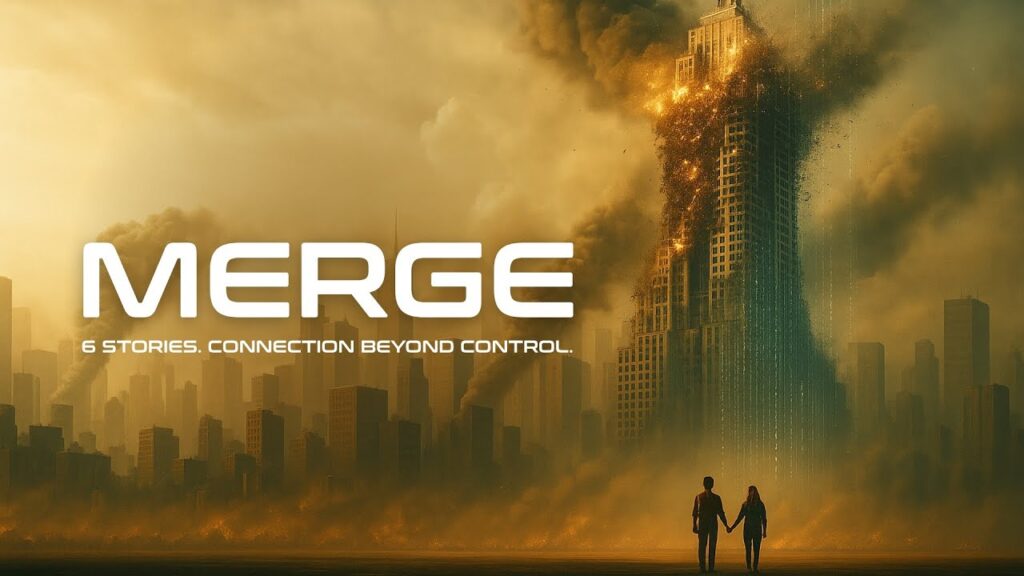
Merge (2025) by Béla Baptiste, Dalano Barnes & Richard Fenwick: Intimacy becomes software, and feeling turns into interface
Summary of the Movie: Technology doesn’t replace emotion—it rehearses it
This anthology frames the future not as a leap forward, but as a soft slide into emotional outsourcing, where machines don’t dominate humans so much as quietly stand in for them. Meaning outweighs plot here, as each segment circles the same unease: what happens when connection becomes easier than vulnerability.
Rather than one narrative spine, the film operates like a feed—discrete, scrollable, and thematically linked by repetition rather than progression. Its cumulative effect comes from pattern recognition, not resolution.
Movie plot: Fragmented futures, shared anxietiesEach short story explores a near-future scenario where technology mediates intimacy, from algorithmic romance to automated empathy, without ever tipping fully into spectacle. The plots remain deliberately thin, prioritizing mood and implication over causality, and asking viewers to sit with discomfort rather than follow momentum.
• Movie themes: Love without friction, grief without ritualThe core thematic engine is emotional convenience—how ease, speed, and customization reshape the way people attach, detach, and mourn. Across segments, the film suggests that removing friction from feeling doesn’t purify love, but flattens it into something safer and less alive.
• Movie trend: Anthology sci-fi as cultural diagnosisPositioned within the post–Black Mirror ecosystem, Merge reflects the current lifecycle of low-budget speculative anthologies that trade polish for provocation. It embraces unevenness as a feature, mirroring the fragmented way audiences now consume ideas about the future.
• Social trend: Emotional labor gets automatedThe stories echo a broader cultural shift where care, attention, and affirmation are increasingly delegated to systems and subscriptions. This reflects a world already comfortable with AI companionship, therapeutic apps, and algorithmic validation as substitutes for human presence.
• Movie director: Collective authorship over singular visionWith three directors sharing authorship, the film leans into plurality rather than coherence, reinforcing its thesis that the future will not arrive as one clean story. The lack of a dominant voice becomes part of the commentary, aligning form with content.
• Top casting: Faces over starsThe ensemble relies on unfamiliar or underexposed performers, allowing scenarios to read as plausible rather than performative. This casting choice keeps attention on ideas and emotional states instead of celebrity gravity.
• Awards and recognition: Marginal by designThe film’s modest festival and critical footprint reflects its position outside prestige sci-fi, operating instead in the liminal space of indie experimentation. Its visibility comes more from word-of-mouth curiosity than institutional endorsement.
• Release and availability: Quiet drop, instant accessReleased theatrically in limited form in late 2025, the film quickly found its primary audience through streaming platforms shortly after. Its availability favors at-home viewing, aligning with its episodic, pause-friendly structure.
• Why to watch movie: Six futures, one shared chillIt offers a compact, idea-forward viewing experience for audiences drawn to speculative concepts over narrative immersion.
• Key Success Factors: Concept density over narrative comfortThe film’s strength lies in how efficiently each segment delivers a single unsettling idea, trusting accumulation rather than escalation to create impact.
Insights: The future doesn’t scream—it gently checks in
Industry Insight: Merge underscores the viability of low-budget sci-fi anthologies as testbeds for cultural anxieties rather than commercial franchises. It shows how concept-driven formats can thrive without narrative cohesion when thematic clarity is strong.Consumer Insight: Audiences increasingly accept fragmentation as a storytelling mode, especially when it mirrors their own mediated emotional lives. Recognition matters more than satisfaction.Brand Insight: Projects that lean into discomfort and incompleteness can generate conversation disproportionate to scale. Minimal resolution invites longer engagement.
The film doesn’t ask for belief in its futures—only recognition. Its endurance lies in how familiar its discomfort already feels. And its consequence is subtle: once seen, everyday technology starts to feel slightly more intimate, and slightly more suspicious.
Why It Is Trending: Fragmented futures mirror how culture now processes fear
The film arrives at a moment when audiences are less interested in grand technological apocalypse than in subtle emotional drift. Its resonance comes from recognition: these futures already feel half-lived through apps, platforms, and interfaces that promise care without closeness.
Rather than predicting what technology will become, Merge reflects how people already negotiate identity, intimacy, and loss through systems that quietly shape behavior. The trend is not novelty, but proximity.
• Concept → consequence: Speculation without spectacleBy stripping sci-fi of visual excess, the film reframes futurism as an emotional condition rather than a technical one, making its warnings feel immediate instead of abstract.
• Culture → visibility: Anxiety travels faster than optimismStories about emotional disconnection and algorithmic care circulate easily right now because they articulate a shared unease that rarely finds language in everyday conversation.
• Distribution → discovery: Streaming favors modular ideasAnthology formats benefit from platform viewing habits, where episodic, pause-friendly narratives align with fragmented attention and selective engagement.
• Timing → perception: AI intimacy hits cultural saturationReleased amid accelerating public debate around AI companions, creative tools, and emotional automation, the film feels less speculative and more diagnostic.
Insights: Futures stick when they already feel familiar
Industry Insight: The film demonstrates how timely thematic alignment can outweigh production scale in driving relevance. Cultural fit now matters more than polish.Consumer Insight: Viewers are drawn to stories that help them name unease rather than escape it. Emotional accuracy beats narrative comfort.Brand Insight: Projects that arrive “quietly right” can gain longevity through alignment with lived experience instead of marketing force.
Merge trends because it doesn’t shout about tomorrow—it listens to today. Its ideas travel easily because they are already circulating. And its relevance grows as technology continues to feel less like a tool and more like a relationship.
What Movie Trend Is Followed: Modular sci-fi turns the future into an emotional testing ground
Merge sits firmly inside a contemporary sci-fi movement that treats the future less as a destination and more as a pressure chamber. Instead of a single world to decode, it offers multiple micro-scenarios that test how identity bends under technological intimacy.
This trend favors emotional experiments over narrative immersion, asking how people adapt moment by moment rather than how systems collapse all at once. The result is sci-fi that feels closer to lived psychology than speculative architecture.
• Format lifecycle: Anthology as emotional samplerShort-form segments allow each idea to land quickly, prioritizing conceptual impact over narrative accumulation and reflecting how audiences now absorb meaning in bursts.
• Aesthetic logic: Minimal futures, maximum proximityThe restrained visual language keeps technology ordinary and domestic, reinforcing the idea that disruption doesn’t arrive loudly—it blends in.
• Psychological effect: Discomfort through recognitionEach story provokes unease by exaggerating behaviors already normalized, making viewers feel implicated rather than entertained.
• Genre inheritance: Post–Black Mirror intimacyThe film inherits the cautionary tone of earlier tech anthologies but strips away irony, replacing it with emotional flatness and quiet dread.
Insights: The future now arrives in fragments
Industry Insight: Sci-fi increasingly functions as a laboratory for emotional behavior rather than worldbuilding. Smaller ideas travel faster than big myths.Consumer Insight: Audiences respond to stories that feel diagnostic rather than predictive. Being seen matters more than being surprised.Brand Insight: Fragmented narratives mirror how people already experience technology—piecemeal, intimate, and psychologically invasive.
This trend positions Merge less as a warning and more as a mirror. Its power lies in showing how easily the future slips into the present. And its format acknowledges that modern fear rarely arrives as a single event—it accumulates quietly, one interaction at a time.
Trends 2026: Emotional proximity replaces technological spectacle
The dominant shift isn’t about smarter machines—it’s about closer ones. In 2026, sci-fi increasingly frames technology as something that sits inside emotional life rather than towering over it.
The future is no longer imagined as distant or overwhelming; it’s intimate, ambient, and quietly invasive.
Implications — Technology as emotional infrastructure
Stories like Merge suggest that technology’s real power lies in regulating connection, not capability. Love, grief, loneliness, and validation become the primary sites where systems exert influence.
Where it is visible (industry) — From worldbuilding to mood-building
Studios and indie creators alike are moving away from high-concept futurism toward emotionally legible scenarios. The emphasis shifts from “How does it work?” to “How does it feel to live with it?”
Related movie trends — The future gets personal
-
Soft dystopias: Futures that resemble the present with one emotional variable subtly altered.
-
Anthology logic: Modular storytelling that mirrors fragmented digital attention and identity.
-
Domestic sci-fi: Homes, relationships, and private spaces replace cities and institutions as the main battlegrounds.
Related consumer trends — Intimacy under pressure
-
Algorithmic closeness: Growing awareness that connection is increasingly mediated and shaped by unseen systems.
-
Emotional self-surveillance: People monitoring their own feelings as data points to optimize relationships.
-
Tech fatigue reframed: Not rejection of technology, but exhaustion with its emotional demands.
Trend Summary: The future arrives quietly
|
Sci-fi becomes emotionally diagnostic |
||
|
Relationships feel optimized, not organic |
||
|
Power operates through care, not force |
||
|
Small stories scale culturally |
||
|
Recognition outweighs novelty |
This trend signals a lasting recalibration of sci-fi’s role. The genre no longer warns from afar—it sits beside everyday life. And its most unsettling visions are the ones that already feel familiar.
Final Verdict: Sci-fi stops predicting the future and starts diagnosing the present
Merge doesn’t arrive with spectacle or prophecy; it arrives with recognition. Its power comes from how closely its imagined futures already resemble everyday emotional life.
Meaning — Technology as an emotional mirror
Rather than warning about machines becoming human, Merge reflects how humans already outsource feeling, validation, and intimacy to systems. Each segment frames technology not as a villain but as a quietly responsive presence that absorbs unmet emotional needs.
Relevance — A future that feels already lived in
The film lands in a moment where AI, algorithms, and platforms increasingly mediate connection. Its relevance comes from scale rather than shock: these stories feel plausible because they echo daily behaviors rather than speculative extremes.
Endurance — Anthology as a cultural format, not a workaround
While uneven by design, the anthology structure strengthens the film’s cultural shelf life. Fragmentation mirrors how people now experience identity, relationships, and technology—episodic, modular, and emotionally discontinuous.
Legacy — A minor film that signals a major shift
Merge may not define the genre, but it clearly points to where sci-fi is heading. Its legacy lies in normalizing intimacy-first futurism, where emotional realism outweighs narrative cohesion.
Insights: The future no longer needs scale to feel dangerous
Industry Insight: Sci-fi is increasingly valuable as a mood-based diagnostic tool rather than a blockbuster genre. Low-budget, concept-led films can now shape cultural conversations more effectively than high-concept spectacles.Consumer Insight: Audiences are drawn to futures that explain their feelings, not just their fears. Emotional recognition has become a stronger hook than technological novelty.Brand Insight: Stories that humanize systems create deeper resonance than those that demonize them. Brands operating in tech-adjacent spaces benefit from narratives that acknowledge emotional complexity rather than promise control.
Merge ultimately succeeds by staying small. It doesn’t demand belief—it invites recognition. And in doing so, it confirms a broader cultural truth: the most unsettling futures are the ones that already feel familiar.