


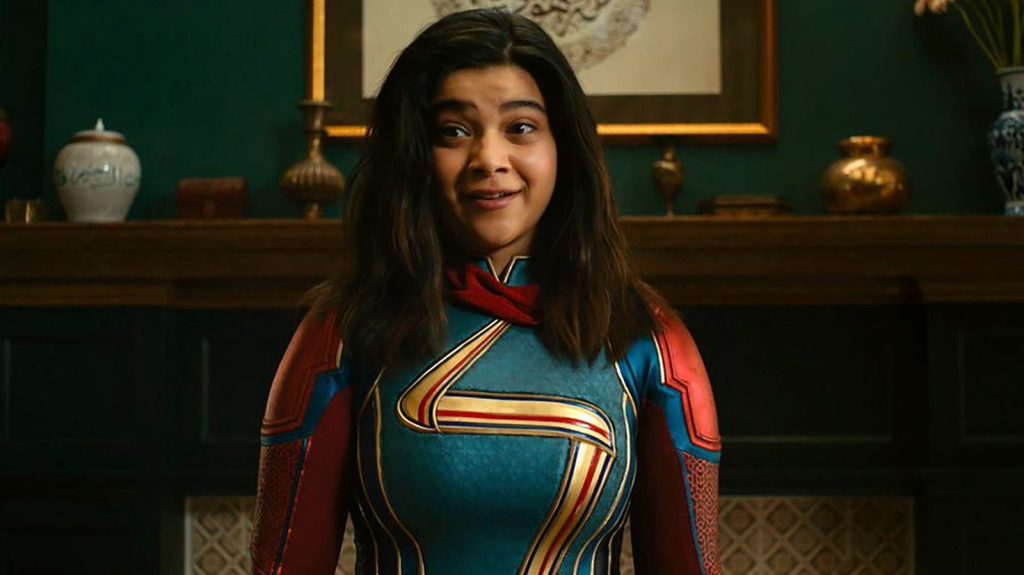

Whatever role Kamala Khan has to play in the Marvel Cinematic Universe, Marvel Studios needs to keep actress Iman Vellani on its payroll. A genuine comic book expert and enthusiast, Vellani is currently flexing her knowledge as co-host of Marvel’s “Countdown to Avengers: Doomsday” podcast, running through all 15 films on the official “Doomsday” prep list. On the “X-Men” episode covering the original 2000s “X-Men” film trilogy, Vellani got into her love for the source material of “X2” — Chris Claremont and Brent Anderson’s 1982 graphic novel, “X-Men: God Loves, Man Kills.”
“If I had to recommend a single ‘X-Men’ comic that kind of encapsulates, like, it’s the purest distillation of what these characters represent, it’s ‘God Loves, Man Kills,'” Vellani said, echoing common consensus among “X-Men” fans. The book’s villain is Reverend William Stryker, a televangelist who believes mutants are demonic. When Stryker’s “Purifiers” abduct Professor X in a plot for mutant genocide, the X-Men ally with Magneto against their common foe.
“Stryker’s speaking for God, but he’s preaching hatred and murder. It’s so dark and explores how a lot of people’s beliefs are often more dangerous than the people themselves,” said Vellani. (“X2” left out the comic’s religious themes and is a lesser story.)
Claremont wrote “X-Men” for 16 years and almost 200 issues. It’s a soap opera, and it’s so hard to pick a single story that stands out as ideal for new readers. Except for “God Loves, Man Kills,” which, as Claremont told Vox in 2017, was the entire idea: “If you never read an issue of (‘X-Men’) but wanted to know what the series, the concepts, the characters, the reality was all about — and to do so in a way that had, and sadly still has, relevance to the ‘real world’ — this was the story.”
X-Men: God Loves, Man Kills went where no Marvel comic had
To this day, “God Loves, Man Kills” is one of the few books in Marvel’s library that reaches true literary prestige, and which can compare to the great works of their rival publisher DC, like Frank Miller’s “The Dark Knight Returns” or Alan Moore and Dave Gibbons’ “Watchmen.” It runs over 60 pages, three times as long as a typical “X-Men” issue. The art is also moodier and more down to earth than other Chris Claremont-written “X-Men” comics; heavier shadows and no flat coloring reflects the less fantastical tone.
The comic also adds more texture to how humans hate and fear mutants. The opening scene is Stryker’s Purifiers gunning down two mutant children and stringing their bodies up. (Adding to the lynching imagery, both children are Black.) There’s no robotic Sentinels hunting mutants here, only hateful human beings. “Genocide in the name of God. A story as old as the race,” Magneto bitterly observes of the Purifiers.
The rest of the comic remains bracingly political. Claremont wrote “God Loves, Man Kills” in response to “the rise of the evangelical movement across the United States and their insertion into the political process” during the 1980s. Reverend Stryker would fit right in with the Moral Majority. (It’s worth noting that one of the evangelical movement’s casus belli in those days was opposition to school desegregation.) While “God Loves, Man Kills” remains a clear product of the 1980s, its themes are timeless; you would only have to change the allegory’s specifics to set it today. Perhaps in 2026, Stryker would propagate mutant hatred with social media and podcasts instead of television.
But while “God Loves, Man Kills” remains Claremont’s masterpiece to most, it’s not without controversy — for one scene in particular.
God Loves, Man Kills remains an essential X-Men story
Kitty Pryde gets in a brawl with a boy who calls her a “mutie lover” (unaware she is a mutant). Her Black friend Stevie Hunter tries to calm her, so an enraged Kitty asks Stevie if she’d be preaching tolerance if the slur had been the N-word instead of “mutie.” In the original printing, the slur was written in full, though modern printings censor it.
I’ve never forgotten reading that when I was about 13-years-old: a Marvel comic was allowed to print something like that? The shock value has a point to make; it’s easier to say “stick and stones” about bigotry if you’re not its target. It makes the racism against mutants feel real and harmful, yet it tests allegory’s limits: Mutants aren’t real, but anti-Black racism is.
Chris Claremont more elegantly tied mutants’ oppression to reality a year earlier in 1981 when, in “X-Men” #150, he revealed Magneto as a Holocaust survivor. (Claremont is Jewish himself.) “God Loves, Man Kills” comes off of that then-fresh reinvention and was pivotal in cementing Magneto as no longer a megalomaniac. Throughout the story, Magneto urges the X-Men to make their alliance permanent, but on his terms. When Kitty instead asks Magneto to join them, he refuses: “For all our sakes — mutant and human — I hope you (succeed). But should you fail, it will be my turn.”
Magneto and the X-Men both believe Stryker’s hatred will endure even with his defeat. Stryker’s claim that mutants are made in the Devil’s image also hits especially hard for Nightcrawler, who does look demonic despite being a practicing Catholic. Later works, including “X-Men: The Animated Series,” would explore that religious conflict inside Nightcrawler, pushing on the boundaries that “God Loves, Man Kills” tested first.