


A Faded Champion, a Shy Boy, and a Coastal Road Trip That Turns a Tennis Coach Into the Most Unexpectedly Honest Father Figure in Italian Cinema
Italy, late 1980s. Thirteen-year-old Felice Milella is a shy tennis prodigy suffocated by his father’s ambitions. Raul Gatti is the coach assigned to take him through the national junior circuit — a former champion who almost hit the real big time, now prowling the lower circuits, bedding tanned tennis ladies, and looking for whatever comes next. The road trip becomes a relationship. The relationship becomes the film’s most honest available subject: two losers who grow each other. The bipolar disorder Raul has never treated gives the comedy its most emotionally specific available shadow — the highs and lows arriving without warning, costing him everything each time, and still producing the most precise coaching instinct Felice has ever encountered. Written by Andrea Di Stefano and Ludovica Rampoldi. Cinematography by Matteo Cocco. Score by Bartosz Szpak. Produced by Indiana Production, Indigo Film, Vision Distribution. Venice out of competition world premiere August 31, 2025. Italian theatrical November 13, 2025 via Vision Distribution. ➡️ Letterboxd: “the story of two losers who grow each other — finally a film about two perdenti who find their way together” — the most commercially honest available single-sentence description of what the film is actually about.
Why It Is Trending: A Warmhearted Italian Road Movie Comedy That Earns Its Venice Selection Through the Most Rascally Available Favino Performance and a Young Actor’s Prize
Variety: “tennis has been having a centre-court moment at the movies, and My Tennis Maestro officially makes it a trend — Favino plays the type as though he invented it.” ➡️ The aged-out champion finding purpose in an unlikely mentorship is the most commercially durable available sports drama subject — and Favino gives it the most warmly rascally available human register. Screen Daily: “a pair of sparkling performances from Menichelli and Favino that play out as one long match-point rally — Italian comedies rarely fly well abroad, but this well-crafted charmer could prove an exception.” ➡️ The “exception to the rule” formulation is the film’s most commercially specific available international distribution argument — Favino’s profile and the Venice imprimatur giving it the most institutionally credible available export pathway.
Elements Driving the Trend: Favino’s Wolfish Grin, the Bipolar Coaching Genius, and the 1980s Coastal Authenticity
-
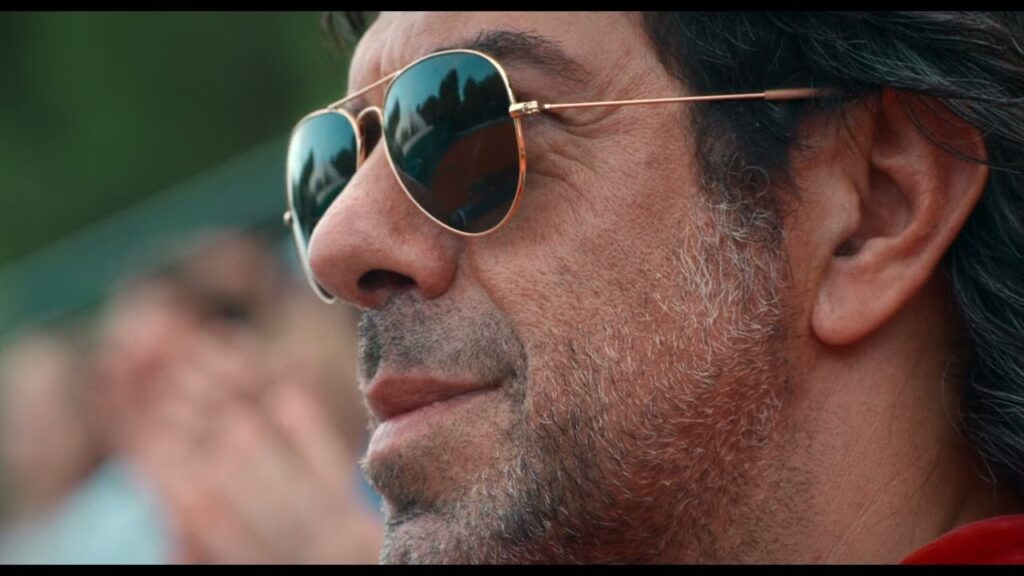
Variety: “with his wolfish grin and rascally vibe, his hungover eyes concealed by mirrored aviators, Favino plays the type as though he invented it.” ➡️ A national treasure playing the rascally Italian failure with the specific warmth that makes every wrong decision feel like a lifestyle choice rather than a character flaw.
-
The bipolar disorder Raul never treats gives the comedy its most emotionally specific depth charge — the highs that make him the most charismatic available coach, the lows that explain why he is training a 13-year-old in provincial tournaments. ➡️ IMDb reviewer: “Favino masterfully portrays the highs and lows — the film even touches on a past suicide attempt; the consequences of leaving it untreated are devastating.”
-
The 1980s coastal Italian setting — wooden rackets, terry-cloth tracksuits, grainy earth-toned cinematography — gives the nostalgia its most commercially specific available texture. ➡️ Letterboxd: “l’esthétique des années 80 est impeccable mais sobre — on évite le néon cliché pour une image plus granuleuse, aux couleurs terreuses.”
-
Loud and Clear: “it starts as the coming-of-age tale of a gifted young athlete and turns out to be so much more — balancing action and comedy with poetry and vulnerability.” ➡️ The genre surprise is the film’s most commercially productive available word-of-mouth mechanism — the tennis comedy that becomes something more specific than the premise suggests.
Virality: Favino as National Treasure and the Road Movie Discovery Register
Favino is Italy’s most commercially recognisable A-list actor — his name is the film’s most institutionally trusted available domestic quality signal. ➡️ The international arthouse audience that follows Italian cinema through Favino’s career is the most pre-converted available secondary discovery community. Letterboxd: “Pierfrancesco Favino! Mamma mia, this actor is amazing in every role — it will definitely be in my top 2026!” ➡️ The enthusiastic Italian and international fanbase is the most commercially reliable available organic advocacy community. The film is for the audience that wants to watch a charming Italian failure teach a shy boy something true about life while completely failing to apply it to himself.
Critics Reception: Warmly Positive — Favino and Menichelli the Unanimous Strengths
-
Variety: “an enjoyably raffish tennis comedy — Favino plays the type as though he invented it.” ➡️
-
Screen Daily: “a well-crafted charmer — sparkling performances playing out as one long match-point rally.” ➡️
-
Cineuropa: “a road-movie about an unexpected deep relationship — Favino literally inhabited by his character.” ➡️
-
Loud and Clear: “superb performances — defies expectations more than once; poetry and vulnerability.” ➡️
-
Letterboxd: “Di Stefano avrebbe potuto dirigere Challengers, ma Guadagnino non avrebbe mai potuto dirigere Il Maestro.” ➡️ The most commercially honest available Italian critical formulation — the film belongs to its own register entirely.
-
IMDb 6.7 from 887 voters. 25 critic reviews.
Awards and Recognitions: Venice RB Casting Award — David di Donatello Best Editing and Hair Design Nominees
-
Venice 2025: RB Casting Award — Tiziano Menichelli (win).
-
David di Donatello 2026: Best Editing (Franchini) nominee. Best Hair Design (Di Serio) nominee.
-
Venice world premiere August 31, 2025. Italian theatrical November 13, 2025.
Director and Cast: Di Stefano’s Warmest Film Yet — Favino Inhabits the Character, Menichelli Wins Venice
-
Andrea Di Stefano — Escobar: Paradise Lost (2014), The Last Night of Amore (Berlin 2023) — pivots from hard-boiled crime to a tennis road-movie comedy that is his most formally accessible and most personally felt film. ➡️ The formal range confirmed across five features confirms a director who has found his most precise available register in the Italian domestic comedy-drama.
-
Pierfrancesco Favino (Raul) — Italy’s most commercially recognisable A-lister, literally inhabited by the character per Cineuropa — gives the faded champion his most warmly rascally available human register. ➡️ The Venice audience moved by his performance is the most commercially specific available institutional confirmation that the bipolar coach is the most emotionally complete role of his current career phase.
-
Tiziano Menichelli (Felice) — Venice RB Casting Award winner — carries the shy 13-year-old caught between his father’s rationality and his coach’s magnificent chaos with the most emotionally contained available performance in the film. ➡️ The Venice prize is the most commercially specific available institutional recognition for a young actor whose restraint gives the road movie its most grounded available human anchor.
-
Giovanni Ludeno (Pietro) — the rational parental counterweight that makes Raul’s magnificent disorder the most appealing available alternative. ➡️
Conclusion: Favino at His Most Irreplaceable and Menichelli’s Venice Prize Confirm the Most Emotionally Honest Available Italian Sports Comedy in Years
The Venice imprimatur, Favino’s national treasure profile, and the David di Donatello institutional recognition give the film its most commercially complete available domestic infrastructure. ➡️ Screen Daily’s “exception to the rule” is the most commercially productive available international distribution argument — a domestic charmer with the formal qualities the European arthouse audience is most specifically prepared to receive. Di Stefano has confirmed the most commercially specific available formal pivot in his career.
What Movie Trend Is Followed: The Italian Mentorship Road Movie — a Faded Champion and an Overshadowed Boy Find Each Other at the Exact Moment Both Need Rescuing
My Tennis Maestro belongs to the Italian mentorship road movie tradition — Cinema Paradiso’s teacher-student bond applied to a coastal 1980s sports setting — with Di Stefano’s most specific contribution: the mentor is not a wise guide but a magnificent disaster, and the lesson is not about tennis but about being seen. ➡️ The bipolar disorder layer gives the mentorship its most emotionally honest available complication — Raul cannot reliably be what Felice needs, which is precisely why their relationship becomes the most moving available version of that dynamic.
Trend Drivers: The Mentor’s Disorder, the Road Structure, the Period Authenticity
-
Raul’s bipolar disorder is not a complication to the mentorship but its most emotionally specific subject — the man who can teach Felice everything about tennis and nothing about how to sustain a life. ➡️ The gap between his coaching genius and his personal chaos is the film’s most commercially durable available emotional argument.
-
The road structure — provincial tournaments, pension hotels, coastal roads — gives the relationship its most efficient available discovery device. ➡️ Each new location adds a new layer to the Raul-Felice dynamic.
-
The 1980s period setting — wooden rackets, earth-toned cinematography, Sabrina Salerno on the soundtrack — gives the nostalgia its most commercially specific available texture without tipping into cliché. ➡️ The period authenticity is the film’s most commercially distinctive available formal credential for the Italian domestic audience.
What Is Influencing Trend: Favino’s Domestic Authority and Vision Distribution’s Platform
-
Favino’s status as Italy’s most commercially recognisable A-lister is the single most efficient available substitute for pre-existing IP in the Italian domestic comedy-drama market. ➡️
-
Vision Distribution’s theatrical infrastructure gives the film its most commercially motivated available Italian domestic release platform. ➡️
Macro Trends Influencing: The Sports Mentorship Wave and Italian Cinema’s Theatrical Confidence
-
The sports film mentorship wave — Challengers, Islands, My Tennis Maestro — has established a critical infrastructure treating the aged-out champion as one of contemporary cinema’s most formally productive available subjects. ➡️ Di Stefano arrives in a critical environment already prepared for this register.
-
The Italian domestic comedy-drama’s renewed theatrical confidence — C’è ancora domani, Io capitano — confirms that Italian-language films can generate sustained theatrical engagement beyond the arthouse. ➡️ My Tennis Maestro arrives within the most commercially productive available Italian theatrical moment for domestic comedy-drama.
Consumer Trends Influencing: Favino’s International Profile and the Mentorship Comedy’s Streaming Discovery
-
Favino’s European profile — Hammamet, Nostalgia, The Ties — gives the film a pre-converted arthouse audience that treats his new releases as priority discovery events. ➡️
-
The mentorship comedy-drama’s streaming community — audiences seeking Cinema Paradiso’s contemporary equivalents — is the film’s most commercially motivated available international secondary audience. ➡️
Audience Analysis: Italian Domestic Audiences, European Arthouse Communities, Mentorship Drama Followers
The core audience is 25–60 — Italian domestic audiences who follow Favino as their most trusted national cinema star, European arthouse communities activated by the Venice imprimatur, and mentorship drama followers who respond to the Raul-Felice dynamic as the most emotionally specific available version of that subject in 2025. ➡️ The film rewards the audience that arrives for the tennis and stays for the specific warmth of two people who need each other more than they are prepared to admit.
Conclusion: A Road Movie That Uses the 1980s Italian Tennis Circuit to Ask Who Teaches Whom When Neither Has Their Life Together
The bipolar disorder layer, the road structure, and the period authenticity give the film its most formally specific available emotional architecture. ➡️ The Challengers comparison activates the international arthouse audience while the Favino-Menichelli dynamic delivers something those films do not — the specific Italian warmth of two imperfect people finding each other on a coastal road in 1989.
Final Verdict: Di Stefano’s Most Emotionally Honest Film — Favino Inhabits the Character, Menichelli Grounds It, the Most Warmhearted Italian Sports Drama in Years
The film delivers more emotional range than the tennis road movie premise suggests — a comedy that earns its most moving moments by taking the bipolar disorder seriously rather than using it as a plot device. ➡️ IMDb reviewer: “Favino masterfully portrays the highs and lows — caught between his father’s rationality and his mentor’s madness, the boy ultimately recognises a core of truth and goodness in the man.”
Audience Relevance: Italian Domestic Audiences, Mentorship Drama Followers, Anyone Raised by a Brilliant Disaster
This film is for the audience that has been loved imperfectly by someone who was still the most important teacher in their life. Works best for viewers who respond to Italian domestic comedy-drama’s most emotionally specific register — warmth that earns its moments rather than manufacturing them, and a flawed mentor whose disorder is his most honest available quality. ➡️ If you want a sports film about something more complicated than winning, this is the most commercially specific available Italian option of 2025.
What Is the Message: The Best Father Figure Is Sometimes the One With No Business Being Anyone’s Father Figure
Raul cannot reliably be what Felice needs — which is precisely why he is the most honest available version of it. The people who teach us most are often the ones who have failed most completely at the thing they are teaching. ➡️ Raul’s bipolar disorder is not an obstacle to the mentorship but its most honest available condition — the man whose chaos makes him incapable of performing the coach role while making him the most genuinely present available person in Felice’s life.
Relevance to Audience: A Coming-of-Age Road Movie That Replaces the Wise Mentor With a Magnificent Disaster and Finds More Truth There
The film refuses the conventional mentorship drama’s most available comfort — the guide who has their life together. Raul has nothing together, which is why his coaching instinct is the most credible available thing about him. ➡️ The gap between his professional precision and his personal chaos is the film’s most commercially specific available emotional argument — the one that makes the Raul-Felice dynamic more emotionally honest than any conventional sports mentor the genre has produced.
Social Relevance: The Father’s Expectations as Pressure, the Coach Who Teaches That Losing Is Not the Worst Outcome
Pietro’s rational ambition is not the film’s villain but its most socially honest available portrait of Italian parental expectation. The pressure of a father who sees his son’s talent as a project rather than a child is the film’s most socially grounded available observation. ➡️ Raul’s genuine interest in Felice as a person rather than a prospect is the most emotionally subversive available coaching philosophy in the Italian sports drama calendar.
Performance: Favino’s Career-Phase Best, Menichelli’s Venice-Winning Restraint, Ludeno’s Counterweight
Favino is the reason to see the film and Menichelli is the reason it works. Favino’s Raul — wolfish grin, mirrored aviators, bipolar highs and lows performed with specific warmth — is the most commercially irreplaceable available element. ➡️ Menichelli’s Felice — Venice RB Casting Award, the most emotionally contained available young performance in the Italian 2025 calendar — gives Favino’s chaos its most grounded available human counterweight. Ludeno’s Pietro provides the rational domestic architecture that makes Raul the most appealing available alternative Felice has ever encountered. ➡️
Legacy: Di Stefano’s Most Formally Complete Italian Film and the Most Emotionally Honest Mentorship Road Movie of 2025
My Tennis Maestro will be remembered as the film that confirmed Di Stefano’s most precise available register after five features across two languages and two genres. Letterboxd: “Di Stefano avrebbe potuto dirigere Challengers, ma Guadagnino non avrebbe mai potuto dirigere Il Maestro” — the most commercially specific available critical legacy statement. ➡️ Di Stefano’s next film arrives with this emotional warmth confirmed as the most commercially specific available quality signal for the Italian domestic audience and the European arthouse community simultaneously.
Success: Venice RB Casting Award — David di Donatello 2 Nominations — Italian Theatrical November 2025
-
Venice 2025: RB Casting Award (Menichelli). David di Donatello 2026: Best Editing, Best Hair Design nominees. Italian theatrical November 13, 2025. Budget €10.3 million. Worldwide gross $2.6 million.
My Tennis Maestro proves that the most emotionally honest sports films are the ones where the coach has no business coaching anyone — and that Favino understood Raul well enough to make every magnificent failure feel like the most specifically Italian available version of grace.
Insights: Di Stefano’s most emotionally complete film — Favino inhabiting the bipolar faded champion with specific warmth, Menichelli’s Venice-winning restraint giving the road movie its most grounded human anchor. Industry Insight: Favino’s national treasure profile and the Venice imprimatur give the film its most commercially complete available domestic and international infrastructure — Screen Daily already identified it as the exception to the Italian comedy export rule. Audience Insight: The Raul-Felice dynamic is the film’s most reliable word-of-mouth asset — a tennis road movie delivering more emotional range than the premise suggests is the most reliable available mechanism for discovery through recommendation. Social Insight: Pietro’s rational ambition and Raul’s indifference to results together make the film’s most specific available observation about Italian paternal expectation — the father who sees talent as a project and the coach who sees a person. Cultural Insight: My Tennis Maestro positions Di Stefano as the Italian filmmaker most committed to the warmhearted domestic road movie — and the Letterboxd formulation confirms the film belongs to an Italian emotional register that Challengers never reached.
Conclusion: Favino at His Most Irreplaceable, Menichelli at His Most Grounded — Two Perdenti on a Coastal Road in 1989 Make the Most Emotionally Honest Available Italian Sports Drama in Years
The most important thing the film confirms is that the best available mentor is sometimes the one who has failed most completely at the thing he is teaching. My Tennis Maestro earns its institutional recognition through the formal qualities Italian domestic cinema at its most honest always demonstrates — warmth that earns its emotional moments, period authenticity that never tips into cliché, and a Favino-Menichelli dynamic that plays out as the most specifically Italian available version of the mentorship road movie’s most honest subject. ➡️ Di Stefano’s next film arrives with this formal identity confirmed and this emotional register established — the most commercially specific available signal that Italian domestic cinema has found its most warmhearted available active voice.
Summary: One Faded Champion, One Shy Prodigy, One Coastal Road Trip, and the Discovery That Two Perdenti Can Grow Each Other Better Than Any Champion Ever Could
-
Movie themes: The mentor who has no business mentoring anyone and is therefore the most honest available teacher, the father’s expectations as Italy’s most specific available parental pressure, bipolar disorder as the condition that makes Raul simultaneously impossible and irreplaceable, and the road trip as the device that strips two people down to what they actually need from each other. ➡️ The film’s most emotionally specific available thesis: the people who teach us most are often the ones who have failed most completely at the thing they are teaching.
-
Movie director: Andrea Di Stefano — Escobar: Paradise Lost (2014), The Last Night of Amore (Berlin 2023) — pivots from hard-boiled crime to a tennis road-movie that is his most formally accessible and most personally felt film. ➡️ Five features across two languages confirm a director who has found his most precise available register in Italian domestic warmth.
-
Top casting: Favino’s Raul — wolfish, mirrored aviators, bipolar highs and lows with specific warmth — is the most commercially irreplaceable available element. Menichelli’s Felice — Venice RB Casting Award, most emotionally contained young performance in the Italian 2025 calendar — gives Favino’s chaos its most grounded available counterweight. Ludeno’s Pietro provides the rational architecture that makes Raul the most appealing available alternative. ➡️ Two performances playing out as one long match-point rally.
-
Awards and recognition: Venice 2025: RB Casting Award (Menichelli). David di Donatello 2026: Best Editing, Best Hair Design nominees. Venice world premiere August 31, 2025. Italian theatrical November 13, 2025. Budget €10.3 million. Worldwide gross $2.6 million. ➡️ The Venice prize and David di Donatello nominations give the film its most commercially complete available Italian institutional infrastructure.
-
Why to watch: The Italian road movie that replaces the wise mentor with a magnificent disaster and finds more truth there — Favino’s wolfish charm and bipolar chaos, Menichelli’s shy restraint gradually opening, 1980s coastal Italian authenticity that never tips into cliché, and the specific warmth of two people who need each other more than either is prepared to admit. ➡️ For the audience that wants the sports film actually about what losing teaches you — this is the most emotionally specific available Italian option in the 2025 cinema calendar.
-
Key success factors: Favino’s national treasure profile plus Menichelli’s Venice-winning restraint plus Di Stefano’s formal pivot to warmhearted domestic comedy plus bipolar disorder’s emotional specificity plus 1980s period authenticity plus road structure as discovery device plus Venice imprimatur plus Vision Distribution’s theatrical platform. ➡️ The Favino-Menichelli dynamic is the single most commercially productive available factor — two performances delivering more emotional range than the tennis premise suggests.
-
Where to watch: Italian theatrical from November 13, 2025 via Vision Distribution. International distribution available through Vision Distribution. ➡️ A profoundly Italian film that delivers its full warmth in its original language — the theatrical experience is the most commercially productive available viewing condition.
Conclusion: Two Perdenti, One Coastal Road, and the Most Emotionally Honest Available Italian Sports Film — Magnificent Failures Make the Best Available Teachers
The most important thing My Tennis Maestro confirms is that the best available mentor is the one who has nothing left to perform. My Tennis Maestro earns its Venice selection and David di Donatello recognition through the formal qualities Italian domestic cinema at its most honest always demonstrates — warmth that earns its moments, authenticity that never tips into cliché, and a Favino-Menichelli dynamic that delivers the most emotionally specific available version of the mentorship road movie’s most honest subject. ➡️ Di Stefano’s next film arrives with this formal identity confirmed — the most commercially specific available signal that Italian domestic cinema has found its most warmhearted available active voice.