


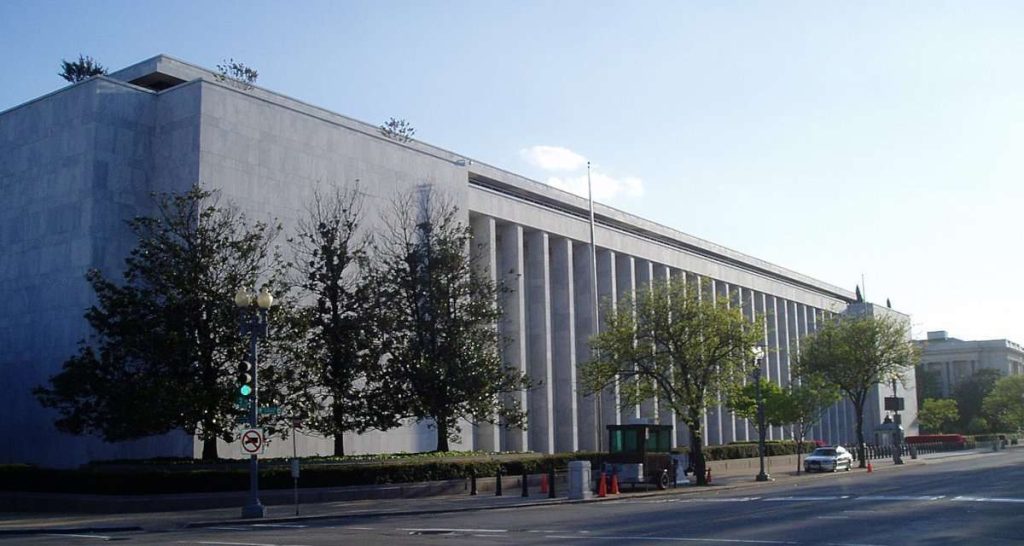


Washington, D.C.’s James Madison Memorial Building, which houses the U.S. Copyright Office. Photo Credit: UpstateNYer
Amid an intensifying Phonorecords V rate-setting battle, the National Music Publishers’ Association (NMPA) and the Nashville Songwriters Association International (NSAI) are doubling down on their push to subpoena bundle-related documents from MLC v. Spotify.
The NMPA and the NSAI once again moved to subpoena the Mechanical Licensing Collective (MLC) on Monday, after leading DSPs last month submitted Phono V rate proposals. The latter cover on-demand streaming’s statutory mechanical royalty rates in the U.S. between 2028 and 2032.
As we broke down in detail, these proposals didn’t sit right with the parties on the opposite side of the proceeding. (Additionally, the Songwriters Guild of America, Word Collections, and others are seeking a simplified flat-rate mechanical.)
Just to recap, Spotify defended the highly controversial Phono IV settlement – including the much-criticized “bundling loophole” therein – as “a success for the industry.”
Specifically, the “bundle terms and economics in particular were a known, core term of the Phonorecords IV settlement,” per Spotify, which proposed a continued 15.35% headline rate (of applicable service provider revenue, that is) and “no other changes” from Phono IV under Phono V.
Meanwhile, Amazon Music suggested a 13.4% headline percentage across 2028 and 2032 – in part because music publishers’ response to the bundling craze allegedly “robbed Amazon of a key benefit it expected to gain from the Phonorecords IV settlement.”
(The Amazon-owned platform also sought to axe the revenue prong in bundled subscription calculations.)
Speaking of this response, many are aware of the Mechanical Licensing Collective’s related lawsuit against Spotify. Less widely discussed, however, is that the case has been chugging along in the background despite a couple setbacks for the MLC; fact discovery is wrapping at present.
And as the suit centers on Spotify’s unilateral audiobook-music bundle reclassifications, it’s safe to say that some of the findings could prove significant in the Phono V showdown.
Returning to the NMPA’s newly submitted motion, then, the entity once again asked the Copyright Royalty Board (CRB) to approve a subpoena pertaining to bundle-related MLC v. Spotify documents.
Previously denied by the CRB judges before the above-noted rate proposals materialized, the subpoena is straightforward enough. If given the green light, it would compel the MLC to turn over “(a)ll documents produced or exchanged in the Part 385 Litigation concerning the MLC’s claim that Spotify misreported and underpaid mechanical royalties owed.”
Though it probably goes without saying in light of the renewed motion, Spotify doesn’t appear to be on board with providing the documents. Furthermore, an MLC v. Spotify protective order means a subpoena is required “to obtain restricted documents in that action,” according to the NMPA.
(“Nothing herein shall preclude the parties from disclosing material designated to be Confidential Information if otherwise required by law or pursuant to a valid subpoena,” the order reads in part.)
“Spotify is exploiting the abbreviated timeline of this proceeding to suppress production,” the movants added for good measure. “There is no practical means to timely obtain the documents other than by subpoena.”
But those documents “are highly relevant to a central issue in this proceeding,” as they “address a dispute over actual practices by services that massively reduced mechanical royalties through their interpretation of core terms and definitions at issue here,” the NMPA continued.
What about compelling Spotify itself to produce the docs? The NMPA acknowledged the option – albeit while stressing that “given Spotify’s efforts to suppress production, it should be clear that it must produce all documents produced or exchanged by any party or nonparty in the” MLC courtroom confrontation.
“Anything less would enable Spotify to unilaterally decide what to produce, and Spotify has already shown it deems plainly relevant documents to be not relevant.”
With that, all eyes are on the CRB’s ruling, and we’ll continue tracking the proceeding from here. Last month, Chief Copyright Royalty Judge Trevor Jefferson granted a request from DSPs to access unredacted Web VI materials in the Phono V proceeding.