


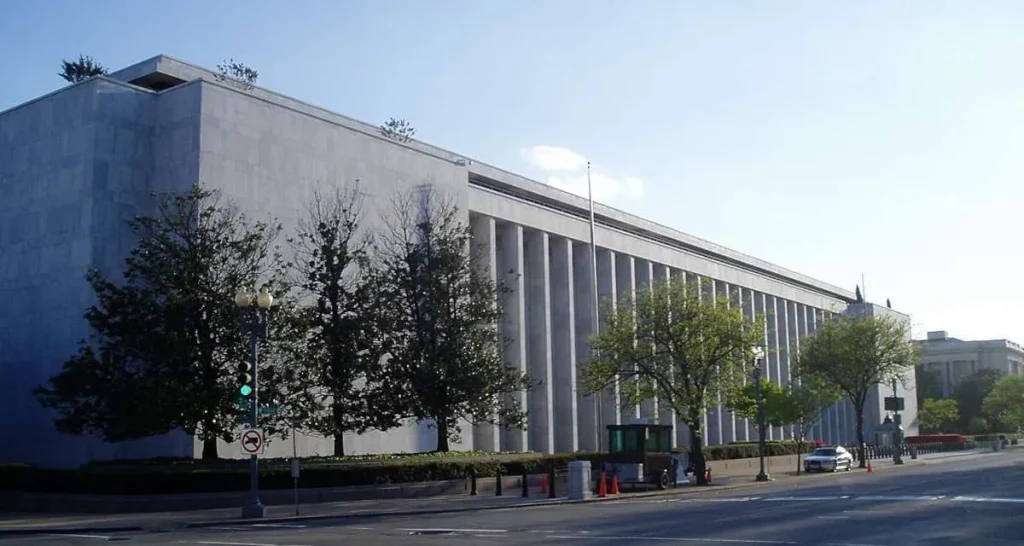


Washington, D.C.’s James Madison Memorial Building, which houses the U.S. Copyright Office. Photo Credit: UpstateNYer
The high-stakes Phonorecords V rate-setting battle is now in full swing – with Word Collections and the Songwriters Guild of America (SGA) among those urging the Copyright Royalty Board (CRB) judges to reject the “demonstrably unreasonable” proposed settlement.
Jeff Price’s Word Collections and Rick Carnes-led SGA just recently took aim at that proposed settlement in a detail-oriented joint objection. But before diving into their arguments – and different comments from various organizations, companies, and individuals – a quick recap is in order.
“Quick recap” isn’t necessarily redundant here; with so many moving parts in play, even a brass-tacks overview of the multifaceted proceedings has the potential to run long.
As we exclusively broke down, late June brought with it a suggested Phono V settlement between the major labels, the American Association of Independent Music (A2IM), the National Music Publishers’ Association (NMPA), the Nashville Songwriters Association International, and the Music Artists Coalition.
Therein, the parties proposed that the existing Phono IV mechanical rates – covering physical formats and permanent downloads (plus ringtones and bundles) – “should not be amended except for continuing inflation adjustments.”
Out of the gate, that rate-freeze framework elicited strong criticism. In the driver’s seat when it comes to approving or rejecting the proposal, the CRB subsequently initiated a public comment period. And with a hard August 10th cutoff in place, recent days delivered an influx of Phono V remarks.
Some rallied behind what essentially amounts to a rate freeze when viewed in the most favorable possible light.
Songwriters of North America (SONA), for instance, expressed the belief that “the proposed settlement generally represents a reasonable and practical resolution that preserves the important progress achieved during the Phonorecords IV proceeding.”
The Recording Academy, for its part, touted the proposed settlement as providing “a level of stability and predictability that are fundamentally essential to the livelihoods of songwriters and compose.” Meanwhile, the Association of Independent Music Publishers (AIMP) applauded the proposal as “a step in the right direction” and “a significant boon for the independent music publishing community.”
But as noted, the supportive statements aren’t indicative of a consensus. Across nearly 50 in-depth pages, copyright activist George Johnson criticized the proposed rate as “still way below-market,” besides exploring historical mechanical rate trends, the alleged “extreme self-dealing between the 3 major labels and their 3 major publishing affiliates,” and more.
And Eminem publisher Eight Mile Style called out the settlement as “effectively a rate freeze, unmoored from economic reality and for which no valid justification exists.”
“The corporate overlap between the bloc of the Settlement Parties comprised of the Majors (effectively an oligopsony) and their vertically-integrated publishing company affiliates which serve as executive members of the NMPA, results in a walled garden where the ‘willing buyers’ and ‘willing sellers’ are the same at the corporate level,” Eight Mile wrote.
(A relatively little-discussed component of Eight Mile’s filing: “(T)he unconscionably cruel controlled composition clause in recording agreements,” which “reduces the mechanical royalty by 25% and fixes the rate at the time of release,” per the commenter.)
Back to the objection submitted by the Songwriters Guild of America and Word Collections, the entities took the opportunity to refute the idea that they (the SGA and Word Collections) had declined to join the agreement.
On the contrary, despite their “willingness to engage” in talks, they claim to have had “extremely limited” contact with the settling parties before the proposal’s submission to the CRB.
As for the actual proposed settlement, the SGA and Word Collections emphasized that it, cost-of-living adjustments aside, would revert back to Phono IV’s initial 12-cent-per-work mechanical rate in 2028 as opposed to picking up at the 2026 rate of 13.1 cents (or higher than that after the 2027 adjustment).
“Most comments submitted so far completely ignore the fact that the proposed deal seems intended to ensure that the ‘new’ Phonorecord V base rate will NOT begin at the current rate of 13.1 cents or more, but would in reality be lowered back to a reset rate of 12 cents on January 1, 2028,” they drove home.
Additionally, as the relevant Phono V participants explained in greater detail, the 12-cent Phono IV base rate was calculated based on inflation data through 2020’s end – not through the highly inflationary 2021-22 window, which would have boosted the same rate to 13.6 cents.
With that – and as noted, there’s more to the 20-page filing – Word Collections and the SGA asked the CRB to deny the proposed settlement and to recommend that all participants “reconvene to negotiate at arms-length” on “reasonable” rates and terms.
In the filing parties’ view, this would come out to approximately 15.6 cents per work for physical and permanent downloads when calculating for “cumulative” cost-of-living shifts since 2020, with annual upward adjustments applied from there.
Finally, their opposition to the proposed settlement aside, Word Collections and the Songwriters Guild of America left the door wide open for concrete Phono V negotiations.
“While being disheartened by this turn of events, we remain open and willing to participate in further voluntary Subpart B and Phonorecord V discussions,” they wrote.
“We are, however, quite sure that what has transpired so far is not the type of good faith communication and fair dealing that Congress had in mind in extending an antitrust exemption to enable private negotiations among parties participating in royalty rate-setting proceedings, especially those proceedings characterized by demonstrable conflicts of interest through vertical integration as already noted by the CRB in Phonorecords IV,” they continued.