


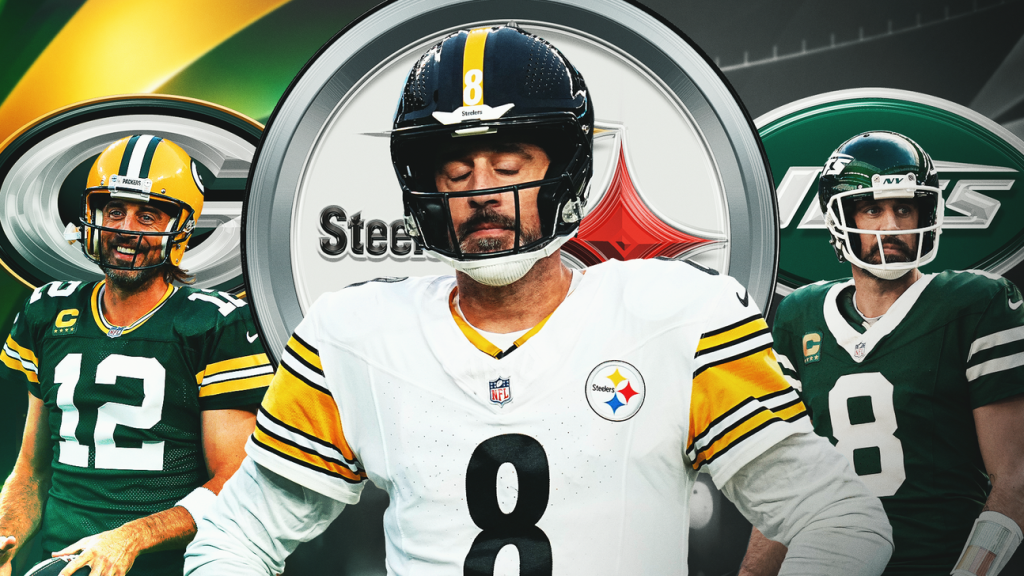
Aaron Rodgers needs help, and his inability to recognize it has spoiled what could have been a happy ending to his incredible NFL career.
While that statement can be interpreted in a number of ways, I’m focusing strictly on Rodgers’ performance on the field, which started to go downhill in 2022 and may have ended this past week with the Steelers’ loss to the lowly Eagles.
The now-former Steelers quarterback was unceremoniously benched by Mike McCarthy on Tuesday night, and within 15 hours, he was live on television with Pat McAfee, airing all the behind-the-scenes dirt he had on the coach. Less than 20 hours after the news broke on Tuesday night, Rodgers was released.
Rodgers says his request that McCarthy give up play-calling duties was the main point of contention between the two. This wasn’t the first time the 42-year-old suggested he should be more involved in picking the plays.
“We need to be better, and it starts with me,” he said after a Week 2 loss to the Patriots. “It starts with me, at like, making sure Mike (McCarthy) knows what’s working and not working, so we can call stuff that has a better chance.”
Aaron Rodgers2,241 Pass YDS · 16 Pass TDs · 6 INTs


2,241Pass YDS
16Pass TDs
6INTs
60.9%Comp%
Aaron Rodgers (right) spoke up about the Steelers offense after the team’s loss to the Patriots back in September. Now, former teammate Mason Rudolph (left, wearing helmet) has taken over as the team’s starting quarterback. (Photo by Winslow Townson/Getty Images)
This is nothing new to Rodgers’ career arc. He’s been doing the “I know best” routine for at least a decade now. Back in 2018, after the Packers fired McCarthy, Sports Illustrated reported that Rodgers regularly changed plays to the point where “McCarthy might call the same play three times in a game, without the play actually being run as he called it.”
When Matt LaFleur took over as the Packers’ head coach the following season, initial friction arose from Rodgers’ desire to make changes at the line of scrimmage, which didn’t align with LaFleur’s sequence-based play-calling.
“I don’t think you want to ask me to turn off 11 years (of football experience),” Rodgers said at the time. “We have a number of check-with-me’s and line-of-scrimmage stuff. It’s just the other stuff that really not many people in this league can do.”
Rodgers and LaFleur eventually found a middle ground, with the quarterback fully buying into a system that asked him to be more of a cog in the machine rather than the full-on engine, and he bounced back from a prolonged stretch of underwhelming play to win two consecutive MVPs.
It was the second time in his career that Rodgers was widely considered the NFL’s best quarterback. The first time, he was in his physical prime. He was considered one of the league’s more mobile quarterbacks. He had an unbelievable arm and a knack for making plays off-schedule. Rodgers was that generation’s version of Patrick Mahomes – the kind of quarterback who could power an elite offense seemingly all on his own.
In his second go-round as the league’s QB1, Rodgers required a little more help. He had LaFleur’s system doing some of the heavy lifting and an all-world receiver in Davante Adams reducing the play-making burden. The result was one of the most productive stretches of quarterback play we’ve ever seen.
During his MVP seasons2020–21
Completion %
Yards per attempt
Pass TDs
INTs
Passer rating
It felt like Rodgers was headed for a Tom Brady-like ending to his career, but things fell apart quickly from there. Adams was traded to Las Vegas the following offseason, and the offense regressed significantly. As things got worse, Rodgers seemed to take more control of the offense, and we saw fewer of the hallmarks of LaFleur’s scheme, with Green Bay’s under-center and play-action rates dropping in 2022.
“There’s certain things situationally that could occur a little bit differently, but … we give Aaron the liberty to, especially situationally, to get us out of the look based on what the defense is presenting,” LaFleur said mid-season in response to criticism of his play-calling.
That was Rodgers’ final season in Green Bay, which felt like a mutual split at the time. The Packers got back to running LaFleur’s offense in its purest form, and it’s helped turn Jordan Love into a star.
Meanwhile, Rodgers ended up with the Jets, where he was given the keys to the offense. New York hired his former Packers QB coach Nathaniel Hackett to call plays, but really it felt like he was there to support Rodgers more than he was to run the offense. Wide receiver Allen Lazard, who followed the quarterback from Green Bay, even called it “the Aaron Rodgers offense.”
That first season in New York was a lost one, with Rodgers tearing his Achilles just four snaps into his debut. The following campaign was hardly a success either, with the Jets going 7-10 and the offense finishing last in the NFL in expected points added.
But Rodgers was doing things on his own terms. He was in shotgun formations more often, with fewer play-action dropbacks. He had full freedom to change plays at the line, and nearly every run play had a pass option attached. Rodgers rarely attacked the middle of the field, preferring to throw vertical, perimeter shots.
Aaron Rodgers wasn’t able to replicate his past MVP-level performances during his two seasons with the Jets. (Kara Durrette/Getty Images)
Not much changed after Rodgers wore out his welcome with the Jets and signed with the Steelers.
It’s as if the “Aaron Rodgers offense” is designed to pad his completion percentage and maintain a healthy touchdown-to-interception ratio. Over the last three seasons, Rodgers has completed 63.4% of his passes with 68 touchdowns and 24 interceptions. Those aren’t bad numbers, but the advanced metrics paint a much different picture. Only Cam Ward has lost more EPA on dropbacks over the last three years, and his 40.7% success rate ranks fifth-worst, per Next Gen Stats.
Put simply, Rodgers has been one of the league’s worst quarterbacks in the NFL for nearly half a decade.
It’s fitting that Rodgers’ last act as an NFL quarterback was him butting heads with his coach over play-calling. His insistence on having the final say has ultimately led to his steep fall from grace in the twilight of his career.
It didn’t have to be this way. For a decade, Rodgers was viewed as the NFL’s best player and arguably the greatest quarterbacking talent the league has ever seen. But by his own design, he’s made it impossible to ignore how his career is ending, as much as we’d all like to.